Key Takeaways
- Blockchain law firms offer specialized legal services covering regulatory compliance, litigation, smart contracts, and corporate structuring for Web3 projects.
- Top firms employ former SEC, CFTC, and DOJ officials, bringing insider knowledge of enforcement trends.
- Pricing varies widely. Hourly rates range from $400 to over $1,500 depending on firm size, practice area, and geography.
- Selecting the right blockchain law firm requires evaluating technical depth, industry rankings, and fee transparency.
- Even decentralized projects like DAOs increasingly need legal wrappers to limit liability, a key service offered by leading blockchain-focused practices.
A blockchain law firm is a legal practice that handles regulatory compliance, litigation defense, and smart contract review for crypto and Web3 clients. These firms bridge traditional legal disciplines with technical understanding of tokenomics, decentralized governance, and on-chain activity.
What Is a Blockchain Law Firm?

Defining the Scope of a Blockchain Legal Practice
A blockchain legal practice sits at the intersection of distributed ledger technology and existing law, translating protocol-level activity into terms regulators and courts can evaluate. These firms help clients work through the regulatory frameworks imposed by agencies like the SEC, CFTC, IRS, and FinCEN. Unlike general corporate law firms, a dedicated law firm pairs traditional legal disciplines with real technical fluency in smart contracts, tokenomics, and decentralized governance models.
According to Greenberg Traurig, its global Blockchain & Digital Assets Group comprises more than 100 attorneys across multiple legal disciplines, which shows how large these specialized practices have grown (Greenberg Traurig). This multidisciplinary approach matters because blockchain matters often touch securities law, anti-money laundering (AML) rules, tax code, and intellectual property at the same time.
The Rise of Specialized Legal Expertise
Blockchain has existed for a little over a decade, and its legal implications are still being worked out in real time. Early in the crypto era, few attorneys could reliably distinguish a utility token from a security token. Today, firms compete for top talent, and many hire former government enforcers directly. Freeman Law reports that nearly one-third of its attorneys serve as law professors at tier-one law schools, which says something about the academic rigor now expected in this space (Freeman Law). This reflects a broader shift: crypto miners, DAO treasuries, and token issuers alike now treat legal strategy as seriously as protocol architecture.
Core Services Offered by a Blockchain Law Firm
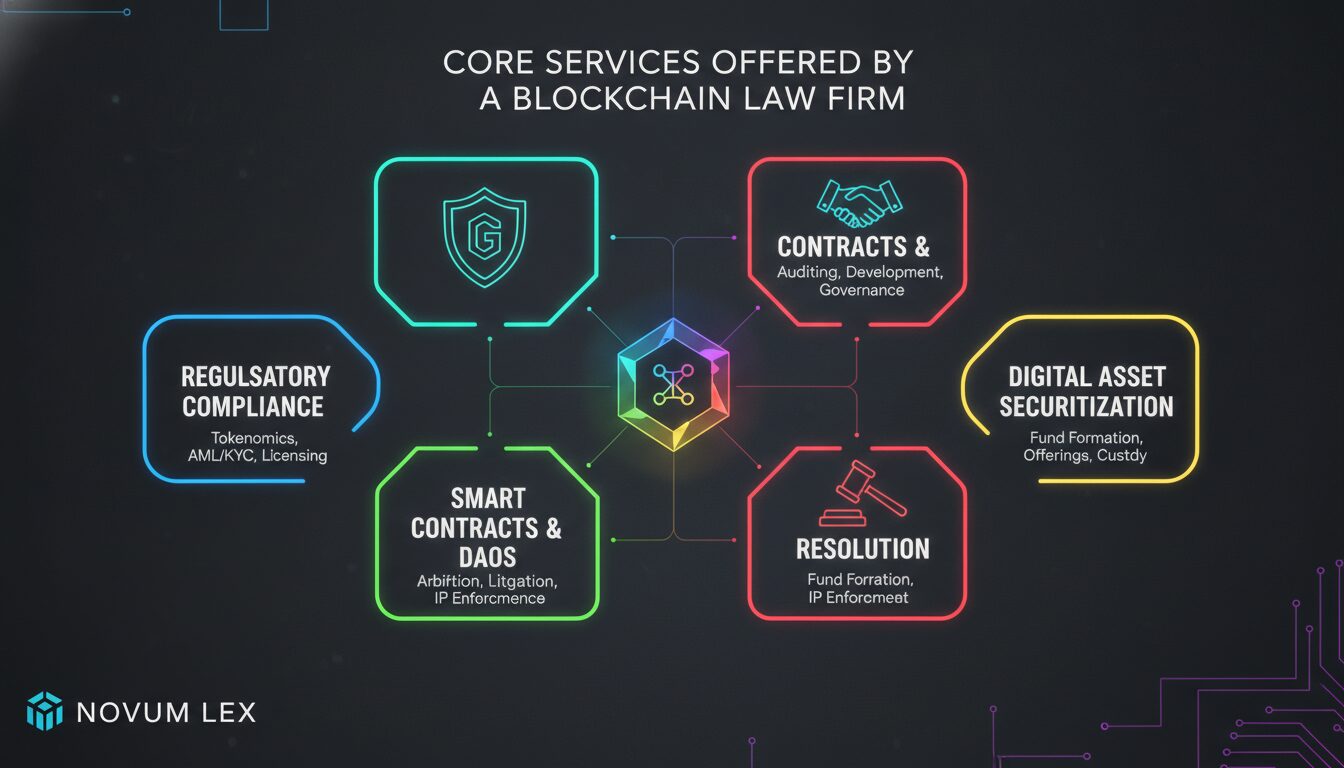
What Services Does a Blockchain Law Firm Provide?
Compliance work forms the foundation of most blockchain legal practices, spanning SEC registration analysis, CFTC derivatives compliance, FinCEN licensing, and IRS tax reporting for digital assets. Holland & Knight, which wrote one of the first books on blockchain and the law, notes that its attorneys include former SEC enforcement supervisors involved in the earliest bitcoin-related actions (Holland & Knight). Firms in this space also build out Know Your Customer (KYC) and Anti-Money Laundering (AML) programs that satisfy Bank Secrecy Act and OFAC sanctions requirements.
Transactional and Corporate Structuring
Crypto startups and established enterprises both rely on legal counsel for entity formation, token structuring, private capital raises, and M&A deals. Baker Donelson advises venture capitalists, financial institutions, and international companies on matters ranging from cryptocurrency mining to NFT regulatory analysis (Baker Donelson). Firms like Latham & Watkins structure compliant stablecoins and tokenized assets while also handling derivatives trading platforms, helping clients avoid both civil and criminal enforcement exposure.
Litigation and Enforcement Defense
When disputes arise, whether government investigations, class-action lawsuits, or fraud allegations, a this type of firm provides white-collar defense built for crypto-specific fact patterns. Oberheiden P.C., led by former U.S. Attorneys, offers both compliance guidance and fraud defense for crypto matters (Oberheiden P.C.). Ropes & Gray integrates its crypto defense team with broader securities and commodities enforcement practices; one client told Chambers that the firm’s cross-practice capabilities “really set them apart” (Ropes & Gray).
“Ropes & Gray’s cross-practice capabilities really set them apart. Whatever issue arises, they ensure you have the best person with the most expertise.” – Chambers FinTech client review (Ropes & Gray)
Navigating the Regulatory Landscape
How Does U.S. Federal Oversight Work for Crypto?
U.S. federal oversight of crypto splits across at least three agencies, each claiming jurisdiction over different aspects of digital assets. The SEC treats many tokens as securities, triggering registration or exemption requirements under the ’33 and ’34 Acts. The CFTC claims jurisdiction over cryptocurrencies as commodities, and FinCEN requires money transmitter registration for many crypto businesses, with specific licensing thresholds varying by state. A capable this kind of firm helps clients figure out which agency’s rules apply and how to avoid overlapping enforcement risk. Freeman Law notes that “blockchain and virtual currency activities take place in a rapidly-evolving regulatory landscape” (Freeman Law).
International Regulatory Coordination
For global projects, legal counsel has to coordinate across multiple jurisdictions at once. Fasken, a Canadian firm, advises on how Canadian and U.S. regulators approach token offerings and privacy differently (Fasken). European and Asian rules add further complexity, which is why cross-border capability and local partnerships matter more than firm size alone.
“Latham & Watkins advise on highly complex mandates. Their knowledge and understanding of digital assets and regulations is exceptional.” – Chambers FinTech 2026 (Chambers)
How to Select the Right Blockchain Law Firm
How Do You Assess Technical Proficiency?
You assess technical proficiency by asking a firm to walk through a real DeFi exploit or token reclassification they’ve handled, not just their marketing copy. Not every lawyer codes, but the strongest practitioners can read smart contracts, understand consensus mechanisms, and weigh the legal implications of protocol upgrades. Holland & Knight notes that some of its blockchain attorneys are active coders, which lets them audit code and interpret on-chain data directly rather than relying on secondhand summaries (Holland & Knight).
Evaluating Track Record and Rankings
Industry rankings offer a useful shortcut for gauging competence when you can’t evaluate technical depth firsthand. Chambers FinTech awarded Latham & Watkins a Band 1 ranking in its 2026 Blockchain & Cryptocurrencies category, and Chambers & Partners recognizes Freeman Law among leading U.S. attorneys in the space (Latham & Watkins). Look for firms that have handled government enforcement actions similar to your risk profile, and check their standing on Legal 500 and U.S. News Best Lawyers.
Understanding Fee Models
Blockchain-focused firms generally bill in one of three ways: hourly, flat-fee project work (like a token launch package), or hybrid subscription retainers. On-demand talent platforms like Axiom offer experienced cryptocurrency lawyers on a full-time, part-time, or as-needed basis at below-Big-Law rates (Axiom). Get billing structure in writing before engagement so cost expectations match the scope of work.
Comparison of Blockchain Law Firm Specializations
| Firm Type | Key Strengths | Typical Clients | Example Firms |
|---|---|---|---|
| Large Full-Service | Global reach, deep bench, integrated tax and regulatory teams | Fortune 500 companies, major crypto exchanges, institutional funds | Latham & Watkins, Greenberg Traurig, Holland & Knight |
| Boutique | Hands-on partners, aggressive defense, niche technical knowledge | Startups, individual executives, small-cap token issuers | Oberheiden P.C., Freeman Law |
| Virtual / On-Demand | Flexible staffing, cost efficiency, broad talent pool | Projects with intermittent needs, lean Web3 teams | Axiom |
Blockchain Law Firms and Decentralized Autonomous Organizations (DAOs)
What Legal Wrapper Structures Work Best for DAOs?
Legal wrapper structures for DAOs typically take the form of a Delaware Series LLC, a Cayman foundation, or a Swiss association, each encapsulating the DAO’s treasury and activities under a recognized legal entity. DAOs often operate without formal entity status, which leaves members exposed to unlimited personal liability under a general partnership theory. Latham & Watkins advises on DAO formation and governance design intended to align on-chain code with corporate law (Latham & Watkins).
DAO Governance and Liability Mitigation
Without clear governance documents, token-holder votes can be challenged as an unlawful general partnership, exposing every participant to joint liability. The right blockchain law drafts operating agreements, participation terms, and delegation of authority provisions that shield passive members from fiduciary duties. This bridge between decentralized governance and legal reality has become a standard offering among top-tier practices, and it’s one of the areas where our team at Digital Blockchains sees the most founder confusion during token launches.
The Cost of Hiring a Blockchain Law Firm
How Much Does a Blockchain Law Firm Charge?
Hourly rates for a partner at a major law firm in New York or San Francisco typically run $950 to $1,500 or more, while associates bill in the $500-$750 range. Boutique firms tend to charge $600-$900 per hour, and on-demand platforms can reduce effective rates by roughly 30-50% compared to traditional Big Law billing (Axiom). Flat-fee token reviews commonly run $15,000 to $50,000 depending on complexity and jurisdiction count.
Value vs. Cost in High-Stakes Matters
Regulatory investigations can result in fines reaching into the millions, and in some cases criminal exposure for founders and executives. Proactive legal advice from an experienced this type of firm is often a fraction of the cost of fighting a regulatory action after the fact. This is why serious projects budget for legal counsel from day one rather than treating it as an afterthought once a regulator sends a letter.
Missing Pieces Most Founders Overlook
What Regulatory Areas Do Founders Underestimate?
Founders most often underestimate state-by-state money transmitter licensing, which can require separate applications in dozens of states depending on where users are located. Stablecoin issuers face additional scrutiny around reserve attestation procedures, particularly after high-profile depegging events drew regulatory attention to reserve transparency. Crypto mining operations also face country-specific regulatory hurdles around energy usage and environmental reporting, and blockchain patent prosecution has become its own subspecialty as more protocols seek IP protection for consensus innovations. A firm that only handles securities work may not have depth in these adjacent areas, so ask directly about experience with licensing, attestation, or patent matters relevant to your project.
Future Trends in Blockchain Legal Services
What’s Next for Blockchain Regulatory Clarity?
As of 2026, several U.S. congressional proposals aim to clarify whether digital assets are securities or commodities, which could simplify parts of a this kind of firm’s work going forward. New rules will still create fresh compliance obligations that only specialized counsel can interpret correctly. Fasken has already seen Canadian regulators demand stricter privacy controls following cross-border enforcement actions, a signal that international coordination is tightening rather than loosening (Fasken).
The Intersection of AI and Blockchain Law
AI-driven contract analysis and real-time transaction monitoring are increasingly built into law firm operations, not just marketed as add-ons. Holland & Knight, for example, used proprietary blockchain tools to serve legal notices via NFTs in 2022, a first at the time (Holland & Knight). This year’s generation of blockchain-focused practices is leaning harder into data analytics to predict enforcement patterns and structure compliant products before regulators ask them to.
Pros and Cons of Hiring a Specialized Blockchain Law Firm
Pros
- Deep familiarity with SEC, CFTC, and FinCEN enforcement patterns specific to digital assets
- Attorneys who can read smart contracts and audit on-chain activity directly
- Access to cross-border networks for projects operating in multiple jurisdictions
- Established playbooks for DAO legal wrappers and token structuring
Cons
- Partner-level hourly rates at major firms can exceed $1,000, pricing out early-stage teams
- Boutique firms may lack the global regulatory bench of larger practices
- Fast-moving regulation means advice can become outdated within a year or two
- On-demand platforms trade cost savings for less continuity on complex, long-running matters
Founders building token models, DAO structures, or launch strategies often need legal and technical guidance in the same room. If you’re weighing tokenomics design alongside legal structuring, our venture studio works alongside counsel throughout the token launch process to keep architecture and compliance aligned from day one. Serious builders ready to move past theory can apply to the Genesis Cohort at digitalblockchains.com.
Frequently Asked Questions
What does a blockchain law firm do?
A blockchain law handles legal matters involving cryptocurrency, NFTs, DeFi, and distributed ledger technology, ranging from regulatory compliance and token offerings to fraud defense and smart contract disputes. Most firms combine traditional legal training with technical fluency in how these systems actually work on-chain.
How much does a blockchain lawyer cost?
Hourly rates typically fall between $400 and $1,500 or more depending on firm size, practice area, and location. Many firms also offer flat-fee packages for specific projects like token launches or compliance reviews, which can be easier to budget against than open-ended hourly billing.
Can a blockchain law firm help recover stolen cryptocurrency?
Most firms don’t directly recover stolen funds themselves, but they can work with forensic analysts and law enforcement to trace transactions and pursue legal remedies, including civil asset recovery orders. Recovery odds depend heavily on how quickly you act and whether funds moved through a regulated exchange.
What should I look for when hiring a blockchain law firm?
Prioritize technical literacy, former regulatory experience such as ex-SEC or DOJ backgrounds, industry rankings like Chambers FinTech or Legal 500, and a transparent fee structure that matches your project’s scale. Ask for specific examples of past DeFi or token matters rather than general capability statements.
Do I need a blockchain law firm for an NFT project?
Yes, in most cases. An NFT project touches intellectual property, securities laws if tokens are marketed as investments, and consumer protection rules, so a qualified firm helps confirm your offering is compliant and your IP rights are actually protected before launch.
Are blockchain law firms regulated?
Law firms themselves are licensed by state bar associations, not by crypto regulators directly. That said, they must follow professional conduct rules and regularly advise clients on regulations set by bodies like the SEC and FinCEN, so their expertise is shaped by those frameworks even without direct oversight from them.