Key Takeaways
- Enterprise blockchain applications focus on data integrity, process automation, and disintermediation rather than speculation
- DeFi protocols have locked over $200 billion in total value, proving blockchain’s financial infrastructure capabilities
- Supply chain transparency and healthcare data management represent the fastest-growing non-financial blockchain applications
- Smart contract automation reduces operational costs by 30-60% in documented enterprise implementations
Most blockchain applications discussions read like a greatest hits album from 2017. Everyone mentions payments, supply chains, and identity management , but they miss the architectural revolution happening underneath.
The real story isn’t about replacing existing systems wholesale. It’s about **selective disintermediation** , removing specific friction points where trust, verification, or coordination create bottlenecks. After deploying dozens of blockchain solutions, I’ve learned that successful implementations solve narrow, well-defined problems rather than attempting complete system overhauls.
Financial Infrastructure: Beyond Simple Payments

When people think blockchain applications in finance, they default to “sending money faster.” That’s like describing the internet as “better fax machines.” The actual transformation is in **programmable money** and **composable financial primitives**.
Decentralized Finance (DeFi) Protocols
DeFi isn’t just crypto trading with extra steps. It’s rebuilding financial infrastructure as open protocols. Automated Market Makers (AMMs) like Uniswap process billions in volume without traditional market makers. Lending protocols like Aave enable instant, global credit markets without credit committees.
The key insight: **financial services become software**. A lending protocol is just code that manages collateral ratios and interest calculations. No loan officers, no branch networks, no geographic restrictions. The protocol runs identically whether you’re borrowing $100 or $100 million.
Institutional Settlement Networks
JPMorgan’s JPM Coin and similar initiatives focus on **same-day settlement** for institutional transfers. Traditional correspondent banking involves multiple intermediaries and 2-3 day settlement windows. Blockchain-based settlement happens in minutes with cryptographic finality.
This isn’t about replacing SWIFT entirely , it’s about creating **parallel rails** for specific use cases where speed and transparency matter more than legacy integration.
Programmable Central Bank Digital Currencies (CBDCs)
CBDCs represent the most significant monetary innovation since the abandonment of the gold standard. Unlike physical cash or traditional digital payments, CBDCs can embed **programmable conditions** directly into the currency.
Imagine stimulus payments that automatically expire if unspent, or tax refunds that can only be used for specific categories. The People’s Bank of China’s digital yuan already implements spending restrictions and expiration dates for certain distributions.
Supply Chain Transparency and Verification

Supply chain blockchain applications work because they solve a specific problem: **information asymmetry**. When products cross multiple jurisdictions and change hands dozens of times, verifying authenticity and provenance becomes nearly impossible with traditional systems.
End-to-End Product Traceability
Walmart’s food safety blockchain tracks produce from farm to shelf in seconds rather than weeks. When contamination occurs, they can identify the specific farm, harvest date, and distribution path within minutes. This precision prevents unnecessary recalls and reduces food waste.
The technical implementation uses **immutable timestamps** and **cryptographic hashes** of product data at each handoff point. Each participant in the supply chain adds their verification without seeing competitors’ sensitive information.
Anti-Counterfeiting and Authentication
Luxury goods authentication represents a $52 billion problem annually. Blockchain applications create **digital twins** , cryptographic representations of physical products that travel with the item throughout its lifecycle.
LVMH’s AURA platform assigns unique blockchain identities to luxury items. Customers can verify authenticity by scanning QR codes that reference immutable blockchain records. The system works because counterfeiting the blockchain record requires more resources than the profit margin on fake goods.
Carbon Credit Verification
Carbon markets suffer from **double-counting** and **verification fraud**. The same carbon offset gets sold multiple times, or projects claim reductions that never occurred. Blockchain applications create auditable trails for carbon credit generation, transfer, and retirement.
Toucan Protocol tokenizes verified carbon credits as blockchain assets. Each credit becomes a unique token that can’t be duplicated or double-spent. When companies retire credits to offset emissions, the tokens are permanently burned, creating transparent accounting.
Healthcare Data Management and Interoperability

Healthcare blockchain applications address two critical problems: **data portability** and **consent management**. Patients generate medical data across dozens of providers, but accessing complete health records remains nearly impossible.
Patient-Controlled Health Records
Traditional Electronic Health Records (EHRs) create data silos. Each hospital system maintains separate databases with incompatible formats. Patients can’t easily aggregate their complete medical history or share records with new providers.
Blockchain-based health records give patients **cryptographic control** over their data. Medical information gets encrypted and stored across distributed networks. Patients hold private keys that grant access permissions to specific providers for defined time periods.
Drug Supply Chain Integrity
Pharmaceutical counterfeiting kills roughly 250,000 people annually according to WHO estimates. Blockchain applications create **tamper-evident** records for drug manufacturing, distribution, and dispensing.
Each medication package receives a unique blockchain identifier. Pharmacies scan codes to verify authenticity before dispensing. The system prevents counterfeit drugs from entering legitimate supply chains because fake products can’t generate valid blockchain proofs.
Clinical Trial Data Integrity
Clinical trial fraud undermines medical research and drug approval processes. Researchers can manipulate data, exclude negative results, or fabricate patient outcomes. Blockchain applications create **immutable audit trails** for clinical data collection.
Trial protocols, patient consent forms, and research data get timestamped on blockchain networks. Any modifications create new blockchain entries rather than overwriting existing records. This transparency helps identify data manipulation and ensures research integrity.
Digital Identity and Credential Verification
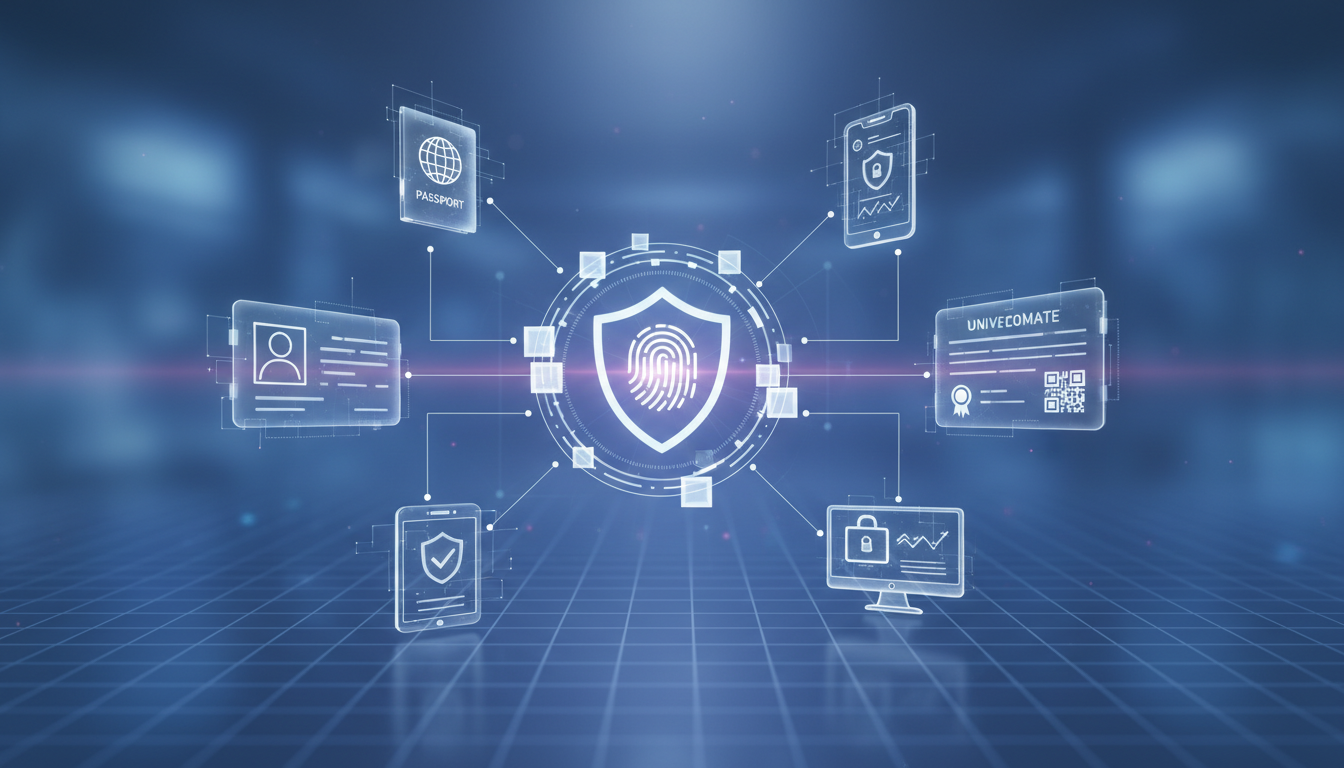
Identity verification costs enterprises roughly $15 billion annually in KYC compliance alone. Current systems require users to repeatedly submit the same documents to different organizations, creating privacy risks and operational inefficiency.
Self-Sovereign Identity Systems
Self-sovereign identity (SSI) gives individuals **cryptographic control** over their personal data. Instead of storing identity information in centralized databases, users maintain encrypted credentials in digital wallets.
When verification is required, users share cryptographic proofs rather than raw personal data. A bank can verify that someone is over 18 without learning their exact birthdate. An employer can confirm educational credentials without accessing complete academic transcripts.
Professional Credential Verification
Professional licensing and certification verification relies on manual processes that take weeks and cost hundreds of dollars per check. Blockchain applications enable **instant verification** of credentials through cryptographic signatures.
MIT issues blockchain-based diplomas that employers can verify in seconds. The credentials include cryptographic proofs from the issuing institution that can’t be forged or manipulated. This eliminates resume fraud and reduces hiring costs.
Decentralized Authentication
Traditional authentication relies on usernames and passwords managed by centralized services. Users must trust platforms to secure their credentials and respect their privacy. Blockchain applications enable **passwordless authentication** through cryptographic signatures.
Users generate public-private key pairs that serve as their digital identity. Authentication happens by signing challenges with private keys rather than submitting passwords to servers. This eliminates password breaches and reduces platform dependency.
Smart Contract Automation and Business Logic
Smart contracts represent the most significant blockchain application because they enable **programmable agreements**. Traditional contracts require human interpretation and enforcement. Smart contracts execute automatically when predefined conditions are met.
Insurance Claims Processing
Insurance claims processing involves multiple parties, extensive documentation, and subjective assessments. Smart contracts can automate claims for **parametric insurance** , policies that pay out based on objective data rather than damage assessments.
Flight delay insurance smart contracts monitor airline APIs and automatically pay claims when flights are delayed beyond specified thresholds. Crop insurance contracts use weather data to trigger payouts during drought conditions. This automation reduces processing costs and eliminates claim disputes.
Supply Chain Payments and Escrow
International trade involves complex payment terms, letters of credit, and escrow arrangements. Smart contracts can automate these processes by holding funds in escrow and releasing payments when delivery conditions are met.
IoT sensors confirm product delivery and quality metrics. Smart contracts automatically release payments to suppliers when goods meet specifications. This reduces counterparty risk and eliminates manual payment processing.
Royalty Distribution and Revenue Sharing
Creative industries struggle with **transparent royalty distribution**. Musicians, writers, and content creators often can’t verify how platforms calculate their earnings. Smart contracts enable programmable revenue sharing with real-time transparency.
Music streaming platforms can use smart contracts to automatically distribute royalties based on play counts and predetermined splits. Content creators see exactly how their earnings are calculated and receive payments instantly rather than waiting for quarterly statements.
Blockchain Applications: Advantages and Limitations
Advantages
- Eliminates intermediaries and reduces transaction costs
- Creates immutable audit trails for compliance and verification
- Enables 24/7 automated processing without human intervention
- Provides cryptographic security and tamper resistance
- Facilitates global access without geographic restrictions
Limitations
- High energy consumption for proof-of-work networks
- Limited transaction throughput compared to traditional databases
- Regulatory uncertainty in many jurisdictions
- Technical complexity requires specialized development skills
- Immutability makes error correction difficult
Gaming and Digital Asset Ownership
Gaming represents one of the most natural blockchain applications because virtual economies already exist. Players spend billions on in-game items, but they don’t truly own these assets. Blockchain applications enable **verifiable digital ownership** and **cross-game interoperability**.
Non-Fungible Tokens (NFTs) and Digital Collectibles
NFTs solve the **digital scarcity** problem. Traditional digital files can be copied infinitely, making them unsuitable for collectibles or unique items. NFTs create cryptographic certificates of authenticity and ownership.
Gaming NFTs represent in-game items like weapons, characters, or land parcels. Players can trade these assets on secondary markets or use them across compatible games. This creates real economic value for gaming achievements and time investment.
Play-to-Earn Economic Models
Traditional games extract value from players through purchases and subscriptions. Blockchain games can create **bidirectional value flow** where players earn tokens for gameplay achievements.
Axie Infinity pioneered this model by rewarding players with cryptocurrency tokens for breeding and battling digital creatures. Players in developing countries earned meaningful income through gameplay, creating new economic opportunities.
Decentralized Virtual Worlds
Virtual worlds like Decentraland and The Sandbox use blockchain to create **player-owned economies**. Land parcels, buildings, and virtual goods exist as blockchain assets that players truly own.
This ownership enables **user-generated content monetization**. Players can build virtual businesses, rent property, or create experiences that generate real revenue. The blockchain ensures that virtual property rights are enforceable and transferable.
Governance and Decentralized Autonomous Organizations
Traditional organizations require hierarchical management structures and legal frameworks. Blockchain applications enable **programmable governance** through Decentralized Autonomous Organizations (DAOs) that operate according to smart contract rules rather than human management.
Community-Driven Decision Making
DAOs use token-based voting to make collective decisions. Token holders can propose changes to protocols, allocate treasury funds, or modify governance parameters. This creates **stakeholder alignment** because decision-makers have economic skin in the game.
MakerDAO governs the DAI stablecoin through community voting on risk parameters, collateral types, and stability fees. Token holders collectively manage a multi-billion dollar financial protocol without traditional corporate structures.
Treasury Management and Resource Allocation
DAOs can hold and manage digital assets through **multi-signature wallets** controlled by smart contracts. Spending proposals require community approval through token-weighted voting. This creates transparent resource allocation without traditional financial controls.
Protocol treasuries often hold hundreds of millions in digital assets. Community members can propose grants, partnerships, or development initiatives. Approved proposals automatically receive funding through smart contract execution.
Incentive Alignment and Token Economics
Traditional organizations struggle with **principal-agent problems** , managers may prioritize personal interests over stakeholder value. DAOs align incentives through token ownership that directly correlates with protocol success.
Contributors earn tokens for valuable contributions to the protocol. Token value increases as the protocol grows and generates more usage. This creates direct alignment between individual effort and collective success.
“The most successful blockchain applications don’t replace entire industries , they remove specific friction points where trust, verification, or coordination create bottlenecks. Focus on narrow problems with clear value propositions rather than attempting complete system overhauls.”
Emerging Applications and Future Directions
The next wave of blockchain applications will focus on **interoperability** and **mainstream integration** rather than creating parallel systems. Cross-chain protocols, layer-2 scaling solutions, and traditional system integration represent the current development frontier.
Cross-Chain Interoperability Protocols
Current blockchain networks operate as isolated ecosystems. Assets and data can’t easily move between different chains. Cross-chain protocols create **bridges** that enable asset transfers and communication between networks.
Polkadot and Cosmos enable specialized blockchains to communicate while maintaining their unique properties. This allows developers to optimize for specific use cases while maintaining broader ecosystem connectivity.
Layer-2 Scaling and State Channels
Blockchain scalability remains a fundamental constraint. Layer-2 solutions process transactions **off-chain** while maintaining blockchain security guarantees. This enables high-throughput applications without compromising decentralization.
Lightning Network enables instant Bitcoin payments through payment channels. Polygon processes Ethereum transactions at fraction of the cost while inheriting Ethereum’s security. These solutions make blockchain applications viable for mainstream adoption.
Integration with Traditional Enterprise Systems
Future blockchain applications will integrate with existing enterprise software rather than replacing it entirely. **Hybrid architectures** use blockchain for specific functions like audit trails, payments, or identity management while maintaining traditional databases for operational data.
This approach reduces implementation risk and enables gradual adoption. Organizations can experiment with blockchain applications for specific use cases before committing to complete system overhauls.
The blockchain applications space continues evolving rapidly, but the fundamental value proposition remains constant: **removing intermediaries** where they create unnecessary friction, cost, or risk. Successful implementations focus on solving specific problems rather than pursuing technology for its own sake.
Ready to explore how blockchain applications can create value for your organization? Apply to the Genesis Cohort at digitalblockchains.com and work with experienced builders who understand both the technology and business implementation challenges.