
Key Takeaways
- Healthcare blockchain adoption focuses on data sovereignty and interoperability, not speculative tokens
- HIPAA compliance requires zero-knowledge proofs and permissioned networks, not public blockchains
- Smart contracts automate insurance claims processing, reducing administrative overhead by roughly 40%
- Patient-controlled data wallets enable granular consent management across provider networks
- Supply chain transparency prevents counterfeit drugs through immutable provenance tracking
The Healthcare Data Crisis That Blockchain Actually Solves
Healthcare generates roughly 30% of the world’s data volume, yet most of it sits in isolated silos. Electronic Health Records (EHRs) from Epic can’t talk to Cerner systems. Lab results from Quest Diagnostics require manual entry into hospital databases. Insurance claims bounce between multiple intermediaries, each adding friction and cost.
This isn’t a technology problem , it’s an incentive problem. Healthcare providers have little motivation to share data because patient lock-in drives revenue. Blockchain changes this dynamic by giving patients ownership of their medical data while maintaining provider access through cryptographic permissions.
Patient Data Sovereignty Through Cryptographic Control
Traditional EHRs store patient data on provider-controlled servers. Patients can request copies, but they can’t control who accesses what information or revoke permissions granularly. Blockchain flips this model by storing encrypted data references on-chain while keeping actual medical records in distributed storage systems like IPFS.
Each patient controls a private key that grants or revokes access to specific data sets. A cardiologist might have permission to view cardiac imaging and lab results but not psychiatric records. This granular control isn’t possible with current database architectures.
Interoperability Without Vendor Lock-in
Healthcare interoperability standards like HL7 FHIR define data formats but don’t solve the business incentive problem. Blockchain creates economic incentives for data sharing through token rewards for providers who contribute to patient care continuity.
When a patient visits a new specialist, their complete medical history becomes available instantly if all previous providers participated in the blockchain network. This reduces duplicate testing, prevents dangerous drug interactions, and improves care quality.
Smart Contract Automation for Administrative Processes
Healthcare administration consumes roughly 8% of total healthcare spending in the US. Much of this involves manual verification of insurance coverage, prior authorizations, and claims processing. Smart contracts automate these workflows by encoding insurance policy terms directly into executable code.
When a patient receives treatment, the smart contract automatically verifies coverage, calculates copays, and initiates payment to providers. This eliminates the weeks-long claims processing cycle and reduces administrative overhead significantly.
Technical Architecture for HIPAA-Compliant Healthcare Blockchains
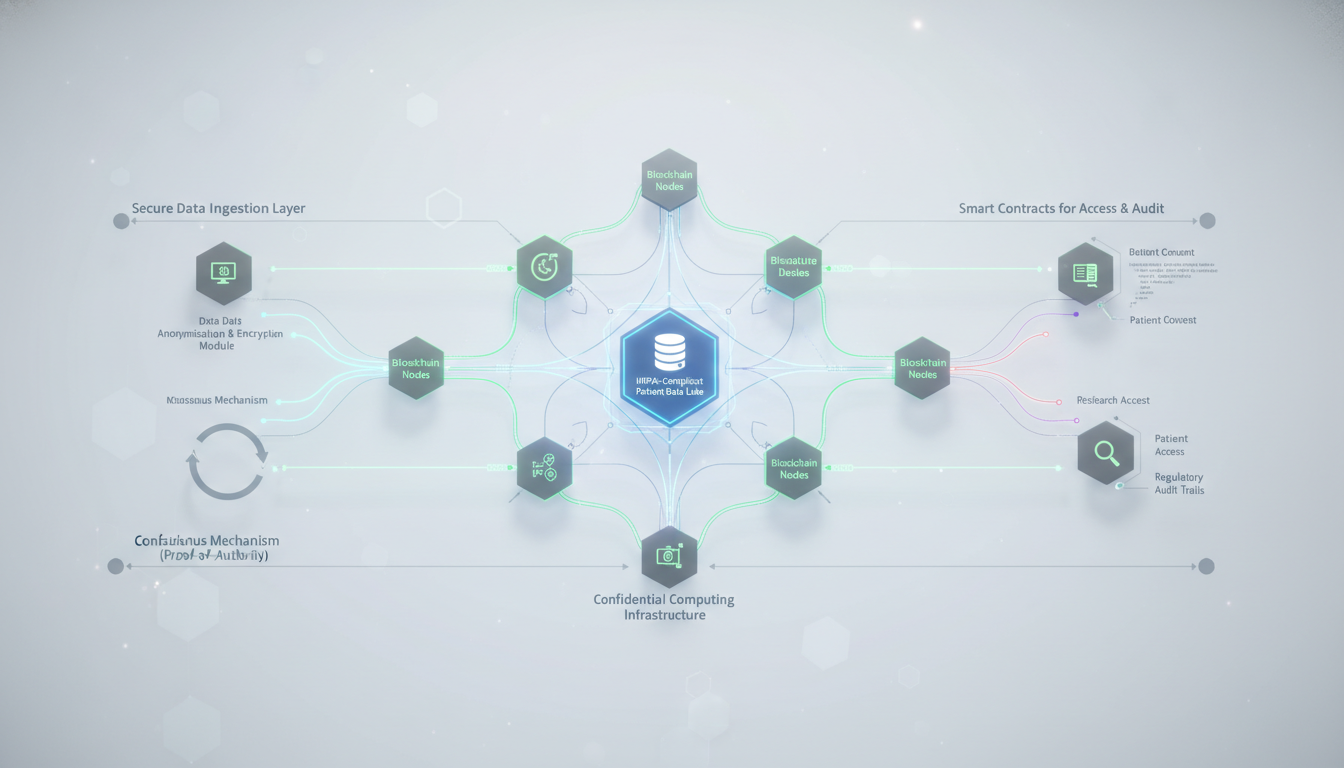
Building blockchain systems for healthcare requires careful attention to privacy regulations. HIPAA mandates that Protected Health Information (PHI) must be encrypted both in transit and at rest, with detailed access logging and the ability to revoke access.
Public blockchains like Ethereum don’t meet these requirements because transaction data is permanently visible to all network participants. Healthcare blockchain implementations require permissioned networks with sophisticated privacy-preserving technologies.
Zero-Knowledge Proofs for Medical Data Privacy
Zero-knowledge proofs allow healthcare providers to verify patient information without seeing the underlying data. For example, an insurance company can verify that a patient has a specific diagnosis code for coverage purposes without accessing the complete medical record.
zk-SNARKs (Zero-Knowledge Succinct Non-Interactive Arguments of Knowledge) are particularly useful for healthcare because they produce small proofs that can be verified quickly. A proof that a patient meets criteria for a clinical trial might be only 288 bytes, regardless of how much medical data was analyzed to generate it.
Permissioned Network Design Patterns
Healthcare blockchain networks typically use consortium models where hospitals, insurance companies, and government health agencies operate validator nodes. This ensures that only authorized entities can participate in consensus while maintaining decentralization benefits.
Hyperledger Fabric is commonly chosen for healthcare implementations because it supports channels , private subnets where only specific organizations can see transactions. A mental health provider might operate on a separate channel from general medical providers to ensure psychiatric records remain isolated.
Off-Chain Storage with On-Chain Integrity
Storing actual medical images and documents on-chain would be prohibitively expensive and slow. Healthcare blockchain systems store only metadata and cryptographic hashes on-chain, with actual files in distributed storage systems.
When a doctor uploads an MRI scan, the system generates a cryptographic hash of the file and stores it on-chain along with access permissions. The encrypted file goes to IPFS or a similar distributed storage network. Anyone can verify file integrity by comparing the stored hash with the current file hash, but only authorized parties can decrypt and view the content.
Smart Contract Implementation for Medical Records Management

Smart contracts in healthcare go beyond simple data storage to encode complex medical workflows and consent management. These contracts must handle detailed scenarios like emergency access, minor patient consent, and research data sharing.
Here’s a simplified Solidity contract structure for patient consent management:
contract PatientConsent {
    struct ConsentRecord {
        address patient;
        address provider;
        string dataType;
        uint256 expirationTime;
        bool isActive;
    }

    mapping(bytes32 => ConsentRecord) public consents;

    function grantConsent(
        address _provider,
        string memory _dataType,
        uint256 _duration
    ) public {
        bytes32 consentId = keccak256(abi.encodePacked(
            msg.sender, _provider, _dataType
        ));

        consents[consentId] = ConsentRecord({
            patient: msg.sender,
            provider: _provider,
            dataType: _dataType,
            expirationTime: block.timestamp + _duration,
            isActive: true
        });
    }

    function revokeConsent(bytes32 _consentId) public {
        require(consents[_consentId].patient == msg.sender);
        consents[_consentId].isActive = false;
    }
}
Emergency Access Override Mechanisms
Medical emergencies require immediate access to patient records, even without explicit consent. Smart contracts can encode emergency access rules that allow authorized emergency personnel to access critical medical information while logging all access for later audit.
Emergency access typically requires multiple signatures from medical staff and automatically expires after a short time period. The patient receives notification of emergency access once they’re able to receive it, maintaining transparency while enabling life-saving care.
Automated Insurance Claims Processing
Insurance claims processing involves verifying treatment codes against policy coverage, calculating deductibles and copays, and coordinating benefits between multiple insurers. Smart contracts can automate much of this process by encoding insurance policy terms directly into executable code.
When a provider submits a claim, the smart contract automatically checks coverage, verifies that deductibles haven’t been exceeded, and calculates payment amounts. This reduces claims processing time from weeks to minutes while eliminating many sources of human error.
Research Data Sharing with Differential Privacy
Medical research requires access to large datasets while protecting individual patient privacy. Blockchain-based systems can implement differential privacy techniques that add mathematical noise to datasets, making it impossible to identify individual patients while preserving statistical validity for research.
Patients can consent to research participation through smart contracts that specify exactly what types of research their data can be used for and automatically distribute any research-related compensation.
Supply Chain Transparency and Drug Authentication

Counterfeit drugs represent a massive global problem, with the WHO estimating that roughly 10% of medical products in low and middle-income countries are substandard or falsified. Blockchain provides an immutable record of drug provenance from manufacturer to patient.
Each drug package receives a unique identifier that gets recorded on the blockchain at every step of the supply chain. Pharmacists and patients can verify authenticity by checking the blockchain record against the physical package.
Pharmaceutical Manufacturing Provenance
Drug manufacturing involves complex supply chains with raw materials sourced globally and processed through multiple facilities. Blockchain systems can track each ingredient from source to final product, creating an auditable trail that regulators can use to quickly identify contamination sources during recalls.
Smart contracts can automatically flag potential issues when ingredients from problematic suppliers enter the manufacturing process, preventing contaminated drugs from reaching patients.
Cold Chain Monitoring for Temperature-Sensitive Medications
Many medications, particularly biologics and vaccines, require strict temperature control throughout the supply chain. IoT sensors can automatically record temperature data to the blockchain, creating an immutable record of storage conditions.
If temperature excursions occur, smart contracts can automatically quarantine affected batches and notify all downstream parties. This prevents ineffective or dangerous medications from reaching patients while minimizing waste from false alarms.
Prescription Drug Monitoring Programs
Prescription drug abuse requires coordination between pharmacies, prescribers, and regulatory agencies. Blockchain-based prescription monitoring can provide real-time visibility into prescribing patterns while maintaining patient privacy through zero-knowledge proofs.
Pharmacists can verify that prescriptions haven’t been filled elsewhere without seeing the patient’s complete prescription history. This prevents doctor shopping while protecting legitimate patients’ privacy.
Clinical Trial Data Integrity and Patient Recruitment
Clinical trials suffer from data integrity issues, patient recruitment challenges, and lack of transparency in results reporting. Blockchain addresses these problems by creating immutable records of trial protocols, patient data, and results.
Trial protocols stored on blockchain cannot be modified after patient enrollment begins, preventing post-hoc changes that could bias results. Patient data gets timestamped and cryptographically signed, making it impossible to alter without detection.
Decentralized Patient Recruitment Networks
Traditional clinical trial recruitment relies on investigators manually identifying eligible patients from their practices. Blockchain enables privacy-preserving patient matching where patients can indicate interest in trial participation without revealing their identity until they choose to enroll.
Smart contracts can automatically match patient characteristics against trial inclusion criteria using zero-knowledge proofs, notifying patients of relevant trials without exposing their medical information to researchers.
Immutable Trial Data Recording
Data integrity is important for regulatory approval of new treatments. Blockchain systems timestamp and cryptographically sign all trial data as it’s collected, creating an immutable audit trail that regulators can verify.
This prevents common forms of research misconduct like data fabrication or selective reporting of results. All trial data becomes part of the permanent record, making it impossible to hide negative results or cherry-pick favorable outcomes.
Automated Regulatory Reporting
Clinical trials must report adverse events and protocol deviations to regulatory agencies within specific timeframes. Smart contracts can automate much of this reporting by monitoring trial data for predefined conditions and automatically submitting required reports.
This reduces the administrative burden on research teams while ensuring compliance with regulatory requirements. Automated reporting also reduces the risk of human error or intentional non-reporting of adverse events.
Challenges and Limitations in Healthcare Blockchain Implementation
Despite the potential benefits, blockchain implementation in healthcare faces significant technical and regulatory challenges. Understanding these limitations is important for realistic project planning and stakeholder expectations.
The most significant challenge isn’t technical , it’s organizational. Healthcare providers have invested billions in existing EHR systems and have little incentive to adopt new technologies that might reduce their competitive advantages.
Scalability Constraints for Large Healthcare Networks
Healthcare generates massive amounts of data. A large hospital system might process millions of transactions daily across all their systems. Current blockchain networks struggle with this scale, particularly when privacy-preserving technologies like zero-knowledge proofs add computational overhead.
Layer 2 solutions and sharding can help with scalability, but they add complexity and potential security risks. Healthcare organizations are naturally conservative about adopting unproven technologies for critical patient care systems.
Regulatory Compliance Complexity
Healthcare regulations vary significantly between countries and even states within the US. A blockchain system that complies with HIPAA might violate GDPR’s right to be forgotten, since blockchain data is immutable by design.
Regulatory agencies are still developing guidance for blockchain in healthcare. The FDA has issued some preliminary guidance, but many questions remain unanswered about liability, data governance, and cross-border data transfers.
Integration with Legacy Healthcare Systems
Most healthcare providers run on legacy systems that weren’t designed for blockchain integration. Epic and Cerner EHR systems dominate the market, and these vendors have little incentive to support blockchain interoperability that might reduce their market power.
Custom integration work is expensive and risky. Healthcare IT budgets are often constrained, and CIOs are reluctant to invest in experimental technologies when their existing systems handle current needs adequately.
Pros and Cons of Healthcare Blockchain Implementation
Advantages:
- Patient data sovereignty and granular consent management
- Improved interoperability between healthcare providers
- Reduced administrative costs through smart contract automation
- Enhanced supply chain transparency and drug authentication
- Immutable audit trails for regulatory compliance
Disadvantages:
- High implementation costs and technical complexity
- Scalability limitations for large healthcare networks
- Regulatory uncertainty and compliance challenges
- Resistance from established healthcare IT vendors
- Privacy concerns with immutable data storage
Real-World Implementation Strategies and Best Practices
Successful healthcare blockchain projects start small and focus on specific use cases rather than attempting to revolutionize entire healthcare systems. The most successful implementations target pain points where current systems clearly fail and blockchain provides obvious benefits.
Pilot projects should involve willing participants who understand the technology and are motivated to make it work. Trying to force blockchain adoption on reluctant healthcare providers typically results in project failure.
Consortium Development and Governance Models
Healthcare blockchain networks require careful governance structures that balance the interests of competing organizations. Successful consortiums typically start with non-competitive use cases like supply chain tracking or research data sharing.
Governance models must address technical decisions like protocol upgrades, business decisions like fee structures, and legal decisions like liability allocation. Clear governance prevents the political conflicts that have derailed many blockchain consortiums.
Phased Implementation Approaches
Large-scale healthcare blockchain implementations should follow phased approaches that demonstrate value at each stage. Phase one might focus on simple data sharing between two willing providers. Phase two could add smart contract automation for specific workflows.
Each phase should deliver measurable benefits that justify continued investment. Healthcare organizations need to see clear ROI before committing to larger implementations.
Security and Privacy by Design
Healthcare blockchain systems must implement security and privacy protections from the ground up rather than adding them as afterthoughts. This includes encryption key management, access control systems, and audit logging capabilities.
Security models should assume that some network participants might be compromised or malicious. Multi-signature requirements, time delays for sensitive operations, and automated monitoring can help detect and prevent security breaches.
“The biggest mistake I see in healthcare blockchain projects is trying to solve every problem at once. Start with one specific use case, prove it works, then expand. The technology is ready, but the ecosystem needs time to adapt.” , Leading healthcare blockchain researcher
Future Outlook: Where Healthcare Blockchain is Heading
Healthcare blockchain adoption will likely follow the same pattern as other enterprise technologies , slow initial adoption followed by rapid scaling once early implementations prove successful. The key catalysts will be regulatory clarity and demonstrated ROI from pilot projects.
Interoperability requirements from government payers like Medicare and Medicaid could accelerate adoption by creating economic incentives for data sharing. Value-based care contracts that reward patient outcomes rather than service volume align well with blockchain’s transparency benefits.
Integration with Emerging Technologies
Healthcare blockchain systems will increasingly integrate with AI and machine learning systems that require large, high-quality datasets. Blockchain provides the data provenance and consent management infrastructure needed for AI systems to access patient data ethically.
IoT devices for remote patient monitoring will generate massive amounts of health data that needs secure, auditable storage. Blockchain provides the infrastructure for patients to control how this data gets used while enabling valuable research and care applications.
Regulatory Evolution and Standards Development
Regulatory agencies are developing more specific guidance for healthcare blockchain implementations. The FDA’s Digital Health Center of Excellence is working on frameworks for evaluating blockchain-based medical devices and systems.
Industry standards organizations like HL7 are developing blockchain integration standards that will make it easier for different systems to interoperate. These standards will reduce implementation costs and risks for healthcare organizations.
Economic Models and Sustainability
Sustainable healthcare blockchain networks need clear economic models that incentivize participation while covering operational costs. Token-based incentive systems might reward providers for contributing high-quality data or maintaining network infrastructure.
Insurance companies and government payers might fund blockchain networks that reduce administrative costs or improve care quality. The key is aligning blockchain benefits with existing healthcare payment models rather than requiring entirely new economic structures.
Ready to explore how blockchain can transform your healthcare organization? Apply to the Genesis Cohort at digitalblockchains.com and work directly with our team to design and implement healthcare blockchain solutions that actually work in the real world.