Key Takeaways
- Chainlink’s integration pricing effectively blocked Cardano from the US Department of Commerce blockchain data program
- Non-EVM compatibility creates additional infrastructure costs that oracle providers can exploit
- Government blockchain adoption reveals critical dependencies on third-party oracle infrastructure
- Protocol-level design decisions made years ago now impact institutional partnerships
- Oracle provider consolidation creates single points of failure in decentralized systems
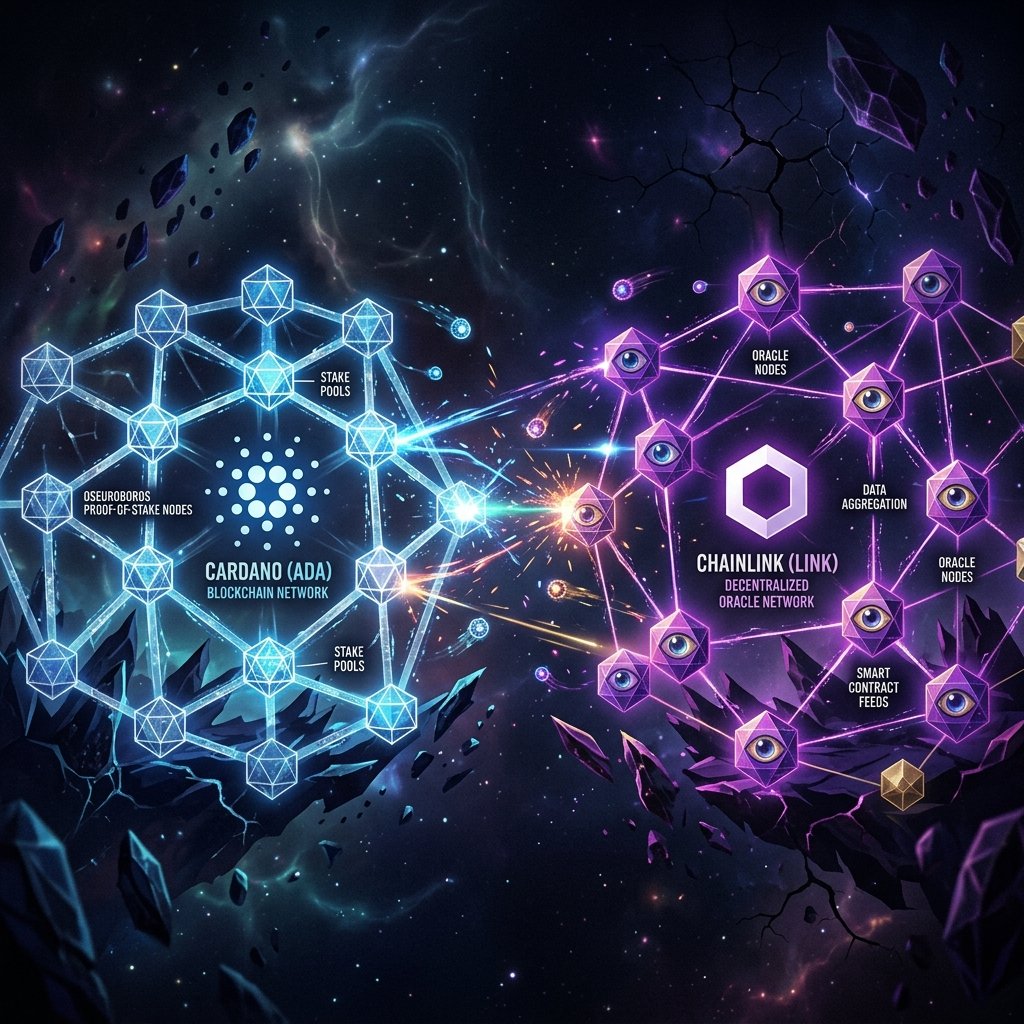
The exclusion of Cardano from the US blockchain data program isn’t just another crypto controversy , it’s a case study in how infrastructure dependencies can override technical merit in institutional adoption. When Charles Hoskinson revealed that Chainlink’s “absurd” pricing kept ADA out of the Department of Commerce initiative, he exposed a fundamental tension in Web3: the gap between decentralized ideals and centralized chokepoints.
This isn’t about hurt feelings or missed opportunities. It’s about understanding how oracle economics, protocol architecture, and government procurement intersect to shape which blockchains get institutional legitimacy.
The Oracle Pricing Problem
Oracle providers hold disproportionate power in blockchain ecosystems, and the cardano us blockchain data program exclusion demonstrates this reality perfectly. Chainlink’s dominance in the oracle space , controlling roughly 60% of total value locked across DeFi protocols , gives them significant leverage when pricing integration services.
Infrastructure Asymmetry
Cardano’s non-EVM architecture requires custom oracle infrastructure. While Ethereum and Solana can leverage existing Chainlink deployments, Cardano needs ground-up integration. This creates a natural pricing disparity that oracle providers can exploit.
The technical requirements aren’t trivial. Cardano’s UTXO model, Plutus smart contracts, and Ouroboros consensus mechanism all require specialized oracle adapters. Building these components involves months of development, extensive testing, and ongoing maintenance , costs that get passed to the requesting party.
Market Dynamics at Play
Chainlink’s pricing strategy reflects basic economics: charge what the market will bear. Government contracts represent high-value, low-risk revenue streams. If the Department of Commerce can proceed with Ethereum, Solana, and other EVM-compatible chains, why would Chainlink discount Cardano integration?
This dynamic creates a feedback loop. Popular chains get cheaper oracle access, making them more attractive for institutional use, which increases their popularity. Less adopted chains face higher integration costs, making institutional adoption harder to achieve.
Negotiation Leverage
Hoskinson’s comments about ongoing discussions with Sergey Nazarov reveal the delicate balance of these negotiations. Chainlink knows their value , they’re the infrastructure layer that makes blockchain data usable for traditional institutions. Cardano needs that access, but at what cost?
The “golden egg” reference isn’t hyperbole. Oracle providers sit at the intersection of on-chain and off-chain worlds, making them indispensable for any blockchain seeking real-world data integration.
Government Procurement Realities

The US blockchain data program selection process reveals how government procurement intersects with decentralized technology. Unlike private sector adoption, government contracts involve specific requirements, budget constraints, and risk assessments that don’t always align with technical merit.
Risk Assessment Framework
Government agencies prioritize proven infrastructure over innovative architecture. Ethereum’s established ecosystem, despite higher fees and energy consumption, represents lower integration risk than Cardano’s newer smart contract platform. This risk-averse approach naturally favors incumbents.
The Department of Commerce likely evaluated factors beyond technical capability: ecosystem maturity, developer tooling, existing partnerships, and integration complexity. Cardano’s five years of zero downtime matter less than Chainlink’s willingness to provide cost-effective integration.
Budget Allocation Constraints
Government contracts operate within fixed budgets. If Chainlink’s Cardano integration costs exceed allocated funds, exclusion becomes inevitable regardless of technical merit. This creates a scenario where oracle pricing effectively determines blockchain participation in government initiatives.
The procurement process probably involved competitive bidding among oracle providers, but Chainlink’s market dominance limits alternatives. Other oracle networks like Band Protocol or API3 lack the government relationships and proven track record that agencies require.
Timeline Pressures
Government initiatives operate on political timelines that don’t align with blockchain development cycles. If Cardano integration requires additional months of development while Ethereum integration can deploy immediately, the choice becomes obvious from a project management perspective.
This timing mismatch explains why early architectural decisions have lasting consequences. Cardano’s choice to build a unique UTXO-based smart contract platform provides technical advantages but creates integration friction that matters in competitive procurement scenarios.
Protocol Architecture Consequences
The cardano us blockchain data program exclusion highlights how fundamental design decisions made during protocol development create long-term strategic implications. Cardano’s architectural choices, while technically sound, create integration challenges that manifest years later in institutional adoption scenarios.
EVM Compatibility Trade-offs
Cardano’s decision to build Plutus instead of adopting EVM compatibility was deliberate. Plutus provides formal verification, better security guarantees, and more expressive smart contract capabilities. However, this choice creates a parallel ecosystem that requires custom tooling, specialized knowledge, and higher integration costs.
The trade-off seemed reasonable in 2017 when Cardano’s development began. EVM had significant limitations, and building a superior virtual machine made sense. But network effects compound over time, and EVM’s ubiquity now creates economic advantages that override technical superiority.
UTXO Model Implications
Cardano’s extended UTXO model provides better parallelization and predictable fee structures than account-based systems. But oracle integration becomes more complex when dealing with UTXO inputs and outputs instead of simple state changes.
Traditional oracle patterns assume account-based state management. Adapting these patterns to UTXO requires rethinking data flow, transaction construction, and state verification. This additional complexity translates directly into higher development and maintenance costs.
Consensus Mechanism Dependencies
Ouroboros, Cardano’s proof-of-stake consensus, provides energy efficiency and security guarantees. But oracle providers must understand epoch boundaries, slot leadership selection, and finality guarantees to build reliable data feeds.
This specialized knowledge requirement limits the number of teams capable of building Cardano oracle infrastructure, reducing competition and increasing costs. Ethereum’s proof-of-stake transition maintained backward compatibility with existing oracle infrastructure, avoiding this knowledge barrier.
Oracle Market Concentration

The exclusion reveals dangerous concentration in the oracle market. When a single provider can effectively block blockchain participation in government programs through pricing decisions, the decentralized ecosystem has a centralization problem.
Chainlink’s Market Position
Chainlink’s dominance stems from first-mover advantage, extensive partnerships, and proven reliability. They’ve secured relationships with traditional finance institutions, government agencies, and major blockchain protocols. This network effect creates barriers to entry that competitors struggle to overcome.
The company’s token economics also reinforce market position. LINK tokens are required for oracle services, creating demand that supports token value, which attracts more node operators, improving service quality, which attracts more users. This virtuous cycle is difficult to disrupt.
Alternative Oracle Providers
Band Protocol, API3, and other oracle networks exist but lack Chainlink’s government relationships and institutional trust. Building these relationships requires years of compliance work, security audits, and proven track records that new entrants can’t quickly replicate.
Cardano could theoretically build its own oracle infrastructure, but this approach requires significant resources and time. The Catalyst governance system could fund such development, but competing with established players in the government market remains challenging.
Systemic Risk Implications
Oracle concentration creates systemic risks for the entire blockchain ecosystem. If Chainlink experiences technical failures, regulatory challenges, or economic disruption, dependent protocols suffer regardless of their own technical merit.
This dependency undermines the decentralization thesis that motivates blockchain adoption. If oracle providers can unilaterally exclude protocols through pricing decisions, the permissionless nature of blockchain technology becomes meaningless for institutional use cases.
Economic Incentive Misalignment
The pricing dispute reveals fundamental misalignment between oracle provider incentives and blockchain ecosystem health. Chainlink’s profit maximization doesn’t necessarily align with promoting blockchain diversity or supporting innovative protocols.
Revenue Optimization Strategy
Oracle providers maximize revenue by focusing on high-volume, low-maintenance integrations. Ethereum and EVM-compatible chains offer this profile , large user bases, standardized interfaces, and proven demand. Custom integrations like Cardano require more resources for potentially smaller returns.
This economic logic makes sense from Chainlink’s perspective but creates barriers for innovative protocols. The result is a feedback loop where popular chains become more popular while alternative architectures struggle to gain institutional traction.
Development Cost Recovery
Building Cardano oracle infrastructure requires specialized development teams, extensive testing, and ongoing maintenance. These costs must be recovered through service fees, creating natural pricing pressure that affects adoption.
The challenge is that Cardano’s smaller ecosystem can’t absorb high integration costs as easily as Ethereum’s massive DeFi market. This creates a chicken-and-egg problem where high costs prevent adoption, which keeps the ecosystem small, which justifies high costs.
Long-term Ecosystem Impact
Short-term profit maximization by oracle providers may undermine long-term ecosystem diversity. If innovative protocols can’t access oracle services at reasonable costs, the blockchain space becomes dominated by a few large networks, reducing innovation and competition.
This concentration risk extends beyond individual protocols to the entire decentralized finance ecosystem. Reduced blockchain diversity means fewer architectural approaches, less experimentation, and potentially missing breakthrough innovations that could benefit the entire space.
Government Blockchain Strategy
The Department of Commerce program represents broader government blockchain strategy, and understanding selection criteria provides insights into how institutional adoption will evolve. The cardano us blockchain data program exclusion reflects specific priorities that may not align with technical merit or decentralization principles.
Institutional Risk Management
Government agencies prioritize proven infrastructure over cutting-edge technology. This conservative approach makes sense given public accountability requirements, but it naturally favors established protocols over innovative alternatives.
Risk assessment frameworks evaluate factors like ecosystem maturity, developer community size, institutional partnerships, and operational history. Cardano’s zero downtime record matters less than Ethereum’s extensive institutional adoption and proven oracle integration.
Procurement Process Constraints
Government procurement operates within specific legal and budgetary frameworks that don’t necessarily optimize for technical excellence. If oracle integration costs exceed budget allocations, exclusion becomes inevitable regardless of protocol capabilities.
These constraints create scenarios where third-party pricing decisions effectively determine government blockchain adoption. Oracle providers gain indirect influence over institutional blockchain strategy through their pricing models.
Strategic Technology Adoption
The program selection reveals government priorities: interoperability with existing financial infrastructure, proven security models, and cost-effective implementation. These priorities don’t necessarily align with blockchain innovation or decentralization principles.
This misalignment creates tension between government blockchain adoption and the broader cryptocurrency ecosystem’s values. Institutional legitimacy comes at the cost of supporting centralized infrastructure providers and established protocols over innovative alternatives.
Technical Integration Challenges
Beyond pricing, Cardano’s exclusion highlights real technical challenges in cross-protocol oracle integration. Understanding these challenges provides context for why custom integrations command premium pricing and how architectural decisions impact institutional adoption.
Smart Contract Platform Differences
Cardano’s Plutus smart contracts operate differently from EVM-based systems. Plutus uses functional programming principles, formal verification methods, and unique transaction validation approaches that require specialized oracle adapters.
Building these adapters isn’t just about translating existing code , it requires understanding Cardano’s unique features like native tokens, multi-asset transactions, and deterministic fee calculation. This specialized knowledge requirement increases development costs and timeline.
Data Format Compatibility
Oracle data feeds must match the consuming blockchain’s data structures and validation requirements. Cardano’s typed transaction outputs and Plutus data types require specific formatting that differs from Ethereum’s more flexible data handling.
This compatibility requirement extends to data verification, timestamp handling, and error management. Each difference requires custom code, testing, and maintenance, contributing to higher integration costs.
Network Communication Protocols
Cardano’s networking layer uses different protocols and message formats than EVM-compatible chains. Oracle nodes must implement Cardano-specific communication protocols to interact with the network reliably.
These protocol differences affect everything from transaction broadcasting to block synchronization. Oracle providers must maintain separate infrastructure stacks for each supported blockchain, increasing operational complexity and costs.
| Integration Factor | Ethereum/EVM | Cardano | Cost Impact |
|---|---|---|---|
| Smart Contract Language | Solidity (standardized) | Plutus (specialized) | High |
| Transaction Model | Account-based | Extended UTXO | Medium |
| Data Types | Flexible | Strongly typed | Medium |
| Network Protocol | Standard | Custom | High |
| Development Tools | Mature ecosystem | Growing ecosystem | Medium |
Frequently Asked Questions
Why was Cardano specifically excluded from the US blockchain data program?
Charles Hoskinson revealed that Chainlink quoted an “absurd” price for Cardano integration due to the technical complexity of building custom oracle infrastructure for Cardano’s non-EVM architecture. The high cost made inclusion impractical within the program’s budget constraints.
Could Cardano have used alternative oracle providers instead of Chainlink?
While alternative oracle providers exist, Chainlink dominates the institutional market and has established government relationships that competitors lack. Building relationships with agencies like the Department of Commerce requires years of compliance work and proven track records that newer oracle providers haven’t developed.
How does Cardano’s architecture contribute to higher integration costs?
Cardano’s extended UTXO model, Plutus smart contracts, and Ouroboros consensus mechanism all require specialized oracle adapters. Unlike EVM-compatible chains that can leverage existing infrastructure, Cardano needs ground-up integration development, extensive testing, and ongoing maintenance.
Will this exclusion impact Cardano’s long-term institutional adoption?
The exclusion highlights broader challenges innovative protocols face in institutional markets. While Cardano’s technical merits remain strong, oracle pricing and integration complexity create barriers to government and enterprise adoption that could slow institutional momentum.
Are there solutions to reduce oracle integration costs for alternative blockchains?
Potential solutions include developing standardized oracle interfaces, creating cross-chain oracle protocols, or building blockchain-native oracle infrastructure. However, these approaches require significant coordination and investment from the broader ecosystem.
What does this reveal about decentralization in blockchain infrastructure?
The situation exposes dangerous concentration in oracle infrastructure, where a single provider can effectively exclude protocols through pricing decisions. This centralization undermines blockchain’s permissionless nature and creates systemic risks for the entire ecosystem.
The Cardano exclusion from the US blockchain data program isn’t just about one protocol missing one opportunity. It’s a window into how infrastructure dependencies, economic incentives, and institutional priorities shape blockchain adoption in ways that don’t always align with technical merit or decentralization principles.
Ready to build blockchain infrastructure that avoids these centralization traps? Apply to the Genesis Cohort at digitalblockchains.com and help us develop the next generation of truly decentralized protocols.