Key Takeaways
- TikTok operates on centralized cloud infrastructure, not blockchain
- Oracle manages U.S. data security through traditional enterprise systems
- Previous NFT experiments used Ethereum and Immutable X
- Meme tokens like $TIKTOK exist on Solana but aren’t affiliated with the platform
- Future blockchain integration would require massive scalability solutions
TikTok’s Current Infrastructure Reality
The short answer to which blockchain does TikTok work with is simple: none. TikTok runs on centralized cloud infrastructure managed by Oracle, not distributed ledger technology. This might surprise developers who assume every major platform has blockchain integration by now, but the technical requirements tell a different story.
Oracle’s Centralized Architecture
Oracle serves as TikTok’s “trusted security partner” in the United States, managing user data through traditional enterprise cloud systems. Their infrastructure handles roughly 150 million daily active users in the U.S. alone, processing terabytes of video content and billions of algorithm interactions. This centralized approach prioritizes speed and regulatory compliance over decentralization.
The Oracle partnership emerged from regulatory pressure, not technical innovation. When ByteDance faced potential bans in 2020-2021, Oracle’s involvement provided a compliance pathway that satisfied government requirements while maintaining operational efficiency.
Why Not Blockchain?
TikTok processes approximately 1 billion video views daily. Even the fastest blockchains like Solana (theoretical 65,000 TPS) or Ethereum with Layer 2 solutions would struggle with this throughput. The platform’s recommendation algorithm makes millions of micro-decisions per second , a computational load that would be prohibitively expensive on any current blockchain network.
Data Storage Considerations
Video content presents unique challenges for blockchain storage. A typical TikTok video ranges from 5-50MB. Storing this on-chain would be technically impossible and economically absurd. Even using IPFS or Arweave for decentralized storage would create latency issues that would destroy user experience.
Historical Blockchain Experiments

While TikTok’s core infrastructure remains centralized, the platform has experimented with blockchain technology through specific features and partnerships. These experiments reveal how traditional platforms approach Web3 integration.
TikTok Top Moments NFT Collection
In 2021, TikTok launched “TikTok Top Moments,” an NFT collection built on Ethereum. The project used Immutable X, a Layer 2 scaling solution, to reduce gas fees and improve transaction speed. Popular videos from creators like Lil Nas X and Grimes were tokenized as collectible moments.
The technical implementation was straightforward: videos were stored on IPFS, with metadata and ownership records on Ethereum. Smart contracts handled royalty distribution, ensuring creators received secondary sale proceeds. However, the project was discontinued after modest adoption, highlighting the gap between crypto enthusiasm and mainstream user behavior.
Creator Fund Blockchain Proposals
Internal discussions at ByteDance reportedly explored blockchain-based creator compensation systems. The concept involved tokenizing creator contributions and using smart contracts for automatic revenue distribution. This would have required integration with payment processors and tax reporting systems , complexity that ultimately favored traditional payment rails.
Partnership Explorations
TikTok has evaluated partnerships with various blockchain projects, including discussions with Polygon for low-cost transactions and Chainlink for oracle services. None materialized into production features, primarily due to scalability concerns and regulatory uncertainty.
The $TIKTOK Token Ecosystem
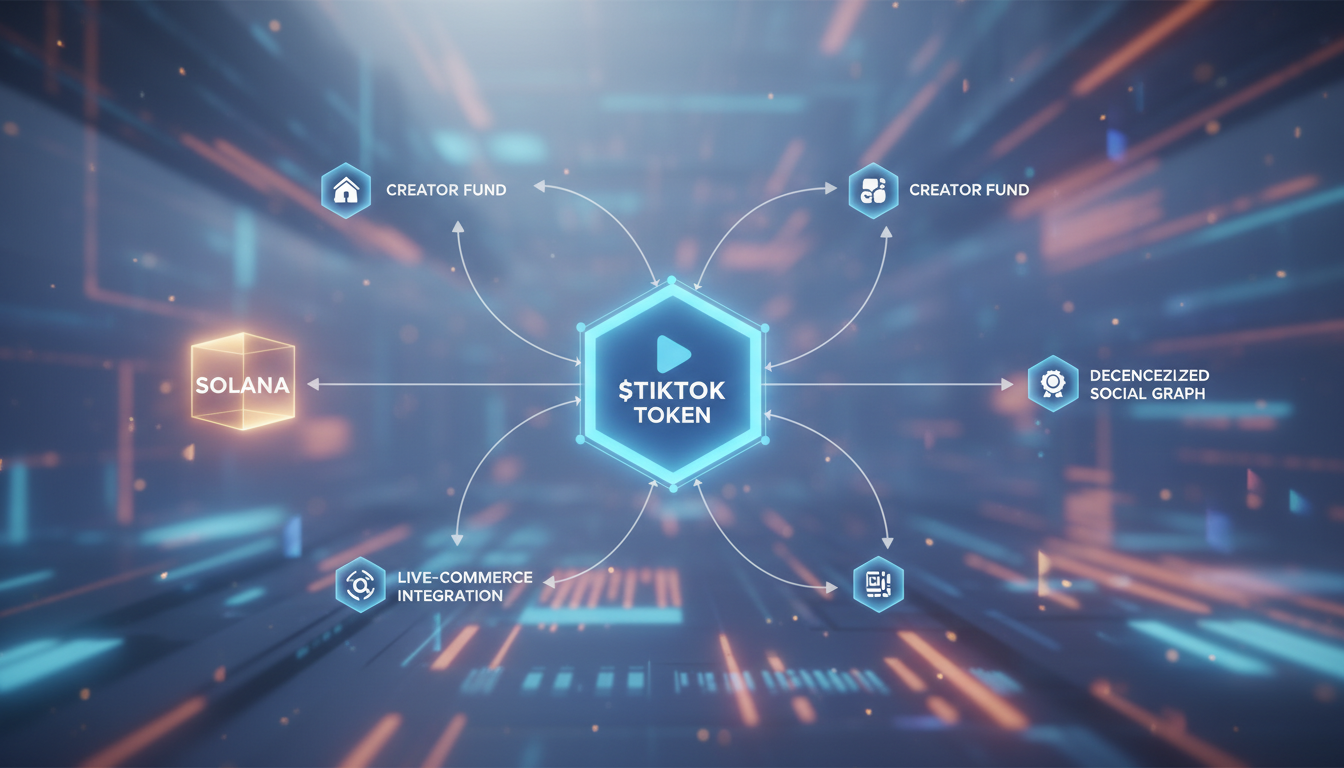
Multiple tokens use “TikTok” branding, but none are officially affiliated with the platform. Understanding this ecosystem helps clarify the relationship between social media brands and cryptocurrency speculation.
Solana-Based TIKTOK Token
The most prominent is $TIKTOK on Solana (contract: CnUDLnrG6ZKBBLR7WPimmjKuN68B3M8p7jBGk77amzMy). This meme token launched in 2023 with no official connection to the social media platform. It trades on decentralized exchanges like Raydium and Jupiter, with typical meme token volatility.
The token’s smart contract includes basic ERC-20 functionality with no unique features. Total supply is fixed at 1 billion tokens, with liquidity provided through automated market makers. Trading volume fluctuates based on social media mentions and broader meme coin sentiment.
Other Blockchain Implementations
Similar tokens exist across multiple chains, including Ethereum, BSC, and Polygon. These are speculative assets created by third parties hoping to capitalize on TikTok’s brand recognition. None offer utility beyond trading speculation.
Legal and Trademark Issues
ByteDance actively monitors unauthorized use of TikTok trademarks in cryptocurrency projects. Several tokens have faced cease-and-desist orders, though enforcement varies by jurisdiction. This creates ongoing legal risk for holders of unofficial TikTok-branded tokens.
Technical Scalability Analysis

Understanding why TikTok doesn’t use blockchain requires examining the technical requirements of social media platforms at scale. The numbers reveal fundamental limitations of current blockchain technology.
Transaction Volume Requirements
TikTok processes roughly 3 billion interactions daily , likes, comments, shares, and follows. Each interaction would require a blockchain transaction in a fully decentralized system. Even at $0.001 per transaction, daily costs would exceed $3 million, not including video storage and bandwidth.
Current blockchain networks can’t handle this load. Ethereum processes roughly 1.2 million transactions daily. Solana’s theoretical maximum of 65,000 TPS would still fall short of TikTok’s peak usage periods.
Latency and User Experience
TikTok’s algorithm responds to user interactions in milliseconds. Blockchain confirmation times , even on fast networks , introduce latency that would degrade the user experience. The “For You” page requires real-time content ranking based on immediate user feedback, incompatible with blockchain settlement times.
Storage and Bandwidth Costs
Decentralized storage solutions like IPFS or Arweave could theoretically handle TikTok’s content, but retrieval speeds and costs remain prohibitive. A single viral video might generate millions of views within hours , bandwidth costs that would bankrupt most decentralized storage providers.
Web3 Social Media Alternatives
While TikTok remains centralized, several blockchain-based social platforms attempt to recreate its functionality. Examining these projects reveals both the potential and limitations of decentralized social media.
Lens Protocol Architecture
Lens Protocol on Polygon offers a decentralized social graph where users own their followers and content. Posts are stored as NFTs, with social interactions recorded on-chain. However, video content is stored on IPFS, creating potential availability issues.
The protocol handles roughly 100,000 transactions monthly , a fraction of TikTok’s scale. Gas costs, even on Polygon, make frequent interactions expensive for casual users.
DeSo Network Implementation
DeSo (Decentralized Social) built a custom blockchain optimized for social media applications. The network can theoretically handle higher throughput than general-purpose blockchains, but still falls short of TikTok’s requirements.
DeSo’s creator coins allow users to invest in content creators, creating novel monetization mechanisms. However, adoption remains limited compared to traditional platforms.
Farcaster’s Hybrid Approach
Farcaster stores social graphs on Ethereum while hosting content on traditional servers. This hybrid model reduces costs while maintaining some decentralization benefits. The approach could theoretically scale to TikTok-like usage, but requires significant infrastructure investment.
Oracle’s Role in TikTok’s Architecture
Oracle’s partnership with TikTok represents enterprise blockchain integration without actual blockchain usage. Understanding this relationship illuminates how traditional tech companies approach Web3 concepts.
Data Security and Auditing
Oracle provides “trusted execution environments” for TikTok’s U.S. operations, ensuring algorithm transparency without blockchain immutability. This approach satisfies regulatory requirements while maintaining operational efficiency.
The system includes automated auditing tools that track data access and algorithm changes. While not blockchain-based, it provides similar transparency benefits through traditional enterprise security measures.
Potential Blockchain Integration
Oracle’s blockchain platform could theoretically integrate with TikTok for specific use cases , creator payments, content licensing, or cross-platform identity verification. However, no such integration currently exists in production.
Regulatory Compliance Framework
Oracle’s involvement primarily addresses regulatory concerns rather than technical innovation. The partnership demonstrates how traditional enterprise solutions often provide more practical paths to compliance than blockchain alternatives.
Future Blockchain Integration Scenarios
While TikTok doesn’t currently use blockchain technology, several scenarios could drive future adoption. Understanding these possibilities helps predict how social media might evolve.
Creator Economy Tokenization
TikTok could implement blockchain-based creator payments using stablecoins or platform tokens. This would enable micro-payments, automatic royalty distribution, and cross-platform creator monetization. Implementation would likely use Layer 2 solutions to manage costs.
Smart contracts could automate revenue sharing between creators, platforms, and advertisers. This transparency could attract creators concerned about platform dependency and payment delays.
Content Ownership and Licensing
Blockchain-based content licensing could help creators maintain ownership rights across platforms. NFT-based licensing agreements could automate usage permissions and royalty payments.
This approach would require industry-wide standards and significant legal framework development. Current copyright systems provide similar protections through traditional mechanisms.
Decentralized Identity Integration
TikTok could integrate with decentralized identity protocols, allowing users to maintain consistent identities across Web3 platforms. This would enable reputation portability and reduce platform lock-in.
However, implementation would require careful privacy considerations and user education about key management and wallet security.
“The path from centralized social media to blockchain integration isn’t about replacing existing infrastructure , it’s about adding value through specific use cases where decentralization provides clear benefits. TikTok’s scale makes wholesale blockchain migration impractical, but targeted integrations could reveal new creator economy models.”
Investment and Market Implications
The relationship between TikTok and blockchain technology creates various investment opportunities and risks. Understanding these dynamics helps navigate the intersection of social media and cryptocurrency markets.
Meme Token Speculation Risks
Unofficial TikTok-branded tokens carry significant risks beyond typical cryptocurrency volatility. Trademark enforcement, regulatory action, and lack of utility create additional downside potential. Most of these tokens have no development teams or roadmaps beyond initial speculation.
Trading volumes often correlate with TikTok news cycles rather than fundamental developments. This creates pump-and-dump scenarios that benefit early speculators while harming retail investors.
Infrastructure Investment Opportunities
Companies providing blockchain infrastructure that could eventually serve social media platforms represent more sustainable investment opportunities. Oracle’s partnership with TikTok demonstrates how traditional enterprise companies can benefit from Web3 adjacent services.
Layer 2 scaling solutions, decentralized storage providers, and content delivery networks could benefit from eventual social media blockchain adoption.
Creator Economy Protocols
Blockchain protocols focused on creator monetization could capture value if major platforms adopt decentralized payment systems. Projects like Livepeer (video streaming), Audius (music), and Mirror (publishing) provide templates for social media blockchain integration.
However, adoption requires overcoming significant technical and regulatory hurdles that may take years to resolve.
The question of which blockchain does TikTok work with reveals the current limitations of decentralized technology at consumer scale. While blockchain offers compelling benefits for creator ownership and platform transparency, the technical requirements of serving billions of users daily remain beyond current capabilities.
TikTok’s centralized architecture isn’t a failure of vision , it’s a practical response to user experience requirements and regulatory constraints. As blockchain technology matures and scaling solutions improve, we may see targeted integrations that enhance specific features without replacing core infrastructure.
For developers and investors, the key insight is that blockchain adoption in social media will likely be gradual and use-case specific rather than wholesale platform migration. The most promising opportunities lie in solving specific problems , creator payments, content licensing, identity portability , rather than rebuilding entire platforms on blockchain infrastructure.
Ready to Build the Future of Social Media?
Join developers and entrepreneurs creating the next generation of creator economy protocols and decentralized social platforms.