Blockchain layers are the architectural framework that divides blockchain ecosystems into specialized tiers, each handling distinct functions like security, scalability, and application logic.
Key Takeaways
- layers divide blockchain technology into specialized functional levels: Layer 0 (infrastructure), Layer 1 (base chain), Layer 2 (scaling), and Layer 3 (applications).
- Each layer improves scalability, security, or interoperability without compromising the core blockchain’s properties.
- Understanding these layers helps investors and developers navigate the crypto ecosystem, as many layer-specific tokens exist.
- Layer 2 solutions can reduce transaction costs by over 90% and increase speed thousands of times compared to some Layer 1 chains.
- The four-layer ecosystem model is the most common framework for understanding how modern such layers work together.
What Are Blockchain Layers?
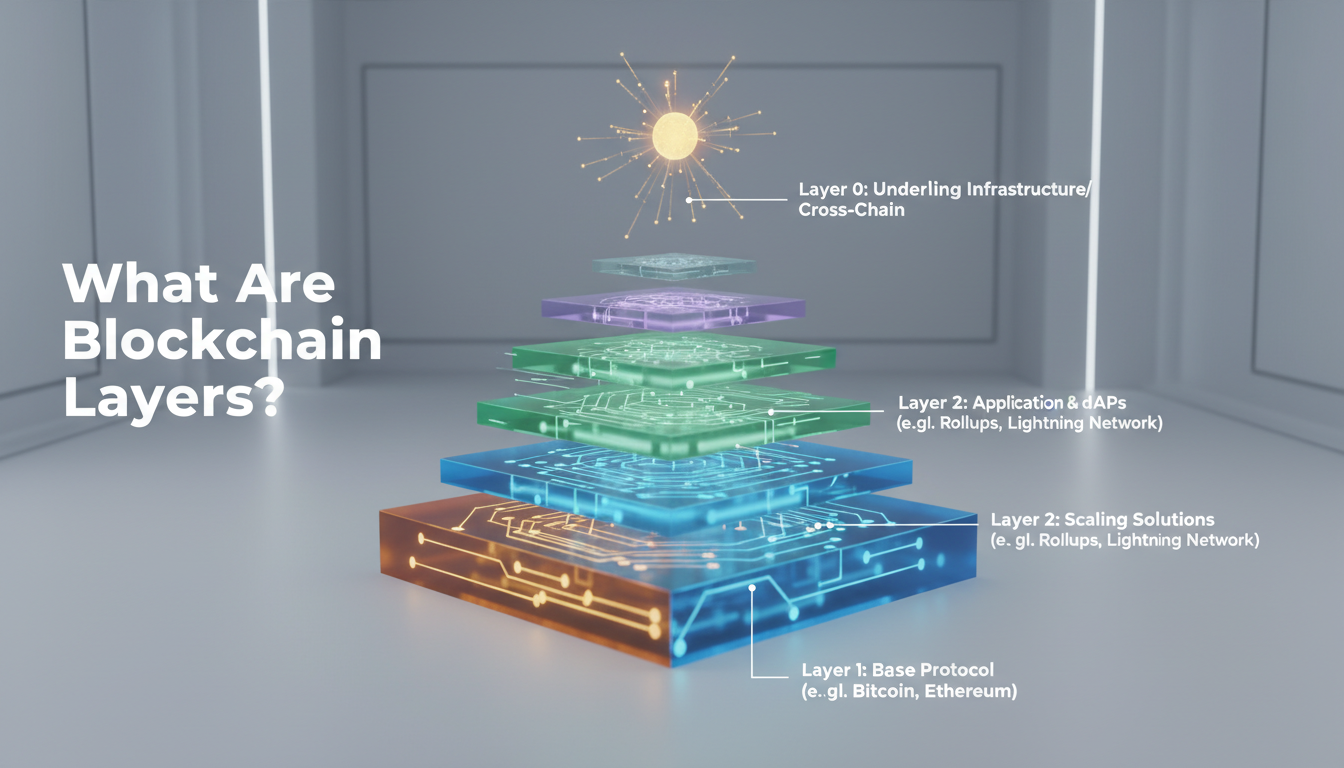
blockchain are specialized tiers in a blockchain stack that handle different functions. Layer 0 provides the underlying network infrastructure connecting multiple chains. Layer 1 serves as the base blockchain processing and finalizing transactions. Layer 2 offers scaling frameworks built on Layer 1 that handle transactions off-chain. Layer 3 hosts decentralized applications (dApps) that interact with users.
“layers are ecosystems that enable third parties to improve the way blockchains work.” , Fidelity Investments
This layered approach isn’t theoretical, it’s a practical solution to the blockchain trilemma. Networks like Bitcoin and Ethereum prioritize security and decentralization, but struggle with scalability. By adding these layers, developers can keep the base chain secure while moving heavy computation to faster environments.
The Need for a Layered Architecture
Early blockchains like Bitcoin were monolithic, they tried to do everything on one layer. This led to strong security but extremely low throughput. Bitcoin processes approximately 7 transactions per second (TPS), while Visa can handle over 20,000. As adoption grew, high fees and slow confirmations became barriers. For example, buying a $5 coffee with Bitcoin could incur a $7 fee and a 10-minute wait.
such layers separate critical security functions from high-volume processing. This allows the base layer to remain decentralized and tamper-proof while scaling happens on upper layers. The result is a system that can support global payment volumes without sacrificing core principles.
From Monolithic to Modular Blockchains
The shift from monolithic to modular blockchain is one of the most significant trends in crypto engineering. Modular blockchain layers split execution, consensus, and data availability into separate tiers. This design enables each component to be optimized independently. For example, Ethereum’s rollup-centric roadmap moves execution to Layer 2 while keeping consensus and data availability on the mainnet.
Projects like Celestia and Polkadot take modularity further by providing dedicated data availability layers or shared security layers. This evolution makes blockchain layers not just convenient but necessary for building next-generation decentralized networks.
Understanding the Blockchain Trilemma
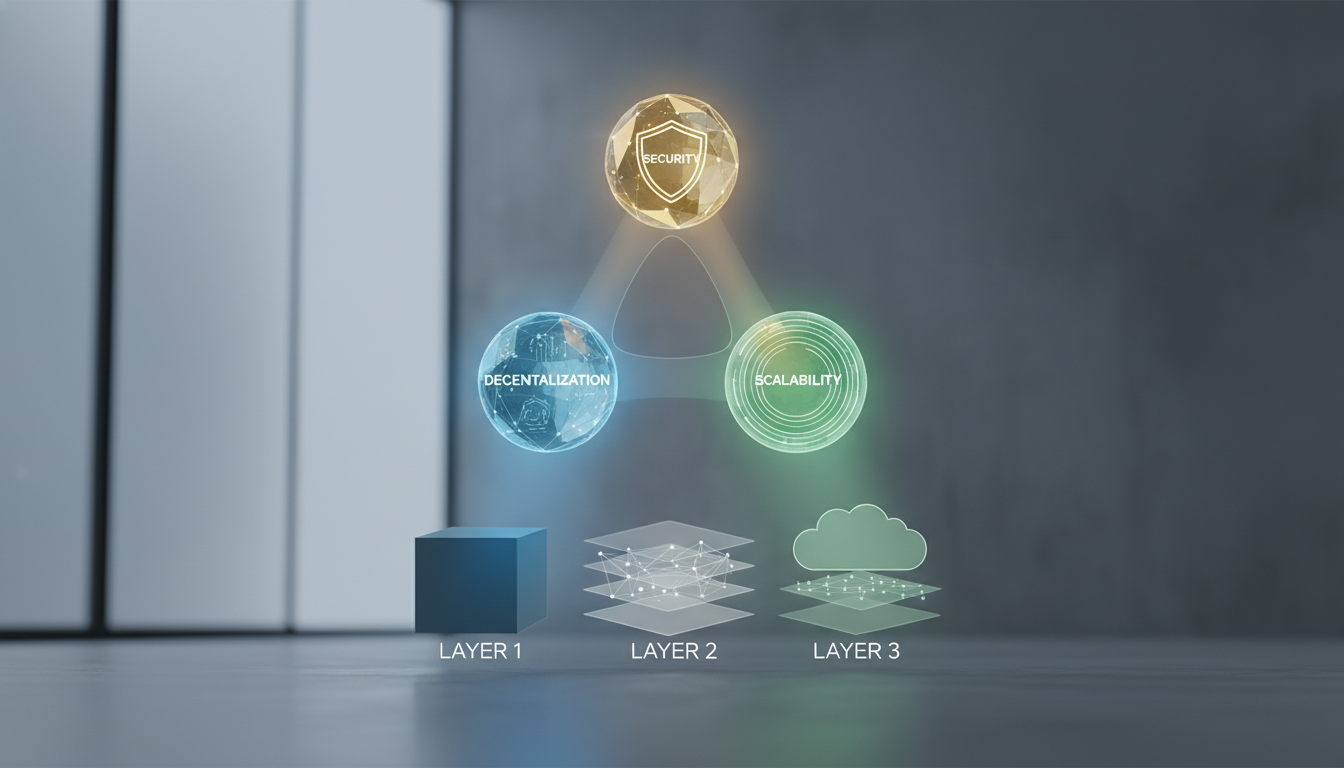
To appreciate why blockchain layers exist, you need to understand the blockchain trilemma, a concept often associated with Ethereum co-founder Vitalik Buterin. It states that a decentralized network can maximize at most two of three properties: security, decentralization, and scalability.
Bitcoin and Ethereum chose security and decentralization, leading to limited scalability. Newer chains like Solana optimize for scalability and security but have fewer validators, raising decentralization concerns. The trilemma is the fundamental engineering constraint that blockchain layers aim to solve.
Security, Decentralization, Scalability
- Security measures resistance to attacks and data corruption. A secure blockchain prevents double-spends and unauthorized changes.
- Decentralization means control is distributed among many nodes, reducing censorship risk and single points of failure.
- Scalability refers to the network’s ability to process a growing number of transactions quickly and cheaply.
In a single-layer system, increasing scalability often requires larger blocks or faster consensus, which can reduce decentralization because fewer nodes can handle the hardware demands. This trade-off is why blockchains originally hit a ceiling.
How Blockchain Layers Help Resolve the Trilemma
Blockchain layers allow a network to achieve high security and decentralization at the base layer while pushing scalability to upper layers. For instance, Ethereum’s Layer 1 remains highly decentralized with hundreds of thousands of validators, while Layer 2 rollups process thousands of transactions per second at a fraction of the cost. This separation ensures that the security guarantees of the base chain are inherited by the scaling layers.
Thus, the trilemma isn’t “solved” in the mathematical sense but mitigated through a division of labor. This is why blockchain layers have become the standard mental model for protocol design.
The Four Main Blockchain Layers
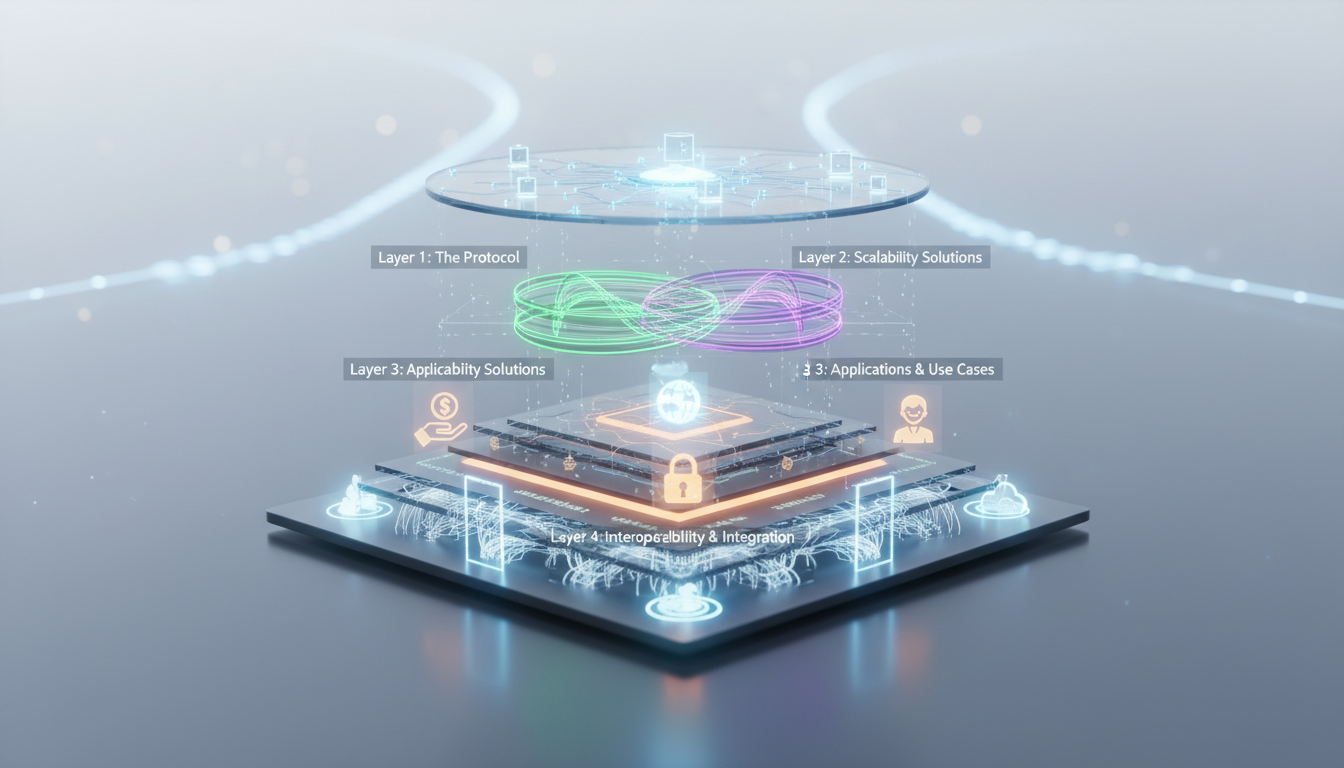
The most common framework divides the ecosystem into four distinct blockchain layers: Layer 0, Layer 1, Layer 2, and Layer 3. Each builds upon the one below it, adding functionality and addressing specific limitations. Understanding these blockchain layers is key to grasping how modern networks like Ethereum, Polkadot, and Cosmos operate.
Layer 0: The Interoperability and Network Layer
Layer 0 is the foundational infrastructure that allows multiple blockchain layers to exist side-by-side and communicate. It includes the physical internet, hardware nodes, and protocols that connect independent networks. Polkadot and Cosmos are prominent Layer 0 projects, they provide a shared security model and cross-chain messaging so that blockchain layers built on them can transfer assets and data seamlessly.
Without Layer 0, blockchain layers would operate in isolation. Interoperability is critical for a maturing digital economy, where users expect to move value across different networks just as they send emails between providers.
Layer 1: The Foundation Blockchain
Layer 1 is the base chain, the core ledger that records all transactions and provides consensus. Bitcoin, Ethereum, Cardano, and Solana are all Layer 1 networks. They maintain their own security, validator sets, and token economics. Transactions on Layer 1 are final and immutable, but the speed and cost can vary dramatically.
Bitcoin’s Layer 1 processes around 7 TPS, Ethereum handles approximately 15-30 TPS, while chains like Solana can reach thousands. However, higher throughput often comes at the cost of greater hardware requirements, which can reduce the number of validators and thus decentralization.
Layer 2: Scaling Solutions and Off-Chain Protocols
Layer 2 is built on top of Layer 1 and aims to increase throughput and lower fees without altering the base layer. It takes transaction execution off-chain and periodically settles batches on the main chain. This allows Layer 2 to inherit the security of Layer 1 while operating at much higher speed.
“Layer 2 solutions are crucial for the widespread adoption of cryptocurrencies, as they enable the high transaction volumes and reduce gas fees, both necessary for global platforms to function efficiently.” , FintechWeekly
Examples include the Lightning Network for Bitcoin, and rollup-based projects like Arbitrum and Optimism for Ethereum. These systems can reduce costs by over 90% and confirm transactions in seconds instead of minutes.
Layer 3: Decentralized Applications and User Interfaces
Layer 3 is the application layer, where end-users interact with blockchain technology. It hosts dApps, games, NFT marketplaces, and DeFi protocols. Developers build on top of Layer 1 or Layer 2 using smart contracts to create user-facing services. Popular Layer 3 dApps include Uniswap (DeFi), OpenSea (NFTs), and Aave (lending).
At this level, the complexity of blockchain layers is abstracted. Users don’t need to know whether they’re transacting on Layer 2 or Layer 1; they simply connect a wallet and use the app. This abstraction is essential for mainstream adoption, as it hides the technical intricacies behind a simple interface.
Inside a Single Blockchain: The Technical Five-Layer Stack

While the ecosystem view describes how blockchain layers interact, each individual blockchain also has its own internal layered structure. Researchers often break down a single blockchain into five technical layers: hardware, data, network, consensus, and application. This stack ensures that every node can securely store, transmit, and verify transaction data.
Hardware / Infrastructure Layer
This is the physical base. It includes the computers, servers, and storage devices that run nodes. For Bitcoin, it includes mining rigs; for Ethereum, validator nodes. Without this hardware layer, no transactions could be processed.
Data Layer
The data layer contains the actual blockchain, an ordered sequence of blocks linked by cryptographic hashes. Each block holds transaction details: sender, receiver, amount, and timestamps. Merkle trees and digital signatures ensure that data remains tamper-proof and verifiable.
Network Layer
This is the communication layer. Nodes connect in a peer-to-peer gossip protocol to share new transactions and blocks. The network layer ensures that every participant eventually receives the same data, maintaining a globally consistent state.
Consensus Layer
The consensus layer makes all nodes agree on which transactions are valid and in what order. Bitcoin uses Proof of Work (PoW), while Ethereum uses Proof of Stake (PoS). This layer provides the security guarantees of the entire system. Without consensus, the network would be vulnerable to attacks.
Application Layer (Internal)
On top of the technical stack sits a lightweight application layer. For early blockchains, this was limited to basic scripting. With the advent of smart contract platforms like Ethereum, this layer now hosts complex dApps, which themselves may be part of Layer 3 in the ecosystem view. Internally, the execution engine processes smart contract code and updates account states.
Understanding this internal structure clarifies how blockchain layers work at a technical level and why a layered approach is so effective for optimization.
Layer 2 Solutions Deep Dive: Rollups, Channels, and Sidechains
Layer 2 is where the most innovation is happening today. Different designs offer different trade-offs in speed, finality, and security. The three main categories are rollups (both optimistic and zero-knowledge), state channels, and sidechains.
| Technology | Throughput | Finality | Security Model | Example |
|---|---|---|---|---|
| Optimistic Rollups | ~2,000 TPS | ~7 days (fraud proof window) | Inherits L1 security via fraud proofs | Arbitrum, Optimism |
| ZK-Rollups | >4,000 TPS | Near-instant (validity proof) | Inherits L1 security via cryptographic proofs | zkSync, StarkNet |
| State Channels | Virtually unlimited | Instant (off-chain) | Requires participants; finalization on L1 if dispute | Lightning Network |
| Sidechains | Varies | Depends on sidechain consensus | Independent security; may have bridge risk | Polygon PoS, Gnosis |
Optimistic Rollups vs. Zero-Knowledge Rollups
Optimistic rollups assume transactions are valid and run a 7-day challenge period during which fraud proofs can be submitted. ZK-rollups bundle thousands of transactions into a single cryptographic proof that is instantly verified by the Layer 1 smart contract. ZK-rollups offer faster finality and higher throughput but are more complex to implement.
The Lightning Network and State Channels
State channels allow participants to transact directly off-chain by locking funds in a multisig contract. Only the opening and closing balances are recorded on Layer 1. Lightning Network is a network of payment channels for Bitcoin, enabling instant, low-cost payments. It can handle millions of microtransactions without bloating the main chain.
Sidechains: A Parallel Approach
Sidechains are separate blockchain layers that run in parallel to the main chain and have their own consensus. They’re connected via a two-way peg that allows assets to be moved. While they can scale effectively, they don’t inherit the security of the parent chain, so users must trust the sidechain’s validator set.
Tokenomics Across Blockchain Layers
Each layer often introduces its own token, which captures value from the services that layer provides. Understanding tokenomics across blockchain layers is essential for investors. Layer 1 tokens like ETH or SOL are used for transaction fees and staking. Layer 2 tokens like ARB or OP often govern protocol upgrades and fee distribution. Layer 0 tokens like DOT secure the relay chain and enable interoperability.
The interplay between these tokens creates a layered value-capture model. For example, as Ethereum’s Layer 2 ecosystem grows, demand for ETH as gas increases, while governance tokens of successful rollups may appreciate with network activity.
How Layer Tokens Gain Value
The value of a layer token typically comes from three sources: utility (paying fees), governance (voting rights), and staking (earning rewards). Layer 1 tokens are often required for every operation, giving them broad utility. Layer 2 tokens may earn fees from sequencers or provide a share of MEV (maximal extractable value) to holders. As the ecosystem matures, some blockchain layers embed mechanisms to share revenue with token holders, creating a direct link between usage and token price.
Staking, Governance, and Fee Sharing
Many modern protocols distribute a portion of transaction fees or inflation rewards to stakers. In Ethereum’s roadmap, after EIP-1559, a portion of gas fees is burned, which can have deflationary pressure on ETH. Layer 2 solutions like Arbitrum use their ARB token for protocol governance, allowing holders to vote on fee structures and treasury allocation. This governance layer adds a new dimension to how blockchain layers create economic incentives.
Real-World Adoption and Use Cases
Layered architecture isn’t theoretical; it’s being deployed at scale. Ethereum’s rollup-centric future is already here, with Layer 2 networks processing more transactions than the mainnet. Bitcoin’s Lightning Network is growing in node count and capacity. Meanwhile, Layer 0 projects like Polkadot have launched parachains that connect diverse applications.
Ethereum and Its L2 Ecosystem
As of early 2026, Ethereum Layer 2 rollups regularly process over 100 TPS combined, up from 10–15 on mainnet. Projects like Base (Coinbase’s rollup) and zkSync have attracted millions of users. The upcoming EIP-4844 upgrade, known as proto-danksharding, will further reduce rollup costs by introducing blob-carrying transactions, making Layer 2 even more efficient.
Bitcoin’s Lightning Network Growth
The Lightning Network continues expanding with thousands of nodes globally. Services like Strike and Cash App now integrate Lightning for instant, low-cost Bitcoin payments. While still a fraction of total Bitcoin activity, Lightning demonstrates how blockchain layers can make the world’s oldest cryptocurrency usable for everyday purchases.
Polkadot and Cosmos: Layer 0 Pioneers
Polkadot’s relay chain secures multiple parachains, each a purpose-built Layer 1. Cosmos’s Inter-Blockchain Communication (IBC) protocol connects dozens of blockchain layers. These Layer 0 ecosystems show that interoperability isn’t just a buzzword but functioning infrastructure, with billions of dollars in value transferring across chains monthly.
Choosing the Right Layer for Your Project
Developers and investors face decisions about which layer to build on or allocate capital to. The choice depends on security needs, target throughput, and the desired level of decentralization.
Factors for Developers
- Security requirement: If you need the highest security, build on a strong Layer 1 like Ethereum. If you can accept slightly less, a sidechain or a newer Layer 1 might be cheaper.
- Transaction cost and speed: For high-frequency applications (micropayments, gaming), Layer 2 or a high-throughput Layer 1 is essential.
- Interoperability: If your app must talk to multiple chains, a Layer 0 hub like Cosmos might be ideal.
What Investors Should Know
Investors should recognize that tokens from different blockchain layers carry different risk profiles. Layer 1 tokens are generally more established but may have slower growth. Layer 2 tokens can offer higher upside if the scaling solution gains adoption, but they often have complex governance and unproven longevity. Diversification across blockchain layers can be a prudent strategy.
Pros and Cons
Pros
- Solves the blockchain trilemma by separating security, decentralization, and scalability concerns
- Enables massive throughput improvements (1000x+ on Layer 2) while maintaining base layer security
- Creates modular architecture where each layer can be optimized independently
- Allows for specialized tokens and economic models at each layer
- Provides clear upgrade paths without disrupting existing infrastructure
Cons
- Adds complexity for developers who must understand multiple layers and their interactions
- Creates potential security risks at bridge points between layers
- Can fragment liquidity and user experience across multiple layers
- Introduces new attack vectors specific to each layer type (e.g., fraud proofs, validator sets)
- May create centralization risks if Layer 2 sequencers or Layer 0 validators become concentrated
The Future of Blockchain Layers
The layering model is still evolving. Upcoming innovations like data availability sampling (DAS) and sharding will blur the lines between blockchain layers, potentially collapsing some layers into a more unified but modular design. The goal remains the same: to build an internet-scale decentralized platform that can serve billions of users.
Trends: Proto-Danksharding and Beyond
Ethereum Improvement Proposal 4844 introduces a new transaction type for blobs, which Layer 2 rollups can use to post compressed data. This reduces costs dramatically while keeping the data available for a limited time. Long-term, full sharding could split the network into parallel chains, further scaling Layer 1 itself. Such advances will influence how blockchain layers are structured in the next five years.
The Path to Mass Adoption
For blockchain to achieve mainstream use, users must never need to think about layers. Just as internet users don’t worry about TCP/IP protocols, crypto users will interact with applications that seamlessly route transactions through the optimal layer. This vision depends on continued innovation in cross-layer communication and abstracted wallets.
Frequently Asked Questions
What is the difference between Layer 1 and Layer 2 blockchain?
Layer 1 is the main blockchain that processes and finalizes transactions natively, like Ethereum or Bitcoin. Layer 2 is a secondary framework built on top that handles transactions off-chain for speed, then settles on Layer 1.
How many blockchain layers are there?
There are typically four ecosystem layers (L0, L1, L2, L3) plus five internal technical layers inside each blockchain (hardware, data, network, consensus, application).
Why are blockchain layers necessary?
Blockchain layers solve the blockchain trilemma by allowing a network to be secure and decentralized at the base while scaling efficiently on upper layers.
What is a Layer 0 blockchain?
Layer 0 is the foundational infrastructure that enables multiple blockchain layers to interoperate. Examples include Polkadot and Cosmos, which provide shared security and cross-chain messaging.
Can blockchain layers be upgraded independently?
Yes. The modularity of blockchain layers means developers can upgrade the consensus mechanism on Layer 1 without disrupting Layer 2 applications, or deploy new rollup technology without changing the base layer.
Ready to build on the next generation of blockchain infrastructure? Apply to the Genesis Cohort at digitalblockchains.com and join the builders shaping the future of decentralized systems.