Key Takeaways
- Blockchain data analytics extracts actionable insights from public ledgers, enabling fraud detection and compliance monitoring.
- Leading platforms like Chainalysis and TRM Labs provide entity attribution, risk scoring, and cross‑chain tracing for enterprises and government agencies.
- The workflow involves data collection, normalization, enrichment, and applying heuristics or machine learning models.
- Challenges include data volume (Ethereum archive nodes exceed 21,000 GB), cross‑chain interoperability, and privacy concerns.
- AI‑powered tools are increasingly used for real‑time fraud prevention and behavioral pattern analysis.
- Regulators worldwide rely on these analytics for anti‑money laundering (AML) and counter‑terrorism financing (CTF) enforcement.
Blockchain data analytics is the systematic examination of on‑chain data to extract insights, trace transactions, and identify behavioral patterns across distributed ledgers.
What Is Blockchain Data Analytics?

data analytics transforms raw transaction records into actionable intelligence for compliance, investigations, and strategic decision‑making. Every transaction, address balance, and smart contract interaction is publicly visible, yet making sense of this vast, pseudonymous data requires specialized tools. The discipline combines data science, graph theory, and financial forensics to map fund flows, cluster related wallets, and reveal real‑world entities behind on‑chain activity.
A Definition from the Field
“Blockchain analytics is the process of examining, clustering, attributing, modeling, and visually mapping data on public distributed ledgers.”
This definition highlights the three pillars: examination of raw transactions, clustering of addresses into controlled groups, and attribution to known services or malicious actors.
Why Blockchain Data is Different
Unlike traditional databases, blockchain data is decentralized, immutable, and timestamped. It lacks a central administrator, so all participants share an identical ledger. This structure gives analysts an unforgeable trail of every asset movement, but also creates challenges: the data volume is enormous, and it spans thousands of independent chains with different formats.
How Blockchain Data Analytics Works: Core Processes
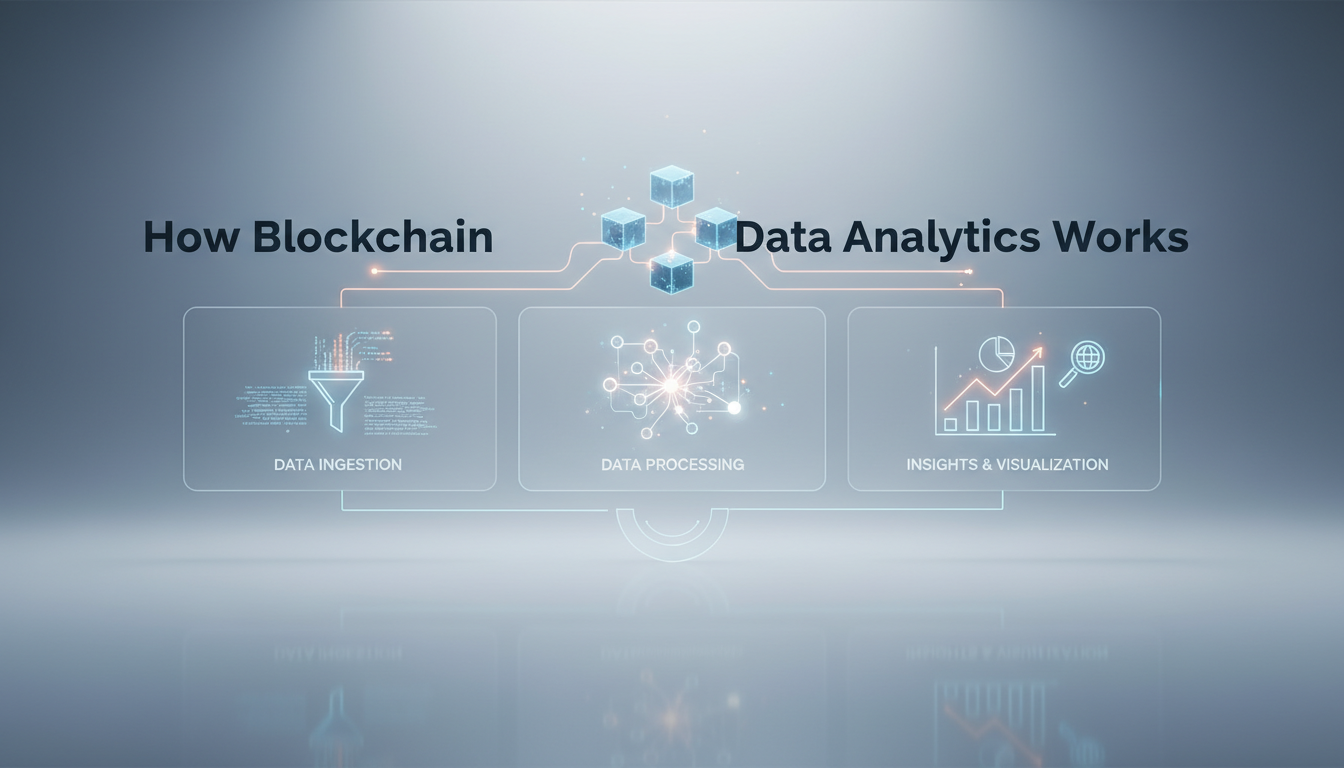
A typical these analytics pipeline follows five sequential steps, from raw ingestion to actionable alert.
- Collect on‑chain data , Transactions, addresses, timestamps, and amounts are pulled directly from blockchain nodes or public APIs.
- Parse and normalize , Data from different chains is converted into a unified schema, reconciling differences in block structures and token standards.
- Enrich with labels and metadata , Known exchange wallets, darknet marketplaces, sanctioned addresses, and other contextual tags are overlaid on the transaction graph.
- Apply heuristics and models , Rules‑based clustering (e.g., common‑input ownership) and machine learning algorithms identify patterns, anomalies, and risks.
- Visualize and alert , Tools display interactive graphs of fund flows and trigger alerts when a transaction touches a high‑risk entity.
UTXO vs Account-Based Clustering Algorithms
Clustering techniques vary dramatically between blockchain architectures. For UTXO‑based chains like Bitcoin, the common‑input heuristic assumes that addresses used together in a single transaction are controlled by the same owner. This creates high‑confidence clusters but can produce false positives when exchanges batch withdrawals.
Ethereum and account‑based chains rely more on behavioral analysis , such as funding patterns, gas price preferences, or repeated interactions with specific dApps , to group addresses. These methods require more sophisticated machine learning but can capture subtle ownership patterns that UTXO heuristics miss.
Risk Scoring and Typologies
Once clusters are formed, risk frameworks assign scores based on proximity to illicit activity. Signal sources include direct interactions with sanctioned entities, use of mixing services, or transaction patterns characteristic of ransomware payments. These scores help compliance teams prioritize investigations and automate blocking of suspicious transfers.
Key Tools and Platforms for Blockchain Data Analytics

The ecosystem of such analytics tools has grown rapidly to serve different needs, from free public explorers to enterprise‑grade intelligence suites. The table below compares the main categories.
| Category | Example Platforms | Core Capabilities | Primary Users | Strengths | Limitations |
|---|---|---|---|---|---|
| Block Explorers | Etherscan, Blockchain.com | Transaction search, address tagging, basic metrics | General public, developers | Free, easy to use | No clustering or risk scoring |
| On‑chain Data Providers | Dune Analytics, Nansen | Custom dashboards, labeled wallets, DeFi metrics | Analysts, traders, researchers | Extensive datasets, flexible querying | Require SQL knowledge, subscription fees |
| Compliance & Investigation | Chainalysis Reactor, TRM Labs | Entity attribution, cross‑chain tracing, legal‑grade evidence | Law enforcement, exchanges, banks | High‑accuracy labels, court‑admissible data | Costly, complex deployment |
| Market Intelligence | CoinMetrics, Glassnode | On‑chain indicators, network health, market data | Fund managers, macro researchers | Real‑time feeds, broad coverage | Limited entity attribution |
“Nine of the top ten crypto exchanges use Chainalysis, and law enforcement agencies have frozen or recovered $34 billion in illicit funds using our data.”
Free vs. Paid Tools
Basic explorers like Etherscan offer immense value at zero cost, making them the first stop for many investigators. However, as investigations scale, paid platforms provide indispensable automation: clustering heuristics handle hundreds of algorithms simultaneously, and machine learning models surface risks in real time. The choice depends on the user’s needs , hobbyist security research versus institutional compliance.
Industry Use Cases for Blockchain Analytics

While blockchain data originated in law enforcement, its applications now span multiple sectors.
Financial Institutions and Crypto Exchanges
Banks and exchanges use these tools to comply with anti‑money laundering (AML) regulations. Real‑time transaction screening flags deposits from high‑risk sources, and compliance teams audit suspicious accounts. According to a 2024 industry survey cited by IBM, the integration of blockchain and big data is projected to save financial institutions hundreds of millions in fraud losses each year.
Law Enforcement and National Security
Agencies use data analytics to trace ransom payments, dismantle darknet markets, and disrupt terrorist financing. Chainalysis has assisted in freezing $34 billion worth of illicit cryptocurrency, and over 45 regulators worldwide now rely on its intelligence to build cases. The immutable ledger provides a powerful evidentiary trail that courts increasingly accept.
Decentralized Finance (DeFi) and Web3
DeFi protocols employ these analytics to monitor protocol health, detect flash loan attacks, and assess governance risks. Nansen’s smart money dashboards track whale movements, while on‑chain metrics help investors gauge network growth. As tokenized real‑world assets cross $30 billion in value, analytics tools are essential for institutional due diligence.
AI and Machine Learning in Blockchain Data Analytics
Artificial intelligence is rapidly reshaping blockchain data analytics, enabling proactive threat detection and pattern recognition at a scale impossible for human analysts.
Fraud Prevention with AI
AI‑powered systems like Chainalysis’ Alterya analyze transaction behavior to identify scams before they succeed. By learning from past attack vectors , phishing, rug pulls, and Ponzi schemes , these models flag suspicious addresses in real time, reducing payments‑related fraud for consumer brands and exchanges.
Pattern Recognition and Predictive Analytics
Machine learning algorithms excel at sifting through billions of transactions to find subtle correlations. For example, clustering algorithms can detect coordinated wash trading or market manipulation across multiple decentralized exchanges. Predictive models also help forecast network congestion, allowing protocols to adjust fees dynamically.
Automating Entity Attribution
Attribution, traditionally relying on manual open‑source research, is being accelerated by natural‑language processing (NLP) and graph neural networks. These techniques cross‑reference on‑chain behavior with off‑chain data , such as social media or darknet forum posts , to link addresses to real‑world identities more quickly and accurately.
Challenges in Blockchain Data Analytics
Despite its promise, blockchain data analytics faces several persistent hurdles.
Data Volume and Scalability
As of March 2025, synchronizing an Ethereum archive node requires approximately 21,358 GB of storage, and Solana’s ledger had already exceeded 150 TB by early 2024 (arXiv). Handling data at this scale demands robust infrastructure and efficient indexing, which many organizations struggle to maintain.
Accuracy and False Positives
Mislabeled addresses can lead compliance teams to freeze legitimate funds, causing customer harm. Even the best clustering heuristics are probabilistic; a shared deposit address does not always mean common control. Continual refinement of models and human review remain essential to keep error rates low.
Cross‑Chain Interoperability
Blockchains are siloed by design. Analysts must reconcile different address formats, consensus mechanisms, and token standards when tracking funds that move through bridges, DEX swaps, or mixers. Achieving comprehensive coverage without missing links requires platforms that can onboard new chains and automatically parse new token types.
Privacy and Ethical Concerns
Blockchain’s transparency is a double‑edged sword. While it enables forensic tracing, it also exposes users’ financial histories. Striking the right balance between investigative power and individual privacy is an ongoing legal and ethical debate, particularly in jurisdictions with strict data protection laws like the GDPR.
Regulatory and Compliance Considerations
Regulators worldwide are embedding blockchain data analytics into their oversight frameworks.
The FATF Travel Rule
The Financial Action Task Force (FATF) requires virtual asset service providers (VASPs) to share originator and beneficiary information for transactions above certain thresholds. Analytics tools help VASPs identify which counterparties are compliant VASPs and flag transactions that lack required data, ensuring global travel rule adherence.
AML Directives and Court Admissibility
In the EU, the 5th and forthcoming 6th Anti‑Money Laundering Directives explicitly cover crypto‑assets, mandating transaction monitoring and suspicious activity reporting. Chainalysis data has been successfully admitted as evidence in numerous high‑profile cases, setting a precedent that validated blockchain data analytics in legal proceedings.
Tax Agencies and Market Surveillance
Tax authorities use these analytics to reconcile crypto‑asset holdings with reported capital gains. The IRS, for instance, has contracted with blockchain intelligence firms to identify unreported transactions and enforce compliance. Similarly, securities regulators monitor on‑chain trading patterns to detect market manipulation.
Pros and Cons
Pros
- Immutable audit trail , Blockchain records cannot be altered, providing investigators with unforgeable evidence of fund flows and transaction history.
- Real-time monitoring , Advanced platforms can flag suspicious transactions as they occur, enabling proactive fraud prevention and compliance screening.
- Global coverage , Public blockchains operate 24/7 across all jurisdictions, giving analysts unprecedented visibility into cross-border financial activity.
- Cost-effective compliance , Automated risk scoring and clustering reduce manual investigation time, helping institutions meet regulatory requirements efficiently.
Cons
- Privacy concerns , Comprehensive transaction tracking can expose users’ financial behavior and spending patterns, raising ethical questions about surveillance.
- False positive rates , Clustering algorithms and risk models can incorrectly flag legitimate transactions, potentially freezing innocent users’ funds.
- Technical complexity , Effective blockchain data analytics requires specialized knowledge of cryptography, graph theory, and multiple blockchain architectures.
- High infrastructure costs , Running full archive nodes and processing terabytes of data demands significant computing resources and storage capacity.
The Future of Blockchain Data Analytics
Several trends will define the next evolution of blockchain data analytics.
Real‑Time and Streaming Analytics
As blockchain applications grow in speed (e.g., high‑throughput L2s), the demand for sub‑second alerting will push tools toward streaming architectures. Expect integration with Apache Kafka and similar frameworks to process transactions as they occur, rather than in batch.
Cross‑Chain Intelligence Graphs
Future platforms will unify data from dozens of blockchains into a single graph, enabling true end‑to‑end tracing. Innovations in zero‑knowledge proofs and decentralized oracles may allow privacy‑preserving cross‑chain analytics, where only risk scores are shared without exposing underlying data.
Broader Enterprise Adoption
With tokenized assets surpassing $30 billion, traditional financial institutions are increasingly entering the space. This will drive demand for analytics that bridge on‑chain data with conventional KYC and CRM systems, creating a unified risk view across digital and fiat operations.
Democratization Through Open‑Source Tools
Community‑driven projects are lowering the barrier to entry. Open‑source libraries for graph analysis are making blockchain data analytics accessible to smaller teams and academic researchers, expanding the ecosystem beyond enterprise vendors.
Ready to build the next generation of blockchain infrastructure? Apply to the Genesis Cohort at digitalblockchains.com and work with our team of protocol architects and tokenomics specialists.
Frequently Asked Questions
What is a blockchain data analyst?
A blockchain data analyst examines on‑chain transactions, clusters addresses, and attributes entities using specialized tools. They combine data science and financial forensics to detect fraud, trace fund flows, and support compliance investigations.
What are the 4 types of blockchain?
The four main types are public (permissionless, e.g., Ethereum), private (permissioned, e.g., Hyperledger), consortium (governed by a group), and hybrid (combining public and private elements). Most analytics focus on public blockchains due to their open data availability.
Is blockchain a high paying job?
Yes. Blockchain‑related roles, including data analysts, consistently rank among the highest‑paid tech positions. Demand continues to outpace supply, and specialized skills in blockchain data analytics command premium salaries.
Can I learn blockchain data analytics for free?
Yes. Block explorers like Etherscan offer free transaction lookup, and platforms like Dune Analytics allow anyone to query public data with SQL. Many universities and online courses also offer introductory materials on blockchain analysis at no cost.
What tools do blockchain analysts use?
Common tools include block explorers (Etherscan), on‑chain data dashboards (Dune, Nansen), compliance platforms (Chainalysis, TRM Labs), and market intelligence providers (CoinMetrics, Glassnode). The choice depends on the use case and budget.