Blockchain programming language is a specialized coding toolset designed to build smart contracts, decentralized applications, and blockchain infrastructure with deterministic execution guarantees.
Key Takeaways
- Solidity dominates EVM development with extensive tooling and the largest developer community
- Rust enables high-performance chains like Solana through memory safety and zero-cost abstractions
- Move introduces resource-oriented programming that prevents entire classes of DeFi vulnerabilities
- Language choice depends on target ecosystem, security requirements, and performance needs
- A structured 10-month roadmap can take you from beginner to job-ready blockchain developer
- Security considerations vary by language but require universal practices like auditing and static analysis
For anyone building in Web3, selecting the right programming language isn’t just technical, it determines your project’s security posture, scalability ceiling, and available talent pool. This analysis breaks down the most critical languages in 2026, their trade-offs, and how to match them to your specific goals.
What Is a Blockchain Programming Language?

A these language is any formal language that enables developers to write software for decentralized ledgers. Unlike general-purpose languages, these are optimized for deterministic execution, gas metering, and formal verification, requirements that traditional computing environments rarely enforce.
Smart Contracts vs. Core Blockchain Development
Blockchain development splits into two distinct domains: smart contract programming (on-chain logic) and core blockchain development (underlying protocol, consensus, and networking). A smart contract language like Solidity runs inside a virtual machine with gas cost constraints and storage layout restrictions. Core protocol languages like C++ or Rust compile directly to native code powering the node software itself.
“Solidity’s flexibility can lead to common vulnerabilities if not carefully handled, requiring meticulous auditing and best-practice adherence.”
Protocol-layer developers need systems-level languages with manual memory management and fine-grained concurrency control.
Key Characteristics of Blockchain Languages
- Determinism: Identical input must produce identical output across all nodes. Non-deterministic functions like random system calls are forbidden.
- Resource Accountability: Most chains meter execution via gas models, requiring the language to account for every opcode and storage access.
- Immutability Awareness: Deployed smart contracts cannot be easily patched, forcing security-first design and robust static analysis tooling.
- Ecosystem Integration: Mature such languages ship with wallet SDKs, testing frameworks, and blockchain-specific libraries like OpenZeppelin.
The Top Blockchain Programming Languages in 2026
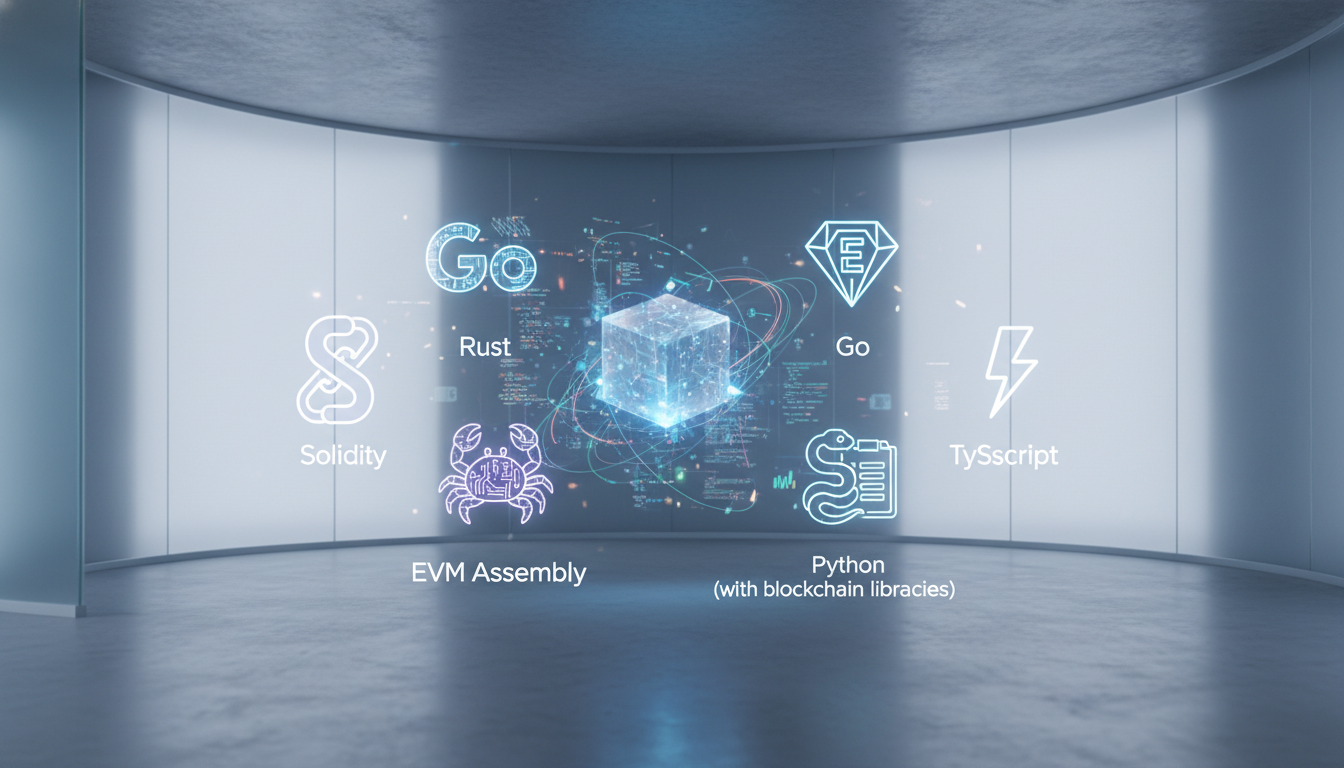
Based on developer activity, GitHub stars, and job market data, these languages form the backbone of Web3 development. The table below summarizes their primary niches before we examine each one.
| Language | Primary Use Case | Key Strengths | Notable Blockchains |
|---|---|---|---|
| Solidity | EVM smart contracts, DeFi, NFTs | Largest community, extensive library ecosystem | Ethereum, BSC, Polygon, Avalanche |
| Rust | High-performance chains, security-critical contracts | Memory safety, zero-cost abstractions, strong type system | Solana, Polkadot, NEAR |
| Go | Core blockchain clients, infrastructure, cross-chain | Easy concurrency, fast compilation, rich standard library | Cosmos, Hyperledger Fabric, Terra |
| Move | Resource-oriented DeFi, digital assets | Linear logic, safe asset handling, expressiveness | Aptos, Sui |
| C++ | Reference clients (Bitcoin Core), low-level optimizations | Direct hardware control, deterministic RAII patterns | Bitcoin, EOS, Ripple |
| JavaScript | dApp frontends, light-weight smart contracts | Ubiquity, asynchronous programming, rich Web3 libraries | Lisk, off-chain tooling across all chains |
Solidity
Solidity remains the dominant blockchain programming for the Ethereum Virtual Machine. With the majority of DeFi total value locked residing in Solidity-based protocols, it serves as the entry point for most developers. The language borrows syntax from JavaScript and C++, making it accessible, while libraries like OpenZeppelin provide battle-tested implementations of tokens and governance logic.
The downside is that Solidity’s flexibility opens doors to reentrancy attacks, storage collisions, and arithmetic overflows unless developers rigorously use static analyzers like Slither and perform independent security audits.
Rust
Rust has emerged as the preferred programming language for performance-focused chains. Its ownership model eliminates data races and null-pointer dereferences at compile time, directly reducing the attack surface of a chain’s runtime. Solana uses Rust for its native programs, and the Polkadot ecosystem relies heavily on Rust-based Substrate.
Learning Rust presents challenges due to concepts like borrowing and lifetimes, but frameworks like Anchor for Solana are lowering barriers by providing Solidity-like abstractions.
Go
Go typically powers blockchain client backends rather than on-chain smart contracts. Go’s goroutines and channels simplify concurrent networking code, which explains why Cosmos SDK and Hyperledger Fabric are built with it. For developers coming from Java or C++, Go’s syntax feels familiar, and its compilation speed keeps iteration cycles short.
“The global blockchain technology market is projected to reach USD 1,879.30 billion by 2034, making it more important than ever to choose a these language with a sustainable talent pipeline.”
Move
Move is a newer such language that treats digital assets as first-class citizens. Instead of integer-based balances that can be accidentally duplicated, Move’s “resource” type enforces linear logic, an asset cannot be copied or implicitly dropped, only moved between storage locations. This design drastically reduces whole classes of bugs in DeFi applications and has been adopted by Aptos and Sui.
C++
Bitcoin Core, the reference implementation of Bitcoin, is written in C++. Its deterministic RAII (Resource Acquisition Is Initialization) patterns and fine memory control enable developers to maximize efficiency in consensus algorithms. C++ also powers EOS and Ripple, making it essential for layer-1 protocol design.
JavaScript
Although rarely used for on-chain logic in major layer-1s, JavaScript dominates blockchain frontend development. Libraries like ethers.js, web3.js, and wagmi enable any browser to interact with blockchains. While chains like Lisk experimented with JavaScript smart contracts, in practice, JavaScript bridges the gap between users and contracts.
How to Select the Best Blockchain Programming Language
The optimal blockchain programming depends entirely on your project goals. A DeFi protocol targeting the Ethereum ecosystem will almost certainly choose Solidity, while a high-frequency gaming engine will lean toward Rust.
Key Evaluation Factors
- Target Ecosystem: Does the language compile to your chosen blockchain’s virtual machine? EVM chains work with Solidity or Vyper, whereas Substrate-based chains need Rust.
- Security Posture: Languages with strong type systems and built-in verification tools help minimize exploits. Rust’s ownership model and Move’s resource logic exemplify security-by-design.
- Developer Tools: A language without mature compilers, debuggers, and testing suites will cost months. Solidity’s Hardhat and Rust’s Anchor shorten development cycles significantly.
- Performance Requirements: Applications processing thousands of transactions per second may require compiled languages like Rust or Go to maintain low latency.
- Community & Talent: Check GitHub activity, Stack Overflow discussions, and job postings. Large communities mean better support and larger hiring pools.
Matching Language to Project Type
DeFi projects building on Ethereum or L2s overwhelmingly choose Solidity for composability with existing protocols. NFT and gaming platforms requiring high throughput often select Rust (Solana) or Move (Aptos). Enterprise consortia building permissioned ledgers frequently adopt Go for easy cloud infrastructure integration. Any project interacting with Bitcoin at the protocol level requires C++ proficiency.
A Step-by-Step Roadmap to Learn Blockchain Development

Becoming a blockchain developer doesn’t require a computer science degree. A structured roadmap can take you from zero to job-ready in roughly 10 months with dedicated practice.
Phase 1: Foundational Skills (Months 1-3)
Start with JavaScript or Python to grasp variables, loops, and functions. Then study data structures (arrays, maps, linked lists) and internet fundamentals (HTTP, DNS). Finally, learn version control with Git and establish a daily coding habit.
Phase 2: Smart Contract Development (Months 4-6)
Choose a programming language, for most, that means Solidity. Use Remix IDE for your first “Hello World” contract, then move to Hardhat for local testing. Study common vulnerabilities (reentrancy, front-running) and implement standard token contracts (ERC-20, ERC-721). Build a simple frontend with React and ethers.js to complete the stack.
Phase 3: Advanced Topics and Real Projects (Months 7-10)
Explore DeFi protocols like Uniswap V2 or Aave and attempt to fork and extend them. Learn gas optimization, upgradeable contracts, and formal verification tools. Contribute to open-source projects and join hackathons like ETHGlobal to build your portfolio.
Security Considerations in Blockchain Programming
Smart contract exploits have drained billions from DeFi protocols, making security the most critical skill for any blockchain developer. Every blockchain programming language has specific pitfalls, but some principles are universal.
Common Smart Contract Vulnerabilities
- Reentrancy: External calls allow attackers to call back into contracts before initial execution completes, enabling fund drainage.
- Integer Overflows/Underflows: Arithmetic operations exceeding variable limits wrap around, causing logical errors. Solidity 0.8+ includes built-in overflow checks.
- Access Control Flaws: Unprotected privileged functions (mint, withdraw) allow unauthorized asset theft.
- Front-running: Public mempools let attackers observe profitable transactions and submit competing ones with higher gas prices.
Auditing and Security Tools
Every serious project should undergo third-party audits by firms like Trail of Bits or ConsenSys Diligence. For daily development, employ static analyzers, Slither for Solidity, MythX for broad analysis, and Rust’s built-in linters. Fuzz testing with tools like Foundry uncovers edge cases that manual review misses.
The Future of Blockchain Programming Languages
The blockchain programming language landscape continues evolving rapidly. As the technology matures, new languages and paradigms emerge to address current limitations.
Emerging Languages and Trends
One trend is the rise of domain-specific languages (DSLs) that compile to multiple backends. Noir, for example, is a zero-knowledge proof DSL targeting Ethereum, Aztec, and other chains. Another trend is proof-carrying code, where compilers generate mathematical proofs that code obeys safety properties, potentially reducing manual audit needs.
In the EVM ecosystem, Fe, developed by the Ethereum Foundation, aims to be a safer Solidity alternative by incorporating lessons from Rust and Move. Meanwhile, Move-based chains prove that asset-centric design prevents entire vulnerability categories, influencing future language design.
The Role of AI in Blockchain Development
AI coding assistants like GitHub Copilot now integrate with popular blockchain programming languages. While they cannot replace solid understanding of blockchain-specific pitfalls, they accelerate boilerplate generation and suggest gas optimizations beginners might miss. In 2026, AI-assisted formal verification is becoming standard in development pipelines.
Real-World Examples of Blockchain Programming
The best way to understand a blockchain programming language’s impact is examining what developers have built with it.
DeFi Protocols Built with Solidity
Uniswap, the largest decentralized exchange by volume, is written entirely in Solidity. Its V4 release uses Solidity’s hooks pattern to enable custom logic within liquidity pools. Aave, a lending protocol with billions in total value locked, relies on Solidity’s inheritance model for modular, upgradeable contracts.
High-Performance Chains Built with Rust
Solana regularly processes thousands of transactions per second thanks to its Rust-based runtime and Sealevel parallel execution engine. Polkadot’s relay chain, also written in Rust, coordinates hundreds of interconnected parachains, each using its own blockchain programming language but compiling to WebAssembly.
Pros and Cons
Pros
- Specialized blockchain programming languages provide built-in security features and gas optimization
- Large developer communities offer extensive learning resources and job opportunities
- Mature tooling ecosystems accelerate development and testing cycles
- Cross-chain compatibility enables code reuse across multiple blockchain networks
Cons
- Steep learning curves require significant time investment to master security best practices
- Rapidly evolving landscape makes skills obsolete quickly without continuous learning
- Limited transferability to traditional software development compared to general-purpose languages
- High-stakes environment where coding errors can result in permanent financial losses
Frequently Asked Questions
What is the best blockchain programming language for beginners?
Solidity is the best blockchain programming language for beginners due to its huge learning community, browser-based IDEs like Remix, and abundance of free tutorials. Its JavaScript-like syntax makes it approachable even without prior programming experience.
Is Solidity the only language for Ethereum development?
No, Ethereum also supports Vyper (a Python-like language with enhanced security) and Fe (under development by the Ethereum Foundation). However, Solidity accounts for the vast majority of deployed contracts and developer tools.
Can I use Python for blockchain programming?
Python is rarely used for on-chain smart contracts due to non-deterministic behavior and execution metering difficulties. However, it’s widely used for off-chain scripting, blockchain data analysis, and building testing frameworks with tools like Brownie and Web3.py.
How long does it take to learn a blockchain programming language?
With dedicated practice, 3 to 5 hours per day, you can become proficient in a blockchain programming language like Solidity in about 4 to 6 months. Building a complete project, including frontend integration, may take another 2 to 4 months.
Do I need multiple languages to be a blockchain developer?
Not initially, but professional blockchain developers typically learn at least two: one for smart contracts (Solidity or Rust) and JavaScript for building frontends that interact with those contracts. Knowledge of Go or C++ is valuable for protocol-level work.
Which blockchain programming language pays the most?
According to industry data, the median salary for blockchain developers is $136,000. However, roles requiring Rust or C++ expertise often command premiums because the talent pool is smaller and the work involves performance-critical infrastructure.
Conclusion
The blockchain programming language you choose shapes your project’s security, scalability, and future potential. Solidity offers the widest ecosystem for EVM-based DeFi, while Rust and Move provide safety and speed for next-generation chains. Combining JavaScript for frontends and Python for off-chain tooling enables complete, production-ready dApps.
Start with the roadmap outlined here, focus on one language initially, and build real projects to demonstrate your skills. As the blockchain industry expands toward a projected $1.8 trillion market, developers who master the right blockchain programming language will be in high demand.
Ready to start building? Apply to the Genesis Cohort at digitalblockchains.com and join the next generation of blockchain developers.