- Key Takeaways
- Blockchain payment processing moves funds directly between parties on a decentralized network, removing banks and card networks from the transaction flow.
- Settlements that once took days can now complete in seconds on certain blockchains, with Ethereum confirming transactions in about 12 seconds.
- Stablecoins – cryptocurrencies pegged to fiat currencies – now exceed $300 billion in market capitalization, making them the dominant instrument for blockchain-based payments.
- Juniper Research projects blockchain cross-border settlement cost savings to grow from $301 million in 2021 to $10 billion by 2030.
- Major processors like Visa and Stripe are integrating stablecoin settlement rails, while JPMorgan’s Onyx and Ripple offer enterprise-focused blockchain payment networks.
What Is Blockchain Payment Processing?

Blockchain payment processing is a direct value transfer system using distributed ledgers to eliminate traditional intermediaries like banks or card networks. This architecture reduces costs, accelerates settlement, and increases transparency for digital transactions.
Defining Blockchain Payments
Blockchain payment processing uses distributed ledger technology to facilitate financial transactions without traditional intermediaries. Unlike conventional systems that route payments through multiple banks, a blockchain-based system records each transaction on a shared, tamper-proof ledger maintained by a network of nodes. According to American Express, the technology “will support real-time domestic and cross-border payments at lower costs versus traditional services.”
A blockchain is a chain of data blocks, each containing a set of payments, cryptographically linked to the previous block. A node is any computer running the blockchain software that verifies transactions. Smart contracts are self-executing code that automates payment conditions – for example, releasing funds only when a shipment is delivered.
The Mechanics Behind Blockchain Payment Processing
Two keys govern every transaction: a public key, which works like an account number to receive funds, and a private key, the secret code that authorizes spending. Users store these keys in a cryptocurrency wallet – a software application or hardware device. When a payment is initiated, the wallet signs the transaction with the private key, producing a digital signature that proves ownership without revealing the key itself.
How Blockchain Payment Processing Works: Step by Step
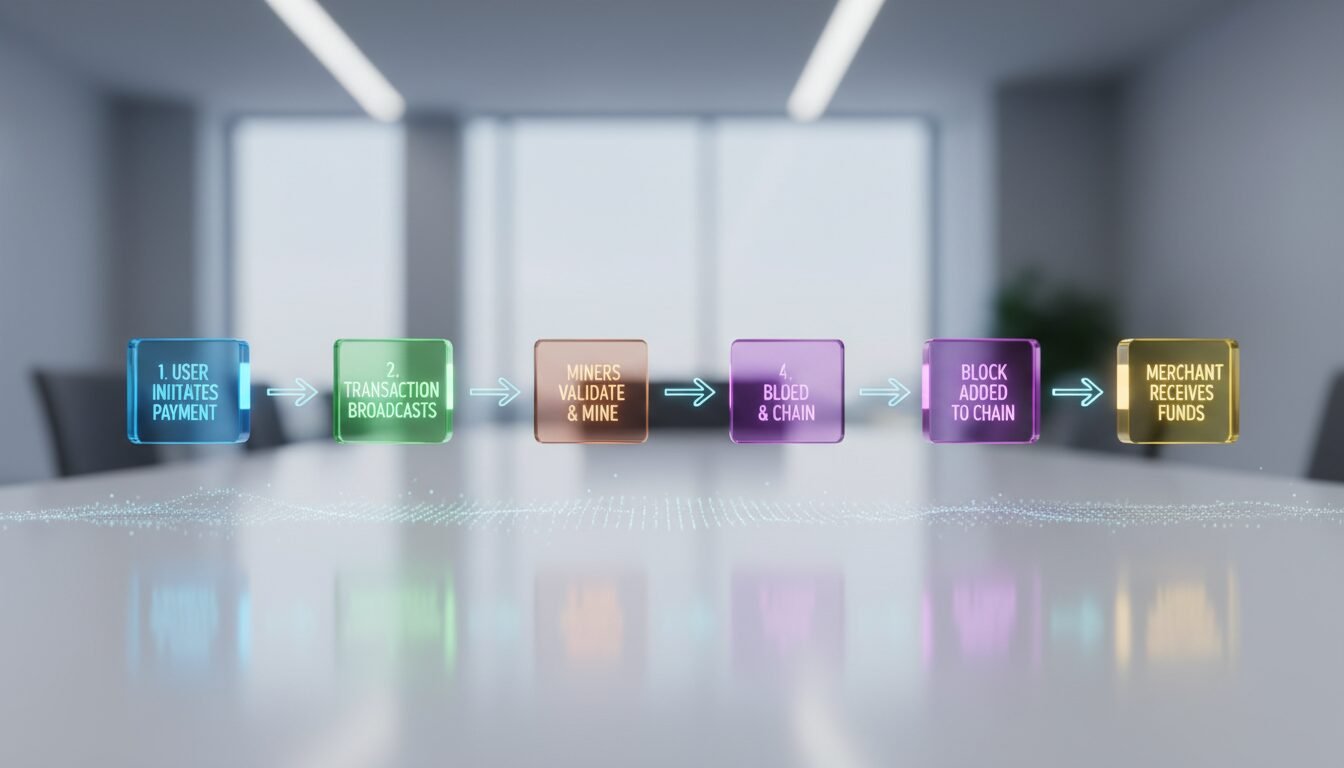
Blockchain payment processing operates through a shared public ledger distributed across a network of computers. When the network approves a transaction, it gets added to the ledger in a block, creating an immutable chain that prevents double spending.
Step 1 – Initiate the Transaction
Payments on blockchain networks require two sets of keys: a public key and a private key. The public key functions like a bank account number, showing the location of funds on the network. The private key acts as the password allowing you to spend those funds. You manage funds through a cryptocurrency wallet – either software-based mobile apps, browser plug-ins, or physical hardware devices. When setting up your wallet, you’ll receive a private key as a recovery phrase (12 or 24 words). Store this phrase offline securely – losing it means losing access to your funds. To send a payment, log into your wallet, locate the Send function, enter the recipient’s public key, choose the amount, and approve the transaction.
Step 2 – Verification by Network Nodes
Nodes are individual computers running blockchain software that witness and verify transactions. Once initiated, your transaction broadcasts to network nodes, which check if you have sufficient funds. If validated, the transaction enters the mempool (the queue of transactions awaiting confirmation) until a validator or miner selects it for inclusion in a block.
Step 3 – Inclusion in a Block and Final Settlement
Validators (in proof-of-stake networks) or miners (in proof-of-work networks) group pending transactions into a block, reach consensus on validity, and append it to the chain. Once added, the transaction is confirmed. Blockchain finality varies by network: Ethereum achieves finality within roughly one epoch (about 6.4 minutes), though individual block times are around 12 seconds. Faster networks like Solana can achieve practical finality in under a second. After finality, the recipient’s wallet balance updates and funds become available.
The Speed Advantage of Decentralized Transactions

Near-Instant Settlements
Traditional wire transfers, especially cross-border ones, often require 2–5 business days due to intermediary bank processing, time-zone differences, and operating-hours constraints. Blockchain payment processing settles in seconds to minutes, depending on the network. Ethereum’s average block time is about 12 seconds, while newer chains achieve sub-second finality. This speed is possible because blockchain networks operate 24/7/365 with no reliance on correspondent banks or automated clearing houses.
Why Speed Matters for Businesses
For businesses, faster settlement means improved cash flow and reduced counterparty risk. A marketplace can pay sellers immediately upon delivery confirmation, rather than waiting days for batch settlement. According to ScienceSoft, blockchain payment systems handle confirmation and processing in seconds rather than days. This immediacy enables new business models like streaming payments – per-second payouts for freelancers or content creators – that are impractical with legacy rails.
Cost Savings Through Decentralization

Eliminating Intermediary Charges
Traditional international payments involve a chain of banks, each taking a fee. The World Bank estimates that the global average cost of sending a $200 remittance exceeds 6% through traditional channels. Blockchain payment processing slashes these costs by removing intermediaries: payments move directly from sender to recipient, with only a network fee that can be a fraction of a cent. ScienceSoft reports that blockchain-based solutions reduce cross-border remittance costs by up to 80%.
Real-World Cost Reduction Statistics
The financial impact is substantial. Juniper Research estimates that blockchain use for cross-border settlements will help banks achieve significant cost savings: from $301 million in 2021 to $10 billion by 2030. Global blockchain market revenue reached $20.16 billion in 2024 and is projected to hit $393.42 billion by 2032, growing at a 43.65% compound annual rate. Payments accounted for 44% of global blockchain revenue in 2022, underscoring the sector’s importance.
Stablecoins: The Backbone of Cross-Border Payments
What Are Stablecoins?
Stablecoins are digital currencies pegged to stable assets, typically the U.S. dollar. The three main types are fiat-collateralized (backed 1:1 by bank reserves), crypto-collateralized (backed by other digital assets), and algorithmic (relying on smart contracts to manage supply). As of early 2026, total stablecoin market capitalization exceeds $300 billion, with USDC and USDT accounting for the vast majority of volume.
Stablecoins in Cross-Border B2B Payments
Enterprises increasingly use stablecoins to move value across borders instantly, 24/7, without the expense and delay of correspondent banking. A U.S. company can send USDC to a supplier in Kenya, who converts it to local currency within minutes – all without touching a traditional banking network. Stripe‘s crypto payment suite includes stablecoin issuing and on/off-ramps, allowing platforms to embed this functionality. Visa has piloted stablecoin settlement on Ethereum, and some providers report 146% growth in active stablecoin customers into 2026.
Companies Driving Blockchain Payment Innovation
Established Processors Integrating Blockchain
Legacy financial institutions are adapting quickly. JPMorganChase launched Onyx in 2020 to serve institutional clients with blockchain-based domestic and cross-border payments. Visa and Mastercard, which together control more than 70% of the global card network market, have both announced blockchain initiatives. PayPal allows U.S. users to transfer cryptocurrencies between its platform and external wallets, and to check out with crypto at millions of merchant locations. Stripe provides crypto onramps, stablecoin wallets, and card-issuing infrastructure for internet businesses.
Crypto-Native Payment Platforms
On the crypto-native side, Coinbase supports over 150 cryptocurrencies and offers tools for earning interest, creating wallets, and connecting NFTs. Circle issues USDC and enables cross-border payments in over 30 countries. Ripple uses the XRP Ledger for enterprise payment settlement, targeting financial institutions. BVNK and Coinspaid offer payment orchestration and compliance infrastructure. BVNK, for example, is ISO 27001:2022 certified, reinforcing the security maturity of blockchain payment rails.
« Blockchain is not replacing card networks or bank transfers. Instead, it is emerging as an alternative settlement and accounting layer that payment processors are increasingly paying attention to, even when merchants never interact with it directly. »
Blockchain vs. Traditional Payment Processing: A Comparison
| Feature | Blockchain Payment Processing | Traditional Payment Processing |
|---|---|---|
| Settlement time | Seconds to minutes, 24/7 | 2–5 business days (cross-border) |
| Cost per $200 remittance | Pennies (network fee) | Over $12 (World Bank average, >6%) |
| Intermediaries | None; peer-to-peer | Correspondent banks, clearing houses, card networks |
| Transparency | Full audit trail on public ledger | Private ledgers; traceable only through intermediaries |
| Finality | Irreversible after block confirmation | Reversible via chargebacks |
| Operating hours | 24/7/365 | Business days, cut-off times |
When to Choose Blockchain Payments
Blockchain payment processing excels for cross-border transfers, B2B settlements, and use cases where instant liquidity matters. Traditional rails still dominate point-of-sale payments and situations requiring credit or dispute resolution. In practice, many businesses adopt a hybrid approach: keeping card acceptance for consumers while using blockchain-based settlement on the back end to move funds faster and cheaper across borders.
Security Architecture and Smart Contract Implementation
Cryptographic Security Fundamentals
Blockchain payment processing relies on elliptic curve digital signature algorithms (ECDSA) for transaction authorization. Each transaction includes a digital signature that proves ownership of the sending address without revealing the private key. The most common implementation uses the secp256k1 curve, the same cryptographic standard securing Bitcoin and Ethereum. Hash functions like SHA-256 ensure transaction integrity – any modification to transaction data produces a completely different hash, making tampering immediately detectable.
Smart Contract Payment Logic
Smart contracts automate payment conditions through code deployed on the blockchain. Here’s a basic escrow contract example in Solidity:
contract PaymentEscrow {
    address public buyer;
    address public seller;
    uint256 public amount;
    bool public released;

    function releasePayment() external {
        require(msg.sender == buyer, "Only buyer can release");
        require(!released, "Already released");
        released = true;
        payable(seller).transfer(amount);
    }
}
This contract holds funds until the buyer confirms delivery, then automatically transfers payment to the seller. More sophisticated contracts can include multi-signature requirements, time-based releases, or oracle integration for external data verification.
Challenges and the Road Ahead
Regulatory Uncertainty
While blockchain payment processing is legal in many jurisdictions, regulations vary widely. Some countries have embraced digital asset frameworks (Singapore, Switzerland), while others have imposed outright bans. Compliance screens for anti-money laundering (AML) and know-your-customer (KYC) rules remain essential, and solutions like BVNK’s compliance-deployment tools help businesses navigate this complexity.
Volatility and Scalability Concerns
Even though stablecoins mitigate price fluctuation, network congestion can temporarily raise fees and slow confirmation times. Ethereum’s transition to proof-of-stake and the growth of layer-2 solutions (Arbitrum, Optimism) are addressing scalability. As the technology matures, throughput increases while costs decline, making blockchain payment processing viable for high-volume, low-value retail transactions.
Blockchain payment processing has moved from experiment to infrastructure. With more than $300 billion in stablecoin liquidity and billions of dollars in annualized settlement volume running on public networks, the technology is being woven into the core of global payments. Its future depends less on whether it works and more on how quickly regulators, businesses, and consumers will adapt.
Ready to build on blockchain payment infrastructure? Apply to the Genesis Cohort and work with our team to design tokenomics and payment flows for your protocol.
Frequently Asked Questions
What is the difference between blockchain payment processing and crypto payments?
Cryptocurrency payments are a subset of blockchain payment processing; the latter can also involve stablecoins or tokenized fiat currencies. Blockchain payment processing refers to any payment settled on a distributed ledger, regardless of whether the asset is a volatile crypto like Bitcoin or a stablecoin pegged to the dollar.
How long does a blockchain payment take?
Block times vary by network. Bitcoin transactions take about 10 minutes on average for one confirmation, while Ethereum block time is roughly 12 seconds. Higher-speed chains can settle in under a second, and layer-2 solutions can bundle thousands of transactions almost instantly.
Are blockchain payments safe?
Blockchain networks themselves are cryptographically secure and immutable once transactions are confirmed. However, users must protect their private keys and use reputable wallets to avoid phishing or theft. The largest risk is often user error, not the protocol.
Do I need a bank account to use blockchain payments?
No. A smartphone with a cryptocurrency wallet and an internet connection is all that’s required. This makes blockchain payment processing especially useful for the 1.4 billion unbanked adults worldwide, providing access to digital commerce without a traditional banking relationship.
Which blockchain is best for payments?
There is no single best chain; it depends on the use case. For high-value settlements, Bitcoin or Ethereum layer‑1 offer proven security. For low-cost, high-speed transfers, Solana, Tron, or layer‑2 networks like Arbitrum are popular. Many stablecoin transactions happen on multiple blockchains to optimize cost and speed.
Can businesses accept blockchain payments without handling crypto?
Yes. Payment processors like Stripe, PayPal, and BVNK allow businesses to accept blockchain payments while receiving settlement in fiat currency. These services handle conversion and compliance, so merchants never need to touch digital assets directly.