Key Takeaways
- Blockchain software development involves creating decentralized applications (dApps), smart contracts, and blockchain protocols.
- Two primary roles: core developers (infrastructure) and blockchain software developers (applications).
- Median U.S. salary for blockchain developers is $136,000, with demand surging in 2026.
- Development process: problem identification, platform selection, smart contract coding, testing, deployment.
- Top skills: Solidity, Rust, cryptography, distributed systems, and familiarity with tools like Hardhat and Truffle.
- 84% of executives report that blockchain increases trust, according to PwC.
- AI coding assistants and modular chains are transforming blockchain software development in 2026.
What Is Blockchain Software Development?
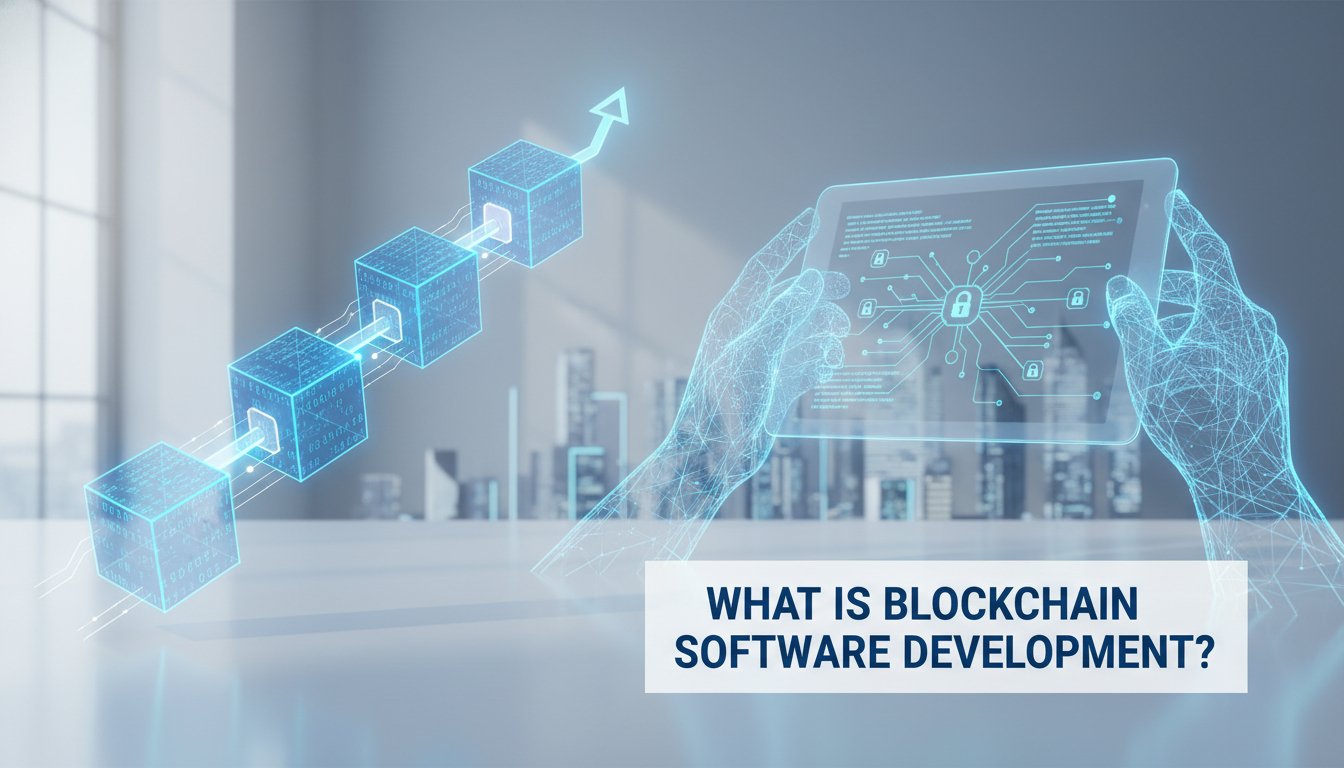
Blockchain software development is the process of designing, coding, and deploying decentralized applications (dApps) and protocols that operate on a distributed ledger. Unlike traditional centralized systems, blockchain development creates trustless, immutable applications that run across peer-to-peer networks.
This field extends far beyond cryptocurrency, it now powers supply chain tracking, digital identity, decentralized finance (DeFi), and tokenized real-world assets. A blockchain software developer builds the logic that runs on blockchains like Ethereum, Hyperledger Fabric, or Solana, ensuring data immutability and trustless execution. According to Coursera, the median total salary for blockchain developers in the United States is $136,000 per year, reflecting the high demand for these specialized skills.
Blockchain vs. Traditional Software Development
Unlike traditional applications that rely on centralized servers, blockchain software development emphasizes decentralization, cryptographic security, and consensus-driven data integrity. A blockchain is a distributed ledger where data is grouped into blocks, linked cryptographically to form an immutable chain. Traditional databases, controlled by a central authority, are prone to single points of failure. In contrast, blockchain networks are maintained by a peer-to-peer architecture, making them resilient and transparent.
Core Components of Blockchain Software
Every blockchain application rests on four pillars: distributed ledger technology (DLT), consensus mechanisms (like Proof of Work or Proof of Stake), cryptographic hashing, and smart contracts. Smart contracts are self-executing programs stored on the blockchain that automatically enforce agreements when predefined conditions are met. For instance, a smart contract can release payment only after a delivery is confirmed, eliminating intermediaries.
Core Types of Blockchain Development

Blockchain software development splits into two primary tracks, each requiring distinct skill sets. Understanding these differences is critical for both hiring and career planning.
Core Blockchain Development
Core developers design and maintain the foundational layer of a blockchain, its protocol, consensus algorithm, and network security. This role involves low-level programming in languages like C++, Rust, or Go, and deep knowledge of distributed systems and cryptography. Core developers implement consensus rules (e.g., Proof of Stake in Ethereum 2.0) and handle node communication protocols. They’re the architects who ensure the network can scale securely.
Application-Level Development
Application-level developers build dApps, smart contracts, and user-facing interfaces on top of existing blockchains. This is the more common entry point for software engineers. They write smart contracts in Solidity (for Ethereum), Move (for Aptos/Sui), or Rust (for Solana/Polkadot). Frontend integration often uses Web3.js or Ethers.js to connect UIs to blockchain nodes. As Jerry Cuomo, IBM Fellow, noted on IBM Think, “We’ve found that 20% of the actual code you write is blockchain specific, but 80% is all the code you had to write before.” This highlights how traditional software skills remain highly relevant.
| Platform | Type | Consensus | Primary Languages | Typical Use Cases |
|---|---|---|---|---|
| Ethereum | Public, permissionless | Proof of Stake | Solidity, Vyper | DeFi, NFTs, DAOs |
| Hyperledger Fabric | Private, permissioned | Pluggable (PBFT, Raft) | Go, Java, JavaScript | Supply chain, enterprise workflows |
| Solana | Public, permissionless | Proof of History + PoS | Rust, C | High‑frequency trading, gaming |
| Polkadot | Public, heterogeneous | Nominated Proof of Stake | Rust, Substrate framework | Cross‑chain interoperability, parachains |
“We’ve found that 20% of the actual code you write is blockchain specific, but 80% is all the code you had to write before.” – Jerry Cuomo, IBM Fellow, IBM Think
Essential Skills for Blockchain Developers

Breaking into blockchain software development requires a blend of classical computer science and niche blockchain competencies. According to IBM’s guide, learning basic database technology and distributed computing provides a strong foundation.
Programming Languages and Smart Contract Expertise
Proficiency in Solidity is table stakes for Ethereum-based development, while Rust is increasingly sought after for high-performance chains like Solana and Polkadot. For enterprise blockchain, Go and JavaScript dominate the Hyperledger ecosystem. Understanding the nuances of gas optimization, contract security, and upgrade patterns differentiates a junior developer from a senior one.
Cryptography and Data Structures
Blockchain development demands a solid grasp of hashing (SHA-256, Keccak-256), public-key cryptography, and Merkle trees. These fundamentals underpin wallet generation, transaction signing, and proof verification. Developers must also be comfortable with peer-to-peer networking and consensus algorithms to architect robust decentralized systems.
The Development Process

Executing a blockchain software development project follows a disciplined lifecycle. ScienceSoft outlines a four-step framework: feasibility study, conceptualization, development and QA, and deployment. Meanwhile, Hashlock expands the process to six stages, emphasizing security audits and continuous maintenance.
Step 1: Problem Identification and Feasibility
Not every problem needs a blockchain. Start by validating that decentralization, immutability, or trustless execution is essential. A feasibility study assesses whether a blockchain solution outperforms a traditional database. During this phase, define clear success metrics and regulatory requirements, especially for financial applications.
Step 2: Architecture and Platform Selection
Choose between public, private, or hybrid blockchains. Public networks (Ethereum, Solana) offer maximum decentralization; private ones (Hyperledger Fabric, R3 Corda) provide controlled access for enterprise workflows. The consensus mechanism, Proof of Work, Proof of Stake, PBFT, directly impacts scalability and energy efficiency. Conceptualize the tokenomics if the solution involves a native asset.
Step 3: Smart Contract and dApp Development
Write, compile, and unit-test smart contracts using frameworks like Hardhat or Truffle. Integrate with a testnet (e.g., Sepolia for Ethereum) to simulate real-world conditions. Frontend developers use libraries such as Web3.js or Ethers.js to enable wallet connections and transaction signing. According to Vention, smart contracts can automate agreements between parties, reducing fraud and speeding up workflows.
Step 4: Testing, Security Auditing, and Deployment
QA testing covers functional, performance, and security testing. Automated static analysis tools (Slither, MythX) detect common vulnerabilities like reentrancy and integer overflows. A professional security audit by firms like Hashlock or ConsenSys Diligence is mandatory before mainnet launch. After deployment, continuous monitoring and upgrade mechanisms (e.g., proxy contracts) ensure long-term maintainability.
Essential Tools and Frameworks
Modern blockchain software development leverages a rich ecosystem of open-source tools that accelerate coding and testing.
Development Environments and Testing Suites
Hardhat has become the de facto standard for Ethereum development, offering a local blockchain network, advanced debugging, and plugin extensibility. Foundry (based on Rust) provides blazing-fast testing for Solidity. For front-end development, Truffle and Ganache remain popular, while Remix IDE offers a browser-based environment for quick prototyping.
Blockchain Middleware and APIs
Connecting dApps to the blockchain requires reliable node infrastructure. Alchemy, Infura, and QuickNode provide scalable API endpoints, while The Graph enables efficient querying of on-chain data. These middleware solutions abstract the complexity of running full nodes, allowing developers to focus on business logic.
Real-World Applications
The impact of blockchain software development extends across industries. Liventus notes its adoption in supply chain administration, healthcare, and government, while Vention highlights financial services and energy sectors.
Supply Chain and Provenance Tracking
By tokenizing physical goods on a blockchain, companies gain end-to-end traceability. Walmart uses blockchain to track food from farm to shelf, reducing contamination response time. Everledger tracks diamonds’ provenance, combating conflict gems. The immutable audit trail increases consumer trust, a fact supported by a PwC survey where 84% of executives said blockchain enhances trust in transactions.
Decentralized Finance (DeFi) and Tokenization
DeFi platforms have unlocked lending, borrowing, and trading without intermediaries. Smart contracts automatically execute interest payments and liquidations. Meanwhile, real-world asset (RWA) tokenization is projected to bring trillions of dollars of assets on-chain, from real estate to fine art, democratizing access to previously illiquid markets.
Career Pathways and Salary Insights in 2026
The demand for blockchain software development talent continues to outstrip supply. According to Coursera, the median U.S. salary is $136,000, with top earners exceeding $200k. Companies like ConsenSys, Coinbase, and Chainlink Labs are actively hiring, while traditional enterprises (IBM, Microsoft, JPMorgan) maintain large blockchain teams.
Roadmap to Becoming a Developer
A typical path takes roughly 10 months, as outlined in various developer roadmaps. Start with foundational programming (Python, TypeScript), then dive into blockchain concepts through platforms like CryptoZombies or the Blockchain Revolution Specialization (43,286 already enrolled). Build a portfolio with simple dApps, contribute to open-source projects on GitHub, and network at hackathons. Many developers upskill using recommended resources or enroll in blockchain bootcamps.
Core Developer vs. Software Developer Salaries
Core blockchain developers often command higher premiums due to their expertise in protocol design and cryptography, salaries typically range $150k–$250k. Blockchain software developers, especially those proficient in Solidity and Rust, average $120k–$180k. Geographic hubs like San Francisco, New York, and Berlin offer the highest compensation, though remote work has broadened opportunities.
Consensus Algorithms and Enterprise Standards
Understanding consensus mechanisms is crucial for blockchain software development. Proof of History (PoH), pioneered by Solana, timestamps transactions before consensus, enabling faster throughput. Enterprise blockchain follows ISO/TC 307 standards for terminology, privacy, and security frameworks, ensuring interoperability across corporate implementations.
Tokenomics Design Considerations
Successful blockchain projects require careful token economics. Consider utility vs. security tokens, inflation/deflation mechanisms, and governance rights. ICO and STO regulations vary by jurisdiction, consult legal experts before launching token sales. Proper tokenomics align incentives between users, validators, and developers, creating sustainable network effects.
Future Trends in 2026
Two emerging trends are reshaping the landscape: AI-augmented development and modular chain architectures. Neither was prominent in earlier roadmaps, giving 2026 developers a fresh edge.
AI-Powered Coding and Auditing
AI assistants like GitHub Copilot can now generate Solidity boilerplate, suggest gas optimizations, and even detect common vulnerabilities. Tools like Certora Prover use formal verification to mathematically prove smart contract correctness, reducing reliance on manual audits. According to market analysis by Vention, blockchain solutions raised over $17 billion in 2022, and AI integration is expected to accelerate innovation further.
Modular Blockchains and Layer 2 Scaling
Monolithic chains are giving way to modular stacks that separate execution, consensus, and data availability. Rollups like Optimism and zero-knowledge proofs (ZK-rollups) reduce fees and congestion. For blockchain software development, this means learning Ethereum’s ERC-4337 Account Abstraction, cross-chain messaging protocols like LayerZero, and storage proofs. Developers who master these techniques will lead the next wave of scalable dApps.
Ready to build the next generation of decentralized applications? Apply to the Genesis Cohort at digitalblockchains.com and join a community of builders pushing the boundaries of Web3 infrastructure.
Frequently Asked Questions
What is blockchain software development?
Blockchain software development is the engineering discipline focused on creating decentralized applications, smart contracts, and protocols that run on a blockchain network. It ensures data immutability, security, and trustless automation through cryptographic techniques.
Will AI replace blockchain developers?
AI is unlikely to replace developers entirely but will augment their productivity. AI tools can generate code snippets and detect bugs, but designing robust tokenomics, consensus mechanisms, and secure architectures still requires deep human expertise.
What programming languages are used in blockchain development?
Solidity remains the most used language for Ethereum smart contracts, while Rust is growing for high-performance chains like Solana and Polkadot. Go and Java are common in enterprise environments like Hyperledger Fabric.
How long does it take to become a blockchain developer?
A focused learner can transition in roughly 10 months by following a structured roadmap. Prior software engineering experience significantly shortens the curve, as 80% of the work involves standard coding skills.
What is the role of a smart contract in blockchain software?
A smart contract is a self-executing program stored on a blockchain that automatically enforces the terms of an agreement when predefined conditions are met. It eliminates the need for intermediaries and ensures trustless execution.