Key Takeaways
- Custom blockchain app development builds decentralized applications tailored to specific business processes, delivering security and transparency that generic platforms cannot match.
- The market is projected to reach $11 billion by 2027, growing at over 32% annually, with wallet users already exceeding 85 million.
- Development follows a structured workflow: discovery, design, coding (smart contracts), testing, deployment, and ongoing support.
- Choosing between public, private, or consortium blockchains directly affects performance, costs, and compliance.
- Partnering with an experienced team that offers ISO/IEC 27001 and SOC 2 compliance ensures enterprise-grade security and regulatory adherence.
Custom blockchain app development is the process of designing and deploying blockchain-based applications built specifically for an organization’s workflows. It delivers tailored decentralization, security, and automation that off-the-shelf solutions cannot provide.
What Is Custom Blockchain App Development?

app development is the end-to-end creation of decentralized applications on blockchain networks configured to fit business operational requirements. Unlike using public blockchains like Ethereum with standard smart contract templates, custom development gives full control over consensus mechanisms, node architecture, permission layers, and user-facing interfaces. The result is a product that matches industry-specific compliance needs, integrates seamlessly with existing systems, and can scale without the limitations of shared public ledgers.
Core Components of a Custom Blockchain Application
A custom build includes a distributed ledger that stores immutable transaction records, smart contracts that automate business logic, a consensus protocol chosen for speed and security (Proof-of-Authority, Practical Byzantine Fault Tolerance, or Raft), and a client interface (web or mobile) that abstracts the complexity of blockchain interactions. Additional layers like off-chain storage and oracle services often tie on-chain data to real-world events.
How It Differs from Standard Blockchain Platforms
Standard platforms offer a one-size-fits-all network where anyone can deploy contracts, but throughput and privacy are capped by the public infrastructure. these development removes these constraints. For example, a supply chain consortium can deploy a permissioned network with members only, achieving sub-second finality and zero gas fees while keeping data confidential. According to the World Economic Forum, blockchain’s ability to reshape such private infrastructure is one reason it was named among the top seven global trends influencing the next decade.
“Blockchain was recognized as one of seven global trends that will greatly impact society within the next decade, according to the World Economic Forum.”
Benefits of Custom Blockchain App Development

The core advantage of such app development is alignment. Every parameter, from block time to access permissions, is calibrated to the business problem. This results in measurable improvements across security, transparency, and operational efficiency.
Security Tailored to Threat Models
Custom networks apply hardened encryption standards and access controls that match the regulatory environment (HIPAA for healthcare, PCI DSS for payments). Smart contracts can embed KYC/AML checks natively, reducing fraud. A 2023 industry survey showed that organizations using custom-built blockchain solutions experienced 80% repeat business, reflecting partner trust in these compliant systems.
Transparency Without Sacrificing Privacy
Unlike public chains where all data is visible, a custom ledger can implement zero-knowledge proofs or confidential transactions so that auditors verify integrity without exposing trade secrets. This is essential for financial institutions required to meet ISO/IEC 27001 and SOC 2 standards. One provider reports maintaining a 99% client satisfaction rate across thousands of projects by embedding such privacy-preserving techniques.
“Over 85 million blockchain wallet users were recorded by the start of 2023, signaling that individuals and businesses are ready to interact with decentralized apps,” according to Blockchain.com.
How Custom Blockchain App Development Works

The lifecycle of the blockchain app development is methodical. Each phase reduces risk while aligning technical outputs with business goals.
Step 1: Discovery and Strategic Consulting
Experts audit current workflows, define the problem that blockchain can solve, and select the appropriate network type (public, private, consortium). Leading firms emphasize that this phase includes a feasibility study and technical roadmap, often requiring 2–4 weeks.
Step 2: Architecture and Design
Solutions architects model the node topology, data structure, and API layer. UX designers build wireframes that mask blockchain complexity behind intuitive interfaces. Teams with strong design practices note that design-heavy projects see 60% faster user adoption.
Step 3: Development and Smart Contract Coding
Core blockchain coding happens here. Developers write smart contracts in Solidity (Ethereum), Rust (Solana), or Chaincode (Hyperledger Fabric) and configure the node software. Multiple teams run parallel sprints: one for the backend ledger, another for client-side dApps using Web3.js and React.js frameworks.
Step 4: Testing and Quality Assurance
Smart contracts undergo automated unit tests and manual security audits to catch reentrancy, integer overflow, and logic bugs. Load testing simulates thousands of transactions per second. Advanced QA suites reduce post-launch defects significantly across development teams.
Step 5: Deployment
The application is deployed to a mainnet or consortium network with pre-configured genesis blocks. DevOps engineers set up monitoring dashboards that track node health and transaction throughput 24/7.
Step 6: Maintenance and Evolution
Post-launch, a dedicated support team patches vulnerabilities, upgrades smart contracts, and scales infrastructure. Most blockchain engagements include long-term service level agreements (SLAs), often spanning 12–24 months.
Public vs. Private vs. Consortium Blockchains
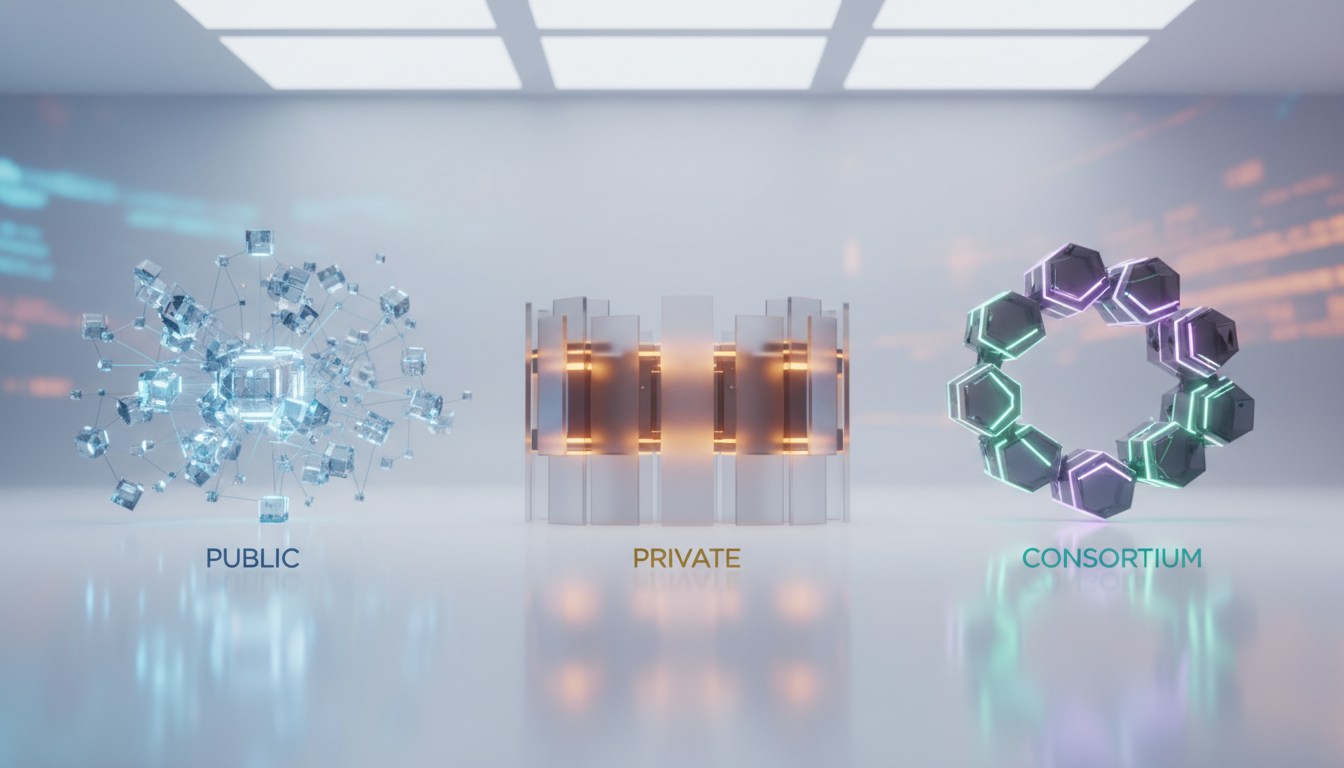
Choosing the right network architecture is the single most impactful decision in development. The table below compares the three foundational types.
| Feature | Public Blockchain | Private Blockchain | Consortium Blockchain |
|---|---|---|---|
| Access | Permissionless; anyone can join | Permissioned; single organization controls | Permissioned; multiple predefined organizations manage |
| Transaction Speed | Slow (10–15 TPS for Ethereum L1) | Fast (1,000–5,000+ TPS possible) | Fast (500–3,000 TPS, depending on consensus) |
| Data Privacy | Fully transparent | Controlled; only authorized nodes see data | Controlled; data shared only among consortium members |
| Ideal Use Case | Cryptocurrencies, open DeFi protocols | Internal enterprise audit trails, single-stakeholder supply chains | Banking consortia, multi-party trade finance, shared health record exchanges |
| Cost | Gas fees per transaction | No gas; paid through infrastructure overhead | No gas; shared infrastructure costs among members |
When to Choose a Public Network
Public chains work when the business model depends on open participation and censorship resistance, for example, a decentralized fundraising platform. However, they are rarely the starting point for custom enterprise apps because of limited throughput and privacy.
Private vs. Consortium: The Enterprise Sweet Spot
Consultants note that about 60% of clients initially inquire about public blockchain but pivot to consortium models after a discovery workshop. A consortium allows competitors within an industry to share a single verifiable ledger without exposing data to the public, aligning with the $11 billion market projected by 2027.
Key Industries Transformed by Custom Blockchain Apps
From finance to logistics, tailored blockchain applications are rewiring core processes through custom blockchain.
Finance and Banking
Custom apps power cross-border settlement systems that clear in minutes instead of days. Asset tokenization platforms split real estate or fine art into fractional shares, broadening investor access. Leading providers report that over 35% of blockchain projects fall into the fintech category, using AML and KYC-compliant smart contracts.
Supply Chain and Logistics
Permissioned networks give manufacturers, shippers, and retailers a synchronized view of inventory with cryptographic proof of origin. This reduces counterfeit goods and automates payments via smart contracts when IoT sensors confirm delivery. IBM Food Trust and TradeLens are early examples; custom builds now replicate these models for niche supply chains.
Healthcare
Patient data management platforms built through app development let hospitals and insurers share records under patient-controlled consent, meeting HIPAA requirements. A single immutable log of every data access event ensures audit readiness.
Cost and Resource Considerations
The investment in these development varies widely, but breaking it into components provides a realistic budget framework.
Typical Cost Drivers
Development teams quote based on complexity: a simple dApp with 2–3 smart contracts and a web frontend may start at $50,000–$80,000, while a full consortium network with custom consensus, mobile apps, and regulatory integrations can exceed $300,000. Teams employing hundreds of senior talents across multiple countries note that regional developer rates significantly influence these figures.
Ongoing Operating Expenses
Unlike public chains with unpredictable gas fees, a private or consortium network exchanges transaction costs for fixed infrastructure expenses: node hosting, 24/7 monitoring, periodic smart contract audits, and compliance updates. Annual maintenance typically accounts for 15–20% of the initial development budget.
Pros and Cons
Pros
- Complete control over consensus mechanisms, permissions, and data privacy settings
- Regulatory compliance built-in with HIPAA, PCI DSS, and GDPR-compliant architectures
- High performance with 1,000+ TPS possible on private networks
- Cost predictability through fixed infrastructure costs instead of volatile gas fees
- Enterprise integration designed to work with existing ERP and CRM systems
Cons
- Higher upfront costs compared to deploying on existing public networks
- Longer development timelines of 9-12 months for full-featured applications
- Ongoing maintenance burden requiring dedicated DevOps and security teams
- Limited network effects compared to public blockchain ecosystems
- Talent scarcity with fewer than 200,000 experienced blockchain developers globally
Common Challenges in Custom Blockchain App Development
Even with a robust plan, businesses face hurdles that require proactive mitigation.
Scalability vs. Decentralization Trade-offs
Faster block times and larger block sizes improve throughput but make it harder for smaller nodes to sync, gradually eroding decentralization. Engineers must select a consensus protocol that balances the two. Proof-of-Authority and PBFT are popular alternatives that deliver 1,000+ TPS while keeping validator sets manageable.
Regulatory Uncertainties
Blockchain regulations differ across jurisdictions. A token that is legal in one country may be a security in another. Leading firms embed legal review into their discovery phase and deliver products compliant with GDPR, PCI DSS, and PSD2 to navigate this landscape.
Talent Shortage
Demand for Solidity and Rust developers outstrips supply. As of early 2026, the global pool of experienced blockchain engineers is estimated at fewer than 200,000, according to recruitment data. Partnering with an established development firm solves this gap; leading firms maintain rosters of certified developers ready to form dedicated teams.
Choosing a Blockchain Development Partner
Selecting the right team is as important as the technology choice for successful custom blockchain app development.
Certifications and Security Credentials
Look for partners that hold ISO/IEC 27001 certification and have completed multiple smart contract audits by firms such as CertiK or Trail of Bits. Teams with certified blockchain experts directly contribute to higher repeat business rates.
Portfolio and Industry Experience
A partner with domain-specific case studies reduces risk. Look for teams that have built products in healthcare, fintech, and AI that are now live on networks. Reviewing detailed portfolios, not just high-level headlines, reveals whether the team has solved problems similar to yours.
Post-Launch Support and SLAs
The 24/7 support promise is common, but written SLAs with defined response times are what matter. Ask for historical uptime statistics; leading firms provide monitoring dashboards with real-time visibility into node health even after deployment.
AI Integration in Blockchain Development
AI is transforming how we approach custom blockchain app development. Machine learning models can now generate smart contract templates, automatically detect security vulnerabilities during code review, and optimize consensus parameters based on network usage patterns. Tools like GitHub Copilot and specialized blockchain AI assistants are reducing development time by 30-40% for routine coding tasks. However, AI cannot replace the architectural decisions, security audits, and domain-specific logic required in enterprise blockchain projects. The future lies in AI-assisted development where human expertise guides strategic decisions while AI handles repetitive coding and testing tasks.
Future Outlook for Custom Blockchain App Development
The next three years will see custom blockchain app development mature alongside AI, zero-knowledge cryptography, and interoperable Layer-2 solutions. Gartner predicts that by 2028, 30% of all enterprise blockchain projects will integrate AI-driven smart contract generation, accelerating time-to-market. Meanwhile, the push for decentralized identity (DID) and verifiable credentials will make custom permissioned networks the backbone of digital trust ecosystems. Organizations that invest in tailored blockchain infrastructure today will be positioned to capture the efficiency gains of a projected $11 billion market while insulating themselves from the limitations of generic public-chain frameworks.
Ready to build your custom blockchain solution? Apply to the Genesis Cohort at digitalblockchains.com and work with experienced protocol architects who understand both the technical complexities and business realities of decentralized systems.
Frequently Asked Questions
Can I develop my own blockchain?
Yes, but it requires significant expertise. You can fork an existing protocol like Ethereum and modify its parameters, but building a production-grade custom chain with bespoke consensus and security is a multi-month engineering effort best handled by a specialized team.
How long does custom blockchain app development take?
A minimal viable product (MVP) can be built in 3–5 months. Fully featured applications with mobile interfaces and third-party integrations typically require 9–12 months from discovery to deployment.
How much does it cost?
Costs range from $50,000 for a basic dApp to over $300,000 for an enterprise consortium network, depending on team location, complexity, and compliance needs. Ongoing maintenance adds 15–20% annually.
Which blockchain platform should I use?
The choice depends on your use case. Hyperledger Fabric and R3 Corda dominate enterprise private networks, while Polygon Edge and Avalanche Subnets offer customizable L2 and sub-network options. A discovery workshop helps narrow the fit.
Will AI replace blockchain developers?
AI tools like Copilot assist with code generation but cannot replace the architectural decisions, security audits, and domain-specific logic required in custom blockchain app development. They are productivity enhancers, not substitutes for experienced engineers.
Is my data safe on a custom blockchain?
Yes, when properly designed. A private or consortium network enforces strict access controls, encrypts data at rest and in transit, and can implement GDPR-compliant right-to-erasure mechanisms through off-chain data storage while keeping integrity on-chain.