Key Takeaways
- Blockchain development tools encompass programming languages, IDEs, frameworks, node services, wallets, and security analyzers.
- Leading frameworks like Hardhat and Foundry streamline smart contract testing and deployment with built-in debugging.
- Frontend libraries such as Ethers.js and wallets like MetaMask are critical for creating user-friendly decentralized applications.
- Selecting the right toolchain depends on the target blockchain, team expertise, and project requirements.
- The ecosystem is rapidly evolving with multi-chain support and AI-assisted auditing capabilities.
Blockchain development tools are specialized software suites that enable developers to build, test, deploy, and maintain decentralized applications and smart contracts across distributed networks.
Understanding Blockchain Development Tools

Definition and Core Purpose
A blockchain development tool abstracts away low-level cryptographic operations, network communication, and consensus mechanisms, allowing developers to focus on application logic. These development tools span integrated development environments, testing frameworks, node infrastructure, and security analyzers. Without them, writing even a simple smart contract would require manually handling transaction signing, gas optimization, and node synchronization.
“Building a cryptocurrency wallet helps new blockchain developers understand security, transactions, and user interactions.” – Algorand Foundation, 2025
Whether you’re building on Ethereum, Solana, Polkadot, or a private Hyperledger network, the right set of these tools dramatically reduces time-to-market and minimizes vulnerabilities. The current landscape includes programming languages tailored for smart contracts, feature-rich IDEs, local testing blockchains, and powerful security analyzers.
The Expanding Ecosystem of Blockchain Development Tools
Over the last five years, the ecosystem has grown from a handful of open-source projects into a mature industry. According to Alchemy’s Web3 developer tools list, there are now over 183 categorized blockchain development tools spanning 25+ blockchain networks. The global blockchain technology market is projected to grow by 90.1% between 2025 and 2030, as noted by Grand View Research (cited in a Coursera article), intensifying the need for efficient development workflows.
Core Smart Contract Programming Languages
Solidity – The Foundation of Ethereum Development
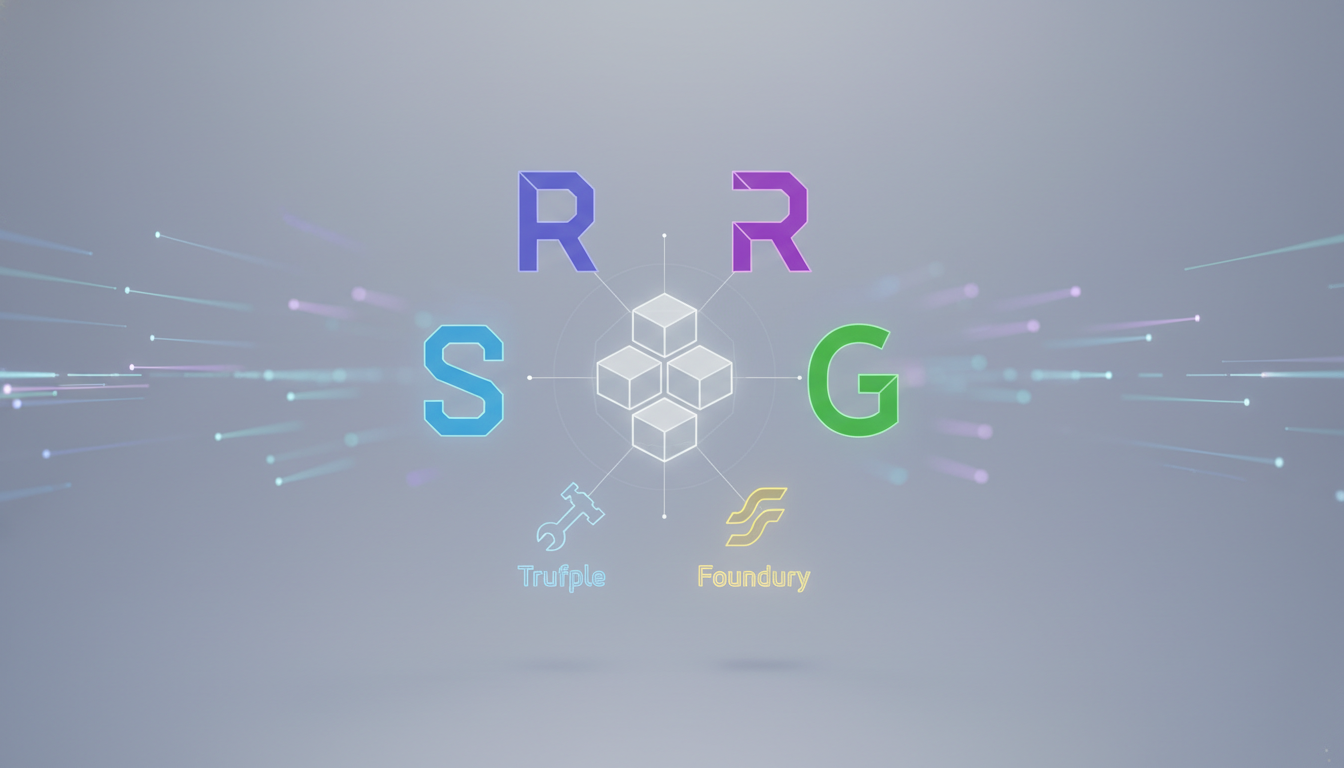
Solidity is a high-level, object-oriented language designed specifically for writing smart contracts on Ethereum and other EVM-compatible networks like BNB Chain, Polygon, and Avalanche. Its syntax borrows from JavaScript, C++, and Python, making it accessible to mainstream developers. Solidity supports inheritance, libraries, and complex user-defined types, enabling everything from simple token contracts to intricate DeFi protocols. The official Solidity documentation remains the definitive resource for version-specific features and security considerations.
Rust – Powering Solana and Polkadot
For high-performance blockchains, Rust has become the language of choice. Solana’s native programs are written in Rust, as are many Substrate-based parachains in the Polkadot ecosystem. Rust’s memory safety guarantees, zero-cost abstractions, and strong concurrency model make it ideal for the demanding throughput requirements of these networks. Learning Rust opens doors to building on Solana, Polkadot, NEAR, and even Ethereum through ZK-rollup toolchains.
Niche Languages: Move, Vyper, and More
Beyond the two giants, several languages serve specialized niches:
- Move – Developed by Meta (formerly Facebook) for the Diem blockchain, now used by Sui and Aptos. Move enforces resource safety at the language level, preventing double-spending vulnerabilities.
- Vyper – A contract-oriented language for Ethereum that prioritizes auditability and simplicity over expressiveness. Its syntax is closer to Python, and it deliberately omits features like inheritance that can introduce complexity.
- Yul – An intermediate language for the Ethereum Virtual Machine, used to write highly optimized assembly-like code.
Integrated Development Environments (IDEs) for Blockchain

Remix IDE – Browser-Based Smart Contract Development
Remix IDE is a web-based environment that requires no installation. It provides Solidity compilation, deployment to injected Web3 providers (like MetaMask), and an interactive debugger. Remix is particularly useful for quick prototyping, educational purposes, and small contracts. Its plugin architecture allows integration with Hardhat, Foundry, and other frameworks, making it a flexible entry point for any blockchain development tools stack.
VS Code and Extensions for Blockchain Development
Microsoft’s Visual Studio Code has emerged as the dominant IDE for professional blockchain work thanks to a rich marketplace of extensions. Key additions include the Solidity extension by Juan Blanco (providing syntax highlighting, linting, and code snippets), the Hardhat extension for seamless integration, and Slither for static analysis directly within the editor. VS Code’s Git integration, terminal, and debugging capabilities make it a hub for the entire development lifecycle when working with blockchain development tools.
IntelliJ IDEA for Enterprise-Grade Development
JetBrains’ IntelliJ IDEA offers a robust environment for enterprise teams already invested in the JVM ecosystem. With plugins like Solidity and Foundry, IntelliJ provides advanced refactoring, code navigation, and integration with CI/CD pipelines. Its Web3-specific tooling, while less extensive than VS Code, appeals to Java and Kotlin developers entering blockchain.
Smart Contract Development Frameworks

Hardhat – The Modern Standard
Hardhat has rapidly become the go-to framework for Ethereum development. It offers a local blockchain node (Hardhat Network) with built-in debugging via console.log(), a task runner for custom scripts, and a vast plugin ecosystem. Developers can write tests in JavaScript or TypeScript, integrate with Ethers.js or Web3.js, and deploy to any EVM-compatible chain. Its ergonomic design and active community make it a foundation of contemporary blockchain development tools.
Truffle Suite – The Established Framework
Truffle Suite was among the first comprehensive development environments for Ethereum. It includes Truffle for compilation and migration, Ganache for a personal blockchain, and Drizzle for frontend integration. While some developers have migrated to Hardhat for its modern features, Truffle remains widely used, especially in educational settings. Ganache alone is invaluable: it automatically creates 10 accounts, each funded with 100 ETH, allowing immediate testing of contract interactions without acquiring testnet tokens.
Foundry – The Lightweight Alternative
Foundry is a blazing-fast, Rust-based toolkit for Ethereum development. It consists of Forge for testing, Cast for chain interaction, and Anvil for a local node. Unlike Hardhat and Truffle, Foundry scripts are written in Solidity itself, appealing to developers who prefer a Solidity-centric workflow. Its speed and native fuzzing capabilities have attracted a growing user base, particularly for protocols requiring extensive security testing.
Framework Comparison Table
| Feature | Hardhat | Truffle Suite | Foundry |
|---|---|---|---|
| Language Support | Solidity, Vyper | Solidity, Vyper | Solidity |
| Testing | Mocha/Waffle, Stack Traces | Mocha, basic assertions | Forge, fuzzing built-in |
| Debugging | console.log(), stack traces | Basic, Ganache events | Cast debugger, trace |
| Console/REPL | Hardhat console | Truffle console | Cast call |
| Scripting | JavaScript/TypeScript tasks | Migrations (JavaScript) | Solidity scripts |
| Extensibility | Rich plugin system | Limited plugins | Minimal, but fast |
| Local Node | Hardhat Network (in-memory) | Ganache (UI & CLI) | Anvil (lightweight) |
Blockchain Node Providers and Infrastructure
Alchemy – Enterprise-Grade Node Services
Alchemy offers a supernode infrastructure that provides reliable API access to Ethereum, Polygon, Arbitrum, Optimism, and more. Its enhanced APIs simplify tasks like fetching transaction history, token balances, and NFT metadata. Alchemy’s monitoring dashboard and detailed analytics help teams debug stuck transactions and optimize gas usage, making it a cornerstone for production-grade applications.
Infura and QuickNode – Reliable Alternatives
Infura, long the default node provider for Ethereum developers, supports a wide range of networks and offers a generous free tier. QuickNode differentiates itself with multi-chain support, core API endpoints, and add-ons for IPFS, Graph, and more. Both services eliminate the overhead of running full nodes, which requires significant storage (over 1 TB for an Ethereum archive node) and bandwidth.
Running Your Own Node with Geth
For maximum sovereignty and trustlessness, running a full node using Geth (Go-Ethereum) is the definitive solution. Geth implements the Ethereum execution layer and can sync in snap, full, or archive modes. Developers connecting to a local Geth node during testing avoid rate limits and external dependencies, though it demands dedicated hardware and continuous maintenance.
Frontend Libraries and Wallet Integration
Web3.js and Ethers.js – The Bridge Between Frontend and Blockchain
To interact with on-chain contracts from a web application, developers use libraries like Web3.js and Ethers.js. Ethers.js has gained preference for its lightweight footprint and intuitive API, while Web3.js remains deeply integrated with MetaMask and many legacy projects. Both handle contract ABIs, signing, and transaction formatting, abstracting the JSON-RPC communication that blockchain development tools require.
MetaMask and WalletConnect – Simplifying User Onboarding
MetaMask is a browser extension and mobile wallet that injects a Web3 provider into the browser window, allowing seamless signing and transaction submission. With over 30 million monthly active users (as of early 2026), it is the most widely adopted wallet. WalletConnect provides a protocol for connecting mobile wallets to dApps via QR code or deep links, broadening access beyond desktop browsers.
Security and Auditing Tools
Static Analysis with Slither and Mythril
Slither is a static analysis framework that detects vulnerabilities like reentrancy, uninitialized storage, and incorrect use of tx.origin. It integrates with CI pipelines and reports issues in a developer-friendly manner. Mythril offers symbolic execution to find deeper logic bugs, though it requires more computational resources. These blockchain development tools are essential for identifying vulnerabilities before deployment.
Fuzzing and Formal Verification with Echidna and Certora
Echidna is a property-based fuzzer that generates random inputs and checks contract invariants, uncovering edge-case vulnerabilities that unit tests miss. For the highest assurance, Certora Prover applies formal verification, mathematically proving that a contract complies with its specification. These blockchain development tools are increasingly adopted by DeFi protocols managing billions in TVL.
The Rise of AI-Assisted Auditing
AI models trained on vulnerable contract patterns are beginning to augment manual reviews. Tools like Hashlock’s AI Audit and OpenAI-based analyzers can flag suspicious code in seconds. While they don’t replace expert auditors, they serve as valuable first-pass filters, and their effectiveness is expected to improve significantly as training datasets grow.
Enterprise Blockchain Platforms
Hyperledger Fabric for Permissioned Networks
Hyperledger Fabric is an enterprise-grade blockchain framework designed for permissioned networks. Unlike public blockchains, Fabric supports private channels, pluggable consensus algorithms, and fine-grained access control. Organizations use Fabric for supply chain tracking, trade finance, and identity management where regulatory compliance and data privacy are paramount.
R3 Corda for Financial Services
R3 Corda is specifically built for financial institutions, focusing on privacy and regulatory compliance. Corda’s unique architecture ensures that transaction data is only shared between relevant parties, making it suitable for banking consortiums and insurance networks. Its JVM-based smart contracts (CorDapps) appeal to enterprise Java developers.
Decentralized Storage and Oracle Integration
IPFS and Arweave for Decentralized Storage
IPFS (InterPlanetary File System) provides content-addressed storage for dApps, allowing developers to store large files off-chain while maintaining decentralization. Arweave offers permanent storage with a one-time payment model, ideal for NFT metadata and historical records. These blockchain development tools solve the scalability challenge of storing large data on-chain.
Chainlink Oracle Networks
Chainlink is the dominant oracle network, providing real-world data feeds for price information, weather data, and sports results. Smart contracts use Chainlink’s decentralized oracle network to trigger actions based on external events. With over $15 billion in total value secured, Chainlink has become critical infrastructure for DeFi protocols requiring reliable price feeds.
Pros and Cons
Pros
- Rapid Development: Modern blockchain development tools like Hardhat and Foundry dramatically reduce time-to-market with built-in testing and debugging.
- Security Integration: Static analysis tools like Slither catch vulnerabilities early, preventing costly exploits in production.
- Multi-Chain Support: Frameworks now support deployment across multiple networks, maximizing reach and liquidity.
- Rich Ecosystem: Over 183 categorized tools provide solutions for every aspect of blockchain development.
- Open Source Community: Most tools are open source with active communities providing support and continuous improvement.
Cons
- Steep Learning Curve: Mastering the full stack of blockchain development tools requires significant time investment and domain expertise.
- Fragmented Ecosystem: Different blockchains require different tools, making it challenging to maintain expertise across multiple chains.
- Rapid Evolution: Tools and best practices change quickly, requiring continuous learning to stay current.
- Security Complexity: Smart contract vulnerabilities can result in permanent loss of funds, demanding rigorous testing and auditing.
- Infrastructure Dependencies: Reliance on node providers and external services can introduce centralization risks.
Future Trends in Blockchain Development Tools
“The global blockchain technology market is expected to grow by an astounding 90.1 percent between 2025 and 2030.” – Grand View Research, as reported by Coursera
Multi-Chain Toolchains and Cross-Chain Interoperability
The future is undeniably multi-chain. Blockchain development tools are evolving to support seamless deployment across L1s, L2s, and appchains. Projects like LayerZero and Chainlink CCIP are building interoperability protocols, while frameworks like Hardhat already support multiple EVM chains. Expect to see unified testnets, cross-chain debuggers, and asset portability features become standard.
AI and Machine Learning Integration
Artificial intelligence is being embedded directly into development workflows. GitHub Copilot can now suggest Solidity code, while tools like Kudelski’s fuzzing engine use ML to generate smarter test cases. AI-driven gas optimizers and code search engines are also emerging, helping developers write more efficient smart contracts faster.
Open Source Communities Driving Innovation
Most blockchain development tools are open source, maintained by foundations (Ethereum Foundation, Solana Labs), DAOs, and volunteer contributors. Hackathons and grant programs fuel rapid iteration. The Algorand Foundation, for instance, runs developer bootcamps in Nigeria, France, and Vietnam, fostering a global community that contributes back to tooling. This collective ownership ensures that the ecosystem remains resilient and aligned with developer needs.
Ready to build the next generation of decentralized applications? Apply to the Genesis Cohort at digitalblockchains.com and join a community of builders shaping the future of Web3.
Frequently Asked Questions
What are blockchain development tools?
Blockchain development tools are software applications and libraries that assist developers in creating, testing, and deploying smart contracts and decentralized applications on blockchain networks. These tools include programming languages like Solidity, frameworks like Hardhat, and security analyzers like Slither.
What programming language is best for blockchain development?
For EVM-based chains like Ethereum, Solidity is the standard. For Solana and Polkadot, Rust is preferred. Move is growing for Sui and Aptos, while Vyper offers a Python-like alternative for Ethereum development.
What is the difference between Hardhat and Truffle?
Hardhat offers modern debugging with console.log and a flexible plugin system, while Truffle provides a mature suite with Ganache for local testing. Many new projects choose Hardhat for its ergonomics and active development community.
How do blockchain node providers work?
Node providers like Alchemy and Infura operate full blockchain nodes and expose APIs, so developers can read and write on-chain data without running their own nodes. This eliminates the infrastructure overhead of maintaining full nodes.
What is MetaMask and why is it important?
MetaMask is a browser extension and mobile wallet that bridges dApps and users by managing private keys and signing transactions, serving as a gateway to Web3. It has over 30 million monthly active users and is the most widely adopted wallet.