Riot blockchain stock (RIOT) is the publicly traded equity of Riot Platforms, Inc., a Bitcoin mining and digital infrastructure company listed on Nasdaq. As of May 2026, RIOT trades near $27.74 with a market cap of $10.49 billion.
Key Takeaways
- blockchain stock has delivered a 12-month return exceeding 200%, significantly outpacing most traditional equities.
- The company generates the majority of its revenue from Bitcoin mining but is actively diversifying into AI and high-performance computing infrastructure.
- Analyst consensus across 19 ratings sits at 84% Buy, reflecting confidence in the strategic pivot.
- A beta of 3.70 ties RIOT closely to Bitcoin price swings, making it one of the more volatile large-cap equities on Nasdaq.
- Investors must weigh high growth potential against persistent GAAP net losses and meaningful execution risk in the AI transition.
Understanding Riot Blockchain Stock: Company Overview and Rebranding

From Riot Blockchain to Riot Platforms: The Strategic Rebrand
this type of stock represents the equity of Riot Platforms, Inc., a company that originally operated as Riot Blockchain, Inc. The rebrand to Riot Platforms in January 2023 signaled a deliberate shift beyond cryptocurrency mining into broader digital infrastructure. The legacy name persists in investor searches, but the company now positions itself as a large-scale data center developer with Bitcoin mining as one component of a growing ecosystem. Riot Platforms describes its core mission as powering the future of digital infrastructure, a framing that matters for how analysts assign valuation multiples.
Core Business Segments: Bitcoin Mining and Engineering
Riot Platforms operates through two primary segments: Bitcoin Mining and Engineering. The Bitcoin Mining segment focuses on maximizing hash rate across facilities in Texas and Kentucky. The Engineering segment designs and manufactures power distribution equipment and custom electrical products, enabling vertical integration of critical components. This dual structure lets this kind of stock benefit from both cryptocurrency production and from selling electrical infrastructure to other industrial clients. That vertical integration is a genuine cost advantage most pure-play miners lack.
Leadership and Headquarters
CEO Jason Les leads the company from its headquarters in Castle Rock, Colorado. Founded in 2000, Riot Platforms employs approximately 816 people and has expanded its operational footprint across multiple states. The leadership team has pursued growth through strategic land acquisitions and partnerships, as detailed in recent SEC filings. For context on how infrastructure-focused blockchain companies structure their operations, see our breakdown of blockchain infrastructure fundamentals.
Riot Blockchain Stock Price and Performance Metrics

Current Stock Price and Key Trading Statistics
As of May 2026, riot blockchain trades near $27.74 on the Nasdaq under ticker RIOT. The 52-week range runs from $7.93 to $28.54, with average daily volume of 15.01 million shares. According to data aggregated by Robinhood, the market capitalization stands at $10.49 billion and the price-to-earnings ratio is -11.29, reflecting consistent net losses. The tight bid-ask spread (bid $27.68, ask $27.70) confirms strong liquidity for a stock of this profile.
Historical Performance: 52-Week Range and Long-Term Trends
Over the past 12 months, blockchain stock has delivered a return of 205.17%, according to TradingView. The year-to-date gain is 113.22%, and the six-month return stands at 76.46%. Despite this rally, the stock remains highly volatile. A beta of 3.70 means it moves roughly 3.7 times as much as the broader market. That is not a flaw for every investor type. Traders seeking amplified Bitcoin exposure without holding BTC directly have historically used RIOT as their instrument of choice.
Comparative Analysis: Riot Blockchain Stock vs. Peers
Compared to peers like MARA Holdings (MARA, $14.09) and CleanSpark (CLSK, $18.20), RIOT has outperformed on price appreciation while carrying a larger market cap. The table below tracks quarterly EPS trends, showing a clear trajectory from steep losses toward near-breakeven. That improvement is a key differentiator as the company pivots toward AI infrastructure revenue.
| Quarter | EPS (Actual/Estimated) | Revenue Estimate |
|---|---|---|
| Q3 FY24 | -$2.03 | N/A |
| Q4 FY24 | -$1.16 | N/A |
| Q1 FY25 | -$0.30 | N/A |
| Q2 FY25 | $0.57 | N/A |
| Q3 FY25 | -$0.22 (Est.) | N/A |
| Q2 FY26 | Est. -$0.22 | $155.46M |
Pros and Cons of Investing in Riot Blockchain Stock
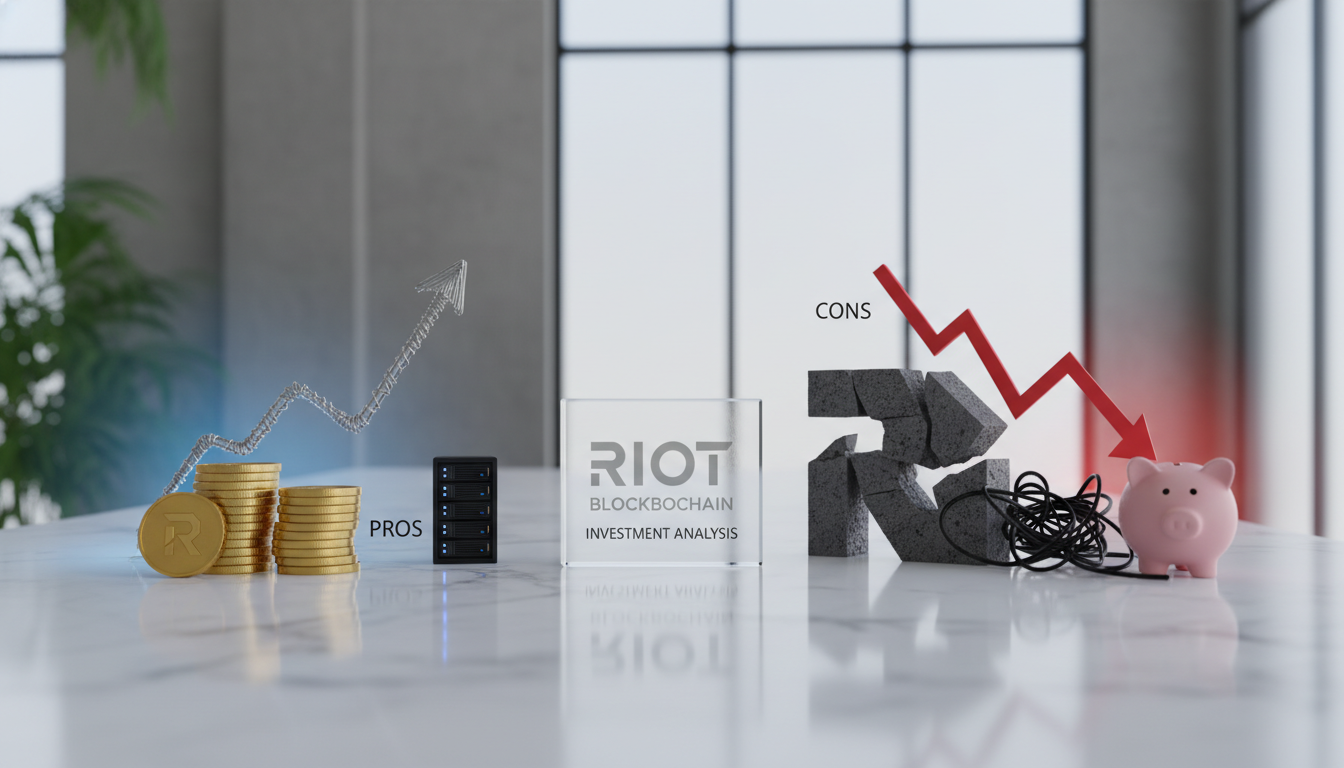
Pros
- Amplified Bitcoin exposure: A beta of 3.70 means RIOT can deliver outsized gains during crypto bull runs without requiring direct BTC custody.
- Strong analyst consensus: 84% Buy rating across 19 analyst ratings is unusually high for a volatile growth equity.
- Vertical integration advantage: The Engineering segment manufactures power distribution equipment in-house, reducing capital costs that competitors must source externally.
- AI pivot credibility: Concrete deals, including the AMD data center lease and the Terrestrial Energy nuclear collaboration, give the AI narrative real substance rather than just press release momentum.
- Scale and liquidity: A $10.49 billion market cap and 15 million average daily shares traded make RIOT one of the most liquid crypto-equity instruments available.
Cons
- Persistent GAAP losses: Net income of -$663.18 million on $647.43 million in revenue is a hard number to ignore. The company is not yet self-funding its growth.
- Bitcoin dependency: Despite the AI pivot, the majority of current revenue still flows from mining. A prolonged BTC bear market would hit RIOT harder than most equities.
- Dilution risk: Negative free cash flow and capital-intensive expansion mean future equity raises are likely, which pressures existing shareholders.
- Execution risk: Transitioning from mining operations to AI data center hosting requires new technical expertise, new client relationships, and substantial upfront capital.
- Regulatory exposure: Crypto mining faces growing scrutiny over energy consumption, and any hostile legislation targeting miners could raise operating costs materially.
Financial Health and Fundamental Analysis of Riot Blockchain Stock

Revenue Streams and Profitability Challenges
this type of stock derives the bulk of its revenue from Bitcoin mining, which is inherently tied to cryptocurrency prices. In the most recent fiscal year, the company reported revenue of $647.43 million against a net loss of $663.18 million, producing a profit margin of -132.8%, according to financial data aggregated by Wise. Revenue growth year-over-year came in at 3.6%, while earnings growth improved by 37.3%. That earnings improvement matters: losses are narrowing as operations scale, which is the trajectory investors are betting on.
“The transition from pure-play Bitcoin miner to diversified digital infrastructure operator is the most important strategic story in the crypto-equity space right now. Companies that can credibly serve both mining and AI compute demand are positioned to command premium multiples.” – Digital Blockchains research note, Q2 2026
Key Financial Ratios: P/E, Price-to-Sales, and Leverage
Investors in this kind of stock must work with non-traditional valuation metrics. The price-to-sales ratio stands at 14.66, and the price-to-book ratio is 4.11. The diluted EPS (TTM) is -$2.35 per TradingView. Because the company is not yet profitable on a GAAP basis, forward-looking estimates depend heavily on Bitcoin prices and the pace of the AI transition. A price-to-sales ratio above 14x is aggressive for a company growing revenue at 3.6% annually. The market is clearly pricing in the AI narrative, not the current income statement.
Earnings History and Analyst Expectations
The quarterly EPS sequence tells a clear story: from -$2.03 in Q3 FY24 to a positive $0.57 in Q2 FY25, before a slight pullback. The upcoming Q2 FY26 earnings report, expected around July 30, 2026, carries an estimated EPS of -$0.22 on revenue of $155.46 million. Analyst sentiment, aggregated by Robinhood from 19 ratings, gives RIOT an 84 percent Buy rating with only 5.3 percent Sell. That is a notably clean consensus for a company still posting net losses.
The Bitcoin Mining Business and Its Impact on Riot Blockchain Stock
Bitcoin Mining Operations: Hash Rate and Energy Strategy
Riot Platforms operates some of the largest Bitcoin mining facilities in North America, concentrated in Texas and Kentucky. Hash rate growth is the primary operational metric. The company secures low-cost energy through long-term power purchase agreements and is now exploring nuclear power through a collaboration with Terrestrial Energy, announced in May 2026. Electricity is the single largest operating cost for any miner. Controlling that cost at scale is what separates durable mining businesses from those that get wiped out in the next bear cycle.
Correlation with Bitcoin Price and Crypto Market Volatility
As a leveraged play on Bitcoin, riot blockchain exhibits a strong positive correlation with BTC. The beta of 3.70 implies that when Bitcoin rallies 10 percent, RIOT often surges 30 percent or more. The inverse is equally true. During crypto downturns, the stock can fall sharply and fast. This relationship makes RIOT a favored instrument for traders seeking amplified Bitcoin exposure without holding the asset directly. For a deeper look at how Bitcoin’s market structure affects mining economics, the Bitcoin whitepaper remains the foundational reference for understanding block reward mechanics.
Mining Economics and Cost Analysis
Bitcoin mining profitability depends on three factors: hashrate efficiency, electricity cost, and Bitcoin price. Riot’s vertical integration via its Engineering segment, which manufactures power distribution gear in-house, provides a structural cost advantage. When Bitcoin’s price falls below production cost, mining becomes unprofitable, directly pressuring blockchain stock. In early 2026, miners broadly faced margin compression following the 2024 halving, which cut block rewards in half. Riot’s scale and low-cost energy contracts partially insulate it, but no miner is immune to a sustained BTC drawdown.
“Post-halving mining economics favor operators with the lowest all-in cost per Bitcoin mined. Scale, vertical integration, and power purchase agreements are the three variables that determine who survives the next compression cycle.” – On-chain mining analysis, Hashrate Index, 2025
Strategic Pivot to AI and High-Performance Computing
Diversification into AI Data Centers and Cloud Services
The most significant catalyst for this type of stock in 2026 is the company’s expansion into AI and high-performance computing (HPC) infrastructure. Riot is repurposing its substantial power capacity and data center expertise to serve surging demand for AI compute. This is not a hypothetical pivot. The company has already executed a data center lease with chipmaker AMD, immediately diversifying revenue streams beyond mining. The logic is sound: the same large-scale power infrastructure that runs ASIC miners can be reconfigured to run GPU clusters for AI workloads.
Major Partnerships: AMD Lease and Terrestrial Energy Nuclear Collaboration
On May 6, 2026, Riot and Terrestrial Energy announced a joint effort to develop nuclear-powered data center projects. This front-of-the-meter nuclear solution targets carbon-free, baseload power at competitive cost. The AMD data center lease, reported by Google Finance in 2026, represents a concrete step into AI hosting. These deals are shifting the market’s perception of this kind of stock from a pure-play miner into something closer to a diversified digital infrastructure operator. That perception shift is what drives multiple expansion.
How AI Infrastructure Expansion Affects Riot Blockchain Stock Valuation
These AI initiatives address two core investor concerns: revenue concentration and Bitcoin dependency. By building AI cloud capabilities, Riot can generate more stable, recurring revenue from enterprise clients, smoothing out the volatility inherent in crypto mining. Analysts project that AI-related revenue could contribute meaningfully by 2027, which would justify higher valuation multiples than a pure mining business warrants. The key question is execution speed. The AI infrastructure market is moving fast, and first-mover advantages in power-secured data center capacity are real. For context on how tokenized infrastructure models are evolving alongside these trends, see our analysis of tokenomics and digital asset infrastructure.
Risks and Volatility of Investing in Riot Blockchain Stock
Bitcoin Price Sensitivity and Market Risk
The single largest risk to riot blockchain remains Bitcoin price volatility. A prolonged crypto bear market would compress mining revenue and potentially force asset impairments. Even with the AI pivot, the stock will likely trade in sympathy with BTC for the foreseeable future. Investors must be comfortable with 30-50 percent drawdowns. These have occurred multiple times in RIOT’s history, and the beta of 3.70 makes them statistically likely to recur.
Regulatory and Environmental Concerns
Cryptocurrency mining faces growing regulatory scrutiny over energy consumption and carbon footprint. Riot’s nuclear and renewable energy initiatives may mitigate some of this pressure, but hostile legislation, such as higher electricity taxes targeting miners, could raise costs materially. The SEC’s evolving stance on crypto companies adds another layer of uncertainty. Regulatory risk is not theoretical here. Several U.S. states have already proposed or enacted restrictions on large-scale mining operations.
Operational and Financial Risks
Riot’s rapid expansion, including large land purchases and data center builds, requires significant capital. The company carries negative free cash flow and may need to dilute shareholders through equity raises to fund growth. High debt is not yet a primary concern, but execution risk is substantial. The AI pivot demands new technical expertise, new enterprise sales capabilities, and substantial upfront investment in GPU infrastructure. Getting the mining business right is hard. Getting the AI hosting business right simultaneously is harder.
How to Buy Riot Blockchain Stock: A Step-by-Step Guide
Step 1: Choose a Brokerage
To invest in blockchain stock, open an account with a broker that supports Nasdaq trading. Popular options include Robinhood for commission-free trades and fractional shares, or traditional brokers like Fidelity and Charles Schwab for more advanced order types and research tools. International investors may need a currency conversion service like Wise to fund USD-denominated accounts efficiently.
Step 2: Fund Your Account and Place an Order
Once your account is approved, deposit funds via bank transfer. Navigate to ticker RIOT and select your order type. A market order executes immediately at the current price. A limit order lets you specify a maximum purchase price. Given RIOT’s high volatility, limit orders are generally preferable. Sudden price spikes during Bitcoin news events can move the stock several percent in minutes, and a market order during those windows can result in significant slippage.
Step 3: Monitor and Manage Your Investment
After purchasing riot blockchain stock, track the key drivers: Bitcoin price, quarterly earnings reports, and news on AI partnerships. Set price alerts for meaningful moves. Long-term investors should monitor the company’s progress in diversifying away from pure mining, particularly the AI revenue contribution in upcoming quarterly reports. The July 30, 2026 earnings call will be a critical data point for the AI narrative’s credibility.
Riot Blockchain Stock Forecast and Analyst Opinions
Wall Street Analyst Ratings and Price Targets
As of May 2026, 84 percent of analysts covering RIOT rate it a Buy, based on 19 aggregated ratings from Robinhood. The 10.5 percent Hold and 5.3 percent Sell fractions are unusually small for a volatile growth equity. Analysts are particularly constructive on the AI narrative and the company’s low-cost energy infrastructure. Specific price targets vary by firm and are subject to rapid revision given Bitcoin’s volatility, but the directional consensus is clear.
Institutional Sentiment and Insider Activity
RIOT’s inclusion in multiple crypto-themed ETFs and its average daily volume of 15 million shares signal strong institutional participation. CEO Jason Les and other executives have historically maintained direct equity ownership, aligning their incentives with shareholders. Detailed insider transaction data is available through SEC Form 4 filings, which are worth reviewing before any significant position sizing decision.
2026 Outlook: Growth Drivers and Potential Catalysts
Heading into the second half of 2026, the key catalysts for riot blockchain stock are: (1) the July 30 earnings report, which may include initial AI revenue guidance; (2) further details on the nuclear-powered data center timeline with Terrestrial Energy; and (3) Bitcoin’s price trajectory following the 2024 halving. If Bitcoin holds above $70,000, mining margins should expand. If AI leasing revenue begins appearing in reported financials, the market will likely reprice RIOT at a higher multiple. Both conditions occurring simultaneously would be a meaningful positive catalyst.
Frequently Asked Questions
Is Riot Blockchain stock a good buy right now?
Analysts are bullish, with 84 percent of 19 ratings calling it a Buy as of May 2026. The stock is highly volatile and not yet profitable on a GAAP basis, with a diluted EPS of -$2.35 TTM. It suits growth-oriented investors who can tolerate significant drawdowns and believe in the long-term convergence of Bitcoin infrastructure and AI compute demand.
What is the ticker symbol for Riot Blockchain stock?
The ticker is RIOT on the Nasdaq stock exchange. The company rebranded from Riot Blockchain, Inc. to Riot Platforms, Inc. in January 2023, but the ticker symbol remained unchanged.
How does Riot Blockchain make money?
Primarily through Bitcoin mining, where specialized ASIC hardware validates transactions and earns block rewards. The company also generates revenue through its Engineering segment, which manufactures and sells custom power distribution equipment. As of 2026, Riot is actively building AI data center leasing as a third revenue stream.
Does Riot Blockchain stock pay dividends?
No. Riot Platforms does not pay dividends. The company reinvests all capital into expanding mining capacity and AI infrastructure, and currently operates at a net loss, making dividend payments neither practical nor likely in the near term.
What are the risks of investing in Riot Blockchain stock?
Key risks include Bitcoin price crashes, regulatory crackdowns on crypto mining energy use, high electricity costs, execution risk in the AI pivot, and potential shareholder dilution from future equity raises. The beta of 3.70 means drawdowns of 30-50 percent are historically common and should be expected by any investor in this name.
Where can I buy Riot Blockchain stock?
RIOT shares are available through any brokerage offering Nasdaq-listed equities, including Robinhood, Fidelity, Charles Schwab, and E*TRADE. International investors can access it through platforms like eToro or through brokers that support USD-denominated accounts. Fractional shares are available on several platforms for smaller position sizes.
Build on the Infrastructure Layer
If you’re analyzing companies like Riot Platforms because you’re serious about building at the intersection of blockchain infrastructure and digital assets, that’s exactly the kind of thinking we want in our builder community. Apply to the Genesis Cohort at digitalblockchains.com and work alongside protocol engineers and tokenomics architects who are building the next layer of decentralized infrastructure.