Key Takeaways
- Argo Blockchain stock (NASDAQ: ARBK) represents equity in a UK-based cryptocurrency miner; as of June 5, 2026, it trades at $3.44 with a micro-cap valuation near $50 million.
- Argo is pivoting from pure Bitcoin mining to AI compute infrastructure, using its existing 50 MW energy capacity and emphasis on renewable power.
- In 2026, the company regained Nasdaq compliance after a reverse stock split, but shares remain highly volatile with a 52-week range of $2.63 to $205.20.
- Analyst price targets span from $54 to $216, while Morningstar’s fair value estimate is $1.18, indicating the stock may be significantly overvalued at current prices.
- Investors can buy Argo Blockchain stock via major brokerages like Robinhood and Stash (ADR on Nasdaq) after the London Stock Exchange delisting in early 2026.
What Is Argo Blockchain?

Argo Blockchain stock (NASDAQ: ARBK) is the American Depositary Share of a London-headquartered company that operates large-scale cryptocurrency mining facilities across North America.
Founded in 2017, Argo uses purpose-built ASIC hardware to mine Bitcoin, earning block rewards and transaction fees. As of 2026, the firm is actively exploring a strategic shift toward AI and high-performance computing (HPC) data centers, aiming to diversify beyond its mining roots. That pivot is the most consequential story surrounding ARBK right now, and I’ll break it down in detail below.
Company History and Evolution
Argo launched during the 2017 crypto boom and went public on the London Stock Exchange in 2018. It later listed American Depositary Shares on Nasdaq in 2021 under the ticker ARBK. According to CNN Money, the company has just 13 employees and is classified in the Data Processing Services industry. That headcount is striking for a firm with $48 million in annual revenue – it signals just how capital-intensive and automated the mining business is.
Over the years, Argo faced significant financial challenges, culminating in a restructuring plan in late 2025 that included a London delisting and a Nasdaq compliance battle. In January 2026, shareholders approved all resolutions at a general meeting, paving the way for a reverse stock split that successfully regained Nasdaq’s minimum bid price requirement.
Business Model and Revenue Streams
Historically, Argo’s revenue has been derived almost entirely from Bitcoin mining. The company earned $48.53 million in total revenue for full-year 2024, down roughly 16% year-over-year, according to CNN Money. Q4 2024 showed a sequential jump of approximately 55% to $11.69 million, reflecting improved mining economics as Bitcoin prices recovered.
The 2026 pivot toward AI compute is expected to open new revenue streams by leasing high-density power capacity to AI firms. This mirrors a broader industry trend: Bitcoin miners with access to cheap, renewable energy are uniquely positioned to serve GPU clusters that demand the same power density as ASIC farms. The economics are compelling on paper. Execution is the open question.
Key Operational Metrics
Argo’s operational foundation rests on two numbers: a total SHA-256 hash rate capacity of 1.7 EH/s and 50 MW of power capacity, as detailed on its official website. Facilities are located in North America and are powered predominantly by renewable sources, including hydroelectric power from Quebec.
These metrics matter beyond mining. High-density power infrastructure is exactly what AI compute operators need. A 50 MW site that currently runs ASICs could, in theory, host GPU clusters for AI training workloads. Whether Argo can execute that transition is the central question for ARBK investors in 2026.
“ARBK is trading at a 391% premium to our fair value estimate of $1.18, with very high uncertainty.” – Morningstar Quantitative Rating Report, June 2026
Argo Blockchain Stock Price and Market Performance
ARBK on Nasdaq: Price History and Volatility
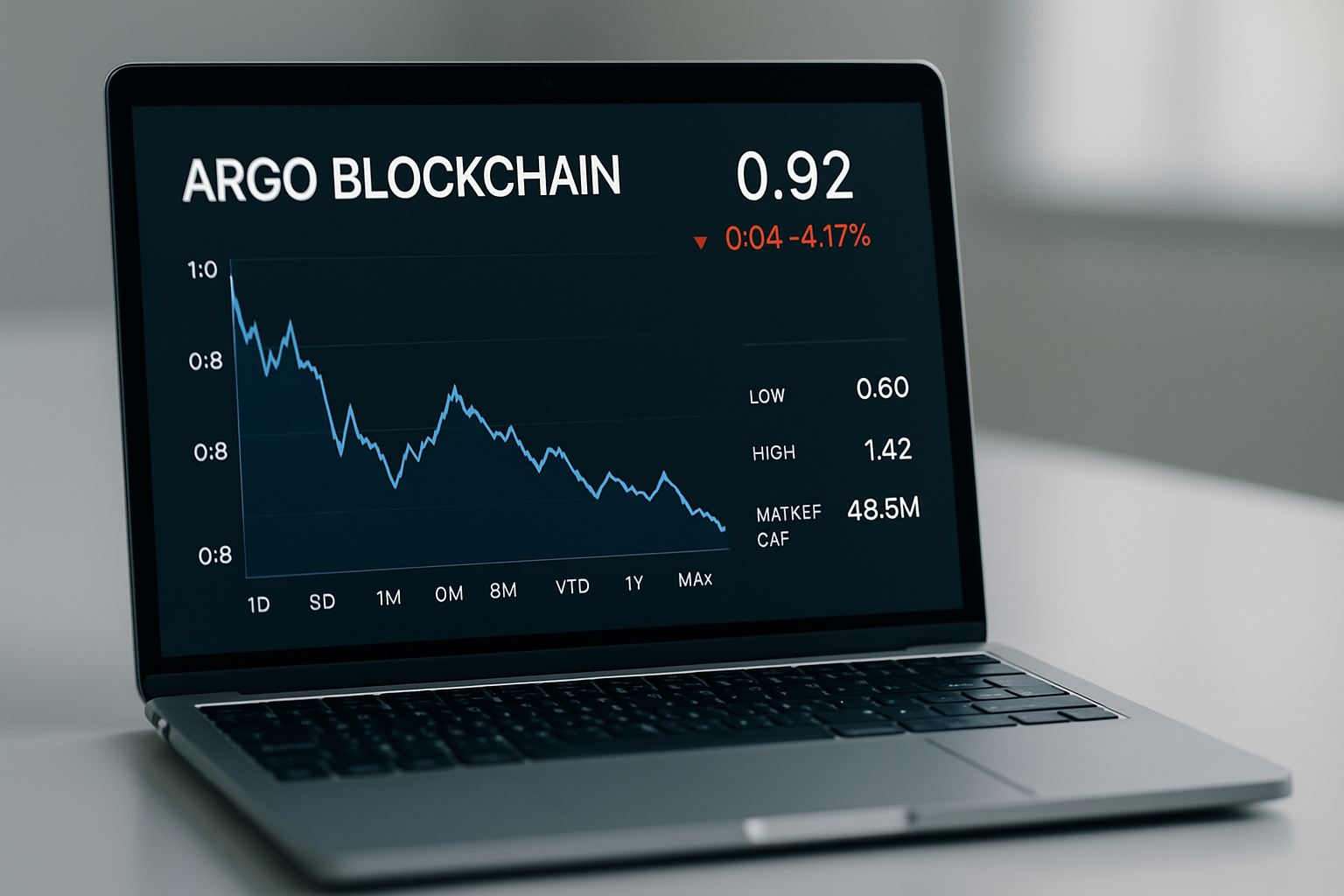
blockchain stock has experienced extreme volatility since its Nasdaq debut, with a 52-week range spanning from $2.63 to $205.20, per Robinhood data. That spread reflects the distorting effect of the reverse stock split, which briefly inflated the share price to meet Nasdaq’s $1 minimum bid requirement before the market repriced the underlying equity.
On June 5, 2026, shares closed at $3.44 with a daily range of $3.27 to $3.71. The current price sits roughly 98% below the 52-week high. For context, that kind of drawdown is not unusual for micro-cap miners post-restructuring. It does, however, set a very high bar for any recovery thesis.
London Stock Exchange Listing and Delisting
Argo originally traded on the London Stock Exchange under the symbol ARB. According to Stockopedia, the London share price at last trade was 0.80p, giving a market cap of approximately £5.77 million. In December 2025, Argo called a general meeting to approve the cancellation of its London listing, a move intended to reduce costs and regulatory burdens.
The delisting took effect in early 2026, after which London shares converted to Nasdaq-listed ADRs. This consolidation left Nasdaq as the sole public market for Argo Blockchain stock. For U.S. investors, that simplifies access. For the company, it eliminates the dual-listing overhead that was draining a small treasury.
Key Financial Metrics and Quarterly Results
For the fiscal year ended December 31, 2024, Argo reported a net loss of $55.12 million and earnings per share of approximately -$195.89, according to CNN Money. The company’s price-to-sales ratio stands at 0.22, and it pays no dividend. Market capitalization was approximately $50.34 million as of June 5, 2026, based on Morningstar data.
A price-to-sales ratio below 0.25 can look attractive in isolation. Here, it reflects a market that is pricing in serious execution risk and balance sheet stress, not a hidden value opportunity. The net profit margin of approximately -135% tells the fuller story.
Balance Sheet and Cash Flow Analysis

Argo’s balance sheet is the most critical risk factor for ARBK investors, and it deserves more attention than most retail analysis gives it.
According to Stockopedia data, Argo’s enterprise value stands at approximately £34.60 million against a market cap of roughly £5.77 million. That gap signals substantial debt relative to equity. The company operates with negative equity, meaning liabilities exceed assets on the books. A Piotroski F-Score of 1 out of 9 places Argo firmly in distress territory. The Z-Score similarly falls in the distress range, a quantitative signal that bankruptcy risk is non-trivial.
Cash flow from operations has been negative in recent periods, meaning the company has been burning cash to sustain mining activity. Any prolonged Bitcoin price weakness or unexpected capital expenditure could force another equity raise, diluting existing shareholders. That dilution risk is real and should factor into any position sizing decision.
“Miners with weak balance sheets face a binary outcome after a halving: either Bitcoin prices rise enough to restore margins, or the company is forced to raise capital at distressed valuations.” – Digital Blockchains research note on post-halving miner dynamics, 2024
How to Invest in Argo Blockchain Stock: A Step-by-Step Process

Buying Argo Blockchain stock is straightforward for U.S. investors now that the Nasdaq ADR (ARBK) is the only public listing. Here is a three-step process to become a shareholder.
Step 1: Choose a Brokerage
Most U.S. online brokers offer trading in ARBK American Depositary Shares. The table below compares popular platforms:
| Brokerage | Commission Fees | Fractional Shares | Notes |
|---|---|---|---|
| Robinhood | $0 | Yes | Commission-free; offers real-time data and after-hours trading. |
| Stash | $0 commissions; subscription from $3/mo | Yes | Fractional investing with educational tools; suited for smaller position sizes. |
| Fidelity | $0 online trades | No (ADRs may have minimums) | Full-service broker with deep research tools and SEC filing access. |
| Interactive Brokers | $0.005 per share, min $1 | Yes | Professional platform; supports ARBK on Nasdaq with advanced order types. |
Step 2: Research and Evaluate
Before purchasing, review Argo Blockchain stock performance, financial statements, and recent news. Key resources include the company’s investor relations page, SEC filings on EDGAR, and independent analysis from Morningstar or CNN Money. Pay close attention to Bitcoin price trends, because Argo’s mining revenue is tightly correlated to BTC spot prices.
Also review the risk signals: a Piotroski F-Score of 1 and a Z-Score in the distress range, per Stockopedia, indicate a high probability of financial stress. These are not reasons to automatically avoid the stock, but they are reasons to size any position accordingly and set clear exit criteria before entering.
Step 3: Place an Order
Once you’ve selected a broker and completed your research, log in and search for ticker ARBK. Choose an order type – market or limit – and specify the number of shares or dollar amount. Because Argo Blockchain stock is micro-cap and often thinly traded, limit orders are strongly preferred over market orders. Slippage on a $3 stock with low daily volume can be material. After the order executes, monitor the position alongside Bitcoin price movements and any company announcements.
Factors Driving Argo Blockchain Stock in 2026
Bitcoin Price Correlation and Halving Events
The single largest driver of Argo Blockchain stock remains Bitcoin’s price. As a pure-play miner, Argo’s top line rises and falls with BTC. The 2024 halving reduced block rewards from 6.25 BTC to 3.125 BTC, squeezing margins across the entire mining sector. Bitcoin’s price recovery in late 2025 and into 2026 has helped offset some of that pressure, but the structural margin compression from the halving is permanent until the next price cycle.
Historical data shows that mining stocks often outperform Bitcoin during bull runs, acting as a leveraged proxy on BTC price. That same leverage works in reverse during downturns. For ARBK specifically, the leverage is amplified further by the company’s weak balance sheet, making it one of the higher-beta plays in the mining sector.
AI Compute Pivot and Energy Infrastructure Demand
A new narrative emerging in 2026 is the repurposing of mining facilities for AI and HPC workloads. Argo’s 50 MW of renewable-powered capacity and its Quebec facility – a region with some of North America’s lowest-cost hydroelectricity – place it at the center of this trend. Investor discussion on Stocktwits frequently points to the 40 MW Quebec site as a potential AI compute location.
No major AI contract has been officially announced as of this writing. But the structural logic is sound: AI training clusters require the same high-density power infrastructure as ASIC mining farms, and renewable energy sourcing is increasingly a requirement for hyperscaler procurement. If Argo secures a meaningful AI hosting agreement, it could fundamentally revalue the company’s asset base. That is a genuine optionality argument, not just hype.
Regulatory and Compliance Milestones
Argo’s battle to remain on Nasdaq has been a defining story for the stock. In January 2026, the company regained compliance with the $1 minimum bid price rule after executing a reverse stock split. According to CNN Money, the successful shareholder vote also preserved Argo’s access to U.S. capital markets, which is critical for any future equity raise.
Looking forward, any violation of Nasdaq listing standards – whether minimum bid price, minimum equity, or reporting requirements – could trigger another delisting threat. For a company with negative equity and ongoing losses, that risk is not theoretical. It is an active monitoring item for any ARBK holder.
Director and Institutional Shareholder Activity
Shareholder composition is another signal worth tracking for Argo Blockchain stock. Micro-cap miners at this stage of distress often see significant insider activity, either through open-market purchases that signal conviction or through dilutive share issuances that signal desperation. Stockopedia tracks director dealings and institutional ownership changes for ARBK, and monitoring those disclosures alongside SEC Form 4 filings on EDGAR provides early warning of sentiment shifts at the board level. Any meaningful insider buying at current prices would be a notable positive signal given the stock’s risk profile.
Analyst Forecasts and Price Predictions for ARBK
Wall Street Consensus and Price Targets
Analyst coverage on Argo Blockchain stock is limited, but those who follow the stock provide widely divergent targets. According to CNN Money, the six-analyst consensus breaks down as 33% Buy, 50% Hold, and 17% Sell. The 1-year price forecast ranges from a low of $54 to a high of $216, with a median of $135.
Those numbers imply potential upside of over 3,800% from the $3.44 level. Treat them with extreme skepticism. They almost certainly reflect models built before the reverse stock split and restructuring, which means the per-share figures have not been properly adjusted for the new share count. The directional signal from the consensus – cautiously hold – is more useful than the specific price targets.
Independent Valuation Models (Morningstar Fair Value)
Morningstar’s quantitative fair value estimate for ARBK is $1.18, implying the stock trades at roughly a 391% premium to intrinsic value at current prices. The stock receives a 1-star rating, with a 5-star (strong buy) threshold set at $6.15. This stark contrast with sell-side targets reflects the extreme uncertainty and speculative nature of Argo Blockchain stock at this stage of its corporate lifecycle.
Morningstar’s quantitative model is not infallible, but it is built on reported financials rather than forward projections that may never materialize. For a company with negative equity and a net loss exceeding its annual revenue, a sub-$2 fair value is not an unreasonable anchor.
Risks to the Outlook
The main risks to ARBK price forecasts include further Bitcoin price declines, high debt levels relative to market cap, and ongoing cash burn. The company’s net profit margin of approximately -135% and an F-Score of 1 indicate acute financial stress. Shareholder dilution remains a concern if Argo needs to raise additional capital, which, given the balance sheet, is a realistic scenario.
On the upside, a confirmed AI compute contract or a sustained Bitcoin rally above prior cycle highs could rapidly change the calculus. This is a stock where the range of outcomes is genuinely wide, and position sizing should reflect that.
Competitors and Industry Position
How Argo Compares to Other Bitcoin Miners
In the micro-cap mining space, Argo competes with firms like BTC Digital Ltd. (BTCT), Abits Group Inc (ABTS), and SOLAI Limited (SLAI). According to the competitor data on CNN Money, these peers all carry market caps under $30 million and trade in the single-digit dollar range.
Larger rivals like Marathon Digital (MARA) and Riot Platforms (RIOT) operate at multi-exahash scale, giving them better economies of scale and access to cheaper capital. Argo’s 1.7 EH/s hash rate is respectable for its size but cannot compete on raw scale. The differentiation argument rests on renewable energy sourcing and the AI pivot optionality, both of which are harder for large-scale operators to replicate quickly at Argo’s specific facility locations.
Financial Health and Survival in the Sector
Argo’s financial stability is among the weakest in the sector. Stockopedia assigns a StockRank of 9 out of 100, with a Quality score of 5, Value score of 43, and Momentum score of 17. The return on capital is deeply negative, and the company operates with negative equity.
In the current environment of tight mining margins post-halving, many analysts question whether Argo can survive without a significant strategic transformation. The AI compute pivot is the most credible path to that transformation. Without it, the financial trajectory points toward further capital raises, continued dilution, and the possibility of another compliance crisis on Nasdaq.
Pros and Cons
Pros
- Renewable energy infrastructure: 50 MW of predominantly renewable-powered capacity is a genuine asset in an era of ESG scrutiny and AI compute demand.
- AI pivot optionality: The Quebec facility represents real optionality for high-density compute hosting, a market growing faster than Bitcoin mining.
- Low price-to-sales ratio: At 0.22x sales, the stock is priced for distress, meaning any positive operational surprise could produce outsized returns.
- Nasdaq compliance restored: Regaining listing compliance in January 2026 removes one near-term existential risk and preserves access to U.S. capital markets.
- Sole Nasdaq listing: Consolidating to a single exchange reduces administrative overhead and simplifies the capital structure going forward.
Cons
- Deeply negative financials: A net loss of $55.12 million on $48.53 million in revenue, negative equity, and a Piotroski F-Score of 1 signal acute financial distress.
- Extreme volatility: A 52-week range of $2.63 to $205.20 reflects structural instability, not normal market fluctuation.
- Dilution risk: Ongoing cash burn and negative equity make future equity raises likely, which would further dilute existing shareholders.
- Bitcoin dependency: With nearly all revenue tied to BTC mining, any sustained price decline directly threatens the company’s ability to operate.
- Morningstar overvaluation signal: An independent fair value of $1.18 against a $3.44 share price suggests the market is pricing in a recovery that has not yet materialized.
- Tiny team: 13 employees executing a complex AI infrastructure pivot is an operational risk that larger competitors do not face.
Frequently Asked Questions
What is Argo Blockchain?
Argo Blockchain is a UK-based company that mines Bitcoin and other cryptocurrencies using specialized ASIC hardware. As of 2026, it is also exploring AI and high-performance computing infrastructure as a second revenue stream, using its existing 50 MW of renewable-powered capacity in North America.
Is Argo Blockchain stock delisting?
No. As of June 2026, Argo remains listed on Nasdaq under the ticker ARBK. The company did delist from the London Stock Exchange in early 2026 to reduce costs, but Nasdaq remains its sole public market after regaining compliance in January 2026.
How can I buy Argo Blockchain stock?
You can purchase Argo Blockchain stock through any brokerage that offers Nasdaq trading, including Robinhood, Stash, Fidelity, and Interactive Brokers. Search for ticker ARBK. Because it is a micro-cap with low daily volume, use limit orders rather than market orders to avoid slippage.
What happened to Argo Blockchain stock in 2025 and 2026?
Argo underwent a significant restructuring that included delisting from the London Stock Exchange and executing a reverse stock split to regain Nasdaq compliance. The stock experienced extreme volatility, with a 52-week range of $2.63 to $205.20. The high reflects the post-split price spike; the current price near $3.44 reflects the market’s reassessment of the underlying equity value.
Will Argo Blockchain stock recover?
Recovery depends on two variables: Bitcoin price trends and the success of the AI compute pivot. Analyst price targets range from $54 to $216, but Morningstar’s independent fair value estimate of $1.18 suggests the stock may already be overvalued. The company’s weak financials make this a high-risk, speculative position rather than a straightforward recovery story.
What is the price prediction for Argo Blockchain stock?
Wall Street price targets range from $54 to $216, while Morningstar’s quantitative fair value sits at $1.18. These discrepancies reflect the extreme uncertainty surrounding ARBK. The most defensible view is that outcomes are binary: either the AI pivot succeeds and the stock reprices significantly higher, or the financial distress continues and the stock trends toward zero.
Ready to build infrastructure that actually scales? Apply to the Genesis Cohort at Digital Blockchains and work with a team that deploys production-grade blockchain and compute infrastructure.