Key Takeaways
- Blockchain certification is a formal credential validating expertise in distributed ledgers, smart contracts, and decentralized systems, with the global market projected to hit $94B by 2027.
- Top programs range from developer-focused credentials by Blockchain Council and 101 Blockchains to compliance-oriented designations from ACAMS and DACFP.
- Certified blockchain developers average $185K in annual salary, with roles spanning developer, architect, legal consultant, and enterprise project manager.
- Many programs offer lifetime access, CPD accreditation, and digital badges; DACFP’s CBDA designation is FINRA-listed for financial professionals.
- Free introductory courses from Great Learning and IBM build foundational knowledge, but paid certifications deliver deeper, verifiable skills for career advancement.
- On-chain verifiable credentials are emerging as the standard for tamper-proof proof of achievement, aligning with the decentralized model blockchain itself represents.
Blockchain certification is a professional credential that verifies expertise in distributed ledger technology, smart contracts, and decentralized applications. It opens roles in fintech, supply chain, and enterprise IT, with developer salaries averaging $185,000.
What Is a Blockchain Certification?

Blockchain certification is a formal recognition of an individual’s knowledge and skills across distributed ledger systems, consensus mechanisms, smart contract development, and decentralized applications. It’s typically awarded after completing a structured course and passing an examination administered by an accredited organization. According to the Blockchain Council, such certifications are CPD accredited and recognized in over 145 countries, validating real-world expertise that employers trust.
Blockchain technology itself is a decentralized, immutable ledger that records transactions across a network of computers, as explained by MIT Professional Education. Each block contains a cryptographic hash of the previous block, transaction data, and a timestamp, making the chain tamper-resistant. Understanding these fundamentals is the baseline for any serious certification program.
Why Certification Matters in Blockchain
Certification signals a baseline competency in a field where technical complexity creates real hiring friction. For employers, a verified credential reduces hiring risk. For professionals, it provides a structured learning path and a marketable signal. The demand for blockchain skills is accelerating: the global blockchain market is projected to grow at a 66.2% CAGR to reach $94 billion by 2027, per data cited by the Blockchain Council. With an estimated 3.5 million blockchain jobs expected by 2028, a credential can separate you from an increasingly crowded applicant pool.
Core Competencies Covered
Most blockchain certifications cover a core set of topics: blockchain architecture, cryptography, smart contracts, decentralized finance (DeFi), and enterprise use cases. Developer-focused programs go deep on Solidity, Ethereum, and Hyperledger, while business-oriented credentials emphasize strategy, compliance, and integration. The ISACA Blockchain Fundamentals Certificate, for instance, spans blockchain concepts, usage, and practical labs on encryption and proof of work, with a 2-hour online exam requiring a 65% passing score.
Why Pursue a Blockchain Certification in 2026?

The blockchain industry continues to mature in 2026, with enterprise adoption accelerating and regulatory frameworks solidifying across major jurisdictions. Certification offers both technical and non-technical professionals a concrete competitive edge. Here are the primary drivers:
- Explosive Market Growth: The blockchain market’s projected value of $94B by 2027, growing at a 66.2% CAGR, indicates sustained demand for skilled talent across every vertical.
- Premium Salaries: Blockchain developers command an average salary of $185,000, according to industry research cited by the Blockchain Council.
- Global Opportunities: Over 145 countries are actively hiring blockchain professionals, spanning finance, healthcare, supply chain, and government sectors.
- Career Future-Proofing: With Web3, DeFi, and tokenization expanding, certified experts are positioned for roles that didn’t exist three years ago.
Industry Adoption and Job Creation
According to ISACA, the enterprise market for blockchain was expected to reach $19.9 billion by 2025. The number of blockchain jobs is projected to hit 3.5 million by 2028. These figures underscore the urgency for professionals to upskill now rather than after the market tightens. Certification acts as a bridge for career switchers and a seal of approval for experienced engineers moving into Web3.
Salary and ROI of Certification
The return on investment for a blockchain certification is straightforward to model. Most programs cost between $200 and $800, while the salary differential for certified professionals is substantial. A blockchain developer with a recognized credential may see a 20-30% salary premium over non-certified peers, based on community discussions on Reddit’s ethdev community. Certified professionals also tend to move into higher-compensation roles like blockchain architect or technical project manager faster than their uncertified counterparts.
Types of Blockchain Certifications

Blockchain certifications fall into distinct categories based on target audience and technical depth. Choosing the right type depends entirely on your career stage and goals.
Developer-Focused Certifications
These programs teach smart contract coding, dApp construction, and consensus mechanism implementation. Examples include the Certified Ethereum Expert™ from Blockchain Council and the Certified Web3 Blockchain Developer (CW3BD)™ from 101 Blockchains. They typically require prior programming knowledge and cover Solidity, Truffle, and integration with Ethereum or Hyperledger. GSDC’s Blockchain Ethereum Developer Certification ($300) focuses on designing and deploying secure decentralized applications, per GSD Council.
Here’s a minimal Solidity contract structure that developer certification programs typically use as a starting exercise:
// SPDX-License-Identifier: MIT

 }

 }

 }
}
Understanding ownership patterns, reentrancy risks, and access control is exactly what separates a certified developer from someone who watched a YouTube tutorial.
Business and Enterprise Certifications
Designed for managers, consultants, and executives, these certifications emphasize blockchain strategy, ROI modeling, and enterprise implementation. The Certified Enterprise Blockchain Professional (CEBP)™ from 101 Blockchains (30 lessons, $399) and the Blockchain Professional Certification from GSDC ($200) fall into this category. They cover use cases across supply chain, finance, and healthcare without requiring heavy coding knowledge. MIT Professional Education’s program also targets business leaders seeking to integrate distributed ledger technology into existing operations.
Compliance and Security Certifications
With crypto regulations tightening globally, certifications that blend blockchain with anti-money laundering (AML) and security are gaining real traction. ACAMS offers a Cryptoasset and Blockchain Certificate ($595 for members, $795 for non-members) covering wallet tracing, risk mitigation, and VASP identification, per ACAMS. The Certified Blockchain Security Expert (CBSE)™ from 101 Blockchains (67 lessons, $399) addresses smart contract vulnerabilities and consensus attacks in depth.
Top Blockchain Certification Providers Compared
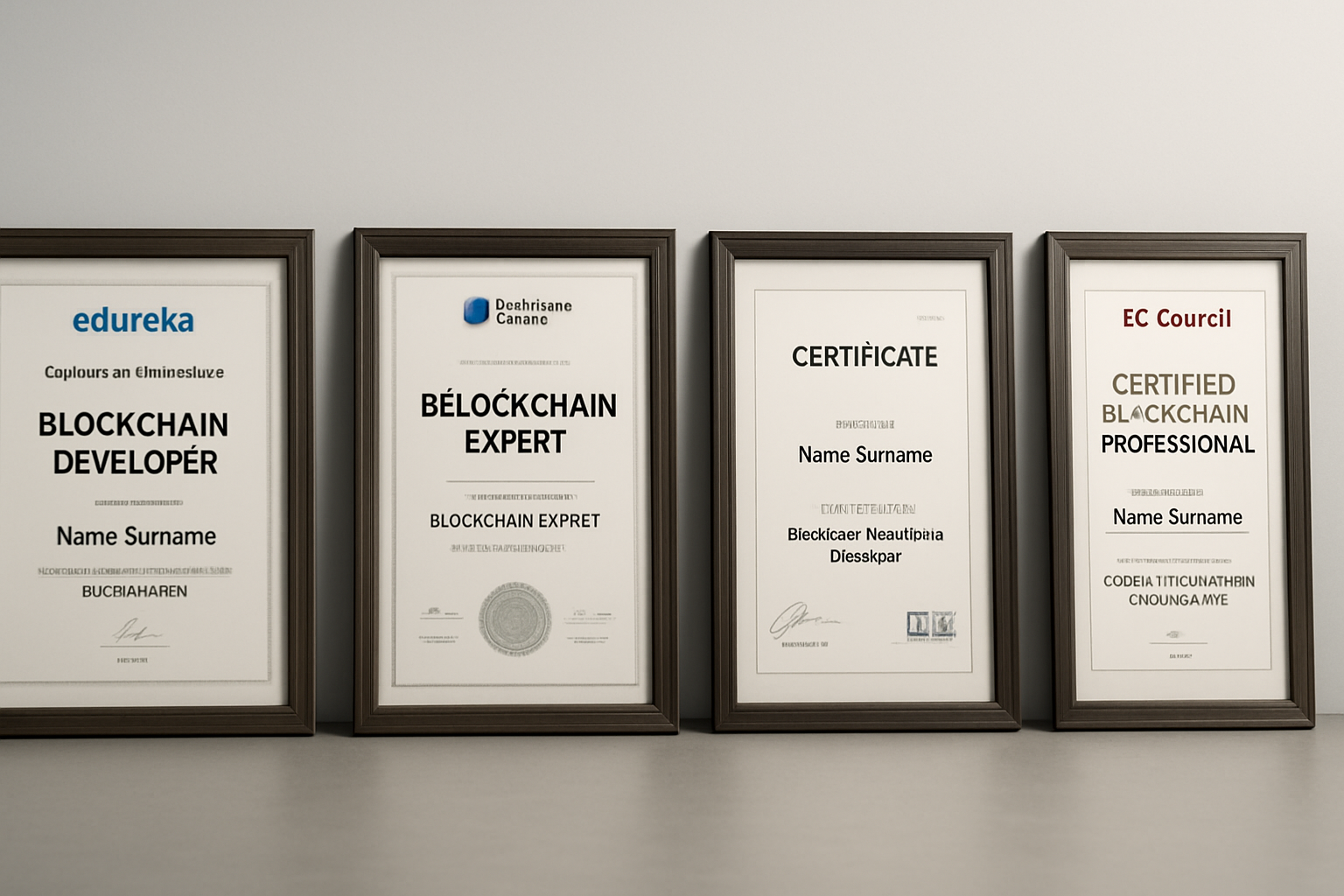
Below is a comparison of leading blockchain certification providers as of 2026. The table highlights focus areas, costs, and unique features to help you decide where to invest your time and money.
| Provider | Certification(s) | Focus Area | Cost (USD) | Duration | Accreditation/Recognition |
|---|---|---|---|---|---|
| Blockchain Council | Certified Blockchain Expert™, Certified Ethereum Expert™, etc. (24+ programs) | Developer, business, DeFi | Estimated $300-$500 | 4-10 hours, self-paced | CPD Accredited, 145+ countries |
| 101 Blockchains | CEBP™, CW3BD™, CBSE™, etc. | Enterprise, Web3, security | $399 each | 30-350 lessons, self-paced | Accredited; used by IBM, Microsoft |
| ISACA | Blockchain Fundamentals Certificate | Principles, usage, labs | Not disclosed (course + exam) | 2-hour exam, online | Globally recognized, CPE credits |
| DACFP | CBDA Designation (Certified Blockchain and Digital Assets) | Bitcoin, Ethereum, DeFi, regulation | Not disclosed (scholarships available) | Self-paced, up to 18 CE credits | FINRA-listed |
| GSDC | Blockchain Professional, Architect, Ethereum Developer | Architecture, development | $200-$300 | Self-paced, exam required | Recognized in 100+ countries, lifetime validity |
| ACAMS | Cryptoasset and Blockchain Certificate | Compliance, tracing, risk | $595 (member) / $795 | 4 hours, self-paced | 4 ACAMS credits |
Costs and durations based on provider websites as of 2026; actual prices may vary.
“The blockchain skills gap is real and widening. Employers increasingly use certification as a first-pass filter because it signals both technical competency and the discipline to complete structured learning.” – ISACA Blockchain Fundamentals program documentation
How to Choose the Right Blockchain Certification for Your Career
Selecting the right blockchain certification requires a structured approach, not a Google search and a gut feeling. Follow these steps to make a defensible decision.
Step 1: Define Your Career Goal
Determine whether you want to become a blockchain developer, a project manager, a compliance officer, or a consultant. Developer roles require deep technical certifications, while management or advisory roles benefit from business-oriented programs. A software engineer targeting a Solidity role should pursue the Certified Ethereum Expert™, whereas a compliance officer should go straight to ACAMS’s certificate.
Step 2: Assess Your Current Knowledge Level
Some programs assume zero prior knowledge, like ISACA’s Blockchain Fundamentals or the free Great Learning Blockchain Basics course. Others, such as the Certified Blockchain Security Expert™, expect familiarity with cybersecurity concepts. Review prerequisites carefully before paying for anything.
Step 3: Evaluate Accreditation and Employer Recognition
Accreditation from bodies like the CPD Certification Service or a FINRA listing adds real credibility. Blockchain Council’s CPD accreditation and DACFP’s FINRA listing are significant advantages for finance professionals. Check whether the certification is recognized in your target country or by the specific employers you’re pursuing.
Step 4: Compare Cost and Commitment
Costs range from free (Great Learning) to $795 (ACAMS). A $400 certification that leads to a $10,000 salary increase is a straightforward investment. Factor in exam retake fees and renewal requirements too. GSDC certifications carry lifetime validity with no renewal cost, which changes the long-term math considerably.
IBM’s Free Blockchain Certification: What You Need to Know
IBM offers free blockchain education through its IBM Skills Network and Coursera partnership, making it one of the most accessible entry points for professionals exploring the field. IBM’s blockchain courses cover Hyperledger Fabric architecture, chaincode development, and enterprise use cases, with completion certificates available at no cost through audit enrollment on Coursera.
The IBM Blockchain Foundation Developer course is particularly relevant for developers wanting exposure to permissioned blockchain networks before committing to a paid credential. It covers the Hyperledger Fabric model, including peers, orderers, and channels, which differs substantially from public chain development on Ethereum. For professionals targeting enterprise roles at companies running private blockchain infrastructure, IBM’s free content is a logical first step before investing in a paid certification from 101 Blockchains or ISACA.
“Hyperledger Fabric’s permissioned model is architecturally distinct from public chains. Professionals who understand both paradigms, public and permissioned, are significantly more valuable to enterprise hiring managers.” – Hyperledger Foundation technical documentation
Blockchain Certification for Specific Verticals
Not all blockchain certification paths lead to the same destination. The vertical you target shapes which credential matters most.
Healthcare
Healthcare blockchain applications focus on patient data interoperability, supply chain integrity for pharmaceuticals, and clinical trial transparency. Professionals in this vertical benefit most from enterprise-focused certifications like the CEBP™ combined with domain knowledge in HIPAA compliance. The intersection of data privacy regulations and on-chain transparency creates a specialized skill set that commands premium compensation.
Supply Chain and Logistics
Supply chain is one of the most active deployment areas for enterprise blockchain, with platforms like IBM Food Trust and TradeLens (built on Hyperledger Fabric) demonstrating real production use. Certifications covering Hyperledger, smart contract automation, and IoT integration are most relevant here. Business-oriented credentials from 101 Blockchains or GSDC, combined with IBM’s free Hyperledger coursework, create a strong profile for supply chain roles.
Financial Services and DeFi
Finance professionals need credentials that bridge traditional compliance frameworks with on-chain mechanics. ACAMS’s Cryptoasset and Blockchain Certificate ($595 for members) and DACFP’s FINRA-listed CBDA designation are the two most credible options for this vertical. Both cover AML/KYC procedures, DeFi protocol mechanics, and regulatory reporting requirements that financial institutions actually care about.
Non-Technical Career Paths with a Blockchain Certification
Blockchain certification is not just for coders. A wide range of non-technical roles benefit from credentialing, expanding career options well beyond development. MIT Professional Education highlights roles including blockchain legal consultant, copywriter, public relations specialist, and crypto journalist as legitimate career paths for certified non-technical professionals.
Marketing and Content Creation
As blockchain projects multiply, the need for clear, accurate communication grows proportionally. Certified professionals can craft whitepapers, social media strategies, and educational content that actually holds up to technical scrutiny. A blockchain copywriter with a credential commands higher rates because they can engage with protocol documentation directly, not just repackage press releases.
Legal and Compliance Advisory
Lawyers and compliance officers with blockchain certifications are sought after to navigate evolving digital asset regulations. Credentials like ACAMS’s Cryptoasset and Blockchain Certificate provide the technical context needed for AML/KYC procedures in crypto businesses, where understanding wallet tracing and VASP identification is now a baseline requirement.
Project Management and Business Development
Certifications like the Certified Enterprise Blockchain Professional™ prepare individuals to manage blockchain implementations, aligning technology with business goals. These roles often carry salaries above $150,000 and are in active demand across consulting firms like KPMG and Accenture, which regularly hire certified talent per the Blockchain Council.
Free vs. Paid Blockchain Certifications: Which Is Worth It?
Free blockchain certification courses provide an entry point, but paid programs typically offer more depth, hands-on labs, and verifiable credentials that employers actually recognize.
Free Certification Options
Platforms like Great Learning offer a Blockchain Basics course at no cost, covering fundamentals, consensus mechanisms, and cryptography. As of 2026, over 93,000 learners have enrolled in this free course, and more than 10,000 certificates have been claimed, per Great Learning. These are ideal for exploring the field without financial risk, but they rarely include proctored exams or industry-recognized digital badges.
Why Paid Certifications Deliver Greater ROI
Paid certifications from 101 Blockchains ($399) or GSDC ($200-$300) include rigorous exams, lifetime access to updated content, and shareable credentials on LinkedIn. They’re more likely to be recognized by major employers like IBM, Microsoft, and KPMG, according to the Blockchain Council. Community sentiment on Reddit’s ethdev community consistently shows that recruiters treat paid certifications as a stronger signal of commitment and technical depth.
Pros and Cons of Blockchain Certification
Blockchain certification offers real advantages, but it’s not the right move for every professional at every stage. Here’s an honest assessment.
Pros
- Verified credibility: A recognized credential from ISACA, ACAMS, or Blockchain Council signals competency to employers who can’t evaluate raw technical skill in a 30-minute interview.
- Structured learning path: Certification programs force you to cover areas you’d otherwise skip, including cryptography, consensus mechanisms, and compliance frameworks.
- Salary premium: Certified professionals consistently report 20-30% higher compensation than non-certified peers in equivalent roles.
- Global portability: CPD-accredited and FINRA-listed credentials are recognized across 100+ countries, making them useful for international career moves.
- On-chain verification: Emerging NFT-based digital badges from providers like 101 Blockchains allow instant, tamper-proof credential verification by any employer worldwide.
Cons
- Variable quality: The certification market is crowded with low-quality programs. Without careful vetting of accreditation, a credential can be worthless or actively misleading on a resume.
- Cost without guarantee: Programs ranging from $200 to $795 represent real financial risk if the credential isn’t recognized by your target employers.
- Rapid obsolescence: Blockchain technology evolves fast. A certification earned in 2022 may not reflect current protocol standards without active renewal or continuing education.
- Not a substitute for portfolio: Most senior hiring managers in Web3 weight deployed code and on-chain activity above any certification. A credential opens doors; your GitHub closes the deal.
Accreditation and Verification: Ensuring Your Credential Holds Value
As the certification market grows, so does the risk of worthless credentials. Accreditation and digital verification mechanisms are critical for ensuring your blockchain certification carries real weight with employers.
What Is Accreditation?
Accreditation means a certification program has been reviewed by an independent body for educational quality and rigor. Blockchain Council certifications are CPD accredited by The CPD Certification Service, a UK-based organization. DACFP’s CBDA designation is listed by FINRA, a significant trust signal for financial advisors. GSDC certifications are recognized in over 100 countries, though they don’t specify an external accreditation body, which is worth noting before you invest.
The Rise of On-Chain Verifiable Credentials
A significant trend in 2026 is the issuance of blockchain-based digital certificates verifiable on a public ledger. These on-chain credentials prevent forgery and allow instant verification by employers without contacting the issuing institution. Some providers, including 101 Blockchains, issue NFTs or verifiable digital badges storable in a Web3 wallet, ensuring lifelong proof of achievement. This approach aligns with the decentralized model blockchain itself represents and is becoming the standard for high-quality certification programs.
For more on how decentralized identity and credential systems work at the protocol level, see our breakdown of Web3 infrastructure fundamentals and our analysis of how we approach protocol-level builds at Digital Blockchains.
Frequently Asked Questions
What is a blockchain certification?
Blockchain certification is a credential that validates your knowledge of distributed ledger technology, smart contracts, and blockchain applications. It’s earned by completing a structured course and passing an exam from an accredited provider like ISACA, Blockchain Council, or ACAMS.
Is a blockchain certification worth it in 2026?
Yes, with market demand growing and developer salaries averaging $185K, certification can differentiate your profile and lead to higher-paying roles in tech, finance, and compliance. The ROI is strongest when the credential comes from a recognized, accredited provider rather than a generic online course platform.
How long does it take to get blockchain certified?
It varies by program. ISACA’s exam is 2 hours, while self-paced courses from Blockchain Council range from 4 to 10 hours of study. More comprehensive programs from 101 Blockchains can span weeks depending on your pace through 30 to 350 lessons.
What is the best blockchain certification for beginners?
For beginners, ISACA’s Blockchain Fundamentals Certificate or Great Learning’s free Blockchain Basics course are strong starting points. Both cover core principles without requiring prior technical experience, and ISACA’s credential carries global employer recognition.
Can I get blockchain certified for free?
Yes. Great Learning’s Blockchain Basics course and IBM’s free Hyperledger Fabric content on Coursera both provide foundational knowledge at no cost. That said, paid certifications from accredited providers offer more comprehensive content, proctored exams, and credentials that carry more weight with serious employers.
Are blockchain certifications recognized by employers?
Reputable certifications from Blockchain Council, 101 Blockchains, and DACFP are recognized by major companies including IBM, Microsoft, and KPMG, and are shareable directly on LinkedIn. FINRA-listed credentials like DACFP’s CBDA carry additional weight in regulated financial services environments.
If you’re building in Web3 and want to work alongside practitioners who read whitepapers and deploy contracts, apply to the Genesis Cohort at Digital Blockchains. We work with serious builders, not credential collectors.