A blockchain developer course is a structured training program that teaches the technical skills needed to build smart contracts, decentralized applications, and blockchain infrastructure. Programs range from free self-paced tutorials to paid certifications preparing learners for Web3 careers.
Key Takeaways
- developer courses cover Solidity programming, smart contract development, and consensus mechanisms as core subjects.
- Leading platforms like Cyfrin Updraft, Coursera, Udacity, and EC-Council offer programs ranging from 6 hours to several months.
- Job market data from Glassdoor indicates blockchain developer salaries in the U.S. often exceed six figures, reflecting strong demand for specialized talent.
- The best this type of course matches your current skill level, career goals, and preferred learning format, whether online, self-paced, or instructor-led.
- Security-first curricula and multi-chain proficiency (Ethereum, Solana, Hyperledger) are now standard rather than optional add-ons.
- A realistic learning timeline runs about 10 months for someone building job-ready skills from scratch.
Understanding the Blockchain Developer Course Landscape
What Makes a Course “Blockchain Developer” Focused?
A course earns the “blockchain developer” label when it prioritizes hands-on coding over conceptual overviews. It’s the difference between watching a documentary on cars and learning to rebuild an engine. A true developer-focused program emphasizes smart contract deployment, gas mechanics, and integration with existing systems rather than just explaining what a blockchain is.
The Cyfrin Updraft Blockchain Basics course, which has enrolled over 200,000 students according to the platform’s own enrollment data, teaches learners to send transactions, understand gas mechanics, and interact with testnets. Similarly, Udacity’s Blockchain Developer Nanodegree runs roughly 29 hours and requires intermediate JavaScript knowledge going in, which tells you the curriculum targets engineers ready to build production dApps, not total beginners.
The Shift Toward Security-First and Multi-Chain Proficiency
Modern this kind of courses increasingly emphasize security because DeFi protocols hold billions in locked value and a single unchecked vulnerability can drain a treasury overnight. EC-Council’s Blockchain Developer Certification (BDC) integrates secure coding practices and covers development across Ethereum, Hyperledger Fabric, and R3 Corda, giving graduates exposure beyond a single chain. The field has moved past Ethereum-only training. Courses now regularly include Solana and Rust, reflecting growing demand for developers who can work across both public and permissioned networks.
“The biggest mistake we see in junior blockchain hires isn’t a lack of Solidity knowledge. It’s a lack of security intuition. You can teach syntax in a weekend. Teaching someone to think like an attacker takes structured practice.” – common feedback from protocol security teams reviewing audit-readiness in junior developers
What Does a Blockchain Developer Course Cover?
Core Technical Modules
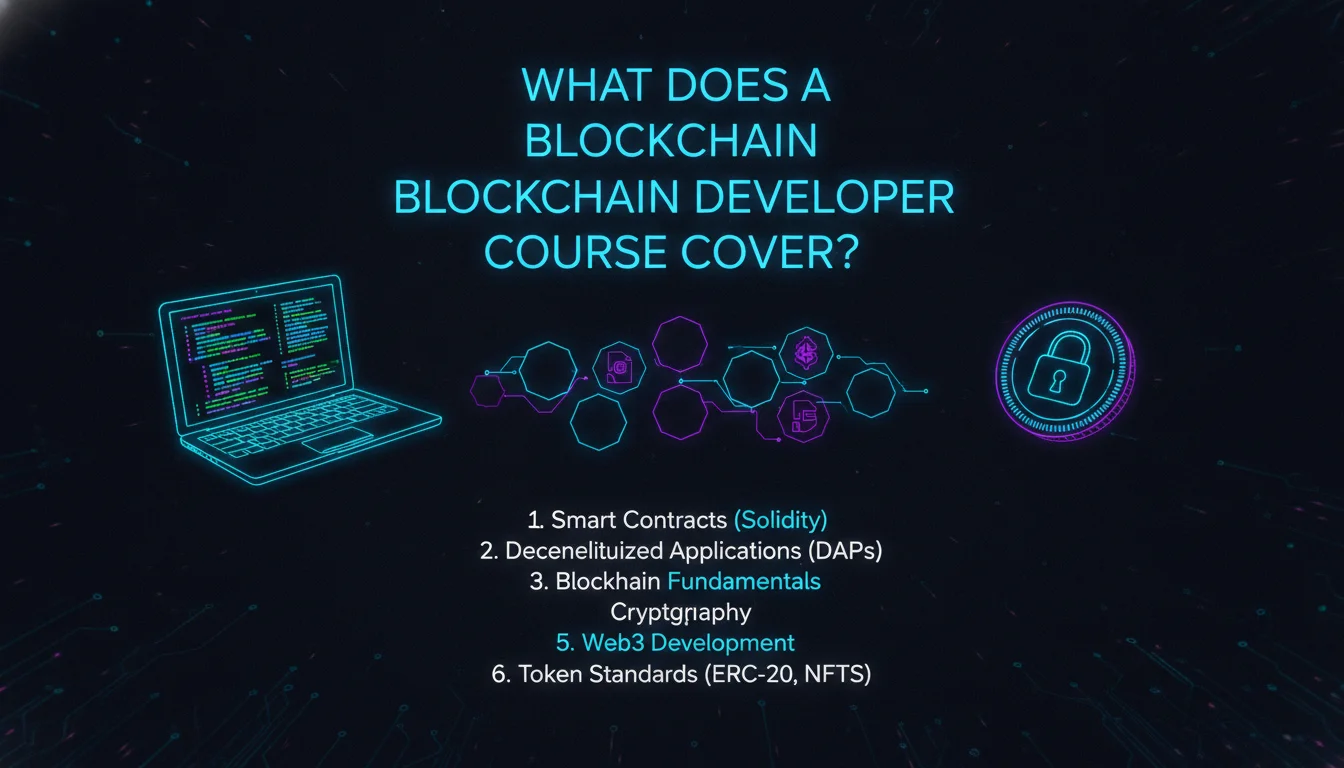
Every solid blockchain developer starts with cryptography and hashing algorithms, the mathematical foundations that guarantee data integrity on a distributed ledger. From there, you move into consensus mechanisms like Proof of Work and Proof of Stake, learning how a decentralized network agrees on which transactions are valid without a central authority.
Course syllabi from Coursera and Udemy show heavy emphasis on smart contract development using Solidity, the primary language for Ethereum and EVM-compatible chains. Udemy alone lists hundreds of blockchain-related courses with an average rating around 4.3, according to the platform’s course catalog data. You’ll also pick up development frameworks like Hardhat and Truffle, version control with Git, and static analysis tools such as Slither.
Advanced Architectures and Scaling Solutions
A rigorous developer course doesn’t stop at the basics. It tackles scalability head-on. Layer-2 solutions such as Optimistic Rollups and ZK-Rollups are now standard curriculum items rather than advanced electives. The roadmap.sh blockchain developer roadmap, tracked by over 10,540 learners according to the site’s public progress tracker, dedicates entire sections to sidechains, state channels, and zero-knowledge proofs.
You’ll also explore oracle networks like Chainlink, which let smart contracts pull in off-chain data such as price feeds or weather conditions. This matters because a contract that can’t verify outside information is limited to purely on-chain logic, which rules out most real-world DeFi and insurance use cases.
// Simple Chainlink price feed consumer in Solidity
pragma solidity ^0.8.19;

import "@chainlink/contracts/src/v0.8/interfaces/AggregatorV3Interface.sol";

contract PriceConsumer {
 AggregatorV3Interface internal priceFeed;

 constructor(address _feedAddress) {
 priceFeed = AggregatorV3Interface(_feedAddress);
 }

 function getLatestPrice() public view returns (int) {
 (, int price, , , ) = priceFeed.latestRoundData();
 return price;
 }
}
Benefits of Pursuing a Blockchain Developer Course in 2026
Career Outcomes and Earning Potential
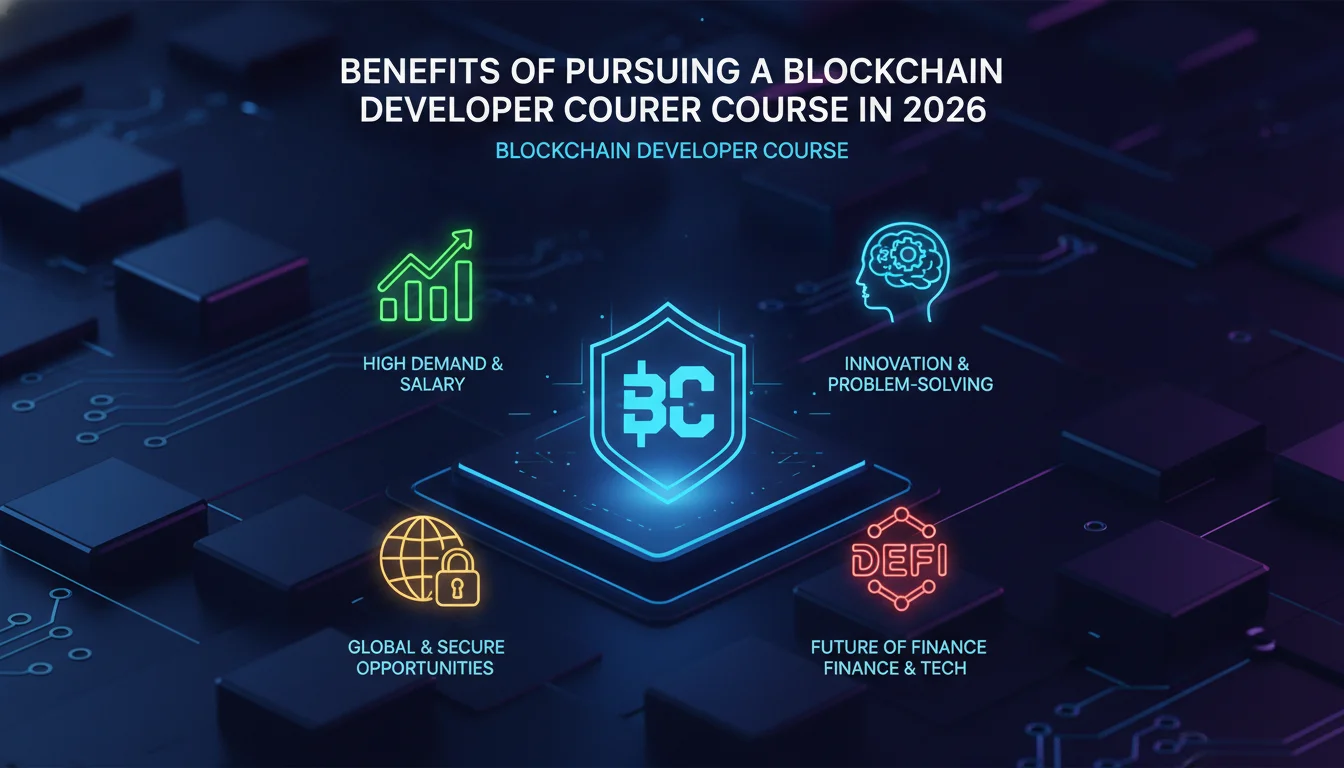
Completing a blockchain developer course pays off in measurable career terms. According to salary data aggregated by Glassdoor, median annual pay for a blockchain developer in the United States exceeds $120,000, with senior roles frequently surpassing $180,000. DeFi metrics indicate the sector continues attracting engineering talent even during market downturns, since protocol maintenance and security auditing remain constant demands regardless of token prices.
Graduates from programs like Alchemy University have moved into engineering roles at Web3 companies, and Cyfrin Updraft’s alumni network includes people now working as auditors, product managers, and founders. That range of outcomes matters: a blockchain developer course isn’t just a ticket to a coding job, it’s a foundation for several adjacent career paths.
Skill Validation and Industry Recognition
A certificate from a recognized platform carries real weight in a hiring process where formal blockchain education is still uncommon. The EC-Council BDC certification is built to be employer-friendly, validating multi-platform development and security competencies rather than just theoretical knowledge. edX offers courses from institutions like the University of Texas at Austin with verifiable credentials, and Coursera hosts a blockchain business models specialization from Duke University that pairs technical concepts with governance and strategy, useful if you’re eyeing a founder or product role rather than pure engineering.
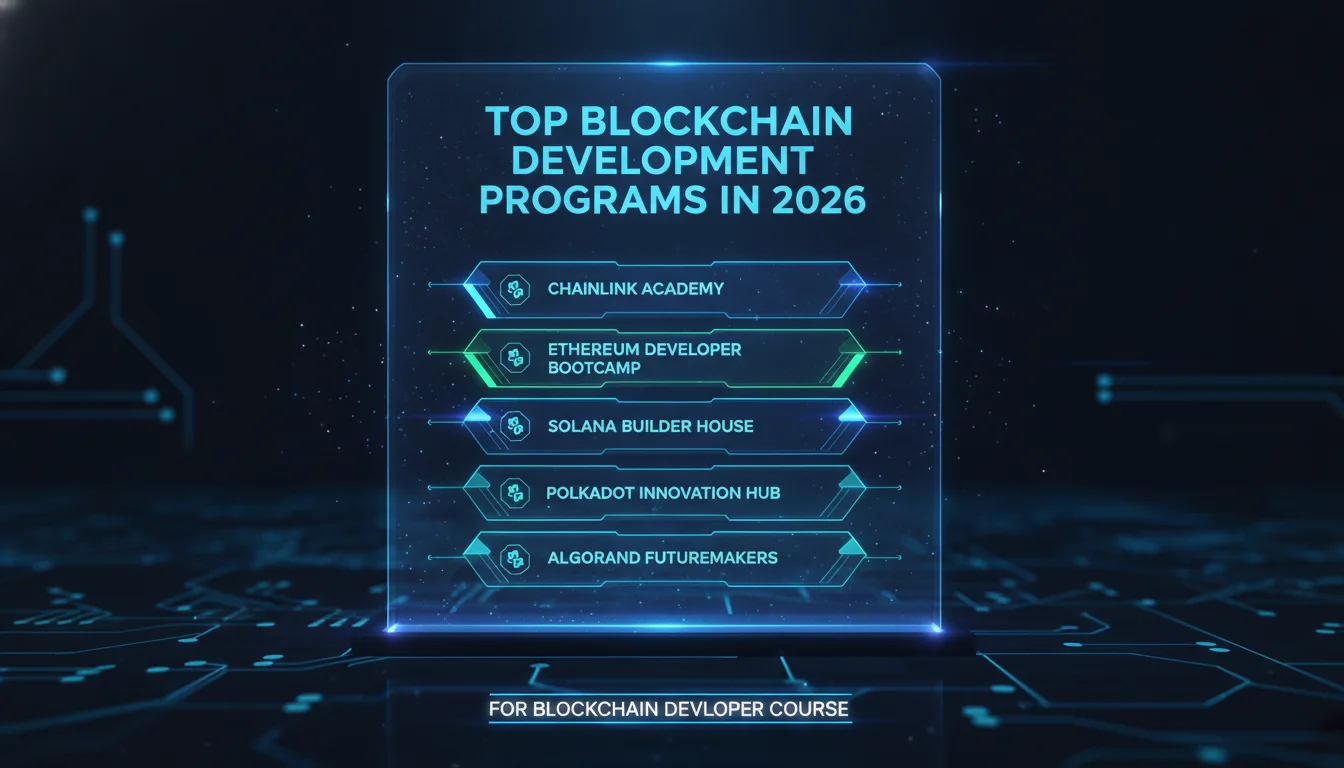
Top Blockchain Development Programs in 2026
Leading Providers at a Glance
Choosing the right blockchain developer course means comparing duration, depth, and delivery format side by side. The table below summarizes reputable options available this year, drawn from platforms that have collectively trained millions of learners.
| Course/Program | Provider | Duration | Level | Key Topics | Price (Approx.) |
|---|---|---|---|---|---|
| Blockchain Basics | Cyfrin Updraft | 6 hours | Beginner | Wallets, gas, consensus, L2, smart contracts | Free |
| Blockchain Developer Nanodegree | Udacity | 29 hours (self-paced) | Intermediate | Solidity, Hardhat, dApp interactions, loan contract project | $249/month or $999 one-time |
| Blockchain A-Z: Build a Blockchain, Crypto, & Smart Contract | Udemy | 14.5 hours | All Levels | Blockchain from scratch, cryptocurrency, consensus | $159.99 (often discounted) |
| Blockchain Developer Certification (BDC) | EC-Council | Varies (bootcamp style) | Intermediate | Ethereum, Hyperledger, Corda, security, AI integration | Contact for pricing |
| Ethereum Bootcamp | Alchemy University | 91 lessons (self-paced) | Intermediate | EVM development, wallets, transactions, tooling | Free |
| Blockchain Specialization | Coursera (Univ. at Buffalo) | 3-6 months | Beginner to Intermediate | Distributed ledgers, consensus theory, applications | Subscription-based |
Free vs. Paid Options: What Do You Get?
Many blockchain developer courses cost nothing, including tracks from Cyfrin Updraft and Alchemy University, both of which are excellent for building foundational knowledge without financial commitment. Paid programs typically add personalized feedback, career coaching, and formal certificates. Udacity’s Nanodegree includes mentorship and project reviews, while the EC-Council BDC includes hands-on labs and a proctored certification exam. Weighing a one-time $999 fee against a starting salary that can clear six figures makes the math straightforward for most serious learners.
Detailed DeFi and NFT Development Modules
DeFi and NFT modules teach the two application categories that generate the most real-world smart contract activity today. Rather than treating these as side topics, strong courses build dedicated units around them because they map directly to hiring demand.
A DeFi module typically covers lending protocol mechanics (collateralization ratios, liquidation logic), automated market maker math, and yield-bearing token standards. On-chain data from aggregators like DefiLlama shows lending and DEX protocols consistently rank among the largest categories by total value locked, which is exactly why courses like Udacity’s Nanodegree build their capstone project around a collateralized loan contract. NFT modules cover ERC-721 and ERC-1155 standards, metadata storage patterns (including IPFS), royalty enforcement, and marketplace contract design. If your target course skips both of these, you’re likely looking at a program that stopped updating its curriculum a few years ago.
Hyperledger and Enterprise Blockchain Development
Enterprise blockchain development means building permissioned networks for businesses that need shared, verifiable records without full public transparency. This is a distinct skill set from public chain development, and it’s growing in relevance as banks, supply chain firms, and healthcare networks pilot private ledger systems.
Hyperledger Fabric, one of the frameworks covered in EC-Council’s BDC curriculum, uses a modular architecture with pluggable consensus and channel-based privacy, letting organizations control exactly which participants see which transactions. R3 Corda takes a different approach, built specifically for financial institutions with a focus on legal enforceability of smart contracts. If you’re targeting enterprise roles rather than public DeFi work, prioritize a blockchain developer course that dedicates real curriculum time to these permissioned frameworks rather than mentioning them in passing.
How to Choose the Right Blockchain Developer Course
A Step-by-Step Decision Framework
Choosing the right program comes down to matching six factors to your situation rather than picking whatever ranks first in a search. Follow this process to narrow your options systematically.
- Assess Your Current Skill Level: If you’re completely new to programming, look for courses with JavaScript or Python prerequisites built in. Udacity requires intermediate JavaScript going in, while Coursera’s Blockchain Specialization from the University at Buffalo is more theory-heavy and beginner-friendly.
- Define Your Career Goal: Decide if you’re aiming to become a core blockchain developer working on protocol-level code, or a blockchain software developer building dApps. Core roles demand deep understanding of consensus algorithms and networking; software roles focus on smart contracts and front-end integration.
- Check the Tech Stack: Examine the syllabus for languages and frameworks. Solidity remains essential for Ethereum development, and Rust is increasingly important for Solana and other high-performance chains. A good course also teaches MetaMask, Remix, Hardhat, and ethers.js.
- Look for Hands-On Projects: Real learning happens by building, not watching. Udacity’s final project requires coding a collateralized loan smart contract, while Cyfrin Updraft has you send actual testnet transactions. Confirm the course includes multiple portfolio-worthy projects.
- Consider Learning Format and Support: Decide between self-paced video lectures (Udemy) or a structured schedule with peer interaction (Coursera). Check for a Discord community or mentor access. Cyfrin Updraft and Alchemy University both maintain active communities for troubleshooting.
- Evaluate Cost and Certification: Free courses work for getting started, but a paid certificate from a recognized institution like EC-Council or edX can give you an edge in applications. Match your budget against what employers in your target region actually value.
Common Pitfalls to Avoid
Rushing into a blockchain developer course without a plan wastes time and money. Avoid courses that are mostly cryptocurrency trading primers dressed up as development training. Also watch for curricula that haven’t been updated in the last 18 months, since blockchain technology moves fast and stale content means missing Ethereum Improvement Proposals and current L2 networks. Don’t skip fundamentals either. A solid grasp of blockchain architecture pays off later when you’re debugging a smart contract at 2am before an audit deadline.
The 10-Month Roadmap: From Beginner to Pro
Step 1: Build Foundations in Months 1-2
Start by mastering core computer science and programming basics. If you’re new to coding, learn JavaScript or Python, both indispensable for blockchain tooling. Alchemy University’s Learn JavaScript course, taken by over 35,000 students according to the platform’s enrollment figures, is a solid starting point. Study data structures, cryptography basics (hash functions, digital signatures), and how networking works. This phase isn’t about blockchain specifically; it’s building the logical muscle you’ll need later.
Step 2: Learn Blockchain Theory in Months 3-4
Move into blockchain concepts through a dedicated blockchain developer course like Cyfrin Updraft’s Blockchain Basics or Coursera’s Blockchain Specialization. Study distributed ledger architecture, consensus models (PoW vs. PoS), and the full lifecycle of a transaction. Experiment with wallets, explore block explorers like Etherscan, and understand the practical differences between public and private chains. By the end of this phase, you should be able to explain how Bitcoin and Ethereum function at a technical level, not just a conceptual one.
Step 3: Write Smart Contracts in Solidity in Months 5-6
Now write your first smart contract. Enroll in a Solidity-focused blockchain developer course such as Ethereum and Solidity: The Complete Developer’s Guide on Udemy, rated 4.3 out of 5 by over 28,000 learners according to the course’s public rating data. Learn Remix IDE for rapid prototyping, then move to local development with Hardhat or Foundry, practicing deployment to testnets. Cover design patterns like access control, token standards (ERC-20, ERC-721), and upgradeability.
// Basic ERC-20 style access control pattern
pragma solidity ^0.8.19;

import "@openzeppelin/contracts/access/Ownable.sol";
import "@openzeppelin/contracts/token/ERC20/ERC20.sol";

contract MyToken is ERC20, Ownable {
 constructor() ERC20("MyToken", "MTK") Ownable(msg.sender) {
 _mint(msg.sender, 1000000 * 10 ** decimals());
 }

 function mint(address to, uint256 amount) public onlyOwner {
 _mint(to, amount);
 }
}
Step 4: Connect Front-Ends and Build dApps in Months 7-8
Blockchain back-ends are useless without a usable interface. Connect your smart contracts to a front-end using libraries like ethers.js or web3.js. Build simple dApps demonstrating wallet connection, transaction signing, and event listening. A comprehensive blockchain developer course at this stage, such as Udacity’s Nanodegree, walks you through full-stack projects. Add React or Vue for responsive UIs, and learn to handle gas optimization and error states without breaking the user experience.
Step 5: Master Security and Auditing in Months 9-10
The final stretch focuses on security and specialization. Study common attack vectors like reentrancy, front-running, and oracle manipulation, then use tools like Slither and Echidna for automated analysis. Many courses now include a module on AI-assisted security audits, reflecting the industry’s shift toward faster vulnerability detection at scale. Explore scaling solutions like Arbitrum and zkSync, plus account abstraction under EIP-4337. Finish by building a portfolio project, perhaps a DeFi lending protocol or an NFT marketplace, and deploy it to testnet or mainnet. Contributing to open-source blockchain repositories at this stage does more for your job prospects than another certificate.
Emerging Trends: AI and Sustainability in Blockchain Education
How Is AI Changing Blockchain Developer Courses?
AI is changing blockchain developer courses by automating smart contract auditing, accelerating code generation, and adding anomaly detection modules that didn’t exist in curricula even two or three years ago. The EC-Council BDC program teaches AI-assisted performance optimization and security analysis, addressing a persistent shortage of manual auditors relative to the number of contracts being deployed.
Courses are also introducing AI-powered oracle concepts and verifiable machine learning models, preparing developers for data-intensive decentralized applications. As model access gets cheaper, expect generative AI assistants embedded directly in development environments, helping write, test, and deploy contracts without leaving the IDE.