Key Takeaways
- Cosmos is an interoperable blockchain ecosystem designed for scalability across independent chains.
- It uses the Tendermint BFT consensus algorithm for fast, sub-second transaction finality.
- Cosmos SDK lets developers build custom blockchains with modular, composable components.
- The Inter-Blockchain Communication (IBC) protocol enables native cross-chain token and data transfers.
- As of 2026, Cosmos supports over 150 independent blockchains with more than 200 chains built on the SDK.
- ATOM, the native token, serves staking, governance, and fee functions across the ecosystem.
Introduction to the Cosmos Blockchain
Cosmos blockchain is a decentralized network of sovereign, interoperable blockchains built to solve the fragmentation problem that has plagued Web3 since Ethereum’s early days. The project’s core thesis: blockchains should talk to each other natively, not through brittle bridges or centralized relayers.
Most blockchain ecosystems force developers into a single execution environment. You write Solidity, you deploy to Ethereum, and you inherit every constraint that comes with it: gas costs, throughput limits, governance decisions you had no vote in. Cosmos flips that model. Each application gets its own sovereign chain, its own validator set, and its own governance, while still connecting to every other chain in the ecosystem through the IBC protocol.
The vision is an “Internet of Blockchains” where value and data flow as freely between chains as HTTP packets flow between servers. As of 2026, that vision is materially real: over 150 independent blockchains operate within the Cosmos ecosystem, processing billions in daily volume across DeFi, gaming, and institutional infrastructure.
Architecture of the Cosmos Blockchain
Three-Layered Structure
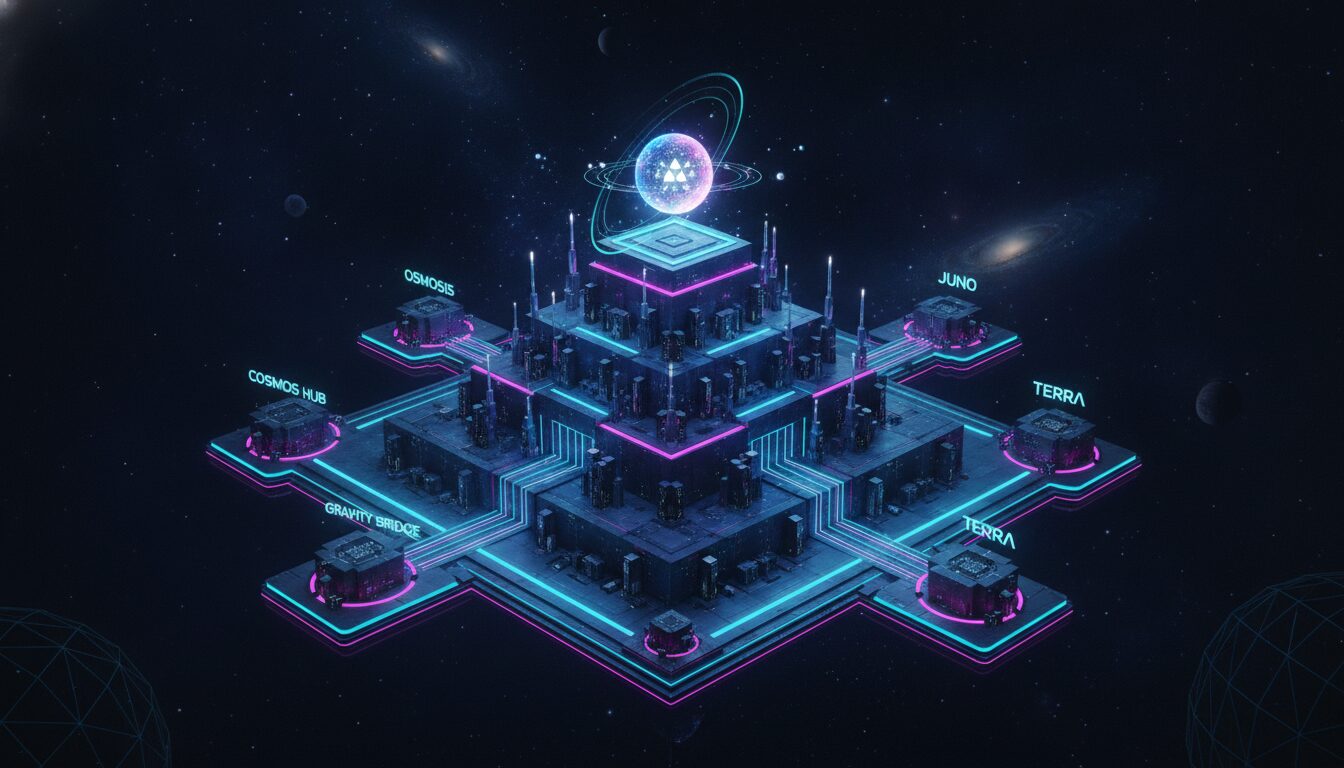
Cosmos separates blockchain concerns into three distinct layers, each independently upgradeable and composable. This separation is what makes the SDK so powerful for application-specific chain development.
- Application Layer: Handles transaction processing, state transitions, and business logic. In Cosmos SDK chains, this is where modules like
x/bank,x/staking, andx/govlive. - Networking Layer: Manages peer discovery, transaction propagation, and block gossip between nodes. Cosmos uses the libp2p-compatible networking stack built into Tendermint Core.
- Consensus Layer: Ensures all validators agree on the canonical chain state. This is where Tendermint BFT operates, providing deterministic finality rather than probabilistic finality.
The clean separation between these layers is enforced through the Application BlockChain Interface (ABCI). ABCI is the socket protocol that lets the consensus engine communicate with the application layer, meaning you can swap out the consensus engine without rewriting your application logic. That’s a level of architectural flexibility that most monolithic chains simply cannot offer.
Tendermint Consensus Algorithm
Tendermint BFT is the consensus engine that powers the Cosmos blockchain’s speed and security guarantees. Unlike Nakamoto consensus (used in Bitcoin), Tendermint achieves instant finality: once a block is committed, it cannot be reversed without compromising more than one-third of the validator set.
The algorithm operates in rounds. Each round has a proposer (selected by weighted round-robin based on stake), who broadcasts a block. Validators then go through two voting phases: Prevote and Precommit. A block is finalized only when more than two-thirds of validators submit Precommit votes. This BFT property means the network tolerates up to one-third of validators acting maliciously or going offline.
In practice, this translates to over 10,000 transactions per second with settlement finality in under one second. For comparison, Ethereum’s base layer processes roughly 15 TPS with probabilistic finality that takes multiple block confirmations to be considered safe. The throughput difference isn’t marginal; it’s structural.
“Tendermint is a high-performance Byzantine fault-tolerant state machine replication engine. It is the consensus algorithm that powers the Cosmos Hub and all chains built with the Cosmos SDK.” – Cosmos Protocol Documentation, Tendermint Core
Cosmos SDK
The Cosmos SDK is a modular framework that allows developers to build custom blockchains tailored to specific needs. Think of it as a blockchain construction kit: you assemble pre-built modules for staking, governance, token issuance, and IBC connectivity, then write custom modules for your application-specific logic.
The SDK is written in Go and follows a module-based architecture. Each module exposes a keeper (for state access), message handlers, and query handlers. Modules communicate through a shared context object, keeping dependencies explicit and auditable.
A minimal Cosmos SDK chain setup looks like this:
// app.go - simplified Cosmos SDK application structure
type App struct {
 *baseapp.BaseApp
 cdc *codec.ProtoCodec

 // Keepers
 AccountKeeper authkeeper.AccountKeeper
 BankKeeper bankkeeper.Keeper
 StakingKeeper stakingkeeper.Keeper
 GovKeeper govkeeper.Keeper
 IBCKeeper *ibckeeper.Keeper

 // Module manager
 mm *module.Manager
}

func NewApp(...) *App {
 app := &App{}
 // Wire modules, set ante handlers, configure IBC
 app.mm = module.NewManager(
 auth.NewAppModule(appCodec, app.AccountKeeper),
 bank.NewAppModule(appCodec, app.BankKeeper, app.AccountKeeper),
 staking.NewAppModule(appCodec, app.StakingKeeper, app.AccountKeeper, app.BankKeeper),
 ibc.NewAppModule(app.IBCKeeper),
 )
 return app
}
Over 200 independent chains have been built using the Cosmos SDK to date, from the Cosmos Hub itself to Osmosis, Celestia, and dYdX v4. The SDK’s maturity and Go’s performance characteristics make it the most battle-tested framework for application-specific blockchain development.
Interoperability in the Cosmos Ecosystem
Inter-Blockchain Communication (IBC)
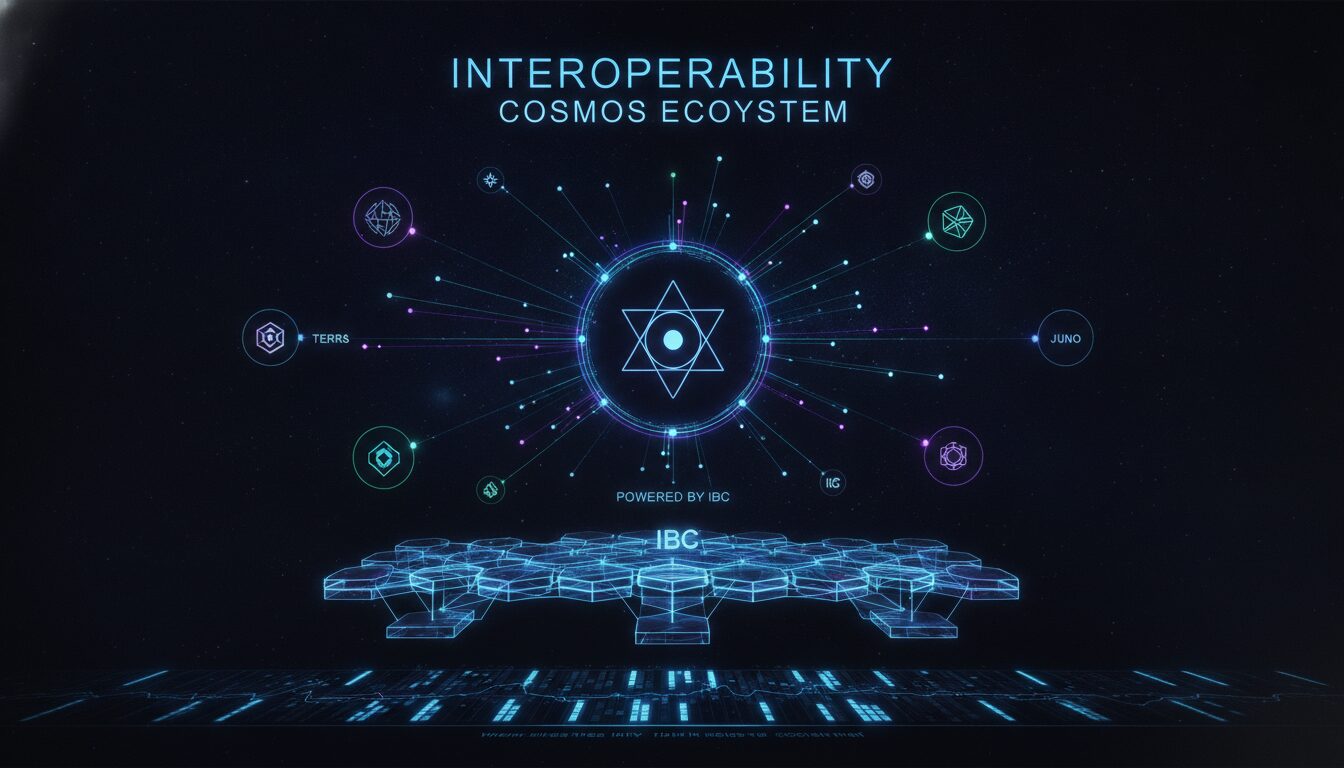
The IBC protocol is the technical foundation of cross-chain interoperability in the Cosmos ecosystem, enabling trustless message passing between any two IBC-enabled chains. Unlike most bridge designs that rely on multisig validators or optimistic fraud proofs, IBC uses light client verification: each chain maintains a light client of the counterparty chain and verifies state proofs cryptographically.
IBC operates through two core abstractions:
- Clients: Light clients that track the consensus state of a counterparty chain.
- Channels and Ports: Ordered or unordered packet channels that applications use to send typed messages (similar to TCP ports in networking).
A token transfer via IBC follows this sequence: the sender chain locks tokens in an escrow account, creates an IBC packet, and submits a proof to the destination chain. The destination chain’s light client verifies the proof against the sender’s latest consensus state, then mints a voucher token representing the locked asset. This is ICS-20, the token transfer standard defined in the Cosmos IBC specification.
The security model here is materially different from trusted bridge designs. There’s no multisig that can be compromised, no oracle that can be manipulated. The security of an IBC transfer is equivalent to the security of both connected chains’ consensus mechanisms.
“IBC is the TCP/IP of blockchains. It provides a permissionless, trustless standard for cross-chain communication that doesn’t require any intermediary or trusted third party.” – Interchain Foundation, IBC Protocol Overview
Benefits of Interoperability
- Increased Liquidity: By connecting multiple blockchains, Cosmos enables capital to flow where it’s most productive without manual bridging steps.
- Enhanced User Experience: Users interact with multiple applications without switching wallets, networks, or RPC endpoints.
- Scalability: Independent chains handle their own throughput, so a congested DeFi chain doesn’t throttle a gaming chain running on the same ecosystem.
- Sovereignty: Each chain controls its own validator set, upgrade schedule, and governance, without being subject to a parent chain’s decisions.
Real-World Applications and Projects
Several production-grade projects demonstrate what the Cosmos blockchain ecosystem can do at scale. These aren’t testnet experiments; they’re live protocols with real economic activity.
Osmosis: The leading decentralized exchange in the Cosmos ecosystem, Osmosis is built as an application-specific chain using the Cosmos SDK. It pioneered superfluid staking, allowing liquidity providers to simultaneously stake OSMO while providing liquidity. According to DeFi metrics tracked on DeFiLlama, Osmosis has consistently ranked among the top IBC-enabled DEXs by volume.
dYdX v4: The perpetuals trading protocol migrated from Ethereum to its own Cosmos SDK chain in 2023. The migration gave dYdX full control over its order book architecture, validator incentives, and fee structure. The chain processes off-chain order matching with on-chain settlement, a design only possible with an application-specific chain.
Celestia: A modular data availability layer built with the Cosmos SDK, Celestia separates data availability from execution and consensus. It’s become a foundational layer for rollup architectures that need cheap, verifiable data posting. Celestia’s architecture directly influenced the modular blockchain thesis that’s reshaping how developers think about chain design in 2026.
Injective Protocol: A DeFi-focused chain built on Cosmos SDK, Injective offers a fully on-chain order book for derivatives, spot trading, and binary options. Its cross-chain composability via IBC connects it to assets from Ethereum, Solana, and other ecosystems through bridge integrations.
Tokenomics of the Cosmos Blockchain
ATOM Token
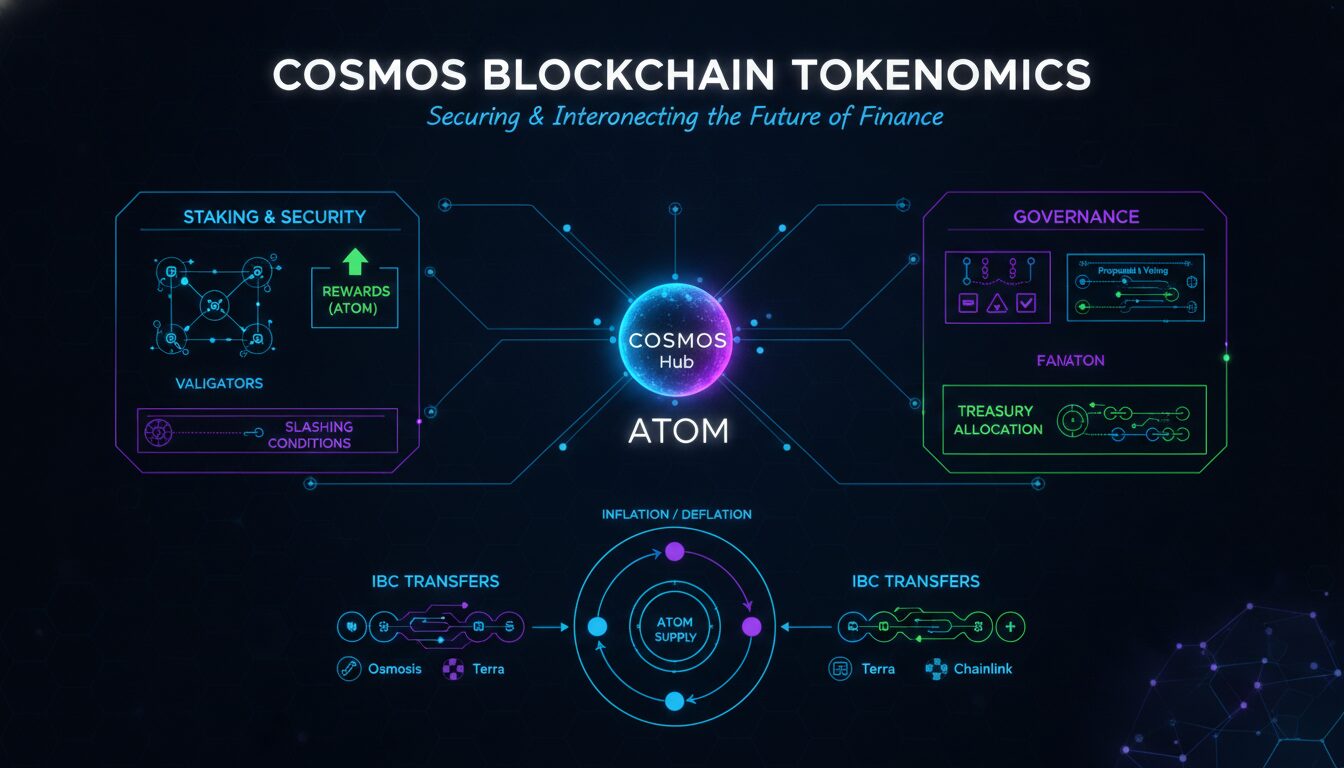
ATOM is the native cryptocurrency of the Cosmos Hub, the first and primary chain in the Cosmos ecosystem. It serves three core functions: paying transaction fees, staking to secure the network, and voting on governance proposals. As of 2026, ATOM’s market cap sits at approximately $738 million, with a circulating supply of 520.89 million ATOM.
ATOM has an inflationary supply model. The protocol targets a staking participation rate of 67%, and the inflation rate adjusts dynamically between roughly 7% and 20% annually to incentivize or discourage staking relative to that target. When staking participation is below 67%, inflation increases to attract more stakers. When it’s above, inflation decreases. This creates a self-regulating incentive mechanism, though it also means ATOM holders who don’t stake face continuous dilution.
Staking and Governance
ATOM holders can participate in staking to secure the network and earn rewards. Staking on the Cosmos Hub requires delegating to one of the active validators (the Hub currently supports up to 180 validators in the active set). Delegators earn a proportional share of block rewards and transaction fees, minus the validator’s commission rate, which typically ranges from 5% to 20%.
Governance is fully on-chain. Any ATOM holder can submit a governance proposal by depositing a minimum amount of ATOM (currently 250 ATOM for the Cosmos Hub). Once the deposit threshold is met, the proposal enters a 14-day voting period. Validators vote on behalf of their delegators unless delegators override with their own vote. Proposals that pass with more than 50% Yes votes (excluding abstain) and less than 33.4% Veto votes are enacted automatically.
This governance model has produced significant protocol changes, including the controversial ATOM 2.0 proposal in 2022, which was ultimately rejected by the community, and subsequent incremental upgrades that have shaped the Hub’s current architecture.
Market Performance and Historical Price Analysis
ATOM’s price history reflects both the broader crypto market cycles and Cosmos-specific narrative shifts. The token launched in April 2019 at roughly $6-7 during the initial exchange offering. It hit its all-time high of $44.70 in September 2021 during the DeFi and altcoin bull run, driven by growing IBC adoption and the launch of Osmosis.
The 2022 bear market hit ATOM hard, as it did most altcoins. The failed ATOM 2.0 proposal added additional selling pressure, as the market reacted negatively to the proposed tokenomics overhaul. As of July 2026, ATOM trades at around $1.42, a significant distance from its 2021 peak.
The price decline doesn’t tell the full story of ecosystem health. IBC transfer volumes, the number of active chains, and developer activity have continued growing even as ATOM’s price has compressed. This divergence between token price and ecosystem activity is a pattern worth tracking: the Cosmos blockchain as infrastructure may be succeeding even as ATOM as a speculative asset faces headwinds from its inflationary supply model and the value accrual debate.
Pros and Cons of the Cosmos Blockchain
Pros
- True sovereignty: Application chains control their own validators, governance, and upgrade schedules without being subject to a parent chain’s decisions.
- High throughput: Tendermint BFT delivers 10,000+ TPS with sub-second finality, far exceeding Ethereum’s base layer performance.
- Trustless interoperability: IBC’s light client verification model is cryptographically secure, avoiding the multisig trust assumptions of most bridge designs.
- Mature developer tooling: The Cosmos SDK, with 200+ production chains built on it, is the most battle-tested framework for application-specific blockchains.
- Modular architecture: The three-layer separation (application, networking, consensus) allows independent upgrades and component swaps without full chain rewrites.
- Active ecosystem: Projects like Osmosis, dYdX v4, Celestia, and Injective demonstrate real production usage across DeFi, data availability, and derivatives.
Cons
- ATOM value accrual problem: The Cosmos Hub’s relationship to the broader ecosystem is loose. Many successful Cosmos chains don’t require ATOM, which limits the token’s fundamental demand drivers.
- Validator bootstrapping cost: Launching a sovereign chain requires recruiting and maintaining a validator set, which adds operational complexity and cost compared to deploying a smart contract.
- Inflationary supply pressure: ATOM’s dynamic inflation model (up to ~20% annually) creates continuous dilution for non-stakers and can suppress price appreciation.
- Fragmented liquidity: While IBC connects chains, liquidity is still distributed across many independent chains, making deep markets harder to achieve than on a single shared execution environment.
- Governance complexity: On-chain governance with 180 validators and thousands of delegators can be slow and contentious, as demonstrated by the ATOM 2.0 rejection.
Comparison of Cosmos with Other Blockchain Solutions
| Feature | Cosmos | Ethereum | Polkadot |
|---|---|---|---|
| Consensus Mechanism | Tendermint BFT | Proof of Stake | Nominated Proof of Stake |
| Transaction Speed | 10,000+ TPS | 15 TPS | 1,000 TPS |
| Interoperability | IBC Protocol | Limited | Cross-Chain Messaging |
| Development Framework | Cosmos SDK | Solidity | Substrate |
| Finality Type | Instant (BFT) | Probabilistic | Instant (GRANDPA) |
| Chain Sovereignty | Full | None (shared) | Partial (relay chain) |
| Native Token | ATOM | ETH | DOT |
The comparison above highlights a fundamental design philosophy difference. Ethereum optimizes for shared security and composability within a single execution environment. Polkadot offers shared security through its relay chain but requires parachains to win slot auctions. Cosmos prioritizes sovereignty: each chain is fully independent, which maximizes flexibility but requires each chain to bootstrap its own security.
For developers choosing between these ecosystems in 2026, the decision often comes down to use case. If you need tight composability with existing Ethereum DeFi liquidity, Ethereum (or an EVM-compatible L2) is the pragmatic choice. If you’re building an application that needs custom throughput, governance, or fee structures, the Cosmos SDK gives you a level of control that neither Ethereum nor Polkadot can match.
How to Build on the Cosmos Blockchain: A Developer’s Starting Point
Building on Cosmos means choosing between two primary paths: deploying a smart contract on an existing Cosmos chain (like Osmosis or Injective, which support CosmWasm), or launching your own application-specific chain using the Cosmos SDK.
Path 1: CosmWasm Smart Contracts
CosmWasm is the WebAssembly-based smart contract platform used across multiple Cosmos chains. Contracts are written in Rust, compiled to Wasm, and deployed on-chain. This path is appropriate for applications that don’t need their own validator set and can operate within an existing chain’s constraints.
// CosmWasm contract entry point - simplified
use cosmwasm_std::{entry_point, DepsMut, Env, MessageInfo, Response, StdResult};
use crate::msg::InstantiateMsg;

#[entry_point]
pub fn instantiate(
 deps: DepsMut,
 _env: Env,
 info: MessageInfo,
 msg: InstantiateMsg,
) -> StdResult<Response> {
 // Store initial state
 let state = State {
 owner: info.sender.clone(),
 count: msg.count,
 };
 STATE.save(deps.storage, &state)?;
 Ok(Response::new()
 .add_attribute("method", "instantiate")
 .add_attribute("owner", info.sender)
 .add_attribute("count", msg.count.to_string()))
}
Path 2: Application-Specific Chain with Cosmos SDK
For teams that need full sovereignty, the Cosmos SDK is the right tool. The typical development lifecycle involves: scaffolding a chain with Ignite CLI (formerly Starport), defining your custom modules, configuring genesis parameters, setting up a testnet validator set, and then launching mainnet with IBC connections to the broader ecosystem.
Ignite CLI can scaffold a new chain in under a minute:
ignite scaffold chain github.com/yourorg/yourchain --no-module
cd yourchain
ignite scaffold module mymodule --ibc
ignite chain serve
From there, you define your module’s message types in protobuf, implement keeper logic in Go, and wire everything through the module manager. The Cosmos SDK documentation and the Interchain Developer Academy (a free online curriculum from the Interchain Foundation) are the best starting resources for teams new to the stack.
What to Expect When Operating in the Cosmos Ecosystem
Whether you’re a developer launching a chain, a validator running infrastructure, or a token holder participating in governance, the Cosmos ecosystem has specific operational realities worth understanding before you commit resources.
For Developers
Expect a Go-heavy development environment. The Cosmos SDK is Go-native, and while CosmWasm supports Rust for contract logic, the chain infrastructure itself requires Go competency. Build times for a full SDK chain are longer than deploying a Solidity contract, and the testing surface area is larger. Budget at least 3-6 months for a production-ready chain launch, including security audits, which typically cost between $50,000 and $200,000 depending on scope and auditor.
For Validators
Running a Cosmos Hub validator requires a meaningful hardware investment. The recommended specs for a production validator are 32GB RAM, 8-core CPU, and NVMe SSD storage with at least 500GB capacity. Validator infrastructure costs typically run $500-$2,000 per month for cloud deployments, depending on redundancy requirements. Slashing conditions apply for double-signing (5% slash) and extended downtime (0.01% slash), so high-availability setups are non-negotiable.
For Token Holders
Staking ATOM through a non-custodial wallet like Keplr or Leap is straightforward. The unbonding period on the Cosmos Hub is 21 days, meaning staked ATOM cannot be transferred or sold for 3 weeks after initiating unstaking. This is a liquidity consideration worth factoring into position sizing. Delegation rewards compound automatically if you redelegate, but gas fees apply to each claim transaction.
Challenges and Future Prospects
Scalability Issues
While Cosmos offers significant scalability advantages at the individual chain level, challenges remain in ensuring that all connected blockchains can handle increased transaction loads without compromising performance. The hub-and-spoke IBC topology can create routing inefficiencies as the number of connected chains grows beyond 150. Direct IBC connections between every pair of chains would require O(n²) relayer infrastructure, which becomes economically unsustainable at scale.
The Value Accrual Debate
One of the most substantive criticisms of the Cosmos model is that ATOM doesn’t automatically capture value from the ecosystem it enables. A chain built on the Cosmos SDK doesn’t need to pay fees to the Cosmos Hub or hold ATOM. This is philosophically consistent with Cosmos’s sovereignty-first design, but it creates a real question about ATOM’s long-term demand drivers. Interchain Security (ICS), which allows Cosmos Hub validators to secure other chains in exchange for fee revenue, is the primary mechanism being developed to address this. As of 2026, ICS is live and being adopted by a growing number of consumer chains.
Regulatory Considerations
As the blockchain space evolves, regulatory scrutiny is increasing across jurisdictions. The Cosmos ecosystem’s decentralized governance structure means there’s no single entity that regulators can target, but individual projects within the ecosystem (particularly DeFi protocols) face the same compliance questions as any other on-chain application. Cosmos must navigate these challenges to maintain its growth trajectory, particularly as institutional adoption of blockchain infrastructure accelerates.
Future Developments
The Cosmos team is actively working on enhancing the ecosystem, including improvements to the IBC protocol and expanding the number of supported chains. The IBC v2 specification introduces significant performance improvements and simplifies the light client architecture. Interchain Security v2 (Partial Set Security) allows consumer chains to select a subset of the Hub’s validator set rather than requiring the full set, reducing costs for smaller chains. Future updates will focus on increasing security and usability for developers and users alike.
Is Cosmos a Dead Crypto? Addressing the Skeptics
The “is Cosmos dead” question comes up regularly, and it deserves a direct answer: no, but the skepticism isn’t baseless.
ATOM’s price is down significantly from its 2021 peak. The ATOM 2.0 proposal failed. Several high-profile Cosmos chains (including dYdX) have indicated they may reduce their dependence on the Cosmos Hub specifically, even while continuing to use the SDK and IBC. These are real headwinds for ATOM as a speculative asset.
But the Cosmos blockchain as infrastructure tells a different story. IBC transfer volumes have grown year-over-year. The number of IBC-enabled chains has increased. Celestia, one of the most technically significant blockchain projects of the past few years, is built on the Cosmos SDK. dYdX v4 chose Cosmos SDK over every other option available. These are not the choices teams make when a technology stack is dying.
The more accurate framing: Cosmos the infrastructure is thriving. ATOM the token faces genuine structural questions about value accrual that the community is actively working to resolve through Interchain Security and other mechanisms. Those are separate questions, and conflating them leads to bad analysis.
Frequently Asked Questions
What is the Cosmos blockchain?
The Cosmos blockchain is a decentralized network of independent, sovereign blockchains designed for interoperability and scalability. It enables trustless communication and token transfers between chains through the IBC protocol, with each chain maintaining full control over its own validators, governance, and upgrade schedule.
How does the Cosmos SDK work?
The Cosmos SDK is a modular Go framework that provides pre-built modules for staking, governance, token transfers, and IBC connectivity. Developers assemble these modules and write custom application logic to create application-specific blockchains without building consensus or networking infrastructure from scratch. Over 200 production chains have been built using the SDK.
What is the role of ATOM in the Cosmos ecosystem?
ATOM is the native token of the Cosmos Hub, used for paying transaction fees, staking to secure the network, and voting on governance proposals. It also plays a role in Interchain Security, where Hub validators secure consumer chains in exchange for fee revenue shared with ATOM stakers.
What are the main benefits of the IBC protocol?
IBC enables trustless, permissionless cross-chain communication using light client verification rather than trusted intermediaries. This means token transfers and data messages between IBC-enabled chains are secured by the cryptographic consensus of both chains, not by a multisig or oracle. It’s the most security-sound cross-chain interoperability standard currently in production.
How does Cosmos compare to Ethereum?
Cosmos offers higher transaction throughput (10,000+ TPS vs. Ethereum’s 15 TPS at base layer) and full chain sovereignty, while Ethereum provides deeper shared liquidity and a larger existing DeFi ecosystem. The right choice depends on whether your application needs tight composability with existing Ethereum protocols or custom chain-level control over throughput, fees, and governance.
Is Cosmos a good investment in 2026?
This isn’t financial advice, but the analytical picture is mixed. The Cosmos blockchain as infrastructure is genuinely used by significant production protocols. ATOM’s value accrual mechanics are weaker than some competing L1 tokens because the ecosystem doesn’t require ATOM to operate. Interchain Security is the primary mechanism being developed to strengthen ATOM’s demand drivers, and its adoption trajectory is worth monitoring before forming a position.