Key Takeaways
- Enterprise blockchain provides an immutable, shared ledger that increases trust and security across business networks.
- Key enterprise blockchain benefits include enhanced security, greater transparency, efficiency gains, and cost savings through disintermediation and automation.
- Smart contracts enable automated, self-executing agreements that reduce manual processing and errors.
- Real-world applications span supply chain, finance, insurance, healthcare, and regulatory compliance.
- The global enterprise blockchain market is projected to reach $145.9 billion by 2030, according to industry market research cited across the sector.
- Adopting enterprise blockchain requires a step-by-step approach covering assessment, platform selection, and scaling.
Enterprise blockchain benefits are the measurable gains, security, transparency, cost reduction, and audit-ready compliance, that businesses realize from deploying permissioned distributed ledgers. These advantages drive adoption across supply chain, finance, and healthcare.
As organizations grapple with data silos, intermediary overhead, and fraud risks, blockchain technology has emerged as a practical infrastructure choice rather than an experiment. As of 2026, enterprise adoption has moved past proof-of-concept theater into production-grade deployments, unlocking blockchain benefits that reshape how value and information move between counterparties. According to Visa’s enterprise blockchain overview, businesses can gain increased security, efficiency, and cost-effectiveness while maintaining regulatory compliance.
“Blockchain creates an audit trail that documents the provenance of an asset at every step,” notes IBM’s research on enterprise blockchain applications, a capability that directly maps to modern regulatory reporting requirements.
What is Enterprise Blockchain?
Defining Enterprise-Grade Distributed Ledger Technology
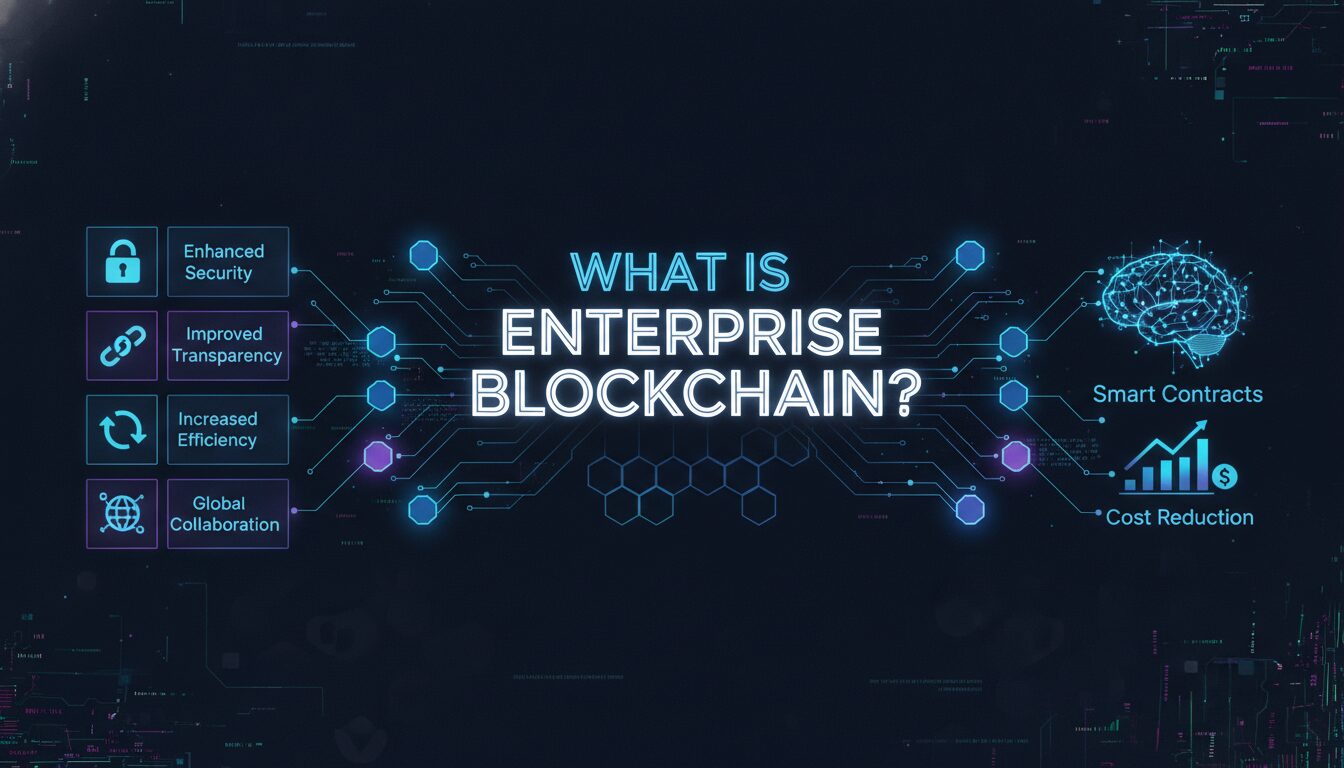
Enterprise blockchain is a permissioned, distributed ledger technology (DLT) built for corporate environments where participants are known and access is controlled. Unlike public, permissionless chains like Bitcoin or Ethereum, an enterprise blockchain restricts transaction validation and data visibility to approved members, preserving confidentiality while still enabling a shared source of truth. Telefónica Tech notes that it “is deployed on private or hybrid networks controlled by individual companies or consortia of organizations,” which keeps sensitive business logic and data protected.
How it Differs from Public Blockchains
A public blockchain operates as an open, trustless system where anyone can join, mine, or transact. A private, permissioned blockchain instead uses identity management and access controls to build a semi-trusted environment among known parties. This architecture removes the anonymity-driven security risks common on public networks while keeping the core benefit of an immutable record. Platforms like Hyperledger Fabric and R3 Corda show what enterprise-focused design actually looks like: throughput, privacy, and modular consensus over open participation.
The Core Components: Nodes, Consensus, and Smart Contracts
An enterprise blockchain consists of a network of nodes, each running a copy of the ledger, a consensus mechanism that governs how transactions get validated, and smart contracts, self-executing code that automates business logic. Consensus in permissioned networks typically runs on practical Byzantine fault tolerance (PBFT) or Raft rather than energy-intensive proof-of-work. PBFT tolerates up to one-third faulty nodes while still reaching agreement, and Raft simplifies leader election for smaller, trusted validator sets. Both approaches enable thousands of transactions per second with finality suitable for real business operations, a meaningful jump over the probabilistic finality of public proof-of-work chains.
Key Enterprise Blockchain Benefits
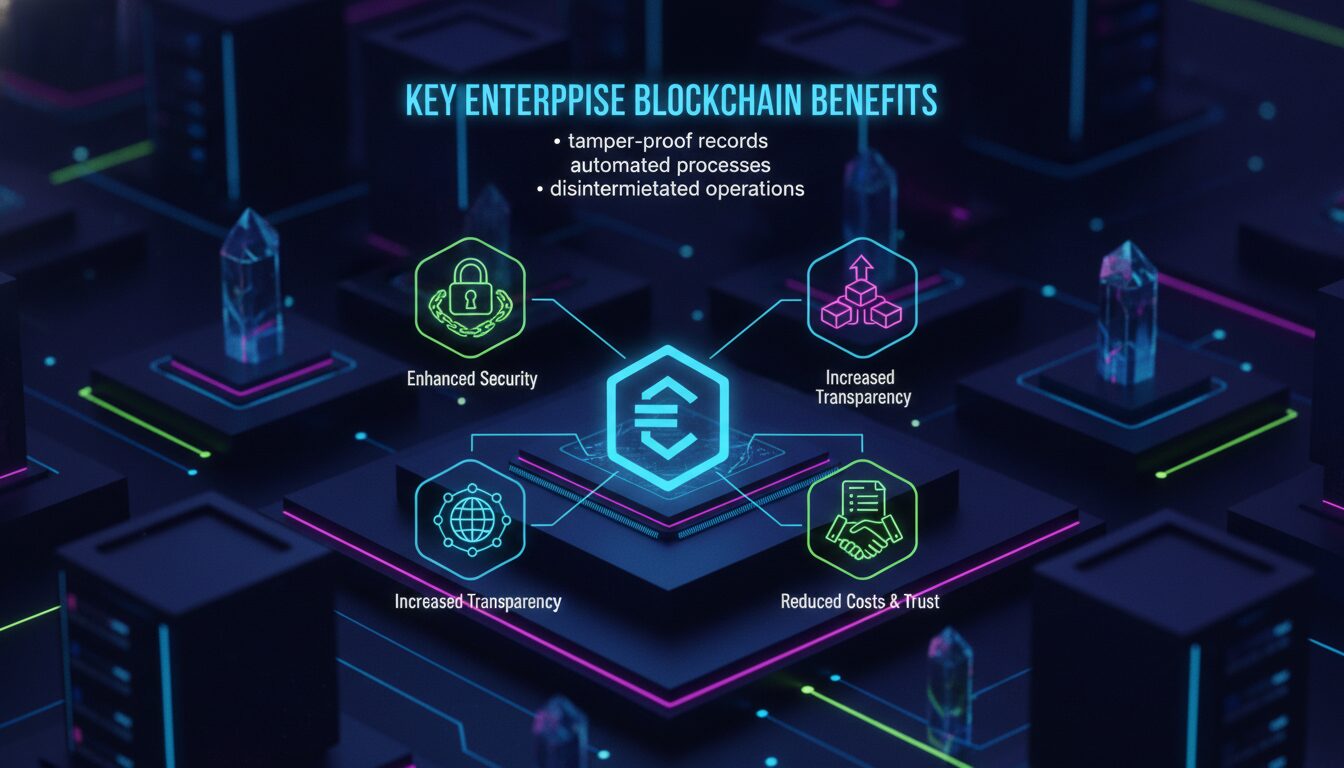
The core this type of benefits are security, transparency, and cost efficiency, each stemming directly from the cryptographic and architectural design of permissioned ledgers. Every benefit below traces back to one of three properties: immutability, shared visibility, or automation.
Enhanced Security and Immutability
this kind of benefits start with security. Each transaction is encrypted, hashed, and chained to the previous block, so any alteration becomes detectable across every participant’s copy of the ledger. IBM explains that the technology “helps prevent fraud and unauthorized activity” by producing a record that cannot be altered and is encrypted end-to-end. Network data lives on multiple nodes instead of a single server, which shrinks the attack surface considerably. Cryptographic techniques like zero-knowledge proofs can also verify transaction validity without revealing the underlying data, a feature seeing growing use in trade finance and digital identity systems.
Greater Transparency and Instant Traceability
With a shared, replicated ledger, every permissioned participant sees the same information at the same time. This transparency levels the playing field: each authorized member gets a complete, real-time view of asset provenance and transaction history. IBM Food Trust, for example, lets retailers and suppliers trace food products from farm to shelf in seconds, improving safety response and cutting recall costs. On-chain data from supply chain deployments like this shows how traceability shifts from a days-long paper trail to a near-instant lookup. IBM describes this capability as “instant traceability,” an audit trail documenting an asset’s provenance at every step.
Efficiency Gains and Cost Savings
Automation through smart contracts, combined with the removal of intermediaries, delivers some of the most quantifiable enterprise blockchain benefits. By eliminating manual reconciliation and third-party verification, organizations can cut both processing times and administrative costs. Paystand highlights that enterprise blockchain enables “secure payment processing, efficient transaction management, and smart contract integration,” with a direct impact on the bottom line. In insurance, blockchain-based claim settlement can run roughly 3x faster and 5x less costly than traditional methods, per the same source, an efficiency gain worth watching as more insurers pilot parametric products.
Enterprise Blockchain Benefits for Supply Chain Management
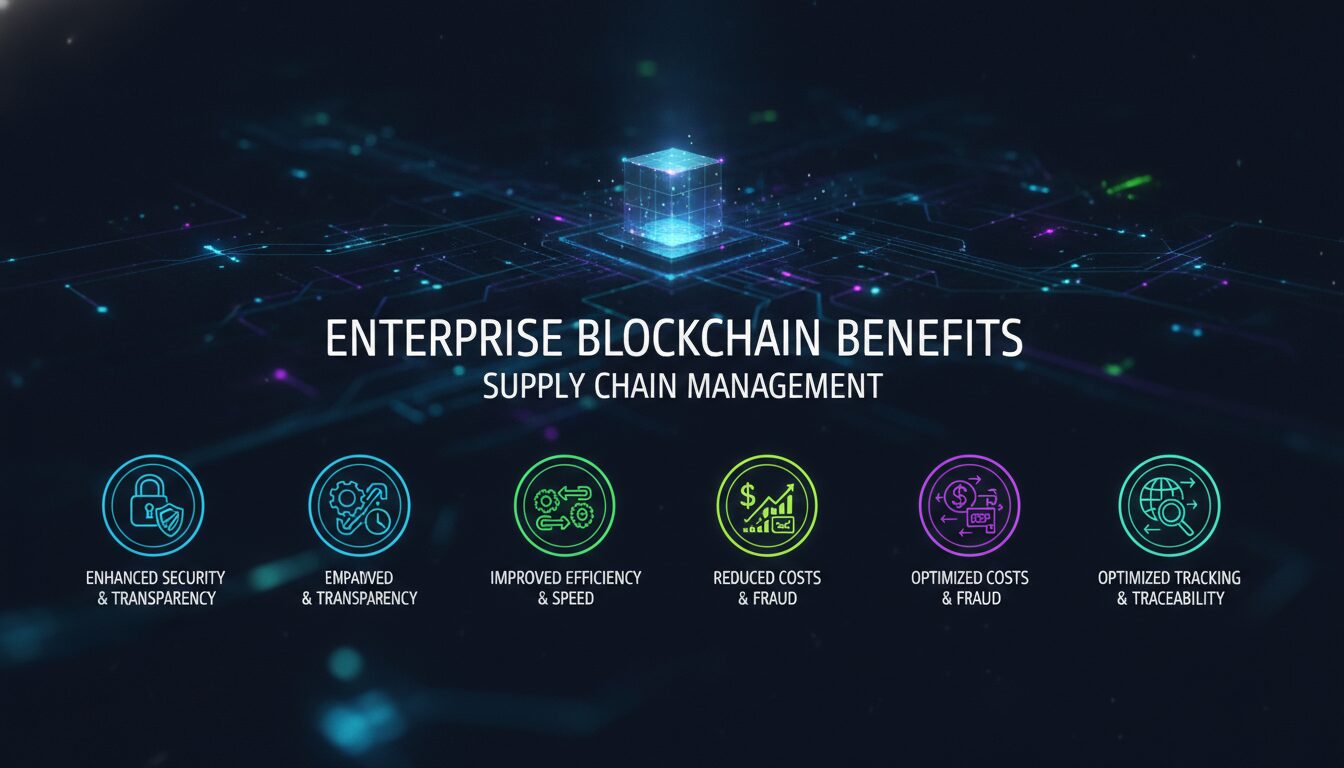
Enterprise blockchain benefits for supply chains center on provenance, counterfeit prevention, and inventory automation, solving the visibility gaps that plague multi-party logistics networks. Each of these use cases depends on the same shared-ledger foundation described above.
Provenance Tracking from Source to Consumer
Supply chains are notoriously opaque, often involving dozens of parties running disconnected IT systems. Enterprise blockchain benefits solve this by creating a single, immutable record of every transfer, certification, and quality checkpoint. From conflict-free minerals to organic produce, each handoff gets timestamped and cryptographically signed, giving regulators and consumers verifiable proof of origin. Telefónica Tech cites the technology’s use in “sustainability initiatives to ensure the ethical sourcing of raw materials and compliance with environmental standards.”
Counterfeit Prevention and Quality Assurance
Counterfeiting drains hundreds of billions from the global economy every year. Enterprise blockchain makes forgery far harder by recording each product’s unique digital identity on a tamper-proof ledger. Luxury brands, pharmaceutical companies, and electronics manufacturers are rolling out blockchain-enabled track-and-trace systems that let customers scan a QR code and view an item’s full journey. This protects brand integrity and speeds up recalls by pinpointing affected batches instantly instead of pulling entire product lines.
Streamlined Logistics and Inventory Management
When logistics providers, warehouses, and retailers share a common ledger, inventory visibility improves dramatically. Smart contracts can trigger automatic reorder points when stock falls below a threshold, kick off cross-border customs documentation, and release payment on delivery confirmation, all without a human in the loop. The result is fewer stockouts, lower inventory carrying costs, and fewer payment delays, which compounds the enterprise blockchain benefits across the entire supply network.
Enterprise Blockchain Benefits in Finance and Insurance
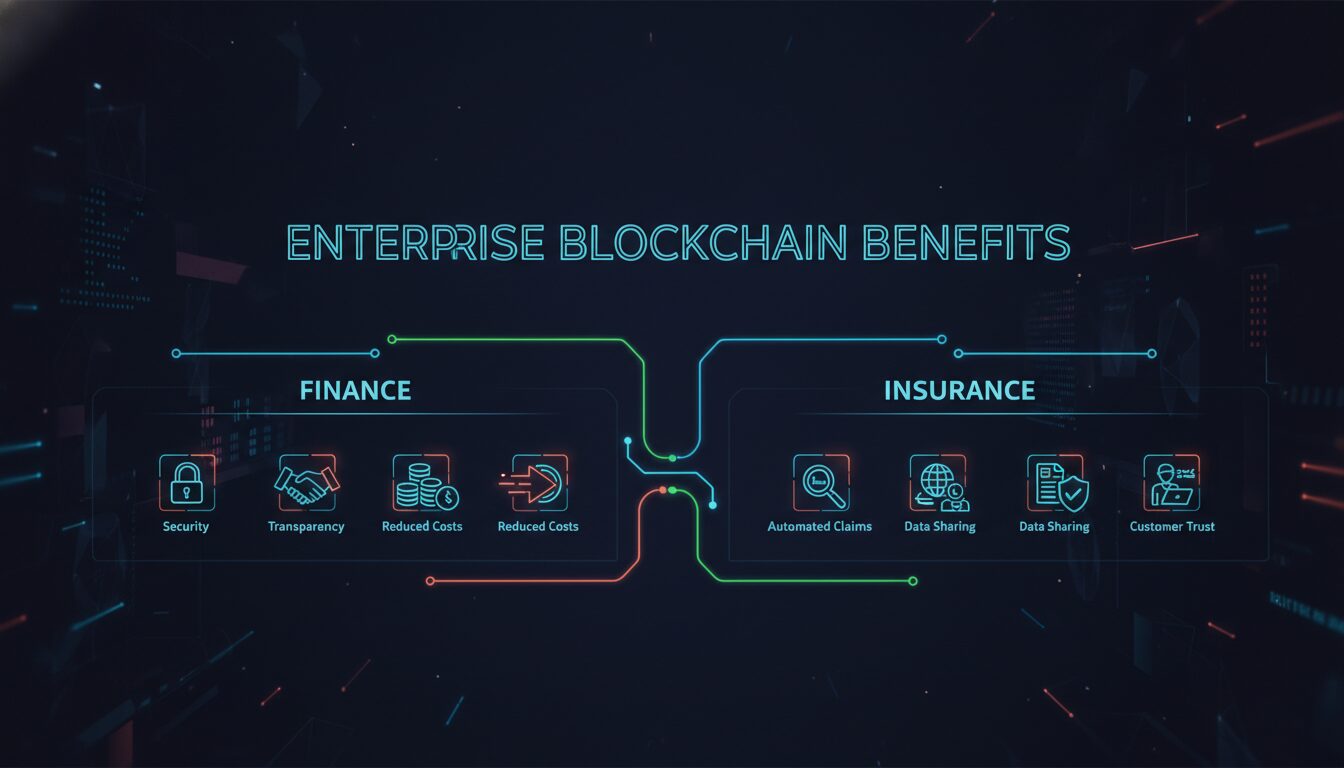
Faster Settlements and Reduced Counterparty Risk
Faster settlement is one of the clearest enterprise blockchain benefits in financial services, since permissioned networks allow near-instant, atomic settlement where payment and asset delivery occur simultaneously. Traditional settlement can take days, tying up capital and exposing parties to credit risk in the meantime. Atomic settlement reduces the need for collateral and removes the risk that one party defaults before the other delivers. Visa’s enterprise blockchain paper emphasizes that distributed technology can improve efficiency and cost-effectiveness in capital markets, trade finance, and cross-border payments.
Smart Contract Automation for Claims and Compliance
Insurance is a prime candidate for enterprise blockchain benefits realized through automation. Parametric insurance policies can use smart contracts that pay out automatically once predefined conditions are met, such as a flight delay exceeding three hours, verified by trusted oracles. The same logic applies to regulatory compliance: know-your-customer (KYC) and anti-money-laundering (AML) checks can be encoded directly into smart contracts, creating an immutable audit trail that satisfies regulators while cutting administrative overhead.
Tokenization of Real-World Assets
Enterprise blockchains enable fractional ownership and trading of illiquid assets like real estate, art, or commodities through tokenization. These digital tokens represent a share of the underlying asset and can trade continuously on secondary markets with low fees. For businesses, this opens new liquidity pools, simplifies fundraising, and broadens investor access, all while maintaining compliance with securities laws through programmable restrictions baked into the tokens themselves. This is an area where tokenomics design matters as much as the underlying chain: badly structured token supply or vesting schedules can undermine even a technically sound tokenization project.
How Enterprise Blockchain Drives Regulatory Compliance and ESG Reporting
Immutable Audit Trails for Auditors and Regulators
Regulatory compliance is one of the most underrated enterprise blockchain benefits, because it replaces sample-based manual audits with continuous, cryptographically verifiable records. Every data entry is time-stamped, signed, and linked to the previous state, so auditors can independently verify financial statements, supply chain reports, or data processing logs without relying on spot checks. This continuous auditability lowers compliance costs and builds trust with oversight bodies. IBM notes that blockchain “creates an audit trail that documents the provenance of an asset at every step,” a feature that maps directly to regulatory reporting requirements.
Sustainability Tracking and Ethical Sourcing
Environmental, social, and governance (ESG) metrics are becoming mandatory for public companies and their supply chain partners. Blockchain provides an incorruptible record of carbon emissions, water usage, labor practices, and raw material provenance. A garment manufacturer, for example, can prove that its organic cotton was grown without forced labor, certified at each stage, and shipped via carbon-neutral logistics, all recorded on-chain. This granular, verifiable data matters for green bonds, sustainability-linked loans, and basic consumer transparency.
Data Privacy and GDPR Alignment
A common misconception is that blockchain’s permanence conflicts with data privacy regulations like GDPR. In practice, enterprise blockchains use off-chain data stores, zero-knowledge proofs, and permissioned visibility layers so personal data is never exposed on-ledger. Only hashes or references to encrypted off-chain data get stored, letting the network verify consistency without holding sensitive content directly. This design allows compliance with “right to erasure” mandates while preserving the integrity of underlying business processes.
Edge Computing and IoT: Extending Enterprise Blockchain Benefits
Edge computing and IoT sensors extend enterprise blockchain benefits by feeding real-world data directly onto the ledger without a centralized intermediary. Temperature sensors on a refrigerated shipping container, for instance, can write readings straight to a permissioned chain, creating an unbroken chain of custody for pharmaceuticals or perishable goods. Combining edge devices with lightweight consensus reduces the latency between an event happening and it becoming verifiable on-chain, which matters for time-sensitive compliance triggers like cold-chain breaches. This pairing is still maturing, but pilot programs in logistics and pharma cold-chain monitoring point to meaningful reductions in dispute resolution time when sensor data and ledger entries are tied together automatically.
Interoperability: Connecting Enterprise Blockchains with Legacy Systems
APIs, Oracles, and Middleware Solutions
No enterprise operates in a vacuum, so blockchain success depends on smooth integration with existing ERP, CRM, and IoT platforms. Modern enterprise blockchain frameworks provide REST APIs and SDKs that let applications read from and write to the ledger about as easily as a traditional database. Oracles, services that feed external data into smart contracts, act as bridges between on-chain logic and off-chain realities such as weather data, exchange rates, or shipment sensor readings. Metana’s guide underscores that interoperability is what makes blockchain scale inside complex, pre-existing IT environments.
Multi-Chain Ecosystems and Standards
The future isn’t one monolithic chain but a mesh of specialized networks that can talk to each other. Initiatives like Hyperledger Cactus and Polkadot’s cross-chain messaging enable asset transfers and data sharing between different blockchains. Enterprise consortia are adopting standards such as ISO/TC 307 and the specifications from the Enterprise Ethereum Alliance to ensure different platform implementations can interoperate, which avoids vendor lock-in and protects long-term technology investments.
Legacy Integration Patterns
Organizations can take a phased approach: start by using blockchain as a notary service, anchoring cryptographic hashes of existing database records onto a chain. Over time, critical workflows move on-chain while legacy systems keep serving as off-chain storage or user-interface layers. This coexistence model protects existing infrastructure ROI while gradually unlocking the full enterprise blockchain benefits of trust and automation.
As one industry engineering team put it in a widely cited protocol design discussion, “the hard part of enterprise blockchain was never the consensus algorithm, it was getting five companies to agree on a shared data schema.” Interoperability standards exist precisely to solve that coordination problem.
A Step-by-Step Approach to Adopting Enterprise Blockchain
Step 1: Assess Pain Points and Identify Use Cases
Start by mapping pain points involving multi-party reconciliation, frequent disputes, or manual paper-based processes. Evaluate whether a shared ledger would genuinely add value, good candidates include supply chain track-and-trace, intercompany settlement, or regulatory compliance reporting. According to Metana, enterprises should prioritize use cases where trust, transparency, or disintermediation produce measurable ROI rather than chasing blockchain for its own sake.
Step 2: Select a Platform and Build a Proof of Concept
Choose a platform that fits your industry consortium, performance needs, and existing tech stack. Hyperledger Fabric excels in permissioned, modular environments; Corda is built for financial services with point-to-point privacy; Quorum offers Ethereum compatibility for teams with existing Solidity expertise. Build a minimal prototype on a testnet, validate assumptions, and measure throughput, latency, and integration effort before committing to a full build.
Step 3: Deploy, Govern, and Scale the Network
Launch a pilot with a limited set of trusted partners, then expand gradually. Establish a governance model, often a consortium backed by a legal agreement, that defines membership rules, data access policies, and dispute resolution. As transaction volumes grow, layer-2 scaling solutions or sidechains help maintain performance without sacrificing the decentralization that made the network trustworthy in the first place.
Comparison of Leading Enterprise Blockchain Platforms
| Platform | Consensus Mechanism | Smart Contract Language | Key Features | Best Suited For |
|---|---|---|---|---|
| Hyperledger Fabric | Pluggable (PBFT, Raft) | Go, JavaScript, Java | Channels for private data, modular design | Supply chain, healthcare, trade finance |
| R3 Corda | Notary service (customizable) | Kotlin, Java | Point-to-point privacy, financial-grade logic | Banking, insurance, capital markets |
| Quorum (ConsenSys) | Raft, Istanbul BFT | Solidity | Ethereum compatibility, private transactions | Enterprise Ethereum use cases, DeFi |
| Polygon Edge | IBFT, PoS | Solidity | Modular framework, L2 scaling | High-throughput dApps, gaming, NFTs |
| Hedera Hashgraph | Asynchronous BFT (Gossip) | Solidity, Java | High throughput, fixed low fees | Micropayments, identity, asset tokenization |
Government and Public Sector Applications
Government adoption of enterprise blockchain benefits centers on land registries, identity verification, and voting pilot programs where tamper-proof records matter more than raw transaction speed. Several national land registry pilots have used permissioned ledgers to reduce title fraud and speed up property transfer verification. Digital identity programs built on blockchain let citizens control what data gets shared with which agency, cutting down on redundant paperwork across departments. Voting pilots remain more experimental and controversial, since auditability has to be balanced against ballot secrecy, but the underlying pattern, an immutable, shared record verifiable by multiple independent parties, is exactly what public sector trust problems need.
Pros and Cons
Pros
- Immutable, tamper-evident records that reduce fraud and simplify audits
- Real-time shared visibility across all permissioned network participants
- Automation via smart contracts cuts manual processing and reconciliation costs
- Faster settlement in finance, potentially reducing counterparty risk significantly
- Strong fit for regulatory reporting and ESG data verification
Cons
- Integration with legacy ERP and CRM systems requires real engineering effort
- Governance across a multi-company consortium can slow decision-making
- Talent shortages in Solidity, Kotlin (Corda), and Go (Fabric) raise build costs
- Regulatory uncertainty persists in some jurisdictions for tokenized assets
- Not every use case needs a blockchain; a shared database sometimes suffices
Frequently Asked Questions
What are the top enterprise blockchain benefits?
The primary enterprise blockchain benefits are enhanced security through encryption and immutability, greater transparency via a shared ledger, instant traceability of assets, efficiency gains from smart contract automation, and real cost savings from eliminating intermediaries and manual reconciliation.
How do enterprise blockchains differ from public blockchains?
Enterprise blockchains are permissioned, meaning only approved participants can join, validate transactions, and access data. They prioritize privacy, throughput, and regulatory compliance, while public blockchains like Bitcoin and Ethereum stay open, trustless, and pseudonymous, optimized for decentralization rather than corporate requirements.
What industries benefit most from enterprise blockchain?
Supply chain, financial services, insurance, healthcare, and government are the leading adopters. Each uses the technology differently, improving traceability, settlement speed, claims handling, patient data management, and public record integrity respectively.
Can enterprise blockchain integrate with my existing systems?
Yes. Modern platforms offer REST APIs, SDKs, and middleware that connect blockchain ledgers to legacy ERP, CRM, and databases. Oracles further let smart contracts interact with off-chain data, making incremental adoption realistic without a rip-and-replace overhaul.
Is enterprise blockchain secure against hacking?
No system is perfectly secure, but enterprise blockchains use strong cryptography, distributed storage, and consensus mechanisms that make altering historical records computationally impractical. Combined with permissioned access controls, they offer a meaningfully stronger defense than a typical centralized database.
What is the future outlook for enterprise blockchain?
The market is projected to reach $145.9 billion by 2030, driven by rising demand for transparency, decentralized identity, and tokenization of real-world assets. This year and beyond, advancements in interoperability standards and clearer regulation should keep accelerating adoption.
Enterprise blockchain benefits only materialize when the technology gets matched to the right problem and built by people who understand both the protocol layer and the business workflow around it. If you’re evaluating a pilot, a tokenized asset program, or a full consortium build, apply to the Genesis Cohort at digitalblockchains.com and build with a studio that treats infrastructure decisions as seriously as you do.