Blockchain and smart contracts are a two-layer system where a decentralized ledger stores immutable records and programmable code enforces agreements automatically when predefined conditions are met.
Key Takeaways
- Smart contracts are self-executing programs stored on a blockchain that automatically enforce terms when predefined conditions are met.
- Blockchain provides an immutable, decentralized ledger, while smart contracts add programmable logic to that ledger.
- Not every smart contract is a legal contract: code may execute parts of a broader agreement or function as an automated workflow.
- Real-world use cases include pharmaceutical supply chains, retail dispute resolution, and trade finance, as documented by IBM.
- Legal recognition varies by jurisdiction, with U.S. states such as Arizona and Nevada expanding blockchain-related laws.
- Ethereum is the dominant platform for smart contract deployment, using Solidity as the primary programming language.
What Are Blockchain and Smart Contracts?
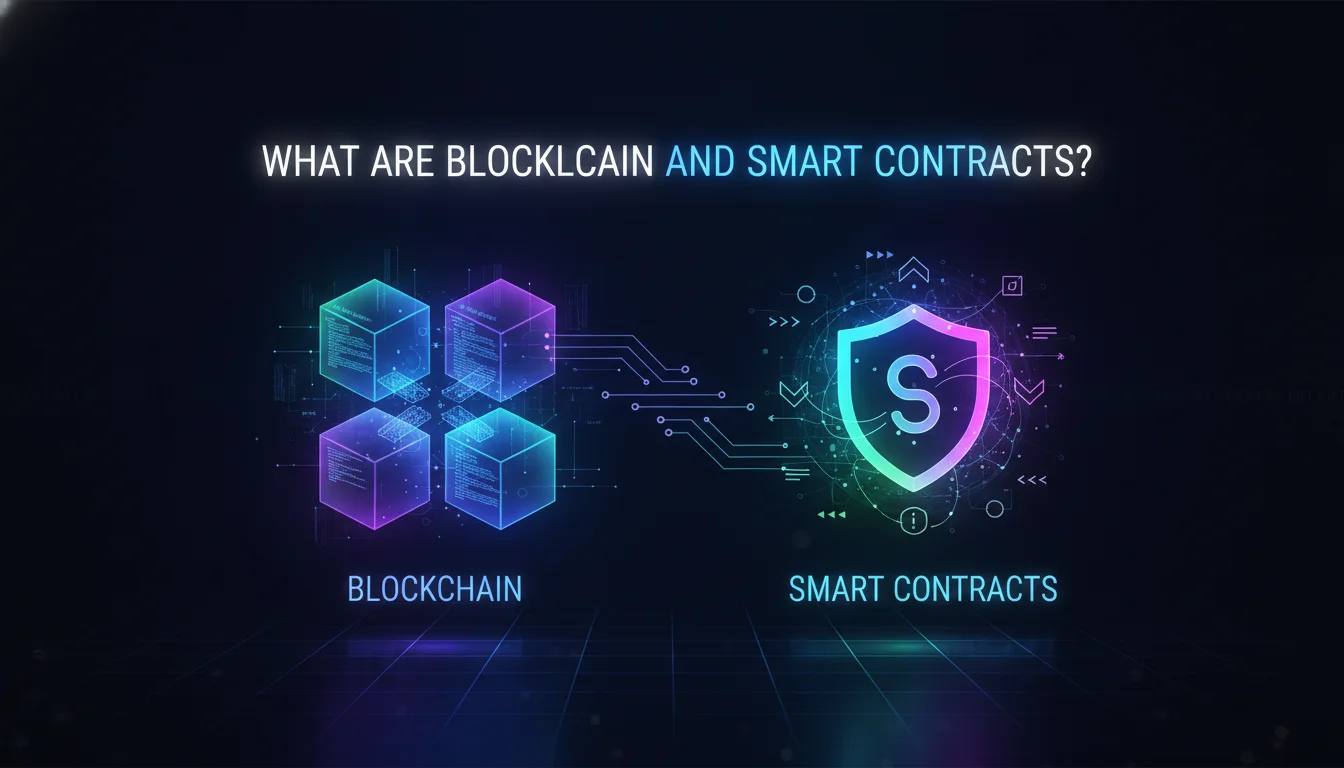
smart contracts together describe a two-layer system: a shared data layer and a programmable execution layer. A blockchain is a digital, decentralized ledger that stores data across a network of computers. Once information is recorded and confirmed, it is nearly impossible to alter or erase, creating a durable and transparent record. Smart contracts build on this foundation by adding executable logic. According to the American Arbitration Association (ADR), smart contracts are software programs stored on a blockchain that automatically execute specified actions when predefined conditions are met.
Defining Blockchain as the Foundational Ledger
A blockchain is best understood as a secure digital record book. Each block contains transaction data linked to the previous block, so altering a single record requires changing the entire chain. This design makes the ledger tamper-resistant and transparent across all participants. The ADR explains that blockchains store data across a network of computers rather than on a single central server, which reduces reliance on any one authority.
Smart Contracts as Programmable Agreements
IBM defines smart contracts as digital contracts stored on a blockchain that are automatically executed when predetermined terms and conditions are met. They automate the execution of an agreement so that all participants can be immediately certain of the outcome without any intermediary’s involvement. Ethereum’s developer documentation simplifies the concept further: a smart contract is a program that runs on the Ethereum blockchain, consisting of code functions and data state.
The Code Contract vs. Legal Contract Distinction
Despite the name, a smart contract is not always a legal contract in the traditional sense. The ADR notes that in many cases it is better understood as self-executing code that implements, supports, or automates a broader commercial arrangement. The Harvard Law School Forum on Corporate Governance makes a similar point: the code can either be the sole manifestation of the agreement between the parties or complement a traditional text-based contract and execute certain provisions, such as transferring funds from Party A to Party B. This distinction is central to understanding this type of contracts.
How Smart Contracts Work on a Blockchain
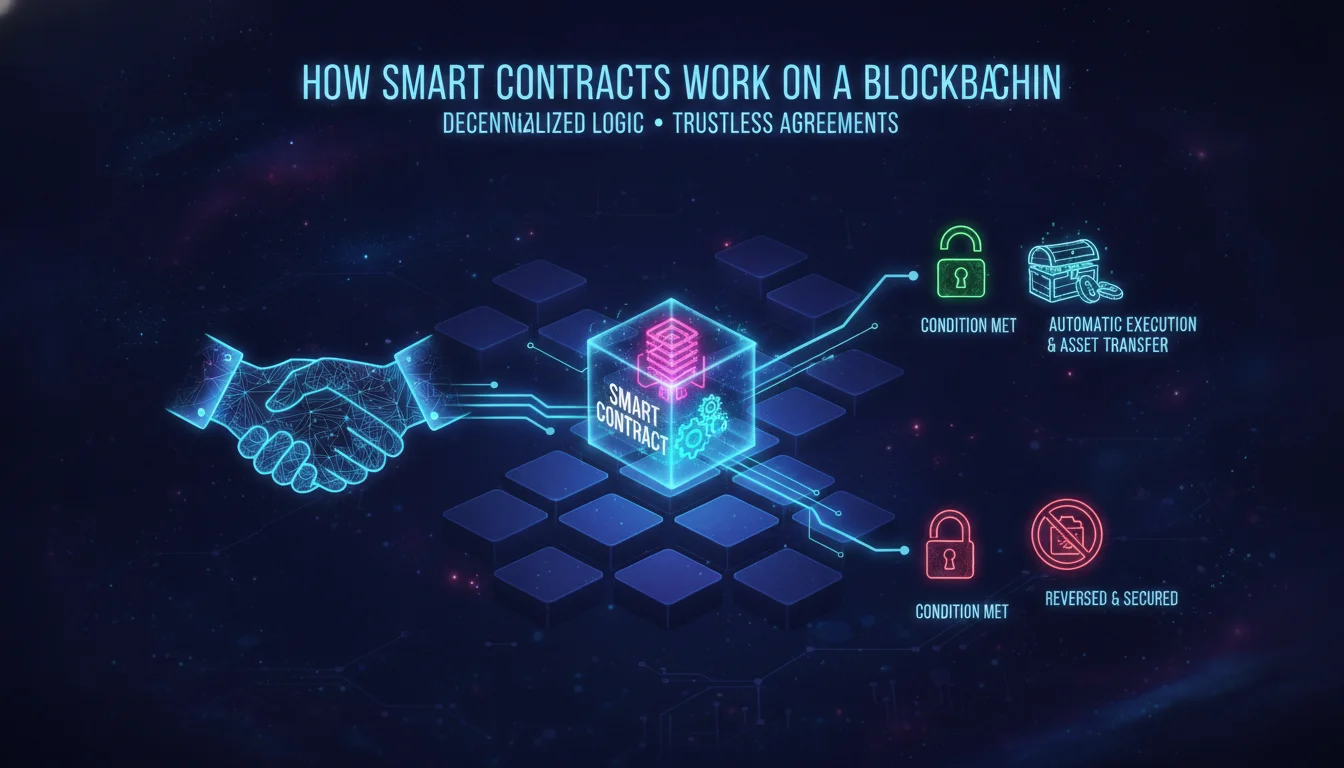
Smart contracts work through simple “if/when…then…” statements written into code on a blockchain. A network of computers executes the actions when predetermined conditions are met and verified. IBM gives concrete examples: those actions might include releasing funds to the appropriate parties, registering a vehicle, sending notifications, or issuing a ticket. The blockchain updates when the transaction completes, making the record difficult to change and visible only to parties with permission.
The If/When-Then Logic in Code
The most basic form of a smart contract is a conditional one. Freeman Law explains that conditional smart contracts take the form of “if/then/else” statements, common to most programming languages. A simple example: Alice lends Bob two bitcoins at an interest rate of 5%, and Bob puts up collateral. If Bob repays the loan on time, the smart contract automatically releases his collateral back to him. If he fails to pay, the smart contract releases the collateral to Alice. This logic removes uncertainty about when and how the outcome occurs.
Here is a minimal Solidity example illustrating that conditional structure:
// SPDX-License-Identifier: MIT
pragma solidity ^0.8.0;

contract CollateralLoan {
 address public lender;
 address public borrower;
 uint public repaymentDeadline;
 bool public repaid;

 constructor(address _borrower, uint _durationDays) payable {
 lender = msg.sender;
 borrower = _borrower;
 repaymentDeadline = block.timestamp + (_durationDays * 1 days);
 }

 function repay() external payable {
 require(msg.sender == borrower, "Only borrower");
 require(block.timestamp <= repaymentDeadline, "Deadline passed");
 repaid = true;
 payable(borrower).transfer(address(this).balance - msg.value);
 }

 function claimCollateral() external {
 require(msg.sender == lender, "Only lender");
 require(block.timestamp > repaymentDeadline, "Not yet due");
 require(!repaid, "Loan was repaid");
 payable(lender).transfer(address(this).balance);
 }
}
From Deployment to Automatic Execution: A Step-by-Step Process
- Parties define terms and rules. Participants determine how transactions and data will be represented on the blockchain, agree on the if/when-then rules, explore possible exceptions, and define a dispute resolution framework.
- Developer programs the contract. A developer writes the logic using a smart contract language such as Solidity. Organizations may also use templates, web interfaces, and online tools to simplify structuring.
- Contract is deployed to the blockchain. The code is placed on the blockchain and replicated across multiple nodes. Once deployed, even the creator cannot modify it.
- Conditions are met and verified. When the network confirms that the predetermined conditions are satisfied, it automatically executes the specified actions.
- Ledger is updated. The blockchain records the completed transaction. The record cannot be changed, and only parties who have been granted permission can see the results.
Role of Gas, Miners, and Network Validation
On Ethereum, submitting a smart contract requires a small fee called gas. Freeman Law notes that programmers pay this fee to the network to supply the computing power needed to run the smart contract’s code. Some Ethereum users, called miners, dedicate processing power to validating smart contracts and receive ether tokens as payment. The amount of gas required depends on the complexity of the contract and the network’s current ratio of miners to smart contract requests.
Smart Contracts vs. Traditional Contracts
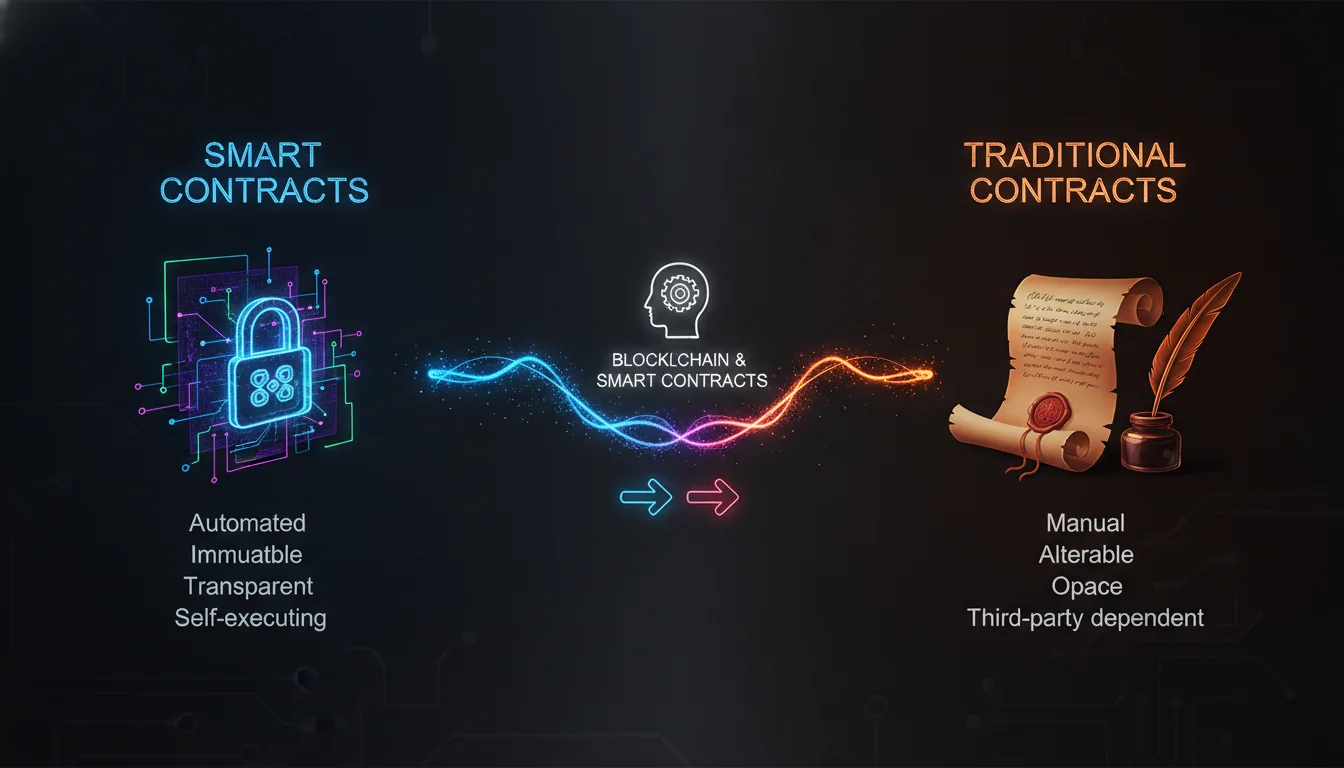
Smart contracts reduce the enforcement burden that traditional contracts place on courts and intermediaries by shifting trust to code and the blockchain network. Traditional contracts are agreements between private parties that create mutual obligations enforceable by law. If one party fails to fulfill its side, the other can take legal action. Because of this, traditional contracts require at least three parties: two to make an agreement and one to enforce it.
Enforcement and Intermediary Differences
Freeman Law explains that a smart contract uses the decentralized blockchain’s power to all but eliminate third-party enforcement of legal contracts. Once both parties agree to terms, the smart contract self-executes. The terms are programmed and placed onto the blockchain, making the contract immutable. If a party fails to follow through on its obligations, that party is charged the agreed-upon penalties. This differs from traditional contracts, where a court or intermediary must determine breach and apply remedies.
Flexibility, Amendment, and Subjective Terms
Smart contracts currently have real limits. Freeman Law states that they are limited to contracts transferring funds or ownership. Contracts requiring more subjective interpretations are not well-suited to the black-and-white, analytic nature of computer code. A traditional contract can be amended by mutual agreement, but a smart contract cannot be modified once deployed. That rigidity is the trade-off for immutability.
Comparison Table of Key Attributes
| Attribute | Traditional Contract | Smart Contract on Blockchain |
|---|---|---|
| Primary enforcer | Court or third-party intermediary | Code executed by blockchain network |
| Immutability | Amendable by mutual agreement | Immutable once deployed; creator cannot modify |
| Execution speed | Manual processing and reconciliation | Immediate when conditions are met |
| Subjective terms | Can interpret and apply judgment | Limited to objective, coded conditions |
| Intermediaries | Banks, escrow, courts | Reduced or eliminated |
| Legal status | Clearly enforceable under contract law | May be a legal contract or a component of one |
Pros and Cons of Blockchain and Smart Contracts
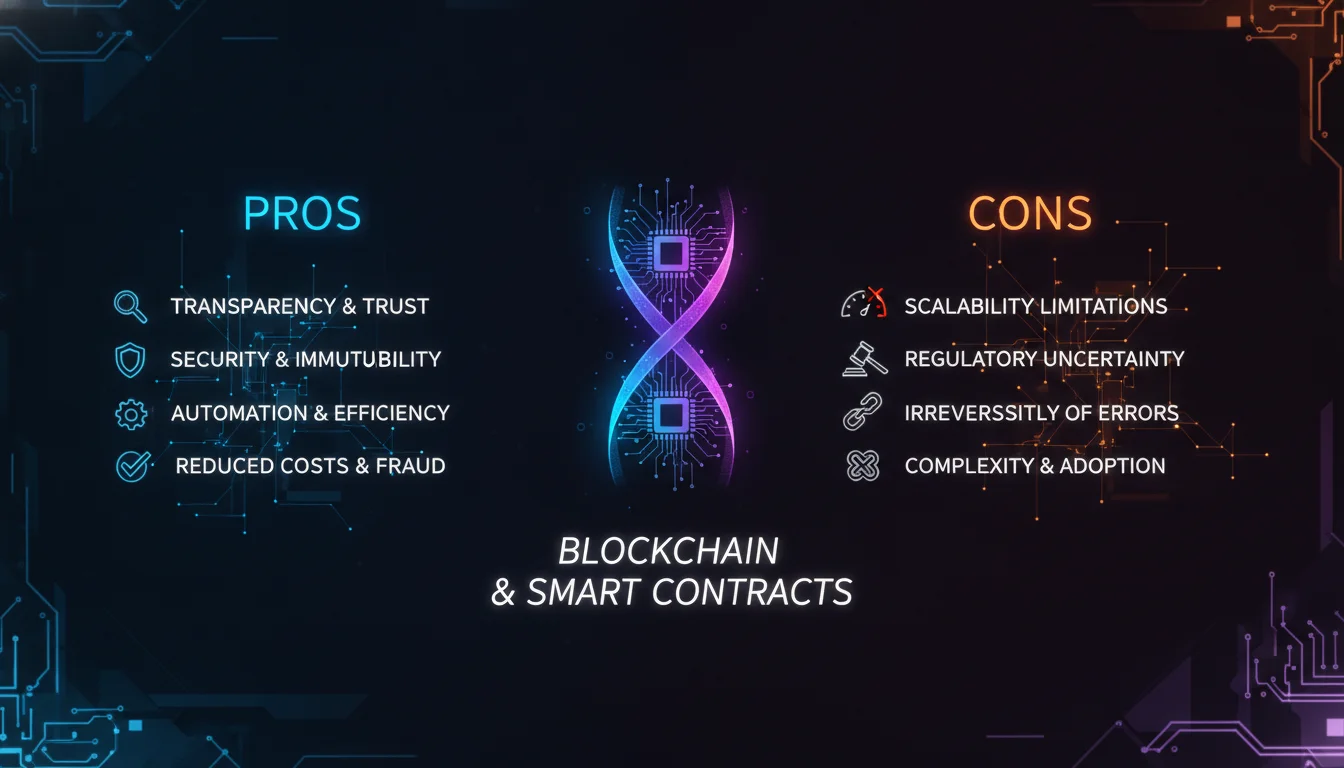
this kind of smart contracts offer real operational advantages, but they also introduce technical and legal risks that builders and enterprises must weigh carefully.
Pros
- Speed and automation: Contracts execute immediately when conditions are met, eliminating manual reconciliation and paperwork delays.
- Transparency and trust: Encrypted transaction records are shared across participants, removing the need to question whether data has been altered.
- Security: Blockchain transaction records are encrypted and linked, so altering one record requires changing the entire chain.
- Cost reduction: Removing intermediaries cuts administrative fees and time delays in lending, escrow, trade, and supply chain operations.
- Deterministic execution: Code executes exactly as written, eliminating ambiguity about outcomes.
Cons
- Immutability cuts both ways: A coding error or logic flaw cannot be corrected after deployment, and consequences can be irreversible.
- Limited to objective conditions: Contracts requiring subjective judgment or nuanced interpretation are not well-suited to code.
- Legal enforceability gaps: On-chain execution may transfer assets before off-chain legal remedies can be applied.
- Oracle dependency: Many real-world agreements require external data feeds (oracles) to trigger conditions, introducing a new trust surface.
- Gas costs and network congestion: Complex contracts on Ethereum can become expensive to deploy and execute during periods of high demand.
Core Benefits of Blockchain and Smart Contracts
IBM identifies four core benefits of smart contracts: speed, efficiency and accuracy; trust and transparency; security; and savings. These benefits arise because the and smart contracts automate manual processes, remove intermediaries, and create a shared, tamper-resistant record of transactions.
Speed, Efficiency, and Accuracy
Once a condition is met, the contract executes immediately. Because smart contracts are digital and automated, there is no paperwork to process and no time spent reconciling errors that often result from manually completing documents. This acceleration is especially valuable in multi-party workflows where delays are costly.
Trust, Transparency, and Security
Because there is no third party involved, and because encrypted records of transactions are shared across participants, there is no need to question whether information has been altered for personal benefit. IBM also notes that blockchain transaction records are encrypted, which makes them hard to hack. Because each record is connected to the previous and subsequent records on a distributed ledger, hackers would have to alter the entire chain to change a single record.
“Smart contracts are a critical component of many platforms and applications being built using blockchain or distributed ledger technology.” – Stuart D. Levi and Alex B. Lipton, Skadden, Arps, Slate, Meagher & Flom LLP, Harvard Law School Forum on Corporate Governance
Cost Savings and Disintermediation
Smart contracts remove the need for intermediaries to handle transactions and, by extension, their associated time delays and fees. This disintermediation can reduce administrative costs in lending, escrow, trade, and supply chain operations. The actual savings depend on the complexity of the contract and the underlying blockchain network.
Real-World Applications and Industry Use Cases
IBM documents several active blockchain solutions that use smart contracts in production. These examples show contracts working together to increase transparency, reduce disputes, and streamline trade.
Supply Chain and Pharmaceutical Tracking
Sonoco and IBM are working to reduce issues in the transport of lifesaving medications by increasing supply chain transparency. Powered by IBM Blockchain Transparent Supply, Pharma Portal is a blockchain-based platform that tracks temperature-controlled pharmaceuticals through the supply chain to provide trusted, reliable, and accurate data across multiple parties. Smart contracts can automatically trigger alerts or payments when shipping conditions meet or violate agreed thresholds.
Retailer-Supplier Dispute Resolution
The Home Depot uses smart contracts on blockchain to quickly resolve disputes with vendors. Through real-time communication and increased visibility into the supply chain, Home Depot builds stronger relationships with suppliers, resulting in more time for critical work and innovation. According to IBM, this use case demonstrates how automated contract terms can reduce friction in commercial relationships.
Trade Finance and Cross-Border Transactions
By joining we.trade, the trade finance network convened by IBM Blockchain, businesses are creating an ecosystem of trust for global trade. The we.trade platform uses standardized rules and simplified trading options to reduce friction and risk while easing the trading process and expanding trade opportunities for participating companies and banks. Smart contracts help automate payment obligations when trade milestones are confirmed.
Oracle Integration: Connecting Smart Contracts to the Real World
blockchain and operate in a closed environment by default. The blockchain itself cannot fetch external data such as commodity prices, weather readings, or shipping confirmations. Oracles solve this by acting as verified data feeds that push real-world information on-chain, triggering contract conditions based on external events.
This creates a meaningful architectural consideration. The oracle itself becomes a trust surface: if the data feed is compromised or manipulated, the smart contract executes on false premises. Decentralized oracle networks address this by aggregating data from multiple independent sources before committing a value on-chain. For any production deployment of blockchain and smart contracts that depends on off-chain data, oracle design is not an afterthought. It is a core security decision.
“Smart contracts may function as automated workflows, transaction mechanisms, or built-in components of decentralized applications.” – American Arbitration Association (ADR)
Smart Contract Security: Vulnerabilities and Formal Verification
Smart contract security is one of the most consequential engineering challenges in blockchain development, because deployed code is immutable and exploits are often irreversible. The Ethereum developer documentation emphasizes formal verification and thorough testing precisely because errors execute exactly as written with no override mechanism.
Common Vulnerability Classes
Several vulnerability patterns appear repeatedly across audited contracts. Reentrancy attacks occur when an external contract calls back into the vulnerable contract before the first execution completes, allowing repeated withdrawals. Integer overflow and underflow errors can produce unexpected arithmetic results when values exceed type boundaries. Access control flaws expose privileged functions to unauthorized callers. Each of these vulnerability classes has caused significant on-chain losses across the history of Ethereum.
Formal Verification and Audit Practices
Formal verification uses mathematical proofs to confirm that contract logic matches its specification. Tools such as those referenced in the Ethereum developer documentation allow teams to check invariants before deployment. Beyond formal methods, most production-grade contracts undergo multiple independent audits. The immutability of blockchain and smart contracts makes pre-deployment verification non-negotiable: there is no patch cycle once code is live.
Legal Recognition and Regulatory Considerations
The legal status of blockchain and smart contracts varies by jurisdiction and by the role the code plays in the overall agreement. The Harvard Law School Forum on Corporate Governance emphasizes that the code itself is replicated across multiple nodes of a blockchain and therefore benefits from the security, permanence, and immutability that a blockchain offers. Whether that code is legally binding depends on existing contract law.
Electronic Signatures and State Law
Legal enforcement of electronic agreements has developed over time. Freeman Law notes that the Uniform Electronic Transactions Act of 1999 granted electronic signatures and records the same legal standing as paper. Later, the Electronic Signatures Recording Act eliminated remaining prejudice against electronic legal documents. Some U.S. states, such as Arizona and Nevada, have expanded the scope of their laws to include blockchain-based exchanges and agreements. According to the Harvard Law School Forum on Corporate Governance, this legal evolution is important but still leaves practical questions unresolved.
Enforceability Gaps and Contract Law Limits
Even though smart contracts are designed to operate independently of any justice system, many fall under the scope of state contract law in the United States per the buyers’ implied right in lieu of any written terms. Freeman Law points out that if a party fails to perform, the other party may still seek legal remedies, but the automated mechanism may already have transferred assets. This creates a potential gap between on-chain execution and off-chain legal enforcement.
The Nick Szabo Vending Machine Analogy
Nick Szabo, who recognized the application of a decentralized ledger for smart contracts in 1994, proposed that a vending machine is a primitive smart contract because buyers have implied rights to receive the goods they ordered whenever they insert the correct amount of currency. Like a smart contract, nothing other than the correct amount of currency can make the vending machine release the product. This analogy helps explain how automation can satisfy contractual expectations without a human intermediary.
Limitations, Risks, and Open Challenges
Despite the benefits of blockchain and smart contracts, several limitations remain. The ADR highlights legal, technical, and operational risks that can arise when self-executing code interacts with real-world obligations and commercial arrangements.
Code Rigidity and Subjective Interpretation
Freeman Law states that smart contracts are currently limited to contracts transferring funds or ownership. Contracts that require more subjective interpretations are not well-suited to the black-and-white, analytic nature of computer code. If the coded terms do not capture every possible exception, the contract may execute in a way the parties did not intend, and once deployed it cannot be changed.
Security and Operational Risks
Blockchain transaction records are encrypted, making them hard to hack, as IBM explains. But smart contracts themselves can still contain coding errors or logic flaws. Because the code executes exactly as written, an error can have irreversible consequences. This operational risk is a key reason why formal verification and thorough testing are emphasized in the Ethereum developer documentation.
Interoperability and Off-Chain Data Needs
Smart contracts on different blockchains may not communicate directly, and many real-world agreements depend on external data such as delivery confirmations or market prices. The ADR notes that smart contracts may function as automated workflows, transaction mechanisms, or built-in components of decentralized applications. This flexibility is valuable, but legal and technical integration with off-chain systems remains an open challenge for blockchain and smart contracts at scale.
Platforms, Languages, and Token Standards
Understanding blockchain and smart contracts requires knowing the platforms and standards that support them. GeeksforGeeks identifies common smart contract platforms including Ethereum, Solana, Polkadot, and Hyperledger Fabric. Each platform has different capabilities and trade-offs.
Ethereum, Solidity, and Turing-Complete Execution
The GeeksforGeeks smart contract overview notes that the Bitcoin network was the first to use a form of smart contract to transfer value from one person to another, with basic conditions like checking whether the amount to transfer is actually available in the sender’s account. Bitcoin’s smart contracts were written in a Turing-incomplete language, restricting their potential. Ethereum later emerged as a more powerful platform because developers could write custom contracts in a Turing-complete language. The vast majority of smart contracts on Ethereum are programmed using Solidity.
Other Blockchain Platforms and Smart Contract Capabilities
Beyond Ethereum, platforms such as Solana, Polkadot, and Hyperledger Fabric support smart contracts with different consensus mechanisms and design priorities. These platforms are often chosen based on transaction speed, permissioning requirements, and enterprise needs. The core principle remains the same across all of them: code is deployed to a shared ledger and executed automatically when conditions are met.
ERC-20, ERC-721, and ERC-1155 Token Standards
According to ethereum.org, Ethereum token standards provide reusable specifications for smart contracts. ERC-20 defines fungible tokens, ERC-721 defines non-fungible tokens (NFTs), and ERC-1155 supports multiple token types in a single contract. These standards allow developers to build interoperable applications on top of blockchain and smart contracts without reinventing core logic.
Frequently Asked Questions
How do smart contracts work in blockchain?
Smart contracts use if/when-then logic written into code on a blockchain. When the network verifies that predefined conditions are met, it automatically executes the specified actions, such as transferring funds or updating a record. No intermediary is required for the execution to occur.
What exactly is a blockchain?
A blockchain is a digital, decentralized ledger that stores data across a network of computers rather than on a single central server. Each block of data is linked to the previous block, making the record tamper-resistant and transparent to all authorized participants. Once information is confirmed on the ledger, it is nearly impossible to alter or erase.
What is the difference between a smart contract and a traditional contract?
A traditional contract is enforced by a court or third party, while a smart contract self-executes on a blockchain when coded conditions are met. Smart contracts are also immutable once deployed, whereas traditional contracts can be amended by mutual agreement. The trade-off is speed and certainty versus flexibility and subjective interpretation.
Are smart contracts legally enforceable?
Many smart contracts fall under existing contract law, especially if they transfer funds or ownership. However, not every smart contract is a legal contract; some simply automate parts of a broader text-based agreement. Legal recognition also varies by jurisdiction, with states like Arizona and Nevada having expanded their laws to cover blockchain-based agreements.
What are common smart contract platforms?
Ethereum is the most widely used platform for blockchain and smart contracts, with Solidity as the main programming language. Other common platforms include Solana, Polkadot, and Hyperledger Fabric, each with different performance and permissioning features suited to different use cases.
Can smart contracts be changed after deployment?
No. Once a smart contract is deployed to a blockchain, it is immutable and even its creator cannot modify it. This is a core feature of blockchain and smart contracts, but it is also a significant limitation when errors occur or circumstances change after deployment.
The Path Forward for Blockchain and Smart Contracts
Blockchain and smart contracts sit at the intersection of computer science and contract law. The code layer provides deterministic execution, immutability, and disintermediation. The legal layer determines whether that automatic execution actually satisfies enforceable obligations.
Sources disagree on whether smart contracts are true legal contracts: IBM treats them as digital contracts, the ADR cautions that they may only automate parts of an arrangement, and Harvard explains that code can be either the whole agreement or a complement to a text-based contract. This matters because users and enterprises must evaluate both technical execution certainty and legal enforceability before relying on blockchain and smart contracts in production.
As of 2026, U.S. states and international bodies continue to clarify rules, and platforms like Ethereum continue to standardize token and contract interfaces. The practical adoption of blockchain and smart contracts is expanding beyond simple transfers into more complex commercial workflows, DeFi protocols, and on-chain asset management. Security, oracle design, and legal integration remain the three open problems that serious builders must solve before deploying at scale.
If you are building on blockchain and smart contracts at the protocol or application layer, apply to the Genesis Cohort at digitalblockchains.com. We work with teams who are serious about getting the architecture right.