Smart contract security is the set of practices used to protect blockchain-based contracts from vulnerabilities that cause financial loss or misuse. Deployed contracts are immutable and public, which makes pre-deployment security far more effective than any post-deployment fix.
Key Takeaways
- contract security spans the full lifecycle: design, coding, testing, auditing, deployment, and monitoring.
- Immutability means bugs persist permanently. There is no silent patch on a public blockchain.
- Over $3.8 billion was stolen from DeFi and smart contract exploits in 2024, according to Chainalysis.
- Audits combine manual code review with automated analysis to catch reentrancy, integer overflows, access control gaps, and unsafe external calls.
- The OWASP this type of security Verification Standard provides an open baseline for secure contract development and auditing.
- Web3 projects lost $482 million in Q1 2026 alone, with smart contract losses surging year over year, per Hacken.
The stakes are real. Smart contracts directly manage digital assets, enforce rules automatically, and operate across decentralized finance, gaming, supply chain, identity, and governance. This guide synthesizes practitioner guidance from Ethereum.org, OWASP, Hacken, SecureLayer7, and Cyfrin to explain what this kind of security means, why it fails, and how to embed it across the full contract lifecycle.
What Is Smart Contract Security?
Defining Smart Contracts and Their Security Model
smart contract focuses on protecting blockchain-based contracts from vulnerabilities that can lead to financial loss or misuse. A smart contract is a self-executing program deployed on a blockchain network that automatically enforces predefined rules without intermediaries. These contracts directly manage digital assets, enforce business logic in decentralized applications, and operate across finance, gaming, supply chain, identity, and governance. Because execution is autonomous and code is immutable after deployment, even minor flaws can be exploited with irreversible consequences. This security model is fundamentally different from centralized server applications, where developers can patch, roll back, or disable features when problems appear.
Why Immutability Changes the Security Calculus
In traditional application code, developers retain the ability to fix bugs, roll back changes, or disable features if issues arise. Smart contracts differ. Once deployed to a public blockchain like Ethereum, contract code usually cannot be changed to patch security flaws. Public, permissionless networks give attackers full code visibility and unlimited time to study weaknesses. Assets stolen from smart contracts are extremely difficult to track and mostly irrecoverable due to immutability. Errors have immediate, irreversible effects, which makes secure design and validation far more critical than in conventional software development. This is why contract security must begin long before deployment.
The Full-System Attack Surface
Effective this type of security extends beyond catching reentrancy before mainnet. Attackers now move across the full system: contract logic, access control, signer workflows, upgrade paths, frontends, deployment keys, oracles, bridges, and monitoring gaps. A secure contract can still sit inside an unsafe protocol. According to Hacken, a large share of 2026 losses stem from operational failures rather than contract logic alone. Audits that only inspect contract code miss operational and off-chain failure modes entirely.
The Business Case for Smart Contract Security
Financial and Reputational Consequences
The financial stakes are enormous. According to the Ethereum.org security guide, the total amount of value stolen or lost due to security defects in smart contracts is easily over $1 billion. High-profile incidents include the DAO hack, which stole 3.6 million ETH, the Parity multi-sig wallet hack, which lost $30 million, and the Parity frozen wallet issue, which locked over $300 million in ETH permanently. More recently, $3.8 billion was stolen from DeFi and smart contract exploits in 2024 alone, largely from reentrancy, access control, and oracle manipulation flaws, according to Chainalysis. A single vulnerability can lead to irreversible financial losses, reputational damage, and loss of user confidence.
“Deployed contract code usually cannot be changed to patch security flaws, while assets stolen from smart contracts are extremely difficult to track and mostly irrecoverable due to immutability.” – Ethereum.org Developer Documentation
Why Traditional Patching Fails
Organizations cannot rely on silent patches. Patching after deployment usually means deploying a new contract and migrating users, balances, and integrations. By that point, funds may already be drained. Compromised smart contracts usually cannot be patched quickly or silently. This is why pre-deployment smart contract security through secure coding, rigorous testing, and audits beats post-deployment remediation. For projects seeking adoption, partnerships, or regulatory confidence, strong security practices are essential to demonstrating reliability and responsibility.
Regulatory and User Trust Implications
Trust is inseparable from security when contracts directly control user funds and critical platform functions. A single exploit can erode user confidence and attract regulatory scrutiny. Aligning security expectations among developers, auditors, blockchain platforms, and DeFi users is a core objective of the OWASP Smart Contract Security Verification Standard. Secure practices protect user assets, ensure predictable platform behavior, and support long-term ecosystem stability.
Common Smart Contract Vulnerabilities
Reentrancy Attacks
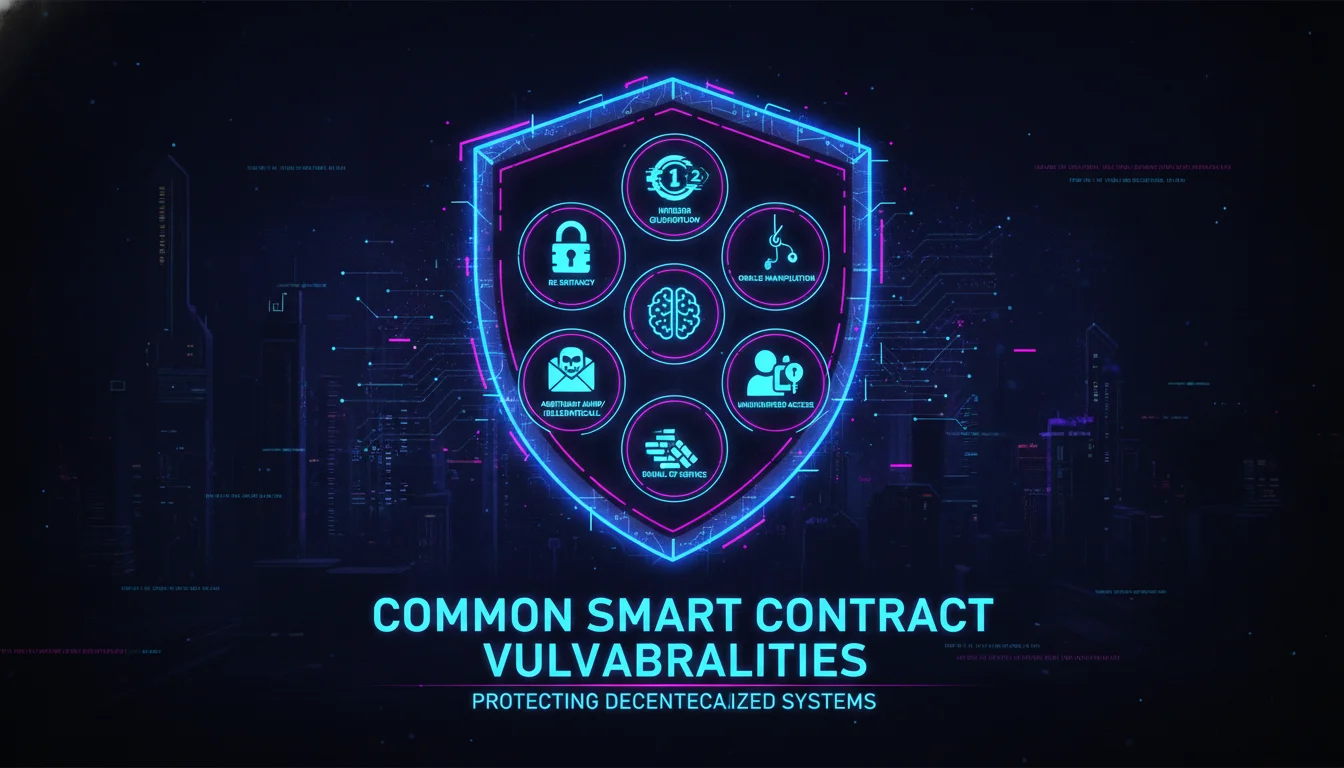
Reentrancy is both extremely dangerous and easy to accidentally introduce. It occurs because smart contracts execute imperatively and can call external untrusted contracts while waiting for the result. A malicious contract can recursively call back into the original function before balances are updated, draining funds. The classic vulnerable withdraw() function sends ETH before zeroing the balance, allowing repeated withdrawals in a single transaction. Mitigations include the checks-effects-interactions pattern and reentrancy guards. Auditors specifically trace external call order to confirm state updates happen before value transfers.
// VULNERABLE: state update happens AFTER external call
contract Vulnerable {
 mapping(address => uint256) public balances;

 function withdraw() external {
 uint256 amount = balances[msg.sender];
 (bool success, ) = msg.sender.call{value: amount}("");
 require(success);
 balances[msg.sender] = 0; // too late
 }
}

// SECURE: checks-effects-interactions pattern
contract Secure {
 mapping(address => uint256) public balances;

 function withdraw() external {
 uint256 amount = balances[msg.sender];
 balances[msg.sender] = 0; // effect first
 (bool success, ) = msg.sender.call{value: amount}("");
 require(success); // interaction last
 }
}
Integer Overflows and Underflows
Integer overflows and underflows happen when arithmetic operations exceed the maximum or minimum value of a data type. In Solidity versions before 0.8, these wrapped silently, leading to exploitable balance inconsistencies. The OWASP SCSVS lists overflows and underflows among the unique security challenges for EVM-based systems. Modern Solidity includes built-in overflow checks, and older code relies on libraries like SafeMath. Effective smart contract security audits review arithmetic operations, compiler version, and any use of unchecked blocks.
Access Control Gaps and Unsafe External Calls
Access control weaknesses occur when privileged functions lack proper authorization or when role assignments are too permissive. Unsafe external calls include unchecked return values, misuse of delegatecall, or calling untrusted contracts without validating outcomes. Auditors specifically review privileged functions, role-based modifiers, and low-level calls. The OWASP SCSVS highlights access control and business logic as key areas for audits and penetration testing, alongside blockchain data integrity.
Pros and Cons of Smart Contract Security Practices
Pros
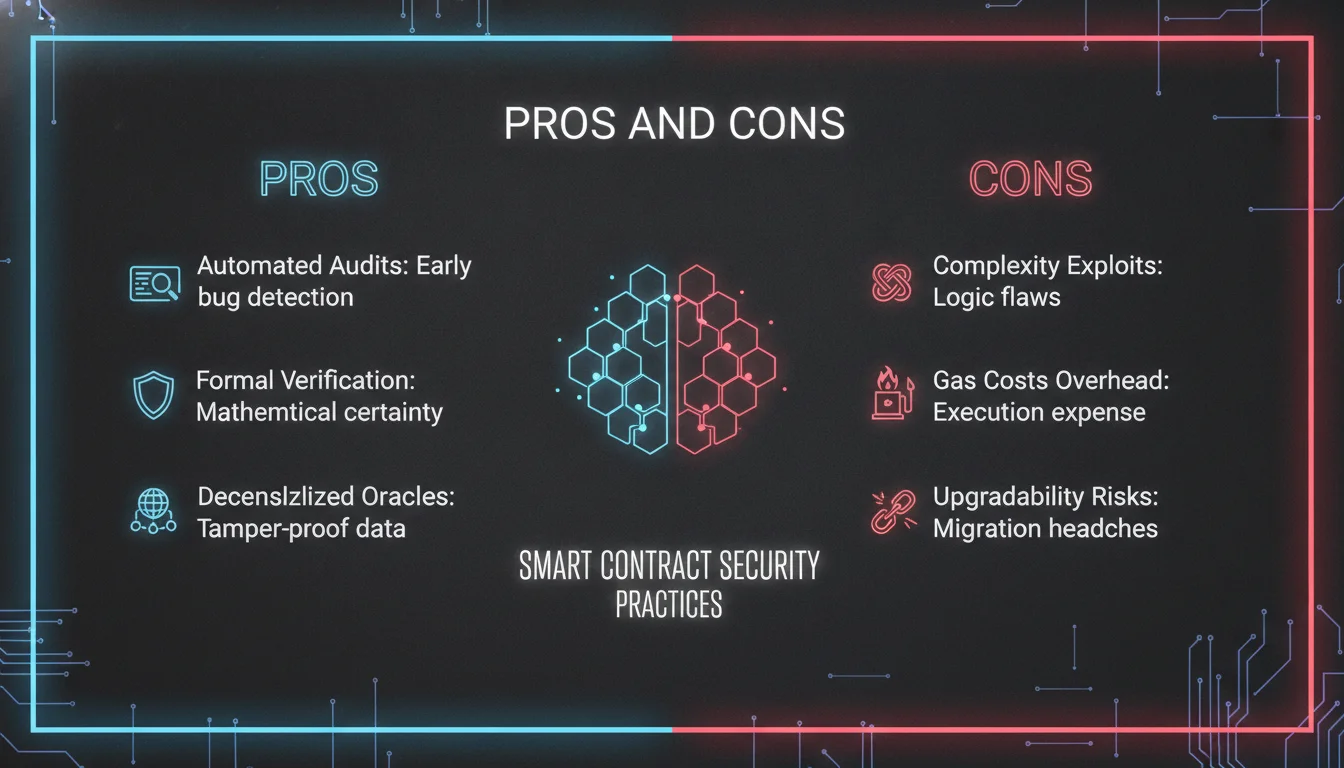
- Irreversible protection: Pre-deployment audits and secure coding catch vulnerabilities before they can be exploited on mainnet, where no patch is possible.
- User trust: Published audit reports signal reliability to users, partners, and institutional investors evaluating your protocol.
- Reduced operational risk: Lifecycle monitoring catches anomalous transactions and oracle deviations before losses compound.
- Regulatory readiness: Documented security practices support compliance conversations and reduce regulatory exposure as DeFi oversight increases.
- Ecosystem credibility: Protocols with clean audit histories attract integrations, liquidity, and developer contributions more readily than those without.
Cons
- Cost and time: Thorough audits and formal verification add weeks and significant budget to a launch timeline, which can be difficult for early-stage teams.
- Audit scope limits: Even a rigorous audit cannot guarantee zero vulnerabilities. Novel attack vectors and complex protocol interactions can slip through.
- Upgradeable contract tradeoffs: Proxy patterns that allow post-deployment fixes introduce governance and admin key risks that must themselves be audited.
- Operational complexity: Full-system security requires monitoring frontends, oracles, bridges, and signer workflows, not just contract code.
The OWASP Smart Contract Security Verification Standard
What the OWASP SCSVS Covers
The OWASP Smart Contract Security Verification Standard (SCSVS) is an open security standard for designing, building, and testing secure smart contracts. It offers guidelines addressing specific security risks related to smart contracts, decentralized applications, and EVM-based blockchain systems. The initial draft version 0.0.1, dated September 2024, is available as a PDF. It focuses on core principles of security in smart contract development, providing a baseline for both developers and auditors.
Objectives of the Standard
The standard consolidates general security practices into comprehensive guidelines. It targets unique challenges such as reentrancy, overflows and underflows, gas optimization, and economic attacks. It guides development teams in secure practices, assists security teams in audits and penetration testing, and establishes security benchmarks that reflect the evolving blockchain ecosystem. It also promotes best practices like defensive coding, formal verification, and test-driven development.
Using OWASP SCSVS in Practice
Development teams can adopt the OWASP SCSVS as a checklist before deployment. Auditors use it to structure manual review and automated analysis. Because the standard is vendor-neutral and community-led, it aligns security expectations among all stakeholders. For teams building on EVM-compatible chains, referencing the SCSVS alongside platform-specific best practices provides a strong foundation for smart contract security.
“The primary aim of the OWASP SCSVS is to provide an open security standard for designing, building, and testing secure smart contracts, focusing on the core principles of security in smart contract development.” – OWASP SCSVS Project
A Lifecycle Approach to Smart Contract Security
Design Phase: Simplicity and Modularity
Secure design starts with understanding the blockchain environment. The Hacken guide recommends keeping design simple and modular, because complexity increases attack surface. Core principles include minimal privileged functions, clear trust boundaries, and well-defined invariants. Developers should map all external interactions, including oracles, bridges, and token contracts, before writing a single line of code.
Development Phase: Defensive Coding and Testing
During development, use require(), assert(), and revert() statements to guard state transitions. Follow checks-effects-interactions to prevent reentrancy. Write test-driven development to validate behavior under edge cases. Since Solidity contracts transfer substantial value, defensive coding is not optional. The Consensys smart contract best practices repository, now maintained under the ConsenSys Diligence organization, serves as a living guide for these patterns.
A Step-by-Step Security Checklist
- Step 1: Define security invariants and a threat model for the protocol.
- Step 2: Apply secure design patterns: modularity, access controls, and checks-effects-interactions.
- Step 3: Use automated testing, fuzzing, and invariant testing to find violations.
- Step 4: Conduct a manual code review focused on reentrancy, overflows, access control, and unsafe calls.
- Step 5: Run a formal audit with an independent team before deployment.
- Step 6: Monitor on-chain activity and operational workflows continuously after launch.
Smart Contract Audits: Manual, Automated, and Independent
What an Audit Is
A smart contract security audit is a systematic review of contract code to identify vulnerabilities, logic errors, and design flaws before deployment. Audits typically combine manual code review with automated analysis. Beyond finding bugs, audits validate whether contracts behave as intended under edge cases and adversarial conditions. They are strongly recommended before launching to mainnet, because retroactively fixing published contracts is very difficult and may not recover stolen funds.
What Auditors Look For
Auditors examine reentrancy, integer overflows, access control gaps, unsafe external calls, oracle manipulation, and business logic flaws. They also review upgrade paths, key management, and off-chain components in modern engagements. The table below summarizes common vulnerability classes and audit focus areas.
| Vulnerability Class | How It Works | Audit Focus |
|---|---|---|
| Reentrancy | External call before state update allows recursive withdrawal | Call order, checks-effects-interactions, guards |
| Integer overflow/underflow | Arithmetic exceeds type range, wraps silently in older Solidity | Arithmetic operations, compiler version, SafeMath usage |
| Access control gaps | Missing or incorrect authorization on privileged functions | Role-based modifiers, ownership, admin functions |
| Unsafe external calls | Unchecked call returns, malicious delegatecall, untrusted contracts | Low-level call usage, return validation, call targets |
Audit Cost and How to Check Legitimacy
Audit costs vary widely based on contract complexity, code length, auditor reputation, and engagement scope. No single figure applies across the industry. To check if a smart contract is legitimate, verify that source code is published and verified on a block explorer, review any independent audit reports, check for known vulnerability patterns, and test the contract on a testnet. A legitimate project should also disclose access controls and upgrade mechanisms. If no audit exists, proceed with caution.
Deployment, Monitoring, and Post-Deployment Operations
Deployment Security: Keys, Upgrades, and Frontends
Deployment is a high-risk phase. Attackers target signer workflows, deployment keys, upgrade paths, and frontends. A secure contract can be compromised by a leaked private key or a malicious upgrade transaction. Use multi-signature wallets for deployer accounts, verify source code immediately on a block explorer, and secure frontends and APIs. Hacken’s five-stage blueprint covers design, development, testing, deployment, and post-deployment operations, reflecting this wider risk surface.
Post-Deployment Monitoring and Incident Response
After launch, continuous monitoring detects anomalous transactions, oracle deviations, and bridge activity. Automated alerting and incident response plans reduce damage from exploits. According to Hacken, Web3 projects lost $482 million in Q1 2026 alone, with smart contract losses surging year over year. Phishing and social engineering caused most of that damage, but contract-level flaws still enabled significant losses. Monitoring is no longer optional for any protocol managing real user funds.
When a New Contract Is the Only Patch
Because deployed contract code usually cannot be changed, fixing a vulnerability often means deploying a new contract and migrating users, balances, and integrations. This process is slow, costly, and may not recover stolen funds. It is a core reason pre-deployment smart contract security through secure coding, testing, and audits beats post-deployment remediation. Upgradeable smart contracts provide some flexibility, but they introduce proxy and governance risks that must also be audited.
How to Learn Smart Contract Security
Courses and Structured Training
The Cyfrin Updraft Smart Contract Security course offers 281 lessons, 6 projects, and 24 hours of video content covering smart contract auditing, fuzzing, invariant testing, and formal verification. It has taught over 10,000 students how to audit and write secure Solidity smart contracts. Structured training accelerates the path to becoming a security researcher, and the curriculum covers both stateless and stateful fuzzing tools alongside manual review techniques.
Open Source Resources and Best Practices
The Consensys smart contract best practices documentation is an essential reference, available on GitHub under the ConsenSys Diligence organization. The Ethereum.org security guide provides foundational concepts and incident history. The OWASP SCSVS offers a free vendor-neutral standard. These resources together give developers a clear path from basics to advanced audit techniques. For deeper context on how on-chain systems are structured, our Digital Blockchains blog covers protocol architecture and tokenomics in detail.
Smart Contract Security as a Continuous Practice
Smart contract security is not a one-time box to check before launch. It is a continuous practice that spans design, development, testing, deployment, and post-deployment operations. The evidence from 2024 and 2026 makes the conclusion unavoidable: organizations that treat security as a lifecycle discipline reduce preventable losses, protect user funds, and build the trust that blockchain ecosystems require. If you are building a protocol and want to apply rigorous security practices from day one, apply to build with Digital Blockchains.
Frequently Asked Questions
How to check if a smart contract is legit?
Verify the contract’s source code on a block explorer, review independent audit reports, check for ownership controls and upgrade mechanisms, and test interactions on a testnet. Legitimate projects usually publish audit results and disclose who can modify the contract.
How much does a smart contract audit typically cost?
Costs vary widely based on code complexity, scope, and auditor reputation. There is no single industry price. Request quotes from multiple firms and compare engagement depth, including whether they cover off-chain components and upgrade paths, before choosing an auditor.
Are smart contracts legally enforceable?
Legal enforceability depends on jurisdiction and whether traditional contract elements such as offer, acceptance, and consideration are present. The code itself is not automatically a legal contract in most legal systems, and this area of law continues to develop across different regulatory environments.
What are the downsides of smart contracts?
Downsides include immutability, which prevents patching bugs after deployment; public code visibility that gives attackers unlimited time to find weaknesses; and irreversible execution that makes stolen assets difficult to recover. Upgradeable contracts reduce some of these risks but introduce new governance and proxy attack surfaces.
What is the most common smart contract vulnerability?
Reentrancy is among the most common and dangerous vulnerabilities, allowing attackers to recursively drain funds before balances are updated. Integer overflows and access control gaps are also frequent findings in audits, and oracle manipulation has become an increasingly significant attack vector in DeFi protocols.
Why is smart contract security important in 2026?
Smart contracts control substantial value in DeFi and decentralized applications, and attackers now target full systems including frontends, keys, oracles, and bridges. Pre-deployment security and continuous monitoring are essential to prevent irreversible losses, as demonstrated by the $482 million lost in Q1 2026 alone, per Hacken.