A public blockchain is a permissionless, decentralized distributed ledger that anyone can join, read, and validate without a central authority. It uses consensus mechanisms like Proof of Work or Proof of Stake to maintain a transparent, tamper-resistant record.
Key Takeaways
- Permissionless by design: anyone with an internet connection can join, read, write, and validate transactions on a public blockchain.
- Consensus mechanisms like Proof of Work and Proof of Stake replace trusted intermediaries with cryptographic guarantees.
- Bitcoin, Ethereum, Solana, Cardano, Polkadot, and BNB Smart Chain are the most widely adopted public networks.
- Transparency and immutability are strengths; privacy gaps, throughput limits, and regulatory uncertainty are the real trade-offs.
- The blockchain market is projected to grow from $44.29 billion in 2025 to $746.41 billion by 2032, according to Fortune Business Insights as cited by Investax.
- Layer 2 networks, sharding, and real-world asset tokenization are the near-term growth drivers worth watching.
What Is a Public Blockchain?

Definition and Core Principles
A public blockchain is a type of distributed ledger technology (DLT) open to anyone: read access, write access, and validation rights require no permission from any central body. According to GeeksforGeeks, this openness is a defining characteristic, producing a decentralized and transparent environment. The network runs on an open-source framework secured through cryptographic principles rather than institutional trust.
The architecture is peer-to-peer. Every node maintains its own copy of the ledger and can participate in block creation. There is no central server to attack or bribe. That design eliminates single points of failure and makes it extremely difficult for any single entity to rewrite history.
How Public Blockchains Differ from Private and Permissioned Networks
The Government of India’s Blockchain Centre of Excellence classifies distributed ledgers into four types: public, private, consortium, and hybrid. Each sits at a different point on the control-versus-openness spectrum.
Private networks restrict access to selected, verified participants. The operator retains the right to override, edit, or delete entries, as Investopedia notes. Consortium chains are semi-decentralized, governed by a group of organizations rather than one. Hybrid systems combine private permission-based access with selective public visibility. The key distinction for builders: only the permissionless model delivers censorship resistance and trustless finality.
How Does a Public Blockchain Work?
Step-by-Step Transaction Lifecycle
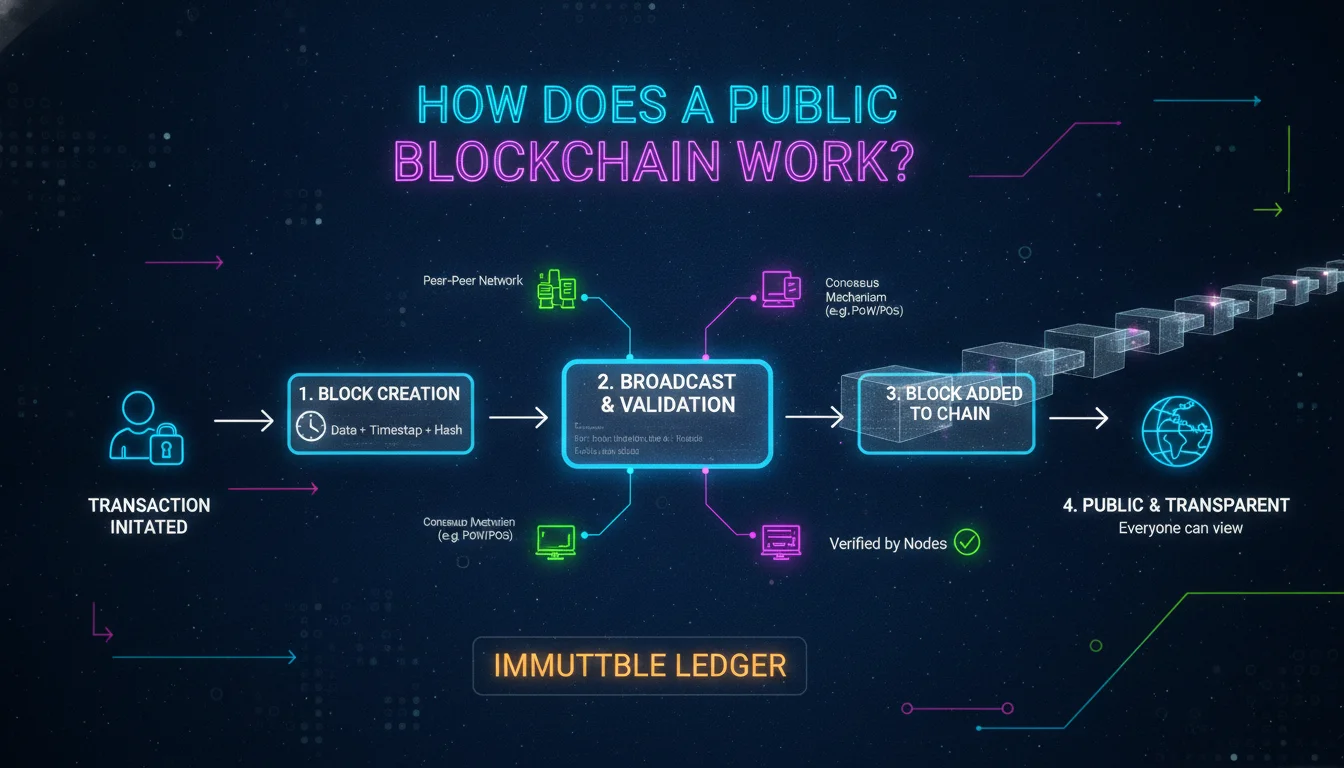
Every transaction on a permissionless network follows the same deterministic sequence, adapted here from GeeksforGeeks:
- Transaction Creation: A user initiates a digital request containing sender, recipient, and amount.
- Broadcasting: The request propagates to all nodes in the peer-to-peer network.
- Validation: Nodes apply the consensus rules (Proof of Work, Proof of Stake, or a variant) to confirm the transaction is legitimate and not double-spent.
- Block Creation: Valid transactions are bundled into a block that references the hash of the previous block, forming the chain.
- Adding to the Chain: The new block is appended, creating a permanent record.
- Synchronization: Every node updates its local copy to reflect the new state.
- Incentives: Validators or miners receive cryptocurrency rewards for honest participation, aligning economic incentives with network security.
Hashing: The Glue That Makes It Immutable
Each block carries a cryptographic hash of its own contents plus the hash of the block before it. As the DeFi Education Fund explains, altering even a single byte of historical data produces a completely different hash value, instantly invalidating every subsequent block. That chain-of-hashes structure is what makes rewriting history computationally infeasible on a large network.
Consensus Mechanisms: Proof of Work vs. Proof of Stake
Consensus algorithms are the rules that let distributed nodes agree on a single version of truth without trusting each other. The two dominant models are Proof of Work and Proof of Stake.
PoW, used by Bitcoin, requires miners to solve computationally expensive puzzles before proposing a block. The energy cost is the security deposit: attacking the network means outspending every honest miner. PoS, adopted by Ethereum after its September 2022 merge and used natively by Cardano, selects validators based on staked tokens rather than raw compute power. According to CFTE, once data is validated under either model, it cannot be altered despite being publicly visible.
Other variants exist. Solana combines Proof of History with PoS to achieve high transaction throughput at low fees. Polkadot uses a nominated proof-of-stake model that coordinates security across its parachain ecosystem. The choice of consensus mechanism directly shapes the network’s position on the scalability-security-decentralization triangle, commonly called the blockchain trilemma.
“Public blockchains can be secured with automatic validation methods and encryption that keep single entities from changing information in the chain, or they can allow anyone to make changes.” – Investopedia
Role of Nodes and Validators
A node is any computer running the network’s software: it stores the ledger, validates incoming transactions, and enforces the protocol rules. According to the DeFi Education Fund, each node communicates with peers, validates new transactions and blocks according to the network’s rules, and maintains its own copy of the chain. Validators and miners are specialized nodes that go further by proposing new blocks and earning rewards. The more independent participants, the harder it is for any single actor to compromise the network.
Pros and Cons of Public Blockchains
Pros
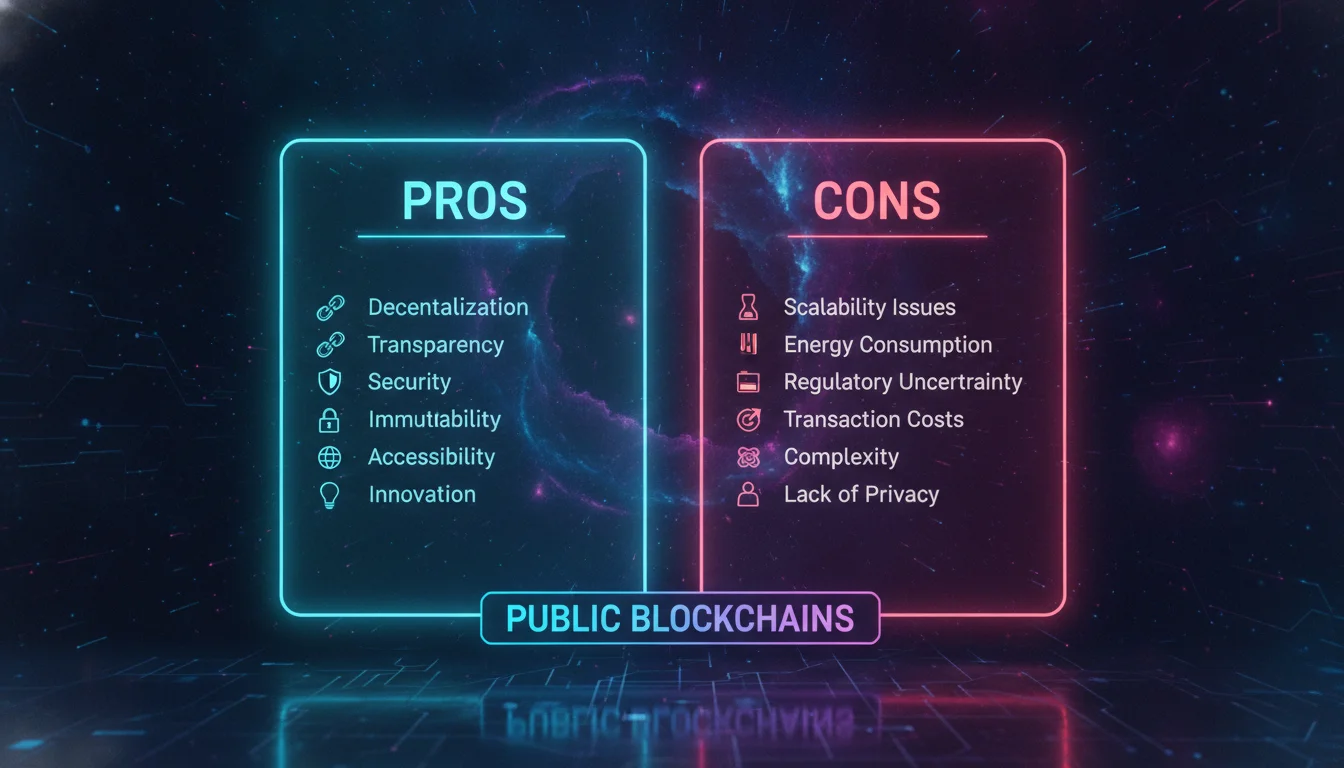
- Trustless operation: cryptographic consensus replaces institutional intermediaries, so users transact directly without banks or payment processors.
- Censorship resistance: no single entity can block a valid transaction or freeze an account.
- Transparency and auditability: every transaction is publicly verifiable, reducing opportunities for fraud or manipulation.
- Security through scale: as Investopedia notes, the vast number of participants keeps a secured network safe from data breaches and hacking attempts.
- Open innovation: any developer can deploy a smart contract or build a DApp without seeking approval.
Cons
- Privacy gaps: transaction amounts and addresses are visible to anyone; if an address is linked to a real identity, the full history is exposed.
- Throughput limits: Bitcoin processes roughly 7 transactions per second; Ethereum has historically faced congestion and elevated gas fees during peak demand.
- Energy consumption: Proof of Work networks require significant electricity. Ethereum’s 2022 shift to PoS dramatically cut its energy footprint, but Bitcoin’s PoW model remains energy-intensive by design.
- Malicious actors: Investopedia warns that cryptocurrencies, by nature of their value, attract hackers and thieves targeting wallets, bridges, and smart contracts.
- Regulatory uncertainty: the compliance landscape varies sharply across jurisdictions, creating legal risk for businesses building on permissionless rails.
Key Features and Advantages in Depth
Decentralization and Trustlessness
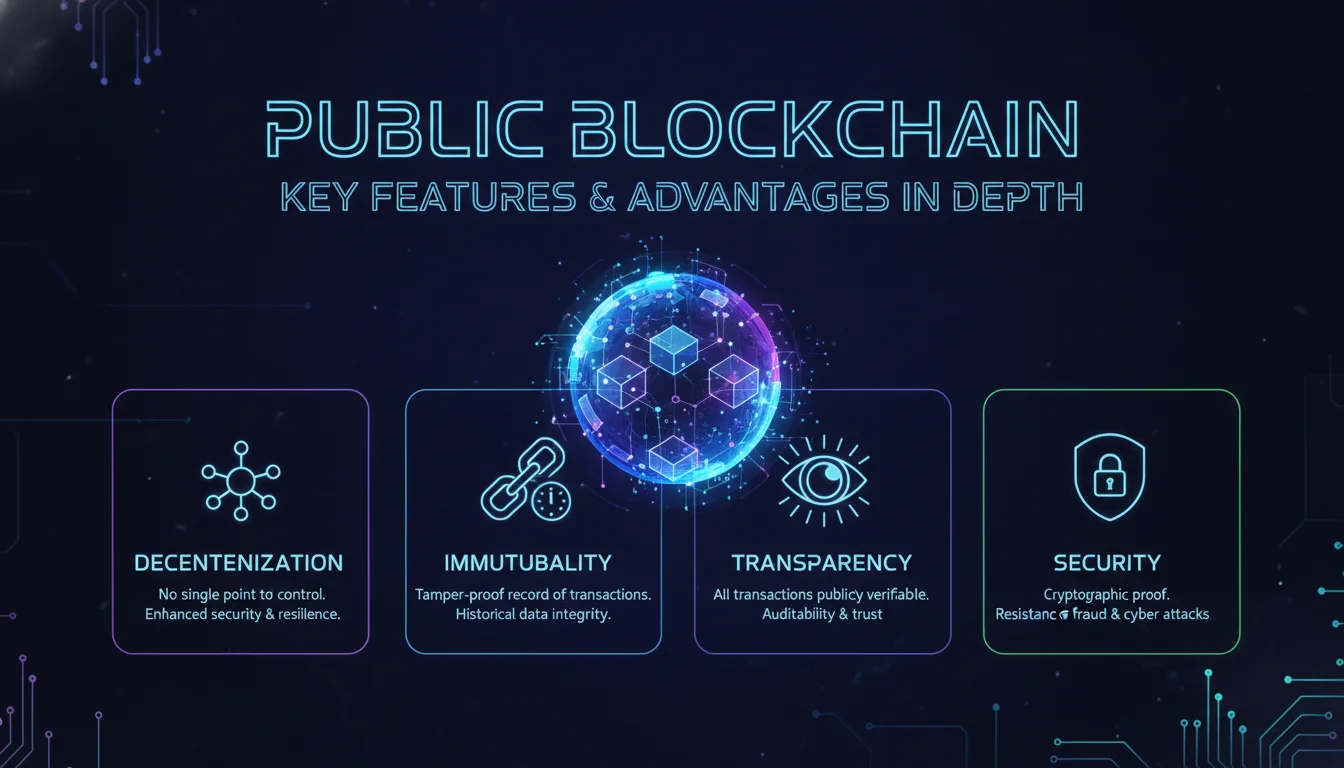
Decentralization means no central authority controls the ledger. A peer-to-peer network of nodes collectively maintains the record, removing the need for trusted intermediaries. As Investopedia puts it, a public blockchain offers a valuable solution for truly decentralized, democratized, and authority-free operations. Users can transact directly without relying on banks or payment processors.
Transparency and Immutability
All transactions are visible to anyone who accesses the ledger. That transparency enables real-time auditing by any participant, reducing corruption risk. Once data is recorded, altering it requires recomputing the hashes of every subsequent block and outpacing the honest network, which is computationally infeasible at scale. This immutability is a foundation of blockchain security, not just a feature.
Security Through Network Participation
Security scales with participation. A larger node count means more validators checking every transaction, raising the cost of a majority attack. The economic incentives built into consensus mechanisms align participant behavior with network health: honest validation earns rewards; dishonest behavior risks losing staked capital or wasted compute.
Challenges and Limitations
Privacy and Anonymity Concerns
Permissionless networks offer pseudonymity, not anonymity. Users are identified by addresses rather than names, but all transaction amounts and counterparties are on-chain and permanently visible. If an address is linked to a real identity through exchange KYC, on-chain analytics, or social data, the entire transaction history becomes traceable. This tension between transparency and privacy is a real barrier for enterprise adoption in regulated industries.
Scalability and Throughput Limitations
Every node must process every transaction, which creates a hard ceiling on throughput. Bitcoin’s base layer handles roughly 7 transactions per second. Newer networks like Solana claim significantly higher throughput using Proof of History, but critics argue that performance comes at some cost to decentralization. Layer 2 networks, sharding, and alternative consensus designs are active areas of development, though no approach has fully resolved the trilemma.
Energy Consumption and Environmental Impact
Proof of Work is energy-intensive by design. The computational competition that secures Bitcoin requires substantial electricity, and the environmental cost is a recurring criticism. Ethereum’s transition to Proof of Stake in September 2022 reduced its energy consumption dramatically, demonstrating that the trade-off is not inevitable. For builders choosing a chain, the consensus model is now an environmental and reputational consideration alongside technical ones.
Malicious Actors and Regulatory Uncertainty
Open participation cuts both ways. Anyone can join, including bad actors. Smart contract exploits, bridge hacks, and wallet drains are recurring events across permissionless ecosystems. Regulatory clarity is improving in some regions: the EU’s Markets in Crypto-Assets (MiCA) regulation provides a framework for crypto assets, and the United States is actively debating stablecoin and market structure legislation. Overly restrictive rules risk pushing development to more permissive jurisdictions, while clear frameworks could accelerate institutional adoption.
Popular Public Blockchain Examples and Use Cases
Bitcoin: Digital Gold and Peer-to-Peer Payments
Bitcoin, launched in 2009 by the pseudonymous Satoshi Nakamoto, is the first and most recognized permissionless network. It is primarily used for peer-to-peer value transfer and as a digital store of value. Bitcoin uses Proof of Work and has a fixed supply of 21 million coins, enforcing scarcity at the protocol level. According to GeeksforGeeks, it remains the foundational example of a permissionless, decentralized network.
Ethereum: Smart Contracts and Decentralized Applications
Ethereum, launched in 2015, introduced smart contracts: self-executing code that runs deterministically on the blockchain. That capability enabled DApps, DeFi protocols, and NFTs. Ethereum completed its transition from Proof of Work to Proof of Stake in September 2022, dramatically reducing its energy footprint. It remains the most active chain for developer activity and DeFi total value locked, according to DeFiLlama on-chain data.
Other Leading Networks: Solana, Cardano, Polkadot, BNB Smart Chain
Several other permissionless networks have earned significant adoption. Solana, launched in 2020, uses Proof of History combined with PoS to achieve high throughput and low fees. Cardano, founded in 2017, takes a research-driven approach with a layered architecture separating settlement and computation. Polkadot, also launched in 2020, enables interoperability between chains through its parachain model. BNB Smart Chain, developed by Binance, offers fast transactions and low fees and is popular for DeFi. As Investax notes, examples also include XDC Network, Polygon, and BASE, showing the breadth of options available.
“Public blockchains have been gaining popularity due to their decentralized nature, making them better suited for certain applications” including real-world asset tokenization. – Investax
Real-World Use Cases: DeFi, NFTs, RWA Tokenization
Permissionless networks power far more than cryptocurrency payments. DeFi protocols enable lending, borrowing, and trading without intermediaries. NFTs represent verifiable ownership of unique digital assets. Real-world asset tokenization is an emerging category: Investax reports that the RWA market is expected to reach $16.1 trillion in tokenized assets by 2030. Open, transparent, and liquid markets make permissionless chains the preferred settlement layer for tokenized securities, commodities, and real estate, though private chains still serve financial institutions running internal operations.
For a deeper look at how tokenization works at the protocol level, see our breakdown of smart contract architecture and token standards on the Digital Blockchains blog.
Public vs. Private vs. Consortium vs. Hybrid Blockchains
Comparison Table of Blockchain Types
The following table summarizes the key differences among the four types, based on definitions from the Government of India Blockchain CoE and Investopedia:
| Blockchain Type | Access | Governance | Use Cases | Examples |
|---|---|---|---|---|
| Public | Permissionless; anyone can join, read, write, validate | Decentralized; no central authority | Cryptocurrencies, DeFi, NFTs, RWA tokenization | Bitcoin, Ethereum, Solana, Cardano, Polkadot, BSC |
| Private | Permissioned; only selected verified participants | Centralized; operator can override or edit entries | Internal enterprise operations, supply chain, financial record-keeping | Hyperledger, Corda |
| Consortium | Semi-decentralized; multiple organizations manage the network | Shared governance among known entities | Inter-organizational data sharing, industry-specific consortia | R3 Corda (consortium deployments), Hyperledger Fabric in consortia |
| Hybrid | Combines private permission-based and public permissionless access | Controlled access to selected data; public access to other data | Selective transparency, regulated industries needing both privacy and auditability | XinFin, Dragonchain |
When to Choose Each Type
Choosing the right architecture depends on what you’re optimizing for. A permissionless network is the right call when you need maximum decentralization, censorship resistance, and open participation: cryptocurrency, global DeFi protocols, and RWA tokenization for liquid markets. A private chain fits enterprises that require strict access control, data privacy, and the ability to correct errors. Consortium chains work for groups of organizations sharing data while retaining some governance control. Hybrid chains offer flexibility for regulated industries that need public auditability alongside private data.
How to Get Started with Public Blockchains
Step 1: Set Up a Wallet and Join a Network
The entry point is a digital wallet. A wallet generates a cryptographic key pair: a public key (your on-chain address) and a private key (used to authorize transactions). Popular options include MetaMask for Ethereum-compatible chains, Phantom for Solana, and hardware wallets like Ledger for cold storage. Once your wallet is set up, you can receive and send assets, interact with DApps, and explore the network directly.
Step 2: Participate as a Node or Validator
Running a full node is a more active form of participation. A full node downloads the entire chain and validates every transaction and block, contributing to network security without necessarily earning block rewards. Validators and miners go further by proposing new blocks and earning cryptocurrency in return. Requirements vary significantly: Bitcoin mining requires specialized ASIC hardware, while Ethereum staking requires 32 ETH to run a solo validator. Delegated staking pools let smaller holders participate with less capital.
Step 3: Build on Permissionless Infrastructure
Developers build decentralized applications using smart contract languages like Solidity (Ethereum, BSC) or Rust (Solana, Polkadot). Alchemy’s directory lists 162 blockchains, including Ethereum, Solana, Base, Arbitrum, and OP Mainnet, with developer tools and RPC access across all of them. By using these platforms, developers can deploy contracts, create tokens, and build DeFi or NFT applications without managing underlying infrastructure.
If you’re evaluating which chain to build on, our studio page covers the protocol selection process we use for new projects.
The Future of Public Blockchain Technology
Scalability Solutions: Layer 2s and Sharding
Scalability is the most active area of protocol development. Layer 2 networks like Arbitrum and Optimism process transactions off the main Ethereum chain, reducing fees and increasing throughput while inheriting the security of the base layer. Sharding, planned for Ethereum’s later development phases, will split the network into parallel segments to handle more transactions simultaneously. These approaches aim to make permissionless networks viable for global-scale applications without sacrificing decentralization.
Institutional Adoption and Tokenization
Institutional interest is accelerating. The blockchain market is projected to grow from $44.29 billion in 2025 to $746.41 billion by 2032, at a CAGR of 56.3%, according to Fortune Business Insights as cited by Investax. Real-world asset tokenization is expected to be a primary driver, with $16.1 trillion in tokenized assets predicted by 2030. Permissionless chains are increasingly positioned as the settlement layer for tokenized securities, commodities, and real estate.
Governance Models and On-Chain Coordination
Protocol governance is maturing. Many public networks now use on-chain governance mechanisms where token holders vote on protocol upgrades, parameter changes, and treasury allocations. This model, associated with decentralized autonomous organizations (DAOs), shifts decision-making from core teams to the broader community. The quality of governance design directly affects a network’s ability to adapt, upgrade, and resist capture over time. As of 2026, governance participation rates and proposal quality vary widely across protocols, and this remains an open research area.
Regulatory Developments
Regulation is evolving faster than most builders expected. The EU’s MiCA regulation provides a structured framework for crypto assets across member states. The United States is actively debating stablecoin legislation and broader market structure bills. Clearer rules could accelerate enterprise adoption; overly restrictive ones risk pushing innovation to more permissive regions. Balancing openness with compliance will define how permissionless networks integrate with traditional finance over the next several years.
A public blockchain offers a combination of decentralization, transparency, and security that is reshaping finance, ownership, and data management. Challenges around privacy, throughput, and regulation persist, but Layer 2 solutions, improved consensus models, and RWA tokenization point to a growing role in the global economy. Understanding how these networks work and where they fit relative to other architectures is foundational knowledge for anyone building in Web3.
Ready to build on permissionless infrastructure? Apply to the Genesis Cohort at digitalblockchains.com and work with a team that reads whitepapers for breakfast.
Frequently Asked Questions
What are the four types of blockchain?
The four types are public, private, consortium, and hybrid blockchains, as defined by the Government of India’s Blockchain Centre of Excellence. Public is permissionless and open to anyone; private is restricted to selected participants; consortium is managed by multiple organizations; and hybrid combines public and private elements for selective transparency.
Is blockchain real or fake?
Blockchain is real, production-grade technology. It is a distributed ledger that records transactions across a network of computers using cryptographic proofs. Public networks like Bitcoin and Ethereum have operated continuously for over a decade and collectively secure trillions of dollars in value.
What are the top 5 public blockchains?
Bitcoin, Ethereum, Solana, Cardano, and BNB Smart Chain are among the most widely adopted permissionless networks by market capitalization and developer activity. Polkadot and Polygon are also significant by ecosystem size and usage.
What is the difference between public and private blockchain?
A public blockchain is permissionless, decentralized, and transparent: anyone can join, validate, and audit it. A private blockchain is permissioned, controlled by a central operator who can override or delete entries, and restricts access to verified participants. The core trade-off is censorship resistance versus control.
Can anyone join a public blockchain?
Yes. Anyone with an internet connection can join a permissionless network, read the ledger, create transactions, and participate in validation by running a node or staking tokens. No approval from any authority is required.
What are some examples of public blockchains?
Examples include Bitcoin, Ethereum, Solana, Cardano, Polkadot, BNB Smart Chain, XDC Network, Polygon, and BASE. As of 2026, Alchemy’s chain directory lists 162 active blockchain networks spanning the major Web3 ecosystems.