A private blockchain is a permissioned distributed ledger restricted to authorized participants, controlled by a single organization or consortium. It trades full decentralization for speed, privacy, and governance, making it the architecture of choice for regulated industries.
Key Takeaways
- A blockchain is a closed network where only verified participants can read, write, or validate transactions.
- It combines blockchain’s immutability with centralized governance for improved performance and data privacy.
- Top platforms include Hyperledger Fabric, R3 Corda, and ConsenSys Quorum.
- Use cases span supply chain, healthcare, finance, and identity management.
- The global blockchain market is projected to reach $746.41 billion by 2032, driven in part by enterprise adoption of permissioned networks.
- Consensus mechanisms like PBFT and Proof of Authority enable throughput orders of magnitude higher than public chains.
What Is a Private Blockchain?

A this type of blockchain is a distributed ledger technology (DLT) that operates on a permissioned basis, meaning access is limited to a select group of known and approved participants. Unlike public blockchains such as Bitcoin or Ethereum, which allow anyone to join and validate transactions, a this kind of blockchain restricts participation to entities that have been identity-verified and authorized by a central gatekeeper. This central authority, often a single organization or a consortium, governs the network, controlling who can run a node, propose transactions, or view the ledger.
According to Investopedia, a private “allows only selected and verified participants; the operator has the right to override, edit, or delete entries on the blockchain.” That level of control makes it distinct from the decentralized ethos of public networks, but it aligns closely with enterprise requirements for accountability and data sovereignty.
“A blockchain is not decentralized but rather a distributed ledger that operates as a closed database, controlled by a single entity.” – Investopedia, Public, Private, and Permissioned Blockchains Compared
Core Principles of Permissioned Networks
At its core, a this type of blockchain is a distributed database secured by cryptographic hashes, where each block contains a timestamp and a link to the previous block. The key departure from public chains lies in the governance model. The network is permissioned, meaning that before a node can join, it must receive explicit authorization. This permission is managed through digital certificates, smart contracts, or manual approval processes, depending on the platform.
Because the network is closed, it can employ more efficient consensus mechanisms like Practical Byzantine Fault Tolerance (PBFT), Raft, or Proof of Authority (PoA). These mechanisms require no energy-intensive mining, which drastically reduces latency and operational costs compared to proof-of-work systems.
How It Differs from Public Blockchains
Public blockchains are permissionless, trustless systems where any participant can read the ledger, propose transactions, and take part in consensus. They rely on economic incentives, such as proof-of-work or proof-of-stake, to maintain security without a central authority. A this kind of blockchain substitutes trust in a central entity for that trustlessness. This trade-off enables faster transaction finality, greater privacy, and the ability to amend records when necessary, which are features critical for regulated industries operating under GDPR, HIPAA, or similar frameworks.
How Permissioned Blockchains Operate

The operational model of a private hinges on a trusted intermediary, a term used by Bird & Bird to describe the entity or consortium that builds and maintains the network. This intermediary manages access rights, operates validator nodes, and typically provides a user-facing application for participants to interact with the ledger.
The Role of the Trusted Intermediary
In a typical blockchain deployment, the trusted intermediary will:
- Build or license the blockchain protocol, such as Hyperledger Fabric or Corda.
- Set up the initial nodes and define the governance rules.
- Onboard new participants after identity verification.
- Define access levels: some participants may only view selected transactions, while others can submit new transactions or operate a validator node.
- Maintain network health and enforce compliance with agreed-upon business logic.
This structure ensures the network remains exclusive and controllable, yet still benefits from blockchain’s immutability and auditability. Bird & Bird’s briefing note on this type of blockchains emphasizes that the legal relationship between the intermediary and participants must be clearly defined in a participation agreement, covering liability, data rights, and exit conditions.
Legal Considerations for Private Network Operators
Operators of a this kind of blockchain carry significant legal exposure that public chain participants do not. Because a single entity controls the ledger, it can be held accountable by regulators, counterparties, and data subjects. Key legal considerations include:
- Data controller status: Under GDPR, the operator is likely the data controller, responsible for lawful processing and subject access requests.
- Liability for errors: If the operator overrides or deletes an entry incorrectly, affected participants may have contractual or tort claims.
- Jurisdiction: Nodes distributed across multiple countries create complex questions about which law governs the ledger and dispute resolution.
- Smart contract enforceability: Automated execution of business logic must align with applicable contract law in each operating jurisdiction.
Drafting a robust participation agreement before network launch is not optional. It is the legal architecture that makes the technical architecture enforceable.
Consensus Mechanisms in Private Networks
Because all participants are known and trusted to some degree, privates do not need to defend against Sybil attacks with expensive mining. Instead, they use lightweight consensus algorithms. For example:
- PBFT (Practical Byzantine Fault Tolerance): Tolerates up to one-third of faulty nodes, achieving consensus through a series of message exchanges. Used in Hyperledger Fabric’s ordering service.
- Raft or Kafka: Crash-fault tolerant algorithms suitable for networks where all nodes are assumed honest. Used for ordering in some enterprise deployments.
- Proof of Authority (PoA): Identity-based consensus where validators are pre-approved. Used in private Ethereum networks like Quorum.
These mechanisms allow transaction throughput of thousands per second, compared to 7–15 TPS on public Bitcoin or Ethereum 1.0, according to GeeksforGeeks. That performance gap is the primary technical reason enterprises choose permissioned architectures for high-volume workflows.
Node Management and Data Distribution
Nodes in a blockchain are typically run by the trusted intermediary or delegated to known entities. Each node stores a full copy of the ledger, ensuring redundancy and tamper-resistance. Unlike public networks, the content of the ledger is not publicly visible. Access to transaction details can be restricted through channel technology, as in Hyperledger Fabric, or by configuring node-level permissions to expose only relevant data to each participant.
Pros and Cons of Private Blockchains
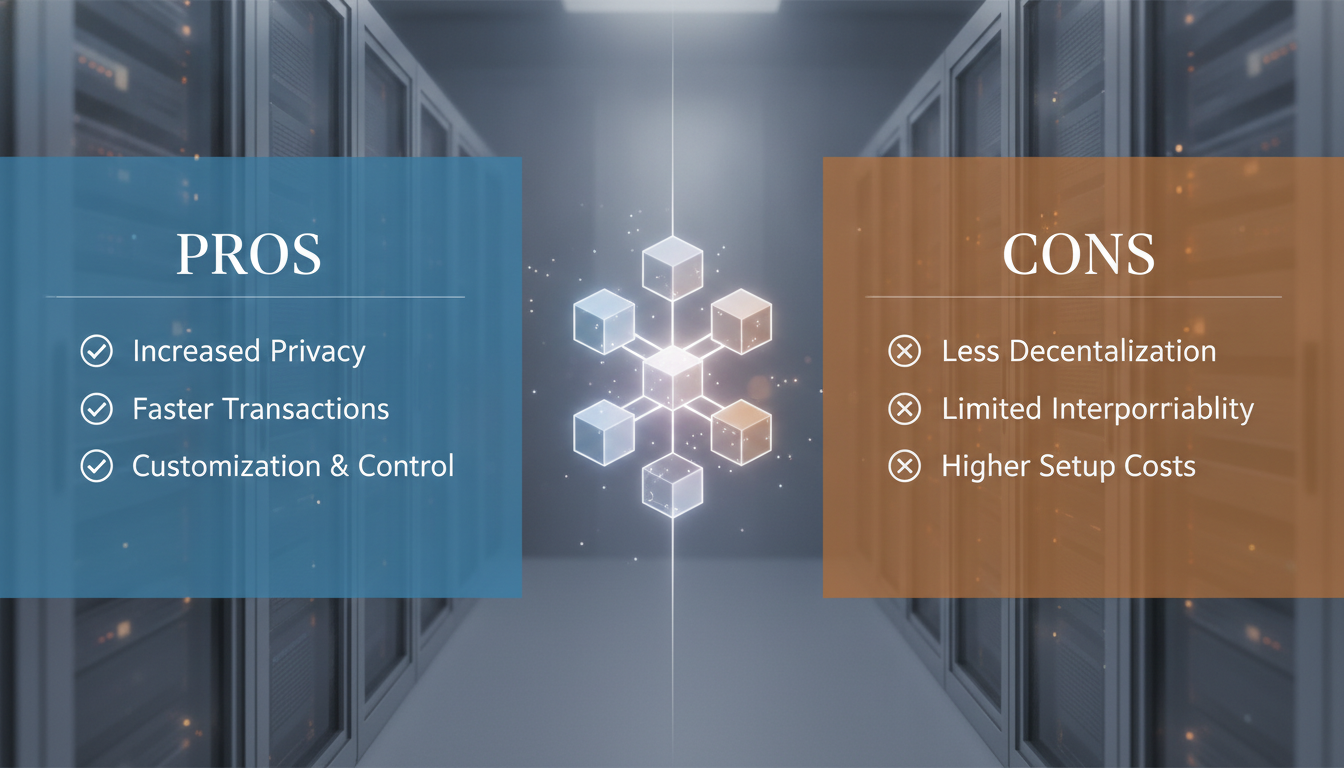
A this type of blockchain offers a specific set of trade-offs. Understanding them clearly is essential before committing to a permissioned architecture.
Pros
- High throughput: Lightweight consensus enables thousands of transactions per second, suitable for enterprise-scale workloads.
- Data privacy: Fine-grained access controls keep sensitive business data, such as PHI or trade secrets, away from unauthorized parties.
- Regulatory compliance: Centralized governance allows operators to implement data deletion, anonymization, and audit trails required by GDPR, HIPAA, and SOX.
- Energy efficiency: No proof-of-work mining means dramatically lower energy consumption and operational cost.
- Immutable audit trail: Every transaction is cryptographically linked, making tampering evident and simplifying compliance audits.
- Faster finality: Transactions settle in milliseconds with a single confirmation round, eliminating the probabilistic finality of public chains.
Cons
- Centralization risk: A single controlling entity reintroduces the single point of failure that public blockchains were designed to remove.
- Trust dependency: Participants must trust the operator not to alter or censor data arbitrarily, which undermines the trustless value proposition of blockchain.
- 51% collusion risk: A small validator set makes the network more susceptible to coordinated attacks by a majority of validators.
- Interoperability constraints: Private networks often operate as silos, making data exchange with other ledgers or legacy systems technically complex.
- Vendor lock-in: Choosing a specific platform like Fabric or Corda creates dependency on that ecosystem’s roadmap and support structure.
- Reduced transparency: The closed nature limits external auditability, which can be a disadvantage in multi-stakeholder environments where no single party is fully trusted.
Benefits of Private Blockchains in Depth

this kind of blockchains deliver measurable operational advantages when deployed in the right context.
Efficiency and Cost Reduction
By limiting participation to a small set of known validators, a private can process transactions in milliseconds and settle them with a single confirmation round. This speed reduces operational delays and lowers the cost per transaction significantly. As Gigster notes, permissioned networks are “lighter and therefore faster than their public counterparts” because the data set is smaller and fewer nodes need to reach consensus.
Enhanced Privacy and Data Control
Sensitive business data, such as trade secrets, personal health information, or financial records, can be shielded from competitors and the public. The operator of a blockchain can enforce fine-grained access controls, ensuring that each participant sees only the data relevant to their role. As Ledger Academy explains, private blockchains “prioritize efficiency and immutability” while reducing the focus on user anonymity that characterizes public networks.
Regulatory Compliance and Auditability
Regulated industries must comply with laws like GDPR, HIPAA, or the Sarbanes-Oxley Act. A private blockchain can be designed to store data in a way that meets these requirements, for instance by enabling data deletion or anonymization upon request. The centralized governance also means a clear entity can be held accountable by regulators. The immutable audit trail provides a tamper-proof record of all transactions, simplifying compliance reviews and reducing audit preparation time.
Energy Efficiency
Unlike proof-of-work-based public ledgers, a private blockchain avoids energy-intensive mining entirely. GeeksforGeeks highlights “reduced energy consumption” as a key characteristic of permissioned networks. This lowers environmental impact and reduces operational costs, making blockchain technology more viable for organizations with sustainability mandates or tight infrastructure budgets.
Challenges in Closed Blockchain Networks
Private blockchains introduce trade-offs that builders must address directly, not paper over with marketing language.
Centralization and Trust Dependency
Because a single organization or consortium controls a private blockchain, participants must trust the operator not to alter data arbitrarily or censor transactions. This reintroduces a single point of failure that public blockchains were designed to eliminate. Investopedia states that such networks are “not decentralized” but rather a “distributed ledger that operates as a closed database.” For many enterprise use cases, this trade-off is acceptable. For others, it defeats the purpose of using blockchain at all.
Security Risks and Collusion
A private blockchain with a limited number of validator nodes is more susceptible to collusion, where a majority of validators could coordinate to rewrite history. Ledger Academy warns that the small validator set “makes them targets for malicious attacks, such as the 51% attack.” Proper vetting of validators, robust participation agreements, and well-designed consensus rules are essential mitigations. This is not a theoretical risk: any network where 3–5 entities control validation is one coordinated breach away from a ledger rewrite.
Interoperability Constraints
Private blockchains often operate as silos, making it challenging to exchange data with other ledgers or legacy systems. Standards and bridges are emerging, including Hyperledger Fabric’s interoperability work with public networks via interledger protocols, but achieving smooth integration across heterogeneous systems remains an active engineering problem rather than a solved one.
Comparing Blockchain Types
Understanding where a private blockchain fits requires a direct comparison with the other major network architectures.
Public vs. Private vs. Consortium vs. Hybrid
| Feature | Public Blockchain | Private Blockchain | Consortium Blockchain | Hybrid Blockchain |
|---|---|---|---|---|
| Access | Permissionless: anyone can join | Permissioned: only authorized entities | Permissioned: multiple organizations share control | Mix: private data, public verification |
| Governance | Decentralized, often through token voting | Centralized under one entity | Semi-centralized, governed by consortium members | Controlled by owner; can expose parts to public |
| Transaction Speed | Slow (7–15 TPS for Bitcoin/Ethereum 1.0) | High (thousands of TPS) | High (comparable to private) | Variable, depends on configuration |
| Privacy | Transparent: all transactions visible | Closed: only authorized parties see data | Limited: visible to consortium members | Selective: choose public vs. private visibility |
| Use Cases | Cryptocurrencies, DeFi | Enterprise internal processes | Cross-org workflows (e.g., supply chain) | Regulated open markets |
| Examples | Bitcoin, Ethereum, Polygon | Hyperledger Fabric, R3 Corda | Energy Web Chain, Marco Polo | XinFin XDC Network |
When to Choose a Private Network Over Public
Organizations should consider a private blockchain when:
- Data confidentiality is legally or competitively required.
- Transaction finality must be guaranteed within seconds.
- A known set of participants needs to collaborate under a shared governance model.
- Compliance with regulations demands data redaction or central accountability.
- No economic incentive is needed to secure the network, because participation is based on contractual obligations rather than token rewards.
Top Industry Applications for Permissioned Networks
A private blockchain delivers tangible value in sectors where trust, speed, and data sovereignty are non-negotiable.
Supply Chain and Logistics
Global logistics operators like Maersk and Walmart have piloted private blockchains to track goods from source to shelf. By sharing a single, immutable record among suppliers, shippers, and retailers, a private blockchain eliminates disputes over shipment status and reduces paperwork. Temperature-sensitive pharmaceuticals, for instance, can be monitored in real time, with automated alerts triggered if conditions deviate from acceptable ranges.
Healthcare and Identity Management
Hospitals and insurers use private blockchains to securely share patient records while complying with HIPAA. Each provider gets permissioned access to only the necessary data, and every access event is logged immutably. This reduces fraud, speeds up claims processing, and gives patients meaningful control over their own medical history without exposing it to the public ledger.
Financial Services and Asset Tokenization
Banks use private blockchains for interbank settlement, cross-border payments, and tokenized securities. Because the network is closed, transaction details remain confidential among counterparties, yet regulators can be granted read-only access for audit purposes. J.P. Morgan‘s Onyx platform, built on a private fork of Ethereum, processes billions in intraday repo transactions daily. Asset tokenization on permissioned networks is also accelerating: tokenized bonds, real estate, and fund units can settle in minutes rather than the T+2 standard that still governs traditional markets.
“Tokenization of real-world assets on permissioned ledgers is one of the most consequential infrastructure shifts in institutional finance since the introduction of electronic trading.” – Hyperledger Foundation, Enterprise Blockchain Trends Report
Government and Public Records
Government agencies use private blockchains for land registries, voting systems, and identity documents. The immutable ledger discourages tampering, while private channels protect citizen privacy. India’s National Informatics Centre explores hybrid models to keep sensitive records confidential while enabling public verification of document authenticity, a pattern that is becoming a reference architecture for e-government deployments globally.
Hyperledger Fabric vs. R3 Corda: Architecture Trade-offs
Choosing between Hyperledger Fabric and R3 Corda is one of the most consequential technical decisions in a private blockchain deployment. Both are mature, production-grade platforms, but they reflect fundamentally different architectural philosophies.
Hyperledger Fabric Architecture
Fabric is a general-purpose permissioned blockchain framework hosted by the Linux Foundation. Its architecture is modular: consensus, membership services, and smart contract execution (chaincode) are all pluggable components. The channel mechanism is Fabric’s most distinctive feature. Each channel is an independent sub-ledger shared only among a defined subset of participants, allowing a single Fabric network to host multiple confidential workflows simultaneously.
Fabric supports chaincode written in Go, Java, or Node.js. Its ordering service, which sequences transactions before they are committed, can use Raft for crash-fault tolerance or be replaced with a custom implementation. Performance benchmarks from the Hyperledger community show Fabric networks achieving throughput in the range of 3,000–20,000 TPS depending on configuration, hardware, and chaincode complexity.
R3 Corda Architecture
Corda was designed from the ground up for financial institutions. Its most significant architectural departure from Fabric is that transactions are shared only between the parties directly involved, not broadcast to all network participants. This point-to-point model provides stronger privacy guarantees by default, without requiring channel configuration.
Corda uses a notary service for consensus rather than a global ordering service. The notary checks for double-spend and confirms transaction validity, but it does not see the full transaction content unless configured to do so. Smart contracts in Corda are written in Kotlin or Java and are called CorDapps (Corda Distributed Applications). Banks and central banks have used Corda for digital currency pilots, trade finance, and securities settlement, making it the dominant platform in capital markets blockchain deployments as of 2026.
Which Platform to Choose
Use Fabric when you need a flexible, general-purpose permissioned network with complex multi-party workflows and channel-based data isolation. Use Corda when you are building financial applications where transaction privacy between counterparties is the primary requirement and you want native integration with existing JVM-based banking infrastructure. For teams already invested in the Ethereum ecosystem, ConsenSys Quorum offers a third path: Ethereum-compatible smart contracts with PoA consensus and private transaction support via Tessera.
Implementation Roadmap for Organizations
Deploying a private blockchain involves several critical steps that must be executed in sequence.
Step 1: Define Objectives and Governance Model
Identify the business problem, whether it’s supply chain traceability, interbank settlement, or medical record sharing. Then determine who will govern the private blockchain. Will it be a single company or a consortium? Draft a legal agreement outlining participant rights, responsibilities, and dispute resolution. This agreement will directly inform the technical governance rules coded into the network, so legal and engineering teams must work in parallel from day one.
Step 2: Choose a Platform and Technology Stack
Select a blockchain framework that matches your requirements. Hyperledger Fabric is popular for complex enterprise workflows requiring channel-based data isolation. R3 Corda is the standard for financial institutions prioritizing direct peer-to-peer transaction privacy. ConsenSys Quorum offers smart contract compatibility with the Ethereum ecosystem and PoA consensus. Evaluate factors including smart contract language, performance benchmarks, ecosystem maturity, and long-term vendor support commitments before committing.
Step 3: Deploy Nodes and Establish Consensus
Set up the initial nodes on secure infrastructure, define the consensus protocol, and create the genesis block. Onboard participants by issuing cryptographic identities, typically X.509 certificates. Configure network rules, including endorsement policies and channel memberships, that reflect the agreed governance model. Test thoroughly in a sandbox environment before going live. Budget at least 4–8 weeks for integration testing with existing enterprise systems before production deployment.
Leading Private Blockchain Platforms
As of 2026, several mature platforms dominate the enterprise blockchain landscape. Each has a distinct positioning and technical profile.
Hyperledger Fabric
Hosted by the Linux Foundation, Fabric is a modular framework supporting pluggable consensus and smart contracts written as chaincode. It features channels for confidential transactions and has been adopted by IBM, Walmart, and Maersk for supply chain projects. Its performance can reach thousands of transactions per second depending on network configuration, making it suitable for high-volume enterprise workflows.
R3 Corda
Designed specifically for finance, Corda enables direct peer-to-peer transfer of value without broadcasting transactions to the entire network. It uses a notary service for consensus and supports Kotlin and Java-based CorDapps. Banks and central banks have used it for digital currency pilots, trade finance, and securities settlement across multiple jurisdictions.
ConsenSys Quorum
Quorum is an open-source enterprise Ethereum client that supports both private transactions and public Ethereum compatibility. It uses Istanbul BFT or Raft consensus and provides transaction privacy through Tessera, a private transaction manager. It has been used for central bank digital currency (CBDC) pilots and institutional DeFi infrastructure.
Other Notable Options
Other frameworks worth evaluating include Hyperledger Besu (Ethereum-based, suitable for both public and private networks), MultiChain (rapid prototyping for asset-focused use cases), and managed services from AWS, Azure, and IBM that simplify node deployment and reduce infrastructure overhead for teams without dedicated blockchain operations capacity.
Future Outlook and Industry Trends
The private blockchain sector is evolving fast, driven by enterprise demand, regulatory clarity, and the maturation of hybrid architectures.
Convergence with Public Networks
Hybrid models are gaining traction, allowing businesses to keep sensitive data on a private ledger while anchoring proofs or hashes on a public chain for universal verification. This approach, sometimes called “private-first, public-proof,” combines the trustlessness of public networks with the control of private ones. The National Informatics Centre of India describes hybrid blockchains as systems where “only a selected section of data or records from the blockchain can be allowed to go public keeping the rest as confidential.” This pattern is becoming the default architecture for regulated industries that need both auditability and privacy.
AI and Smart Contract Automation
Integrating artificial intelligence with private blockchains can automate complex business logic, such as dynamic pricing in supply chains or real-time fraud detection. Smart contracts triggered by AI-verified events can execute transactions with minimal human intervention, further reducing costs and latency. This combination is particularly powerful in trade finance, where document verification and compliance checks currently require significant manual effort.
Regulatory Tailwinds
Governments worldwide are establishing clearer guidelines for blockchain use. The European Union’s Markets in Crypto-Assets (MiCA) regulation and the accelerating rollout of central bank digital currencies (CBDCs) are pushing financial institutions toward private ledger infrastructures that can satisfy compliance requirements out of the box. As regulation matures through 2026 and beyond, private blockchains will likely become the standard backbone for compliant institutional networks rather than an experimental alternative.
If you’re building on permissioned infrastructure, the architectural decisions you make today will define your compliance posture for the next decade. The teams that get this right early will have a structural advantage. Apply to the Genesis Cohort at digitalblockchains.com to build with practitioners who have worked through these trade-offs at the protocol level.
Frequently Asked Questions
What is a private blockchain?
A private blockchain is a permissioned distributed ledger where only authorized entities can participate. It is controlled by a single organization or consortium and prioritizes privacy, efficiency, and governance over full decentralization. Access is managed through cryptographic identities and explicit permission grants.
What are examples of private blockchains?
Notable examples include Hyperledger Fabric (widely used in supply chain), R3 Corda (dominant in capital markets and trade finance), and ConsenSys Quorum (enterprise Ethereum with private transaction support). Other platforms like MultiChain and Hyperledger Besu are also used in production deployments.
Is XRP a private blockchain?
No, the XRP Ledger is a public blockchain. While it uses a trusted validator node list (UNL), anyone can run a validator and transactions are transparent on the public ledger. It is not controlled by a single entity and does not meet the definition of a private blockchain.
How is a private blockchain different from a centralized database?
Both are controlled by a central authority, but a private blockchain provides an immutable, cryptographically verifiable audit trail that a traditional database cannot. A standard database can be altered without leaving a detectable trace, whereas blockchain’s linked-block structure makes any tampering cryptographically evident to all participants.
Can data be deleted from a private blockchain?
Yes, the operator of a private blockchain has the ability to override or delete entries, unlike public blockchains where data is permanent. This capability is useful for compliance with data privacy laws like GDPR, but it does reduce the immutability guarantee that is one of blockchain’s core value propositions.
What consensus mechanism is used in private blockchains?
Common consensus mechanisms include Practical Byzantine Fault Tolerance (PBFT), Raft, and Proof of Authority (PoA). These are significantly faster and consume far less energy than proof-of-work mining, enabling throughput of thousands of transactions per second on well-configured permissioned networks.