Monad blockchain is a high-performance, EVM-compatible Layer 1 that processes up to 10,000 transactions per second with sub-second finality, letting developers deploy existing Ethereum smart contracts without modification.
Key Takeaways
- blockchain is a high-performance, EVM-compatible Layer 1 that targets up to 10,000 transactions per second with sub-second finality.
- The this type of blockchain uses parallel execution, MonadBFT consensus, and MonadDb to achieve speed without sacrificing Ethereum compatibility.
- As of August 2026, MON trades at $0.02545 with a $301.03 million market cap, down 47.79% from its all-time high of $0.04876.
- The Monad Foundation’s $60 million liquidity program revealed strong holder conviction: nearly all early investors declined to sell their locked MON.
- Developers can deploy existing Solidity contracts without modification, and validators can run on consumer-grade hardware.
What Is the Monad Blockchain?
Definition and Core Architecture
this kind of blockchain is a Layer 1 that maintains full compatibility with the Ethereum Virtual Machine (EVM), letting developers deploy existing Ethereum smart contracts without touching a single line of code. According to 0x’s introduction to Monad, the architecture is built from the ground up to support high throughput and low latency, targeting up to 10,000 transactions per second with sub-second finality. The monad blockchain achieves this through parallel execution and a pipelined consensus mechanism called MonadBFT.
Unlike Ethereum, which processes transactions sequentially, Monad’s parallel execution model runs multiple transactions simultaneously. That single architectural choice is what makes the monad blockchain a high-performance Layer 1 alternative rather than a sharded or rollup-based scaling solution.
Monad vs Ethereum: EVM Compatibility Explained
Monad blockchain is EVM compatible at the bytecode level, meaning Solidity contracts, EVM addresses, infrastructure, tooling, and libraries work out of the box. The Monad Foundation puts it plainly: developers can “focus on building great products – not learning a new stack.” That ease of migration is the central value proposition for the thousands of Ethereum developers who want performance without a rewrite.
Ethereum’s path to scalability runs through sharding and Layer 2 rollups, each adding complexity and bridging overhead. Monad delivers high performance at the base layer, preserving the security and composability of a unified state machine while keeping the familiar EVM execution environment intact.
The Monad Blockchain’s Place in the Layer 1 Landscape
Monad positions itself among high-performance Layer 1 blockchains like Solana, but with a critical difference: Solana uses a unique runtime and consensus mechanism, while the monad blockchain provides a familiar environment for Ethereum developers. This synthesis of Ethereum familiarity and Solana-class speed is Monad’s central thesis. Its custom database and low system requirements let validators run on consumer-grade hardware, supporting decentralization from day one rather than concentrating validation among well-capitalized data centers.
“Monad is EVM compatible at the bytecode level. That means Solidity contracts, EVM addresses, infra, tooling, and libraries work out of the box.” – Monad Foundation
How Monad Achieves 10,000 TPS: Technical Innovations
Parallel Execution and MonadDb
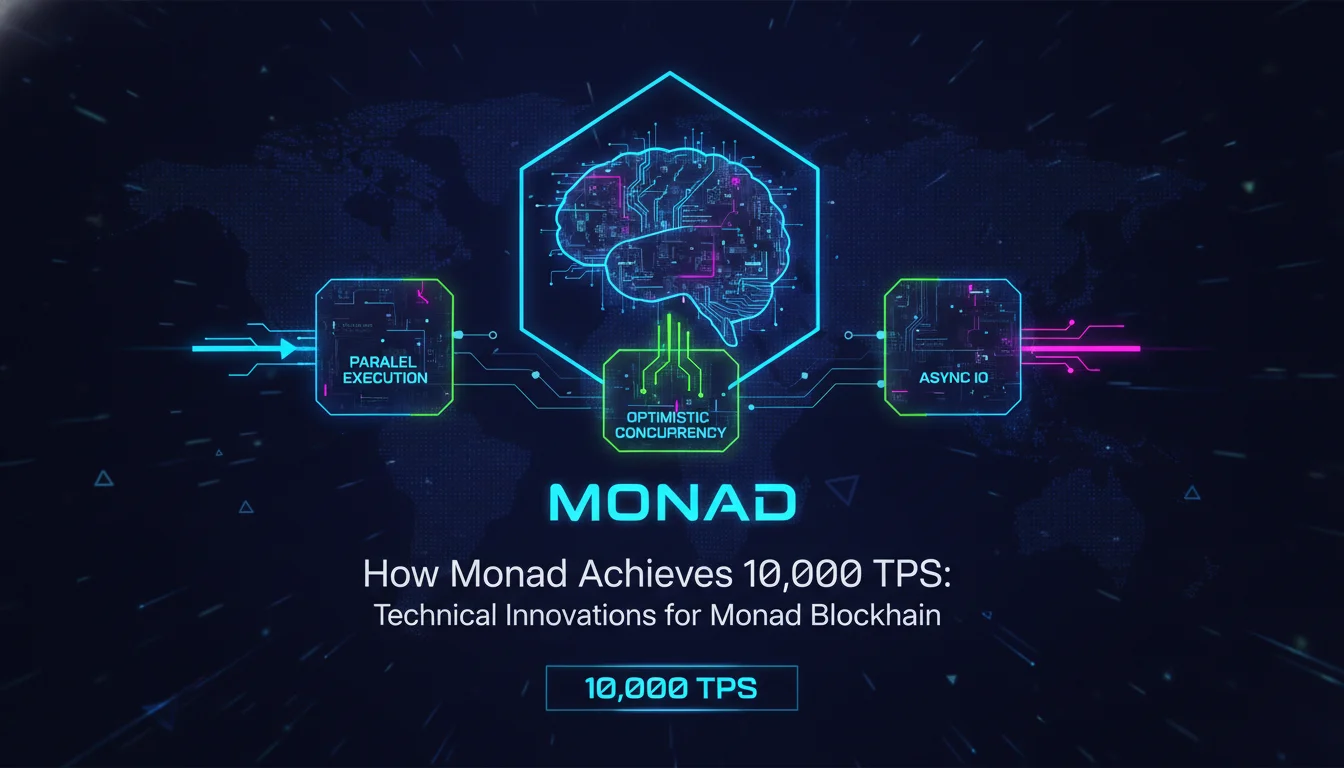
Parallel execution is the core mechanism that allows multiple independent transactions to be validated concurrently rather than one after another. This dramatically increases throughput because the network does not wait for one transaction to complete before starting the next. Monad’s implementation pairs parallel execution with a custom storage layer called MonadDb, which optimizes read and write operations for high concurrency.
According to 0x, Monad’s parallel execution model allows for better scalability, accommodating a growing number of users and applications without compromising performance. That is a direct departure from Ethereum’s sequential processing, which has historically capped throughput even as demand surges.
MonadBFT Consensus Mechanism
MonadBFT is a pipelined consensus protocol that enhances efficiency and reduces communication overhead, contributing to faster block finalization. Pipelining means different stages of consensus – proposing, voting, and committing – overlap across consecutive blocks rather than waiting for each block to complete all stages before the next begins. The result is a tighter gap between transaction submission and irreversible settlement.
The Monad Foundation targets sub-second finality as a core performance benchmark. While exact millisecond figures are not always published in the documentation, the consensus design is explicitly optimized to minimize time-to-finality as a first-class metric.
Low Hardware Requirements and Decentralization
One of the monad blockchain’s less-discussed but strategically important design choices is its low validator hardware requirement. The Monad Foundation states directly that its custom database and low system requirements allow validators to run on consumer-grade hardware. This contrasts with many high-performance chains that demand specialized, expensive machines, effectively centralizing validation among a small number of operators.
By making node operation feasible for individuals, the monad blockchain aims for what its website calls “real decentralization from day one.” This is a meaningful counterpoint to the blockchain trilemma: Monad argues it does not sacrifice decentralization to achieve speed and EVM compatibility simultaneously.
Monad Blockchain Tokenomics and Market Data
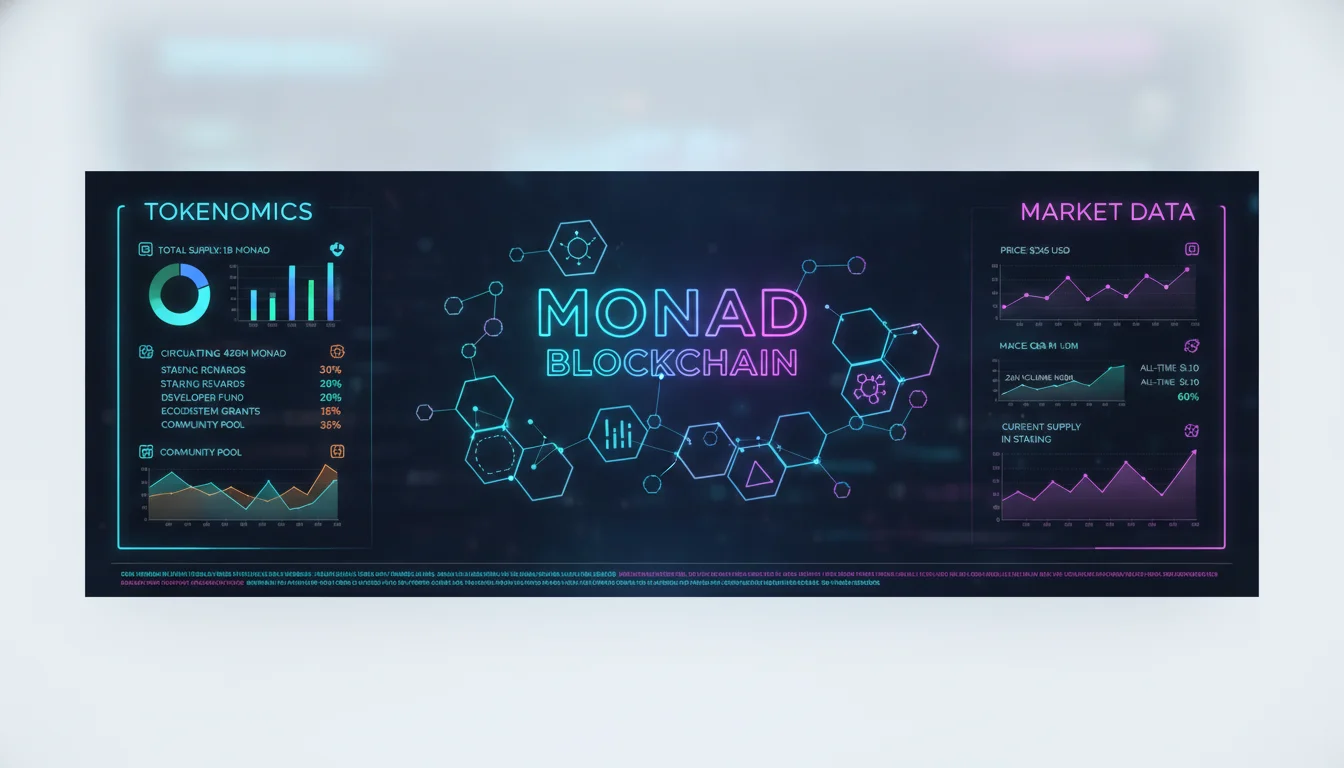
MON Token Supply and Circulating Supply Breakdown
As of August 2026, Monad’s native token MON has a total supply of 100.68 billion tokens, a maximum supply of 114.16 billion, and a circulating supply of 11.82 billion, according to CoinMarketCap. The project has approximately 7,870 holders, and the fully diluted valuation stands at $2.9 billion. The unlocked market cap is $1.29 billion, indicating a significant portion of supply remains locked or on vesting schedules.
The gap between circulating supply (11.82 billion) and total supply (100.68 billion) is the number every MON investor needs to watch. That delta represents ongoing vesting allocations that will eventually hit the open market. Monitoring the unlock schedule is not optional – it is the single most important supply-side variable for MON price.
Price Performance and Historical Highs and Lows
At the time of writing, MON trades at $0.02545, up 16.57% in the prior 24 hours. The 24-hour trading volume is $39.91 million, with a volume-to-market-cap ratio of 13.25%. MON’s all-time high was $0.04876 on November 26, 2025, and the current price sits 47.79% below that peak. Its all-time low was $0.01615 on February 6, 2026, and the current price is 57.63% above that trough, per CoinMarketCap data.
These figures tell a familiar story for newly launched Layer 1 assets: a strong initial rally, a sharp correction, and a recovery phase. The intraday gain shows renewed momentum, but the price remains well below its ATH. CertiK assigns the project a security rating of 4.4, indicating reasonable code audit assurance without a perfect score.
What the $60M Liquidity Program Reveals About Holder Conviction
In August 2026, the Monad Foundation completed a liquidity program under which it offered to buy locked MON from certain early investors at a discount reflecting the applicable four-year lock-up. The program totaled $60 million, per community reporting on CoinMarketCap. Nearly all eligible investors chose not to sell.
“Nearly all eligible investors chose not to sell, meaning most of the locked MON remains with its original holders. This keeps a large portion of the token supply locked while Monad continues its vesting and unlock schedule.” – CoinMarketCap community analyst, August 2026
That outcome signals strong conviction among early backers. Choosing to hold through a four-year lock-up rather than accepting a discounted exit suggests confidence in the monad blockchain’s long-term trajectory. It also keeps a larger portion of supply off the market, reducing immediate sell pressure during a critical growth phase.
Pros and Cons
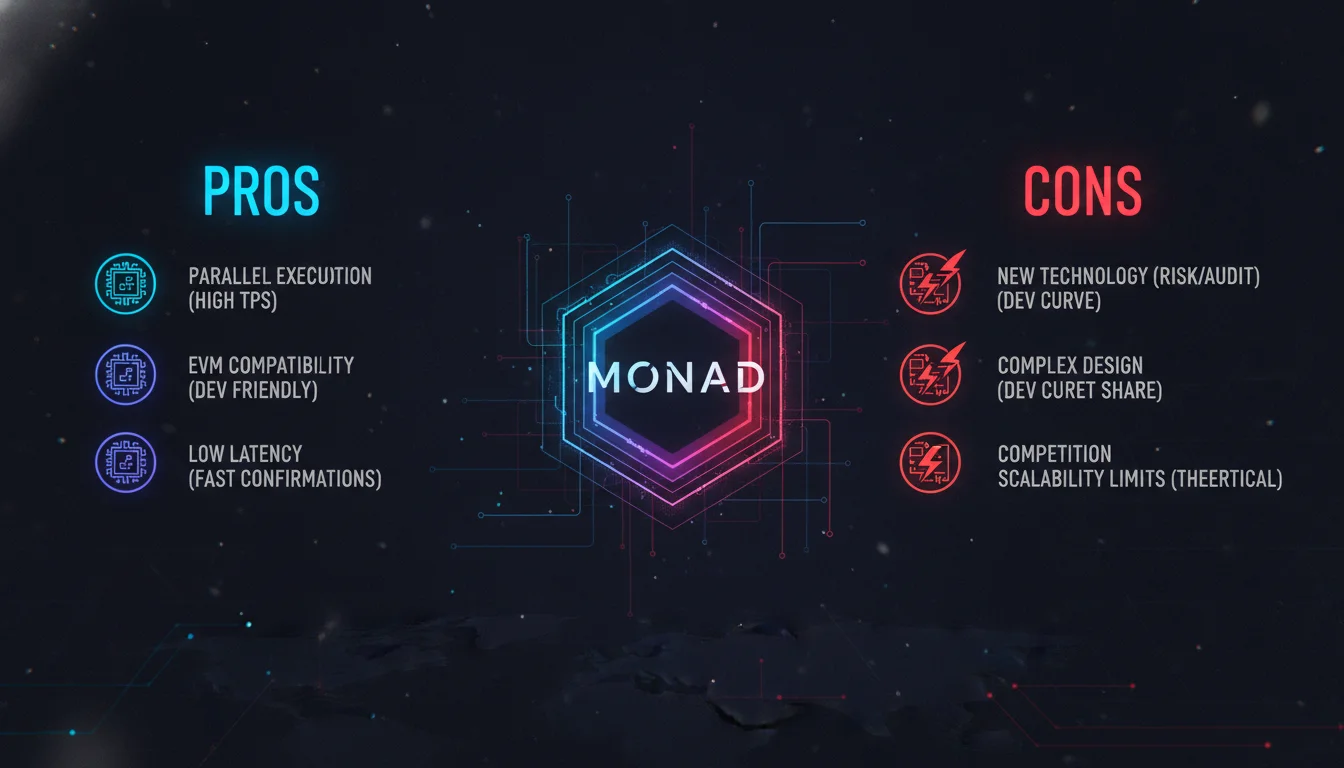
Pros
- Bytecode-level EVM compatibility: Existing Solidity contracts, tooling, and wallets work without modification, giving the monad blockchain immediate access to Ethereum’s developer ecosystem.
- High throughput at Layer 1: Targeting up to 10,000 TPS with sub-second finality without relying on rollups, bridges, or off-chain execution.
- Consumer-grade validator hardware: Low system requirements make node operation accessible to individuals, supporting genuine decentralization rather than data-center concentration.
- Strong early holder conviction: The $60 million liquidity program result shows early investors are not rushing for the exit, a positive supply-discipline signal.
- Near-zero gas costs: Increased network capacity makes DeFi products like orderbooks economically viable, which are cost-prohibitive on Ethereum mainnet.
Cons
- Large unlocked supply overhang: Only 11.82 billion of 100.68 billion total tokens are circulating. Future unlock events represent significant potential sell pressure.
- Early-stage ecosystem: With approximately 7,870 holders, concentrated ownership creates higher price sensitivity to large trades.
- Intense competition: The monad blockchain competes with Ethereum, Solana, Arbitrum, Optimism, and a growing field of parallelized EVM chains for developer and user mindshare.
- Execution risk: Compelling technology does not guarantee adoption. Real-world traction depends on developer onboarding and sustained ecosystem growth.
- Price volatility: Down 47.79% from its all-time high, MON demonstrates the volatility typical of newly launched Layer 1 assets.
Monad Ecosystem and Real-World Use Cases
Decentralized Finance and Orderbooks
One of the monad blockchain’s most compelling use cases is enabling DeFi applications that were previously cost-prohibitive on Ethereum. 0x specifically notes that Monad’s high throughput and near-zero gas costs allow developers to build products like orderbooks – which require frequent, low-latency updates – that are impractical on traditional EVM chains. This opens the door to more efficient decentralized exchanges, derivatives platforms, and lending protocols that can actually compete with centralized alternatives on user experience.
Because the monad blockchain maintains EVM compatibility, existing DeFi protocols can migrate their smart contracts and immediately gain the performance headroom needed for high-frequency interactions.
Prediction Markets and Agentic Payments
The Monad ecosystem is expanding beyond standard DeFi. In August 2026, the Monad Foundation joined the Agentic Payments Alliance, a coalition of 26 founding members across payments, stablecoins, and AI, working to shape how agent-driven commerce gets built. The Monad Foundation’s official X account announced the partnership, signaling intent to support machine-to-machine transactions at scale.
Projects like CRSHMARKET are exploring prediction markets tied to livestream events: whether an Uber will arrive in under two minutes, whether a streamer scores the next goal. These novel market types require low fees and fast finality, making the monad blockchain a natural fit for real-time settlement.
Developer Events and Global Hackathons
Monad’s community strategy includes a series of one-day hackathons called Monad Blitz, with events scheduled in Hyderabad, India; Abuja, Nigeria; and Belgrade, Serbia on August 22, 2026. The Monad Foundation also plans an inaugural summit called Open on October 6, 2026, in Singapore, right before Token2049. These events are designed to onboard developers quickly and demonstrate what the monad blockchain can do under real build conditions.
Institutional engagement is growing alongside developer outreach. The Studio Investor Fireside Chat in New York on August 20, 2026, featuring Metalayer Ventures, bridges founders and investors within the Monad ecosystem.
How to Get Started with Monad Blockchain
Step 1: Install an EVM-Compatible Wallet
Install MetaMask or any EVM-compatible wallet. Monad’s bytecode-level EVM compatibility means any Ethereum wallet works without modification. No new wallet software, no new key formats.
Step 2: Add the Monad Network RPC
Add the Monad network RPC details from the official Monad documentation. The exact RPC URL and chain ID are available on the Monad developer portal. Always verify these details against the official Monad Foundation website to avoid phishing or misconfiguration.
Step 3: Explore with MonadVision
Use the MonadVision block explorer to monitor transactions, view blocks, and verify smart contract deployments. MonadVision is the primary on-chain transparency tool for the monad blockchain ecosystem.
Step 4: Acquire MON Tokens
Obtain MON tokens through supported exchanges or bridges to interact with applications and pay for transactions. Check CoinMarketCap for the current list of supported trading pairs and venues.
Building on Monad: EVM Tools and 0x Integration
Because the monad blockchain is EVM compatible at the bytecode level, developers use the same Solidity contracts, EVM addresses, infrastructure, tooling, and libraries they already know. 0x has published an introductory guide detailing how to get started with Monad using the 0x API, enabling developers to integrate exchange liquidity into Monad-based applications with minimal friction.
The developer experience means teams can focus on product innovation rather than learning a new programming language or framework. This compatibility lowers the barrier to entry for the large base of Ethereum developers already fluent in Solidity.
Running a Validator on Consumer Hardware
Monad’s design explicitly targets low hardware requirements for validators. The Monad Foundation states that its custom database and low system requirements allow validators to run on consumer-grade hardware. This is a deliberate choice to promote decentralization and make it feasible for individuals – not just data centers – to participate in consensus.
Aspiring validators can find setup, configuration, and maintenance guidance in the Monad documentation. The ability to run a node on modest hardware is a real differentiator in a landscape where most high-throughput chains demand specialized equipment.
Monad vs. Other High-Performance Blockchains
Monad vs Ethereum: Sequential vs Parallel
Ethereum processes transactions sequentially, which limits throughput and drives fees up during periods of high demand. The monad blockchain’s parallel execution model processes multiple transactions simultaneously, dramatically increasing capacity. While Ethereum pursues sharding and Layer 2 rollups as scalability solutions, Monad delivers high performance at the Layer 1 level, preserving the security and composability of a unified state machine.
Monad vs Solana: EVM Familiarity vs Unique Runtime
Solana achieves high throughput through a unique runtime and consensus mechanism, but developers must learn a different programming model to build there. The monad blockchain delivers comparable performance while maintaining EVM compatibility, meaning existing Ethereum developers can migrate without rewriting code. The trade-off is philosophical: Solana prioritizes a purpose-built architecture, while Monad prioritizes developer familiarity and the network effects of the Ethereum ecosystem.
Monad vs Layer 2 Solutions: Scalability Without Rollups
Layer 2 solutions like Arbitrum or Optimism scale Ethereum by moving execution off-chain and posting proofs or data back to the main chain. The monad blockchain scales at the base layer, avoiding the complexity of bridges, fraud proofs, and validity proofs. The table below compares Monad’s approach with Ethereum and Solana:
| Feature | Monad | Ethereum | Solana |
|---|---|---|---|
| Consensus | MonadBFT (pipelined) | Post-Merge consensus | Unique consensus (not EVM) |
| EVM compatibility | Bytecode-level | Native | Not native (unique runtime) |
| Throughput | Up to 10,000 TPS | Limited by sequential execution | High but different design |
| Finality | Sub-second | Slower without L2 | Fast but architecture differs |
| Validator hardware | Consumer-grade | Higher requirements | Higher requirements |
This table illustrates Monad’s positioning clearly: it borrows Ethereum’s developer ecosystem while adopting a performance-oriented architecture, without requiring specialized hardware or a new runtime.
Is Monad Blockchain a Good Investment?
Fundamentals: Technology, Token Unlocks, and Market Metrics
From a fundamental perspective, the monad blockchain addresses real scalability pain points, and its EVM compatibility gives it a large addressable developer market. The tokenomics reveal a large total supply (100.68 billion MON) with only 11.82 billion currently circulating, meaning future unlock events could introduce supply pressure. The $60 million liquidity program outcome suggests early investors are not rushing to exit, which is a positive signal for supply discipline.
Market metrics show a $301.03 million market cap and $2.9 billion FDV. The gap between these numbers reflects the weight of locked tokens. Investors should monitor the vesting schedule closely. CertiK assigns a security rating of 4.4, indicating a reasonable level of code audit assurance, though not a perfect score.
Risks: Competition, Volatility, and Early-Stage Uncertainty
Monad faces intense competition from Ethereum, Solana, and a host of Layer 2 networks. Its long-term success depends on attracting developers and users to build a sustainable ecosystem. The token’s price history – down 47.79% from its ATH – demonstrates the volatility typical of newly launched Layer 1 assets. With approximately 7,870 holders, concentrated ownership creates higher price sensitivity to large trades.
Execution risk is real. Compelling technology does not guarantee adoption, and competitors could innovate faster or capture more developer mindshare before the monad blockchain reaches critical mass.
Analyst Signals and On-Chain Metrics to Watch
Several on-chain and market signals suggest cautious optimism. A volume spike of roughly 14x the recent baseline was observed around August 17, 2026, per a trader analysis on CoinMarketCap, indicating growing trading interest. RSI around 81.6 at that time suggested overbought conditions, so chasing the vertical move carried poor risk-reward. The monad blockchain is best viewed as a long-term infrastructure play rather than a short-term trade: its EVM-compatible high-performance architecture gives it a credible path to adoption, but the token remains speculative and subject to supply unlocks.
Frequently Asked Questions
What is the Monad blockchain?
Monad blockchain is a high-performance, EVM-compatible Layer 1 that processes up to 10,000 transactions per second with sub-second finality. It uses parallel execution, MonadBFT consensus, and MonadDb to achieve scalability while letting developers deploy Ethereum smart contracts without modification.
Is Monad crypto a good investment?
Monad has strong technology and a clear use case, but like all early-stage Layer 1 tokens, it carries significant risk. The $60 million liquidity program showed holder conviction, but the token is down 47.79% from its all-time high. Evaluate the fundamentals, token unlock schedule, and competitive landscape before committing capital.
How much is 1 Monad?
As of August 2026, 1 MON is worth $0.02545, with a 24-hour change of +16.57%. The price is volatile and can be checked live on CoinMarketCap.
How high will Monad crypto go?
No one can predict future price with certainty. MON’s all-time high was $0.04876 on November 26, 2025. Price trajectory depends on ecosystem growth, developer adoption, token unlock cadence, and broader market conditions.
How do I buy Monad (MON)?
You can buy MON on centralized and decentralized exchanges listed on CoinMarketCap. Set up an EVM-compatible wallet, add the Monad network RPC, then swap or purchase MON using supported trading pairs.
What is Monad’s total supply?
Monad has a total supply of 100.68 billion MON, a maximum supply of 114.16 billion, and a circulating supply of 11.82 billion as of August 2026. The fully diluted valuation is $2.9 billion, per CoinMarketCap.
If you’re building infrastructure, DeFi protocols, or agentic applications and want to work with a team that thinks at the protocol level, apply to the Genesis Cohort at digitalblockchains.com.