Smart contract development is the process of designing, coding, testing, deploying, and securing self-executing programs that run on a blockchain. It uses languages like Solidity and Rust, with frameworks like Hardhat and Foundry, to automate agreements without intermediaries.
Key Takeaways
- contract development is the process of building self-executing programs that run on a blockchain and automatically enforce rules.
- Smart contracts are a type of blockchain account with their own balance and state, deployed at a specific address, and they cannot be deleted by default.
- Solidity is the dominant language for Ethereum and EVM chains, while Rust, Cadence, and Daml serve Solana, Flow, and Canton Network respectively.
- Security is the top priority in this type of development because a single bug can drain millions of dollars, so production workflows use invariants, fuzzing, static analysis, and manual review.
- According to Fortune Business Insights, as cited by Aezion, the global smart contracts market was valued at USD 2.14 billion in 2024 and is projected to reach USD 12.07 billion by 2032.
- Beginner toolchains include MetaMask, Hardhat, Etherscan, and Alchemy, and a guided track can take around 4-5 hours.
What Is Smart Contract Development?
this kind of development is the engineering discipline of turning contract logic into deployable, self-executing code that runs on a blockchain without a central operator. According to Ethereum.org, a smart contract is simply a program that runs on the Ethereum blockchain. It’s a collection of code, called functions, and data, called state, that resides at a specific address on the chain. Smart contracts are also a type of Ethereum account. That means they have a balance, can be the target of transactions, and are not controlled by a single user. Instead, they’re deployed to the network and run exactly as programmed.
Wikipedia defines a smart contract as a computer program or transaction protocol intended to automatically execute, control, or document events and actions according to the terms of an agreement. The goal is reducing reliance on trusted intermediaries, arbitration costs, fraud losses, and malicious or accidental exceptions.
Good smart contract spans requirement analysis, language selection, coding, testing, security auditing, deployment, and upgrade planning. Unlike traditional software, deployed contracts are generally immutable and irreversible, which imposes a far stricter correctness burden than a typical web app. Every interaction gets recorded permanently on the blockchain, and mistakes can’t be patched by editing a server somewhere.
The Vending Machine Metaphor
The original metaphor for smart contracts is a vending machine, popularized by Nick Szabo, who was using the term by 1996 to describe contracts enforced by physical property, such as hardware or software, instead of by law. Ethereum.org explains that with the right inputs, a certain output is guaranteed: money plus snack selection equals snack dispensed. The logic is programmed into the machine. A smart contract works the same way, with logic programmed into code that runs on a blockchain. This analogy helps developers grasp determinism: the same inputs must produce the same outputs, with zero human discretion involved.
With the right inputs, a certain output is guaranteed.
Smart Contracts as Blockchain Accounts
On Ethereum, smart contracts are one of two account types, the other being externally owned accounts controlled by private keys. A contract account has a balance and can initiate or receive transactions, but only when triggered by a transaction from a user or another contract. This architecture means contract development requires understanding accounts, transactions, and the Ethereum Virtual Machine before writing a single line of logic. User accounts interact with a contract by submitting transactions that execute a function defined on it. Those functions can define rules, like a regular contract, and automatically enforce them via code.
Why Smart Contract Development Differs from Traditional Programming
Web3 University notes that smart contracts tend to be much simpler than traditional programs, but the risks are much higher. A single bug can lead to millions of dollars being drained in minutes. This asymmetry forces developers to think about economic value, adversarial users, and gas costs on every line they write. Traditional software can often be rolled back or patched, but contracts can’t be deleted by default and interactions are irreversible. As a result, professional teams emphasize formal specifications, testing, and audits before anything touches mainnet.
How Smart Contracts Work
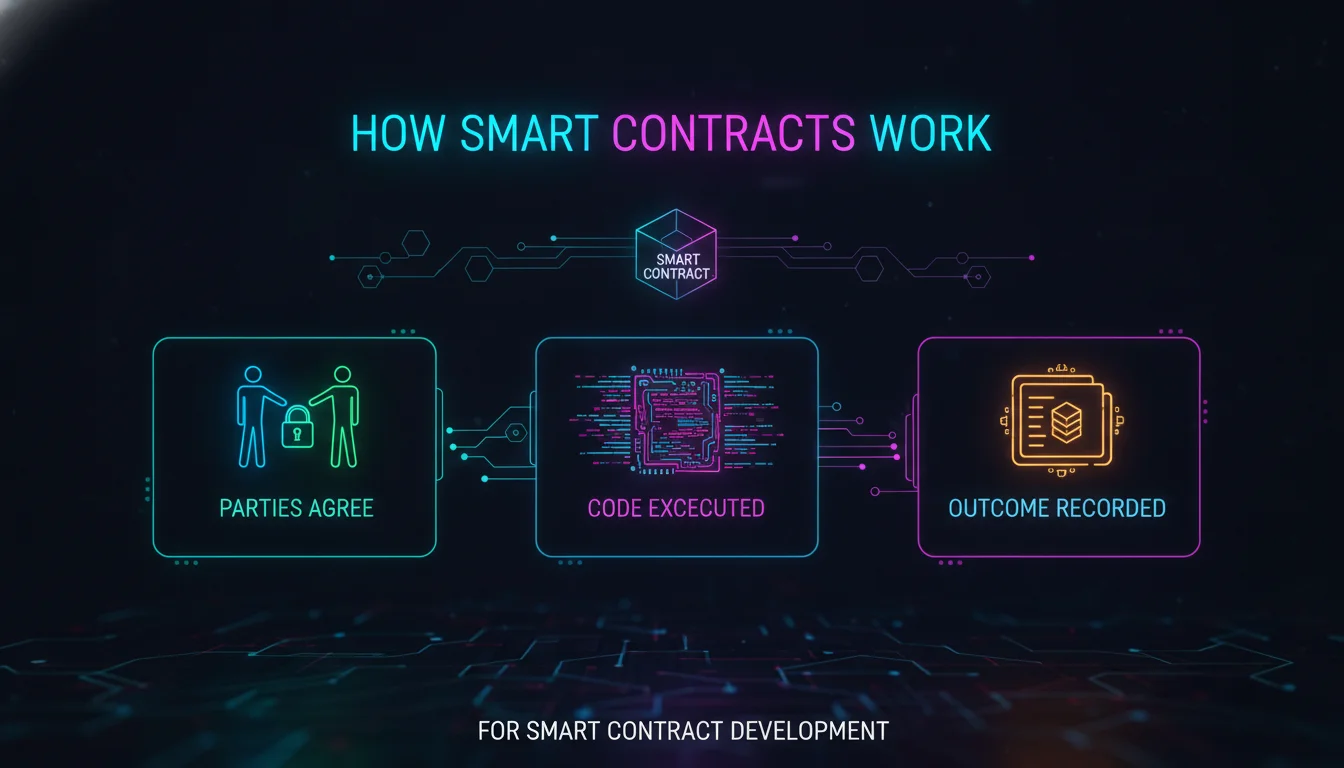
Smart contracts work through if/when…then logic written directly into code that a network of computers executes once conditions are met and verified. IBM notes these actions can include releasing funds, registering a vehicle, sending notifications, or issuing a ticket. The blockchain updates once the transaction completes, making it impossible to change and visible only to permissioned parties. There can be as many stipulations as needed to satisfy participants that a task is completed satisfactorily.
Coursera adds that smart contracts are digital agreements built on a blockchain that self-execute when terms and conditions are met. This may include a series of actions that trigger the next phase of the contract. The blockchain records the details permanently, making them highly reliable because they can’t be altered after the fact. You can implement them quickly and efficiently without an intermediary sitting in the middle.
From Agreement to Automated Execution
The workflow starts when two or more parties agree on the actions that trigger execution, which may involve multiple stages. A developer then programs the contract to enforce those terms. After deployment, it waits for triggering transactions. Because execution is automated, no intermediary is required, which cuts costs, saves time, and improves security. That said, the code must anticipate every possible condition and exception, because the contract executes exactly as written, not as intended, if there’s a mistake in the logic.
The Role of the Ethereum Virtual Machine
The Ethereum Virtual Machine (EVM) is the runtime environment that executes smart contract bytecode on Ethereum. When a user submits a transaction to a contract function, the EVM processes the opcodes, updates state, and charges gas for computational work. Smart contract development for EVM chains requires compiling high-level code like Solidity down to EVM bytecode. The EVM is deterministic, meaning every node in the network must produce the same result given the same inputs. This determinism is what makes consensus on state changes possible in the first place.
Irreversibility and Permanence
Once deployed, a smart contract can’t be deleted by default, and interactions with it are irreversible. This permanence creates both trust and risk. Participants can trust that rules won’t change unilaterally, but developers must accept that bugs can’t be silently fixed after launch. Upgradeable contracts exist, but they rely on proxy patterns and explicit upgrade mechanisms. Even then, the upgrade path itself is code that must be secured. Documenting permissions, pause switches, and admin powers before deployment matters because those decisions become much harder to change later.
Core Languages for Smart Contract Development
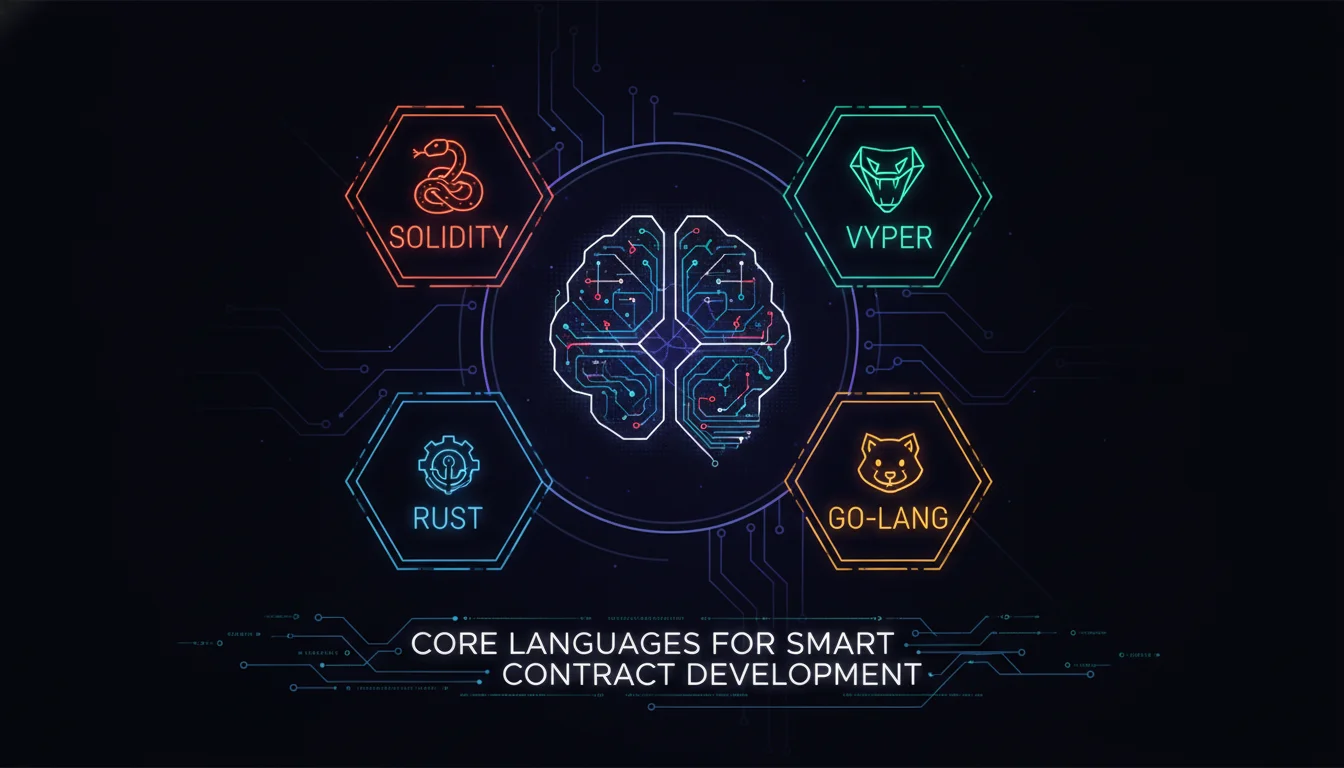
Smart contract development uses a range of programming languages, from general-purpose languages such as JavaScript and C++ to languages built specifically for the job, such as Solidity, according to Coursera. Web3 University identifies Solidity for Ethereum and Cadence for Flow as common examples. LimeChain, a blockchain development firm, writes contracts in Solidity for EVM chains, Rust for Solana, and Daml for Canton Network, switching to native languages for Hedera, NEAR, Polkadot, EOSIO, and Hyperledger Fabric where the chain calls for it.
| Language | Primary Chains/Ecosystems | Notable Characteristics |
|---|---|---|
| Solidity | Ethereum, Polygon, Base, Scroll, and other EVM chains | Object-oriented, most widely used for Ethereum token standards and dApps. |
| Rust | Solana | High-performance systems language used for Solana programs. |
| Cadence | Flow | Resource-oriented language designed for digital assets and NFTs. |
| Daml | Canton Network | Enterprise-grade language for privacy-sensitive and regulated applications. |
| JavaScript / C++ | General-purpose and private blockchain implementations | Accessible entry point for developers transitioning into blockchain work. |
| Native chain languages | Hedera, NEAR, Polkadot, EOSIO, Hyperledger Fabric | Selected when a chain requires its own language for optimal performance or features. |
Solidity and the EVM
Solidity is an object-oriented programming language for implementing smart contracts on Ethereum. It draws influence from JavaScript, C++, and Python, and compiles down to EVM bytecode. The Solidity documentation includes a simple storage example that sets a variable and exposes a getter function, demonstrating the basic anatomy of a contract:
// SPDX-License-Identifier: GPL-3.0
pragma solidity >=0.4.16 <0.9.0;

contract SimpleStorage {
 uint storedData;

 function set(uint x) public {
 storedData = x;
 }

 function get() public view returns (uint) {
 return storedData;
 }
}
The Solidity documentation currently tracks versions up to v0.8.36, reflecting continuous language evolution. Per Wikipedia, the original Ethereum white paper by Vitalik Buterin in 2014 proposed a stronger smart contract system based on Solidity, which is Turing complete, building directly on ideas from Nick Szabo.
Rust, Cadence, and Other Chain-Specific Languages
Different blockchains use different execution environments and priorities. Rust is the primary language for Solana, where high performance and low-level memory control matter most. Cadence runs on Flow, where a resource-oriented model simplifies ownership of digital assets like NFTs. Daml powers Canton Network, which focuses on enterprise privacy and composability. According to LimeChain, chain and language get selected based on the product's privacy, cost, settlement, and ecosystem requirements during architecture. This isn't just a syntax preference. It affects tooling, auditing, performance, and the pool of available developers you can hire from.
Choosing a Language and Chain
Smart contract development begins with architecture decisions, not code. A developer or team must evaluate whether the target chain is EVM-compatible, whether privacy is required, what settlement finality is needed, and what ecosystem tooling exists. For most public Ethereum-aligned dApps, Solidity remains the default choice. For high-throughput financial applications, Rust on Solana may be preferred. For regulated institutional use cases, Daml on Canton or native chain languages may be necessary. These choices constrain the entire development lifecycle, including which test frameworks, static analyzers, and auditors are available to you.
The Smart Contract Development Workflow
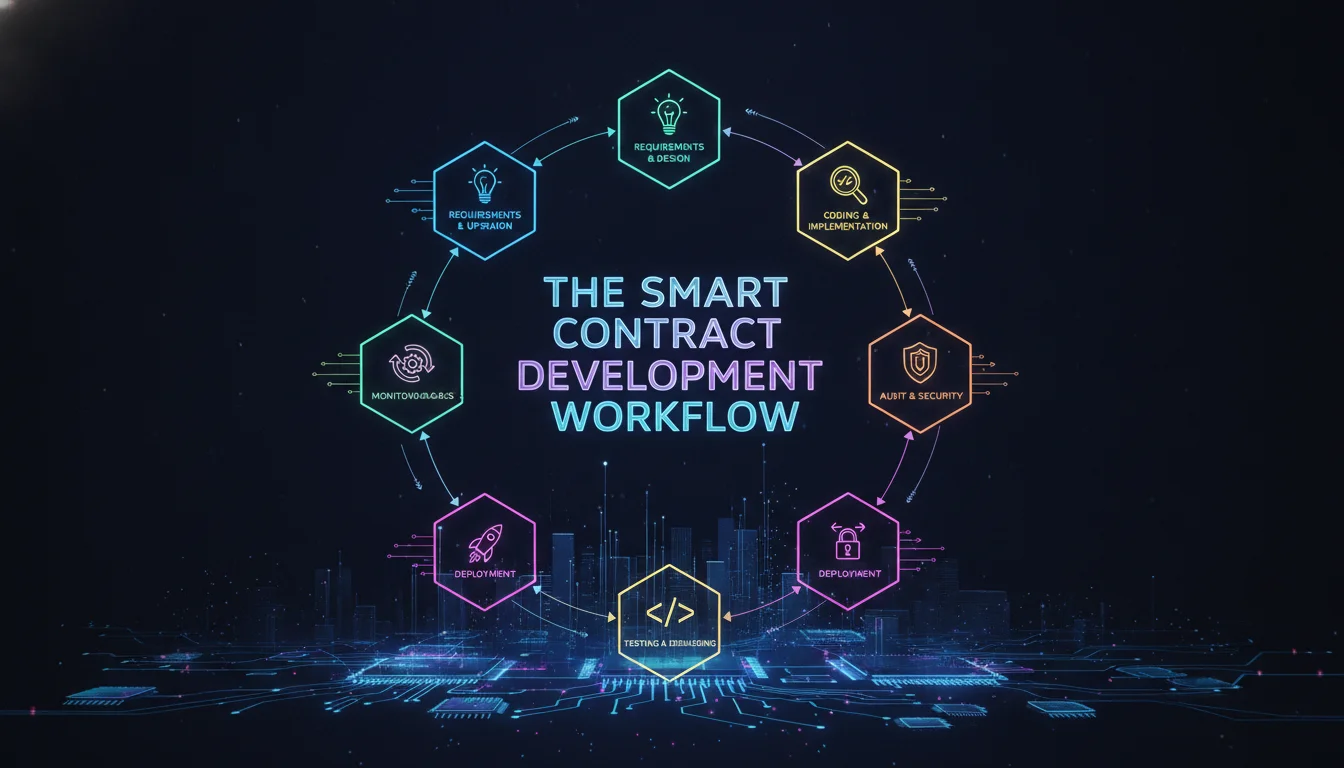
A production-grade smart contract development workflow is more than writing code. LimeChain, which reports work across more than 220 projects and over 8 years of blockchain expertise, uses a seven-step process that starts with invariants and ends with deployment rehearsal. Beginner tutorials from Web3 University cover a simpler five-tool path: MetaMask, Solidity, Hardhat, Etherscan, and Alchemy. Combining the two perspectives gives you a robust mental model for the full lifecycle.
We identify the conditions the contract must always satisfy and turn them into automated tests. A senior engineer reads every value-bearing contract line by line.
Step-by-Step Production Workflow
- Step 1: Define the invariants. Identify the conditions the contract must always satisfy and turn them into automated tests. An invariant is a property that must hold across every possible execution path.
- Step 2: Size assurance to risk. Scope testing and audit effort against the value at risk, the novelty of the mechanism, and the admin powers embedded in the contract.
- Step 3: Document permissions and upgrade paths. Write down admin powers, pause switches, and upgrade mechanics while they can still be changed. This transparency reduces governance friction down the road.
- Step 4: Prototype novel logic first. For mechanisms without precedent, build a narrow version to observe behavior and gas cost early. This avoids full-scale failures on unproven ideas.
- Step 5: Review every value path. Hold weekly technical reviews and read all value-bearing and permissioned logic by hand. A senior engineer reads every value-bearing contract line by line, no shortcuts.
- Step 6: Produce the evidence. Run fuzzing, static analysis, and fork tests, package the results for your auditor, then fix and retest. Evidence is the bridge from internal confidence to external assurance.
- Step 7: Rehearse deployment. Practice signers, configuration, verification, and pause procedures on a testnet, then transfer ownership. Rehearsal reduces the chance of a catastrophic mainnet mistake.
Beginner Toolchain: MetaMask, Hardhat, Etherscan, and Alchemy
Web3 University's introductory track walks through the essential tools for deploying your first smart contract. MetaMask is a software cryptocurrency wallet used to interact with the Ethereum blockchain and pay for gas. Hardhat is an Ethereum development environment that compiles Solidity contracts, tests them on a dev network, and surfaces Solidity stack traces. Etherscan is an online blockchain explorer for viewing transactions, blocks, and wallet states. Alchemy is a web3 developer platform that provides free nodes to connect with the Ethereum network. This toolchain is built for learning and small-scale experimentation, but the same concepts scale to production environments with Foundry, viem, wagmi, and ethers.js.
From Local Testing to Mainnet Deployment
The path from local testing to mainnet deployment includes compiling the contract, running unit tests, deploying to a testnet, verifying source code on Etherscan, and then executing a carefully planned mainnet deployment. Each stage adds confidence and exposes failures that are cheap to fix early. Fork tests, which run contracts against a copy of existing mainnet state, are especially valuable for understanding how a new contract will interact with live protocols. A testnet rehearsal with all signers and configuration in place ensures no operational detail gets left to chance. Only after evidence passes and ownership transfer is executed does a contract become immutable public infrastructure.
Security, Testing, and Auditing in Smart Contract Development
Security is the defining constraint in smart contract development, full stop. Unlike a cloud application, a vulnerable smart contract can't be patched by shipping a hotfix and rolling back a database. The immutability of deployed contracts means vulnerabilities become permanent attack surface. That's why Web3 University warns that a single bug can lead to millions of dollars being drained in minutes. Professional teams design for verification starting from the first line of code.
Invariants and Property-Based Testing
An invariant is a condition that a contract must always satisfy, no matter what path execution takes. LimeChain begins every engagement by defining invariants and turning them into automated tests. Property-based testing then generates many input cases to verify the invariant holds across a wide range of scenarios, not just the handful of examples a developer can think of manually. This approach catches logical errors that unit tests miss, because it explores state combinations rather than hardcoded paths. For example, an invariant for a token contract might be that the sum of all balances always equals total supply after any transfer.
Fuzzing, Static Analysis, and Fork Tests
Fuzzing is a testing technique that feeds random or unexpected inputs to a contract to surface crashes, assertion failures, or invariant violations. Static analysis tools examine contract code without executing it, looking for known vulnerability patterns such as reentrancy, integer overflow, and unchecked return values. Fork tests run a contract against a snapshot of existing blockchain state, letting developers see how it interacts with real protocols before deployment. LimeChain packages fuzzing, static analysis, and fork test results for the client's auditor, then fixes and retests. This evidence-first approach cuts the odds that a third-party audit finds a critical issue at the last minute.
Manual Code Review and Third-Party Audits
Automated tools alone can't guarantee security. A senior engineer reading every value-bearing contract line by line catches logic errors, economic flaws, and permission mistakes that pattern-based tools miss entirely. LimeChain holds weekly technical reviews and reads all value-bearing and permissioned logic by hand. Third-party audits add an independent perspective, and they're often a requirement before a protocol handles significant user funds. Even after an audit, ongoing monitoring and bug bounty programs matter because new attack techniques and cross-protocol interactions can emerge after deployment.
Real-World Smart Contract Use Cases
Smart contracts appeared first in cryptocurrency and finance, but they now extend into mainstream industries. Coursera lists retail, real estate, health care, supply chain management, art and entertainment, and insurance as industries implementing smart contracts. Wikipedia notes that Ethereum smart contracts are generally considered a foundational building block for decentralized finance (DeFi) and non-fungible token (NFT) applications.
DeFi and NFTs
DeFi protocols use smart contracts to automate lending, borrowing, trading, and yield generation without centralized intermediaries. A loan contract can automatically liquidate collateral when a borrower misses a predetermined number of payments. NFT marketplaces rely on smart contracts to manage ownership, royalties, and transfers of unique digital assets. Token standards like ERC-20 for fungible tokens, ERC-721 for NFTs, and ERC-1155 for multi-token contracts form the foundation of these applications. These standards define interfaces that let wallets, exchanges, and other contracts interact with tokens predictably. Smart contract development for DeFi and NFTs requires deep knowledge of these standards and their security implications.
Enterprise and Institutional Applications
Enterprises use smart contracts to automate workflows and cut reconciliation costs. IBM describes actions such as releasing funds, registering a vehicle, sending notifications, or issuing a ticket once conditions are met. LimeChain's institutional practice, Lime Institutional, targets banks and enterprises building in the digital assets space, with a focus on security, testing, performance, and gas efficiency. Enterprise smart contract development often prioritizes privacy, permissioning, and regulatory compliance more heavily than public DeFi does. Canton Network and Daml are examples of platforms built to address those requirements.
Supply Chain, Real Estate, and Insurance
Supply chain applications use smart contracts to trigger payments when goods are delivered, cutting disputes and paperwork. Real estate contracts can automate security deposit returns when a tenant returns keys and an inspection is completed. Insurance activation can occur automatically when specific criteria are met, such as the authorization of a medical procedure. Transportation rental platforms use smart contracts to unlock a bike when a deposit is paid and automatically return the deposit when the bike comes back. These use cases share a common pattern: a digital state change triggers a real-world or financial action without manual processing sitting in between.
Smart Contract Development Platforms and Standards
Smart contract development doesn't happen in a vacuum. It relies on blockchain platforms, token standards, and developer ecosystems. Ethereum remains the reference implementation, but other chains have introduced alternative execution models and programming languages. Knowing this landscape helps developers pick the right tools and avoid getting locked into one ecosystem.
Ethereum Token Standards
Ethereum Improvement Proposals define standards that smart contracts should follow. The most common are ERC-20, a standard interface for fungible tokens such as stablecoins and governance tokens; ERC-721, a standard for non-fungible tokens that represent unique items; and ERC-1155, which supports both fungible and non-fungible tokens in a single contract. These standards aren't legally mandated, but they create interoperability expectations across the ecosystem. A wallet that supports ERC-20 can display and transfer any compliant token without custom code. Standards sit at the center of smart contract development because they enable composability between independent protocols.
EVM Chains, Solana, and Canton
The EVM has become a de facto execution standard across multiple chains. LimeChain writes Solidity for Ethereum, Polygon, Base, and Scroll, all of which are EVM-compatible. Solana uses a different execution model paired with Rust, requiring a separate toolchain and mental model entirely. Canton Network uses Daml and emphasizes privacy and enterprise workflows. Hedera, NEAR, Polkadot, EOSIO, and Hyperledger Fabric each carry their own native language or tooling considerations. Developers who understand one chain can often transfer concepts, but production work requires chain-specific testing and close attention to finality, gas metering, and account models.
Layer 2 Networks and Scaling Considerations
Ethereum's base layer charges gas fees that can make frequent small transactions expensive. Layer 2 networks roll up transactions and post compressed proof or state back to Ethereum, cutting cost and increasing throughput. Ethereum.org maintains a list of layer 2 networks, and some, such as Base and Scroll, are EVM-compatible, so Solidity contracts can deploy with minimal changes. Smart contract development on layer 2 still involves gas, but fees are typically lower than mainnet. Developers should consider whether users interact through a bridge, how finality works, and whether the rollup supports the same opcodes and precompiles as mainnet. These decisions shape both user experience and security assumptions.
Market Growth and Career Considerations
The smart contracts market is expanding at pace. According to a report by Fortune Business Insights, as cited by Aezion, the global smart contracts market size was valued at USD 2.14 billion in 2024 and is projected to be worth USD 2.69 billion in 2025, further reaching USD 12.07 billion by 2032 with a CAGR of 23.9% during the forecast period. These figures point to sustained demand for developers and engineering teams who can build secure contracts, though we'd caution against treating any single market forecast as gospel. As of 2026, that demand shows up in job postings just as much as in funding rounds.
Market Growth Projections
The same report projects the market growing from USD 2.14 billion in 2024 to USD 12.07 billion by 2032. Growth is driven by adoption in finance, supply chain, insurance, and enterprise workflows. While public attention often focuses on token prices, the underlying infrastructure is where durable value tends to accrue. Teams like LimeChain, which reports work spanning more than 220 projects and 8+ years of blockchain expertise, show how much professional services capacity is already supporting this market. Developer education providers like Cyfrin Updraft and Web3 University have responded with full courses and free bootcamps to meet demand.
Skills and Learning Paths
Becoming a smart contract developer typically starts with JavaScript or Python fundamentals, then moves into Solidity and Ethereum-specific concepts. Web3 University's introductory track promises around 4-5 hours of guided learning, including coding projects. Patrick Collins' full Solidity smart contract development course on YouTube runs over 10 hours and covers blockchain, Solidity, ERC20s, full-stack Web3 dapps, DeFi, Chainlink, Ethereum, upgradeable smart contracts, DAOs, Aave, IPFS, and more. IBM's Full-Stack JavaScript Developer Professional Certificate is suggested by Coursera as a way to build practical programming skills that support a path toward smart contract development. No single course gets you there alone, but structured tracks lower the entry barrier meaningfully.
Developer Roles and Responsibilities
Smart contract developers are responsible for more than writing code. They need to understand the economic mechanisms, permission structures, and failure modes of what they're building. They write invariants, produce test evidence, rehearse deployments, and coordinate with auditors. They also choose languages and chains based on privacy, cost, settlement, and ecosystem requirements. Because deployed contracts are public and immutable, the role carries a level of responsibility closer to infrastructure engineering or financial engineering than typical web development. That's why senior review and formal processes are standard practice in professional smart contract development shops.
Pros and Cons of Building On-Chain
Smart contract development trades the flexibility of traditional software for the trust guarantees of an immutable, transparent ledger, and that trade-off cuts both ways depending on what you're building. Weighing these honestly before committing to an architecture saves time later.
Pros
- Removes intermediaries from agreement execution, cutting cost and settlement time.
- Immutability creates strong trust guarantees. Rules can't be changed unilaterally once deployed.
- Composability lets independent protocols interact through shared token standards like ERC-20 and ERC-721.
- Transparent execution means every transaction is publicly verifiable on-chain.
Cons
- Bugs are permanent by default. A single flaw can drain funds with no rollback option.
- Gas costs can make frequent small transactions expensive on base layer Ethereum.
- Upgrade paths require proxy patterns and careful permission design, adding complexity.
- Security auditing and formal testing add real time and cost to the development timeline.
Frequently Asked Questions
What is smart contract development?
Smart contract development is the process of designing, coding, testing, deploying, and securing self-executing programs that run on a blockchain. It requires knowledge of languages like Solidity or Rust, blockchain fundamentals, and security best practices.
Which language is best for smart contract development?
Solidity is the most common choice for Ethereum and EVM chains, while Rust powers Solana and Cadence runs on Flow. The best choice depends on the target chain, privacy requirements, cost, and ecosystem, according to LimeChain.
Do smart contracts require an intermediary?
No. Smart contracts self-execute when predefined conditions are met, removing the need for intermediaries, cutting costs, and improving security through an immutable blockchain ledger.
Can smart contracts be changed after deployment?
By default, smart contracts can't be deleted and interactions with them are irreversible. Upgrade paths can be designed using proxy patterns, but they require explicit permissions and careful documentation.
What tools do I need to start smart contract development?
Beginners typically use MetaMask for wallet access, Solidity for coding, Hardhat for local development and testing, Etherscan for transaction inspection, and Alchemy for blockchain node access. A basic guided track can take around 4-5 hours.
Are smart contracts legally binding?
Smart contracts can be legally binding if they meet essential contract criteria, but ongoing legal discussion exists around the details. They shouldn't be confused with smart legal contracts, which are natural-language agreements with machine-readable selected terms.
Smart contract development has matured from a niche practice into a structured engineering discipline. Beginner-friendly tools and free courses have lowered the barrier to entry, while production teams apply invariants, property-based testing, fuzzing, and manual review to manage the extreme risk of immutable code. The core definition hasn't changed: a smart contract is a self-executing program stored on a blockchain that automatically enforces rules when conditions are met.
If you're building protocol infrastructure or tokenomics systems and want a technical partner who treats smart contract development as an engineering discipline rather than a checkbox, apply to the Genesis Cohort at digitalblockchains.com. We work with serious builders on architecture, security workflows, and deployment strategy from day one.