A blockchain ledger is a decentralized, immutable database that records transactions in blocks linked via cryptography. It enables secure, transparent record-keeping without a central authority.
Key Takeaways
- A ledger is a decentralized digital record shared across a network of computers.
- Transactions are grouped into blocks, cryptographically linked, and made immutable.
- Public blockchains are open and permissionless, while private ones restrict access.
- Real-world applications include cross-border payments, supply chain tracking, and healthcare data management.
- Swift’s blockchain-based ledger went live with 17 banks piloting tokenized cross-border payments.
- As of 2026, institutional adoption is accelerating faster than most enterprise blockchain forecasts predicted five years ago.
What Is a Blockchain Ledger?

Definition and Core Principles
A this type of ledger is a distributed ledger technology (DLT) where transactions get recorded with an immutable cryptographic signature called a hash. Unlike traditional databases, no single entity controls the ledger. It’s maintained by a network of nodes that each hold an identical copy. This decentralization ensures transparency and resists tampering.
How It Differs from Traditional Databases
Traditional ledgers rely on a central authority to validate and record transactions, creating a single point of failure. A this kind of ledger distributes trust across the network instead, cutting out intermediaries and reducing the risk of fraud. If a bank’s central database goes down or gets compromised, every dependent record is at risk. A distributed ledger doesn’t have that weak point because thousands of nodes hold the same data.
Brief History and Origin
The concept emerged in 2009 with the Bitcoin network, built on the white paper published by Satoshi Nakamoto in 2008, solving the double-spending problem that had stumped digital cash systems for decades. Since then, the technology has moved well past cryptocurrency, powering smart contracts, DeFi protocols, and enterprise infrastructure. Per Investopedia, blockchain use cases have expanded into finance, logistics, and identity systems over the past 15 years.
How a Blockchain Ledger Works

What Is the Structure of Blocks and Chains?
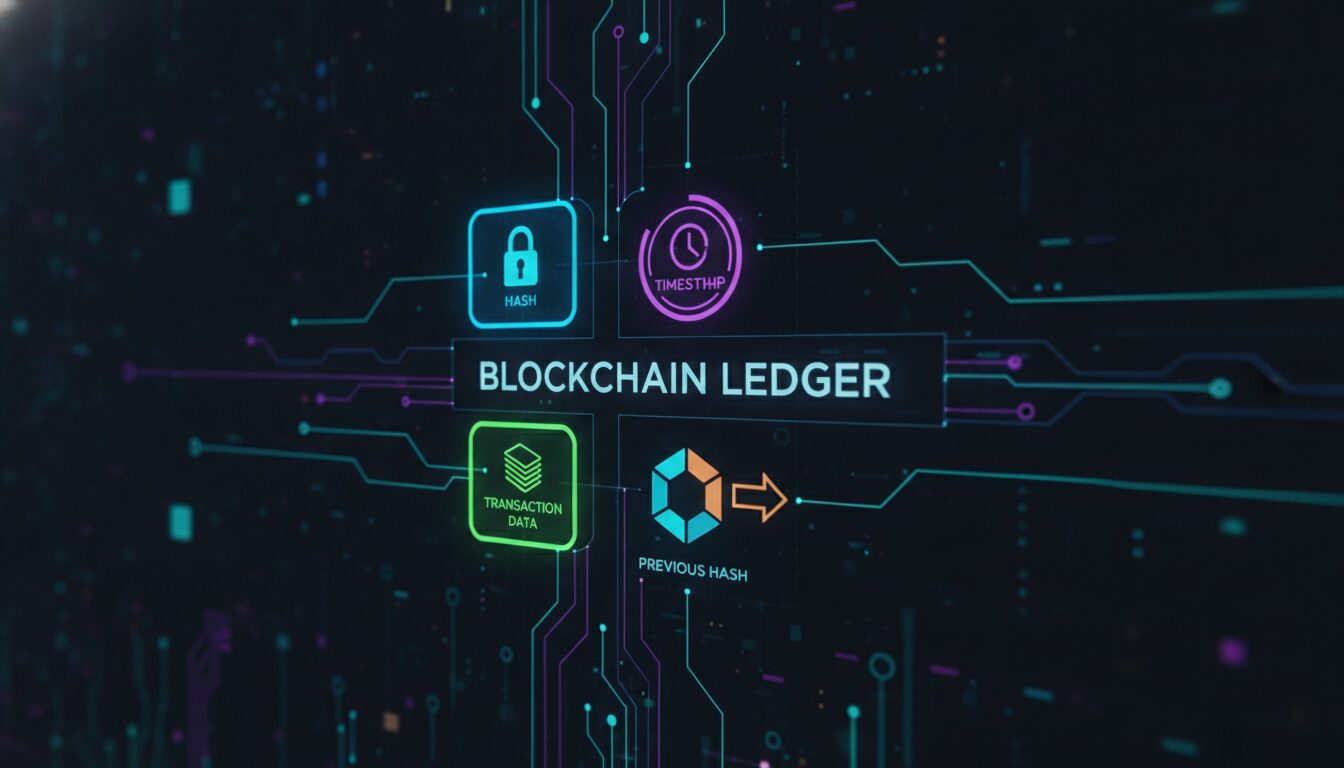
A block contains a batch of transactions, a timestamp, and a reference to the previous block’s hash. This forms an unbroken chain. Altering any block would require recalculating all subsequent hashes across every copy of the ledger, a computationally impractical task on any network with meaningful node count.
The Role of Cryptographic Hashing
Each block’s data runs through a hash function like SHA-256, producing a fixed-length string unique to that data. Even a tiny change in input yields a completely different hash, making tampering evident immediately. The EUIPO describes this as an “irreversible” process that secures the chain end to end.
Consensus Mechanisms and Validation
To add a new block, network participants must agree on its validity through a consensus mechanism. Common methods include Proof of Work (PoW), used by Bitcoin, and Proof of Stake (PoS), adopted by Ethereum after its 2022 Merge. This ensures only legitimate transactions get recorded, and it’s the core reason decentralized systems don’t need a bank in the middle.
“The distributed ledger removes the need for a trusted third party to verify transactions, replacing it with cryptographic proof and network consensus,” notes the original design philosophy foundation most public blockchains today, per the Bitcoin white paper’s founding logic.
Here’s a simplified 5-step flow:
- Transaction Initiation: A user initiates a transaction (e.g., sending Bitcoin).
- Broadcast and Verification: The transaction is broadcast to the network, where nodes verify its validity using the protocol’s rules.
- Block Formation: Verified transactions are bundled into a candidate block by a miner or validator.
- Consensus and Linking: The block is added to the chain once the network reaches consensus; it includes the hash of the previous block.
- Distributed Update: Every node updates its copy of the blockchain, maintaining synchrony.
Key Components of a Blockchain Ledger
Nodes and Decentralization
Nodes are computers that run blockchain software and maintain a full or partial copy of the ledger. Full nodes independently verify the entire history, while light nodes rely on simplified payment verification (SPV). Decentralization ensures no single node can unilaterally alter records, which is the entire point of removing a central authority in the first place.
Immutability and Transparency
Immutability means that once data is recorded on a ledger, it cannot be changed or deleted. This property, combined with the transparent nature of public ledgers, creates an auditable system where anyone can verify transactions independently. You don’t have to trust the recordkeeper. You can check the math yourself.
Smart Contracts and Programmability
Many modern blockchains, including Ethereum and Solana, support smart contracts, self-executing code that automates agreements when predefined conditions are met. These programmable features extend ledger use well beyond simple value transfer into lending, insurance, gaming, and governance.
The Architecture of Decentralized Ledgers

Public vs. Private Blockchains: What’s the Difference?
Public blockchains are open to anyone, offering full transparency and censorship resistance, while private blockchains restrict participation to authorized entities, prioritizing speed and privacy for business use. The table below breaks down the practical differences.
| Feature | Public Blockchain | Private Blockchain | Consortium Blockchain |
|---|---|---|---|
| Access | Open, anyone can join | Invitation only | Selected group of organizations |
| Consensus | PoW, PoS | Pre-approved validators | Distributed among consortium members |
| Immutability | Extremely high | High, but can be overridden by central authority | High, depending on agreement |
| Use Cases | Cryptocurrencies, DeFi | Supply chain, internal audits | Banking, industry collaborations |
| Examples | Bitcoin, Ethereum | Hyperledger Fabric | R3 Corda, Swift’s ledger |
According to the EUIPO, private blockchains are particularly useful in healthcare, where data sensitivity requires controlled access rather than full public visibility.
Permissioned and Permissionless Networks
In permissionless ledgers, anyone can read, write, and validate transactions. Permissioned ledgers assign roles instead: some participants can only read, while designated parties can write or validate. This model is common in enterprise settings where compliance and confidentiality matter more than open access.
Hybrid and Consortium Models
Hybrid blockchains combine public and private features, allowing selective transparency depending on the use case. Consortium blockchains are governed by a group of organizations, balancing decentralization with control. Swift’s blockchain-based ledger, for instance, is a consortium model serving 17 banks across six continents as of its 2026 rollout.
Buying Guide: How to Choose a Blockchain Ledger Platform
Choosing the right this type of ledger platform depends on your access needs, transaction volume, and compliance requirements. There’s no universal best option here. The right choice depends entirely on what you’re trying to build or track.
If you’re evaluating platforms for a project, product, or personal use, weigh these criteria:
- Purpose: Are you tracking payments, verifying supply chain provenance, or building a dApp? Public chains like Ethereum suit open financial applications; permissioned chains like Hyperledger Fabric suit internal enterprise tracking.
- Transaction throughput: Public PoW chains process far fewer transactions per second than permissioned networks. If you need high-frequency settlement, a consortium or private model will likely outperform a public chain.
- Regulatory exposure: Financial and healthcare applications often require permissioned access with audit trails that satisfy regulators. Public ledgers offer transparency but limited built-in compliance tooling.
- Cost structure: Public blockchain transaction fees fluctuate with network congestion. Enterprise and consortium ledgers typically run on fixed licensing or subscription costs instead.
- Interoperability: Check whether the platform supports bridges to other chains. Protocols like Polkadot and Cosmos are built specifically to solve this problem for multi-chain projects.
Price Tiers for Blockchain Infrastructure
Budget-tier options include open-source public blockchains like Ethereum or Solana, where the only real cost is gas fees per transaction, often a few cents to a few dollars depending on network load. Mid-range options include managed enterprise platforms like Hyperledger Fabric deployments, which typically involve development and hosting costs but no licensing fees. Premium-tier solutions include fully managed consortium infrastructure, like Swift’s tokenized ledger or custom R3 Corda deployments, which involve significant integration costs but deliver institutional-grade compliance and support.
How to Use a Blockchain Ledger: Practical Scenarios
Using a blockchain ledger effectively depends on matching the right chain type to your specific transaction or verification need. Below are common scenarios and how they map to ledger types.
- Sending cryptocurrency internationally: Use a public ledger like Bitcoin or Ethereum through a wallet such as Ledger’s hardware wallet for cold storage security, paired with a blockchain explorer like Blockchain.com to track confirmation status.
- Tracking a shipment’s provenance: Enterprises typically use a private or consortium ledger, where each supply chain participant (manufacturer, shipper, retailer) writes verified checkpoints without exposing the whole chain publicly.
- Verifying a transaction happened: Public blockchain explorers, including Blockchain.com, Etherscan, and Solscan, let anyone search a transaction hash or wallet address and see the full history for free.
- Settling institutional cross-border payments: Banks are increasingly using consortium ledgers like Swift’s new infrastructure, which supports tokenized deposits and 24/7 settlement instead of the traditional multi-day correspondent banking cycle.
Real-World Applications and Use Cases
Cross-Border Payments and Finance
Traditional international payments can take days and incur high fees. The Swift network’s activation of a blockchain ledger with tokenized deposits enables near-instant, 24/7 settlement while maintaining compliance and security. This could reshape correspondent banking as we know it.
Supply Chain and Anti-Counterfeiting
The EUIPO reports that blockchain helps combat counterfeiting by creating tamper-proof records of product provenance across luxury goods, diamonds, agri-food, electronics, and pharmaceuticals. Industries handling high-value or safety-critical goods increasingly use ledgers to track items from source to consumer, closing gaps that paper trails and siloed databases never could.
Healthcare and Identity Management
In healthcare, patient records stored on a blockchain ledger can be securely shared among providers while giving patients control over their own data. Self-sovereign identity solutions also rely on decentralized ledgers to reduce dependence on central identity providers, which is a meaningful shift for regions with limited institutional trust.
Benefits and Challenges of Decentralized Ledgers
Security, Efficiency, and Cost Reduction
Decentralized ledgers remove intermediaries, reducing costs tied to reconciliation and fraud detection. Per Investopedia, the immutability of blockchain also strengthens audit trails and data integrity, which matters most in financial services where every transaction needs a defensible history.
Scalability and Energy Consumption
Public blockchains face real scalability hurdles. Bitcoin’s throughput sits far below traditional payment networks like Visa. PoW blockchains have also drawn criticism for high energy use, since mining requires significant computational power running around the clock. Ethereum’s 2022 shift to Proof of Stake cut its energy footprint dramatically compared to its prior PoW model, and newer layer-2 solutions like rollups are helping public chains scale without sacrificing decentralization. Still, energy tradeoffs remain a legitimate consideration when choosing a consensus mechanism, and it’s one reason enterprise deployments often favor PoS or permissioned validator sets over PoW.
Regulatory and Compliance Considerations
As blockchain adoption grows, regulators are building out frameworks to match. Services like Global Ledger offer AML compliance tools that help businesses stay compliant when interacting with blockchain ledgers, particularly around transaction monitoring and risk scoring for exchanges and institutions.
Pros and Cons of Blockchain Ledgers
Pros
- Removes single points of failure by distributing data across many independent nodes.
- Creates tamper-evident records through cryptographic hashing, making fraud far harder to hide.
- Enables 24/7 settlement and cross-border transactions without waiting on banking hours.
- Supports programmable automation through smart contracts, reducing manual processing.
- Gives supply chains and provenance tracking a verifiable, auditable history.
Cons
- Public blockchains can face throughput limits compared to centralized payment rails.
- PoW-based networks carry meaningful energy costs, though PoS and layer-2 solutions are narrowing this gap.
- Immutability cuts both ways: legitimate errors are as hard to reverse as fraudulent ones.
- Regulatory frameworks are still catching up in many jurisdictions, creating compliance uncertainty.
- User error, like losing a private key, has no customer service fallback on most public chains.
Care & Maintenance: Keeping Your Blockchain Ledger Access Secure
Maintaining secure access to a blockchain ledger mainly comes down to protecting your private keys and verifying the tools you use to interact with the chain. This isn’t about maintaining the ledger itself, since the network handles that, it’s about protecting your access to it.
- Use a hardware wallet for meaningful holdings. Devices like Ledger’s hardware wallets keep private keys offline, away from internet-connected attack surfaces.
- Verify addresses before sending. Blockchain transactions are irreversible by design. Double-check every address on a blockchain explorer before confirming.
- Back up seed phrases offline. Never store recovery phrases in cloud storage or screenshots. Physical, offline backups remain the standard for a reason.
- Monitor wallet activity periodically. Free tools like Blockchain.com’s explorer or Etherscan let you check your address history without needing specialized software.
- Keep software and firmware updated. Wallet and node software updates often patch real security vulnerabilities, not just add features.
Recent Innovations in Distributed Ledger Technology
Swift’s Blockchain-Based Ledger for Banks
Swift moved from concept to activation of its blockchain-based ledger in nine months, according to the company’s own announcement. Seventeen banks from six continents are now piloting live transactions using tokenized deposits, enabling around-the-clock cross-border payments and improved liquidity efficiency. As Thierry Chilosi, Chief Business Officer at Swift, stated, this extends “the trust and stability of established finance into the frontiers of digital money.”
“This extends the trust and stability of established finance into the frontiers of digital money,” said Thierry Chilosi, Chief Business Officer at Swift, describing the ledger’s 2026 rollout across a global banking consortium.
The Rise of Tokenized Assets
Tokenization, representing real-world assets like real estate or securities on a blockchain ledger, is gaining traction across institutional finance. This unlocks fractional ownership and liquidity for assets that were historically illiquid, with platforms like Ethereum and Hyperledger driving active tokenization projects this year.
Global Ledger and AML Compliance Tools
Companies like Global Ledger provide investigators and compliance officers with visualization and risk-scoring tools to monitor cryptocurrency transactions. Their platform helps detect fraud and money laundering patterns across public blockchains, filling a gap that pure transparency alone doesn’t solve.
The Future of Blockchain Ledgers
Interoperability and Standards
For widespread adoption, different blockchain ledger implementations need to interoperate with each other. Protocols like Polkadot and Cosmos are building cross-chain bridges specifically to solve this. Real interoperability will be the deciding factor for whether enterprise and institutional use cases scale past pilot programs.
Mainstream Adoption and Institutional Trust
As central banks explore digital currencies (CBDCs) and Swift integrates blockchain into its core infrastructure, trust in decentralized ledgers keeps growing. Updated for 2026, a growing number of countries are actively piloting CBDCs, and many of these run on some form of distributed ledger technology rather than traditional centralized databases.
Conclusion: The Evolution Continues
The blockchain ledger has evolved from a niche cryptocurrency concept into foundational infrastructure for global finance, supply chains, and identity systems. With ongoing progress in scalability, regulation, and interoperability, its role in transparent, secure record-keeping will only grow from here. If you’re building on this infrastructure or evaluating it for institutional deployment, the fundamentals covered here are the starting point, not the finish line.
At Digital Blockchains, we work with builders who want to go past theory and into protocol-level execution, from tokenomics design to consortium ledger architecture. If you’re serious about building on distributed ledger infrastructure, apply to the Genesis Cohort at digitalblockchains.com.
Frequently Asked Questions
What exactly is a blockchain ledger?
A blockchain ledger is a decentralized, distributed database that chronologically and cryptographically records transactions. It ensures immutability and transparency without a central authority controlling the data.
How does a blockchain ledger differ from a standard database?
Unlike a traditional database, a blockchain ledger is spread across multiple nodes, uses cryptographic hashing to link entries, and once data is added, it cannot be altered or deleted. A standard database typically has one administrator with edit rights.
Can a blockchain ledger be hacked?
While no system is invulnerable, altering historical blocks on a large public blockchain would require controlling a majority of the network’s computational or staking power. This makes networks like Bitcoin and Ethereum extremely resistant to tampering in practice.
What are the main types of blockchain ledgers?
The three main types are public (permissionless), private (permissioned), and consortium blockchains. Each offers different levels of access, transparency, and control depending on the use case.
How is a blockchain ledger used in real life?
Applications include cryptocurrency transfers, cross-border payments through networks like Swift’s ledger, supply chain tracking, healthcare record management, and digital identity verification.
Is a blockchain ledger the same as Bitcoin?
No. Bitcoin is a cryptocurrency that uses a blockchain ledger to record transactions. The underlying blockchain concept applies to many industries beyond digital currencies, from supply chains to healthcare records.
Can I see a blockchain ledger myself, or is it private?
Public blockchains like Bitcoin and Ethereum are fully visible through free blockchain explorers such as Blockchain.com, Etherscan, and Solscan. You can search any transaction hash or wallet address and see its complete history without special permission.