A blockchain node is a computer running protocol software that maintains a copy of a distributed ledger, validates transactions, and communicates with peers to secure a decentralized network. Running one provides trustless verification and network resilience.
Key Takeaways
- Blockchain node definition: any device that participates in a consensus mechanism by storing data and enforcing network rules.
- Three main node types: full nodes (complete history), light nodes (SPV for mobile), and archive nodes (historical queries).
- Running a blockchain node offers privacy, censorship resistance, and potential staking rewards, but requires hardware and technical upkeep.
- Node providers like Alchemy, Infura, and Google Cloud’s Blockchain Node Engine simplify operations but introduce centralization trade-offs.
- As of 2026, node infrastructure is critical for dApps, DeFi, and enterprise adoption, with pricing shifting toward compute-unit models.
What Is a Blockchain Node?

A blockchain node is a device, whether a personal computer, server, or mobile device, that runs the software of a specific blockchain protocol. According to Chainlink’s documentation, a node is a stakeholder device that maintains a copy of the blockchain ledger. Nodes communicate with each other to validate transactions, which is what preserves the security, integrity, and decentralization of the network. Without nodes, there’s no blockchain. They’re the physical infrastructure that makes decentralized consensus possible in the first place.
The Core Definition
Utimaco expands on this, describing a blockchain node as a device-stakeholder pair that participates in running the protocol software of a decentralized network. That framing matters: a node isn’t just hardware, it’s a participant in the network’s governance. Each node stores a copy of the transaction history and enforces consensus rules, rejecting invalid blocks outright. The more nodes a network has, the more decentralized and resilient it becomes.
“A node is a stakeholder device that maintains a copy of the blockchain ledger and communicates with other nodes to keep the network in sync.” – Chainlink documentation
Why Nodes Are Essential
Node operations are the foundation of decentralization, full stop. In a traditional client-server model, a central authority holds the data and clients request access to it. Blockchains invert this: every node is a peer, sharing a synchronized ledger with no single owner. When a new transaction is broadcast, nodes verify it by checking signatures, balances, and protocol rules before doing anything else. If valid, the node relays it to its peers; if invalid, propagation stops immediately. This redundancy eliminates single points of failure and ensures no single entity can alter the ledger, a property known as immutability.
How Blockchain Nodes Work
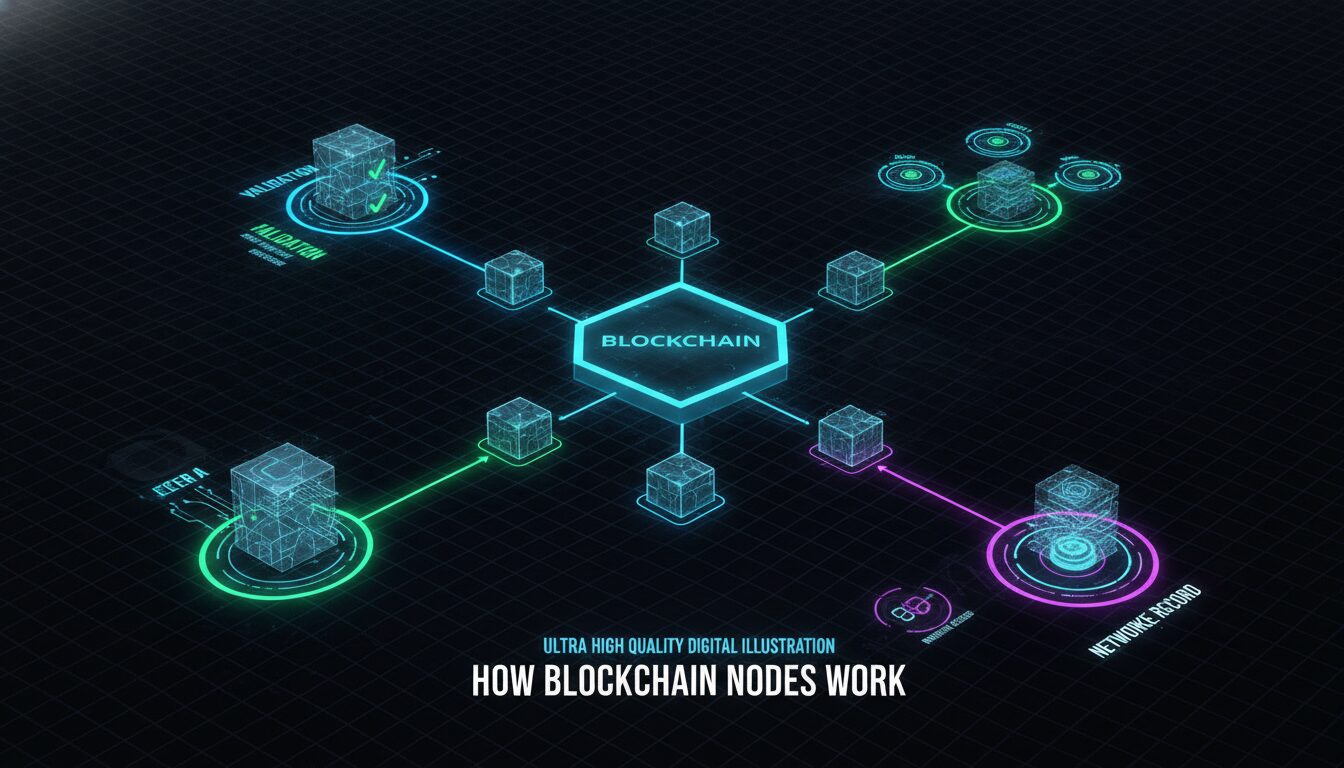
A blockchain node works by following a repeatable cycle: receive, validate, broadcast. When a user signs a transaction, it’s sent to a handful of connected nodes first. Each node independently checks the transaction against the blockchain’s consensus rules, confirming the sender has sufficient balance and the signature checks out. Accepted transactions sit in the node’s mempool, a temporary waiting area, before propagating to peers and reaching nodes worldwide within seconds.
Transaction Validation and Propagation
A node acts as a gatekeeper for the network. It inspects every incoming message and blocks anything that violates protocol rules. A Bitcoin full node, for instance, will reject a transaction attempting to spend already-used UTXOs. This validation is trustless by design: nodes don’t rely on a central source, they verify everything independently, every time. Once validated, transactions get bundled into candidate blocks by miners or validators. Full nodes then verify the new block, checking its hash, the included transactions, and the consensus mechanism’s proof (the nonce, in Proof-of-Work systems). If the block passes, it gets appended to the node’s local copy of the chain.
Achieving Consensus
Consensus is the state where all honest nodes agree on the same version of the ledger. Nodes constantly exchange block data to stay synchronized with each other. If a node drops offline, it requests missing blocks from peers once it reconnects. This gossip protocol ensures that even when some nodes are malicious or faulty, the majority of honest nodes maintain the true chain. The specific consensus algorithm varies by network: Bitcoin uses Nakamoto Consensus (longest valid chain wins), while Ethereum uses Gasper, a combination of Casper FFG and LMD-GHOST. Regardless of the algorithm, the node is the actor executing these rules on the ground.
Types of Blockchain Nodes
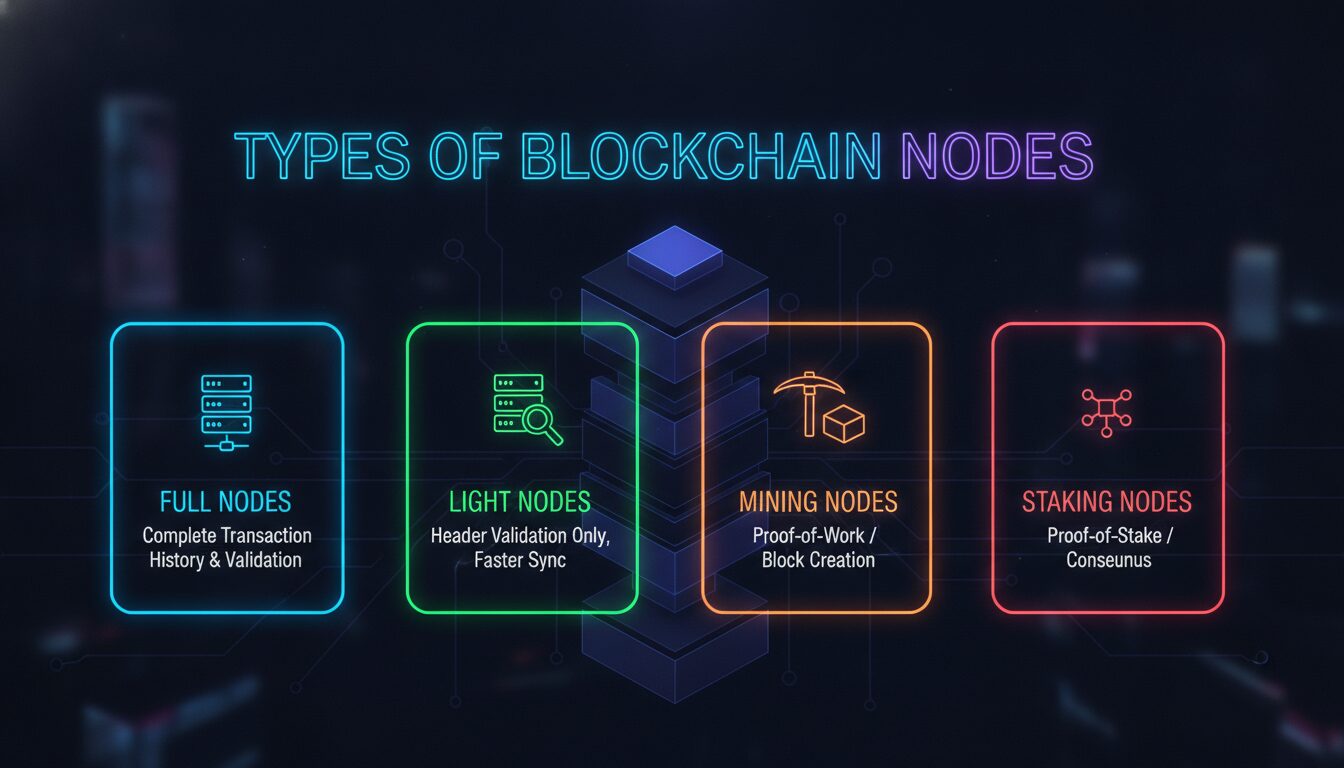
Not all nodes are built the same way. Different node configurations serve distinct purposes, trading off storage, performance, and trust assumptions. The three most common types are full nodes, light nodes, and archive nodes, with specialized roles reserved for miners and validators.
| Node Type | Data Stored | Validation Ability | Storage Requirements | Typical Use Case |
|---|---|---|---|---|
| Full Node | Complete blockchain from genesis to tip (may prune old states) | Fully independent validation of all transactions and blocks | Hundreds of GBs (Bitcoin ~600GB, Ethereum ~1TB for full state) | Decentralized verification, running a wallet with full security |
| Light Node (SPV) | Block headers only (no full transaction data) | Cannot fully validate; relies on full nodes for transaction data | Minimal (fits on mobile devices) | Mobile wallets, resource-constrained IoT devices |
| Archive Node | Every historical state, including intermediate tries (e.g., Ethereum state trie) | Full validation plus ability to reconstruct historical states | Terabytes (Ethereum archive storage runs into the multi-terabyte range as of 2026) | Block explorers (Etherscan), analytics, infrastructure services |
| Mining Node | Full node plus mining software; may store full copy | Validates transactions and blocks, plus participates in block creation | As per full node plus ASICs/GPUs | Proof-of-Work blockchains like Bitcoin |
| Validator Node | Full node plus staking software; stores full copy | Validates and proposes/attests to blocks under PoS rules | Fast SSD, high RAM; often requires staked crypto (e.g., 32 ETH on Ethereum) | Proof-of-Stake networks like Ethereum, Solana |
Full Nodes: The Backbone
A full node downloads and verifies the entire blockchain history, starting from the genesis block. It enforces every consensus rule independently, no shortcuts. Because it stores every transaction, a full node can answer queries about any address balance or transaction ID without trusting an outside source. Running one is the most trustless way to interact with a network: you don’t need to rely on a third-party explorer to know what’s true. That trustlessness comes at a cost, though. Storage and bandwidth requirements are substantial: Bitcoin’s blockchain exceeds 600 GB, and Ethereum’s state can consume over 1 TB for a fully synced full node.
Light Nodes: Speed and Efficiency
Light nodes, also called Simplified Payment Verification (SPV) clients, download only block headers rather than full data. Those headers contain a cryptographic commitment to the block’s transactions through a Merkle root. A light node verifies that a transaction is included in a block by requesting a Merkle proof from a full node. This sacrifices some security, since light nodes must trust that the full node is providing accurate data, but it enables blockchain access on mobile devices and other hardware with limited storage. Most mobile crypto wallets run as light nodes for exactly this reason.
Archive Nodes: Historical Guardians
An archive node retains every historical state the blockchain has ever had. A full node may prune old state data to save disk space, but an archive node keeps the complete state history, allowing queries like “what was the balance of address X at block 1,000,000?” These nodes require massive storage and are typically operated by infrastructure providers, block explorers, and analytics platforms rather than individuals. Google Cloud’s Blockchain Node Engine, for instance, offers archive node options for developers who need to index full historical data without managing the hardware themselves.
Mining and Validator Nodes
In Proof-of-Work systems, mining nodes are full nodes that additionally run specialized hardware (ASICs) to solve cryptographic puzzles and propose new blocks. In Proof-of-Stake networks, validator nodes are full nodes that stake cryptocurrency and participate in consensus by proposing and attesting to blocks. Validator nodes typically require a minimum stake, such as 32 ETH on Ethereum, and must maintain high uptime to avoid penalties. Both roles build on top of the foundational work a full blockchain node already performs.
Node vs. Miner vs. Validator
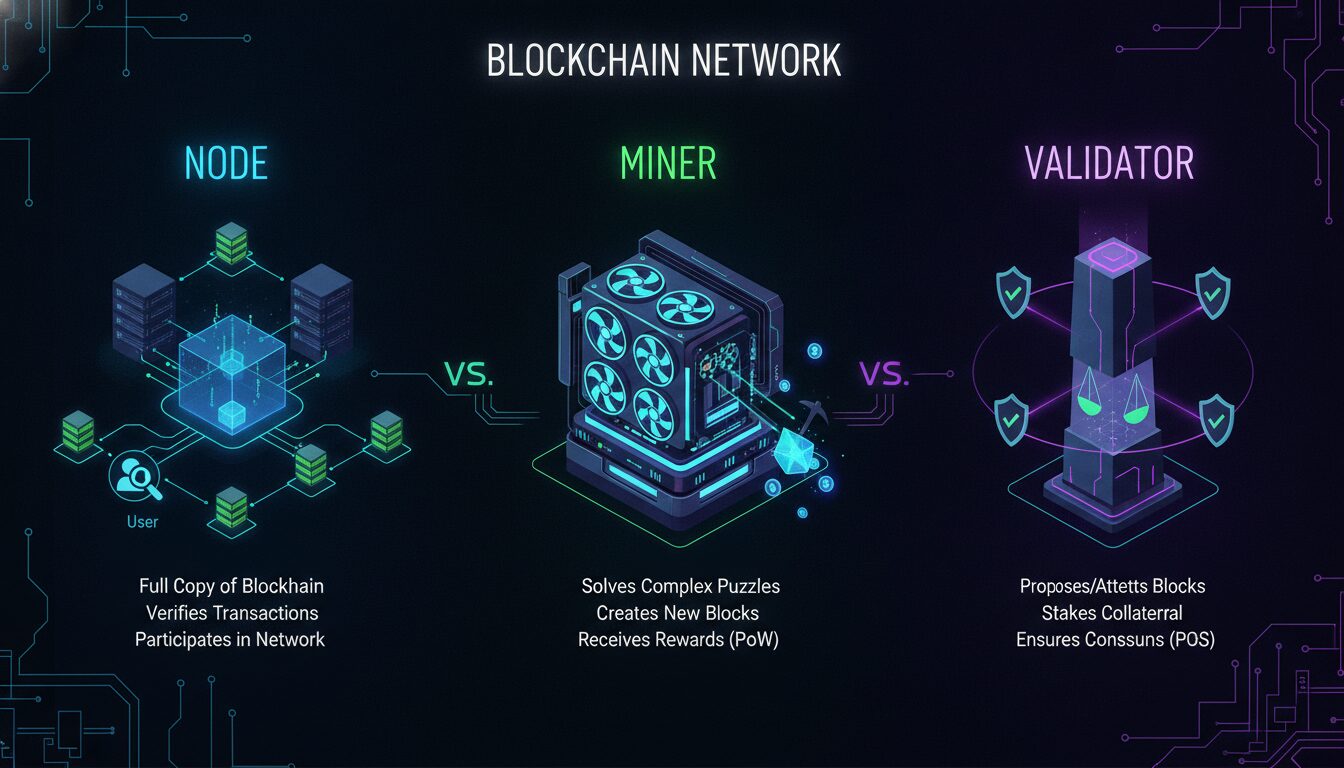
A node, a miner, and a validator are related but distinct roles: a node stores and validates ledger data, while miners and validators are specialized nodes that also create new blocks. These terms get used interchangeably in casual conversation, but the distinction matters once you start building or operating infrastructure.
Proof-of-Work Mining Nodes
In Bitcoin and other PoW chains, miners compete to solve a computationally intensive puzzle. Whoever wins gets the right to append the next block and collect the block reward. Mining nodes are a subset of full nodes that bundle in mining software and hardware. Notably, a miner doesn’t have to run a full node themselves; they can mine in a pool and receive block templates from a pool operator instead. Solo miners who run their own full node gain the advantage of verifying transactions directly and avoiding pool fees. As block rewards diminish over time, mining profitability depends heavily on electricity costs and hardware efficiency.
Proof-of-Stake Validators
In PoS networks like Ethereum post-Merge, validators replace miners entirely. A validator node requires staking a collateral amount, which can be slashed if the validator acts maliciously or goes offline for extended periods. Validators are randomly selected to propose blocks and attest to the validity of blocks proposed by others. Running one demands a reliable connection, consistent uptime, and adherence to the protocol’s staking requirements. Staking-as-a-service platforms now let users delegate stake without running their own infrastructure, though this convenience comes with a centralization trade-off worth thinking about.
Why Run a Blockchain Node?
People run a blockchain node for a mix of ideological and financial reasons: strengthening decentralization, protecting transaction privacy, and in some cases, earning rewards. It’s both a technical commitment and, for many operators, a philosophical one.
Strengthening Network Decentralization
Every additional node increases a network’s resilience against censorship and attack. If a critical mass of nodes went offline simultaneously, a blockchain’s security assumptions could be compromised. By running a node yourself, you contribute directly to network health and make it harder for any single entity to control consensus. Many crypto builders treat this as something close to a civic duty. Companies that depend on blockchain data for business logic can also avoid over-reliance on third-party endpoints, sidestepping the risk of provider outages, like the widely reported 2020 Infura incident that disrupted MetaMask users.
Transaction Privacy and Trust Minimization
When you use a public RPC endpoint or a wallet connected to a centralized node provider, you reveal your IP address and transaction patterns to that provider by default. Running a personal blockchain node keeps your broadcasts and queries private. You verify your own balances and transaction statuses without trusting a third party, which is the practical expression of “don’t trust, verify.” This matters most for high-value wallets or enterprise applications handling sensitive financial data.
Potential Earnings from Running a Node
Basic full nodes generally don’t earn direct rewards on most blockchains. Validator nodes on PoS networks, however, earn staking rewards, and Lightning Network routing nodes can collect fees for forwarding Bitcoin payments. Some newer projects, like Shardeum, build community node incentives directly into their tokenomics to encourage broad participation. That said, profitability has to account for hardware costs, electricity, and ongoing maintenance, so run the numbers before assuming a node pays for itself.
How to Set Up a Blockchain Node
Setting up a blockchain node follows a similar sequence regardless of chain: pick a network, prepare hardware, install software, secure it, sync it, and maintain it. Here’s a practical breakdown based on Shardeum’s node documentation and standard blockchain operations practice.
- Choose a blockchain network. Select the chain you want to support based on your technical ability, hardware budget, and whether earning rewards matters to you. Popular options include Bitcoin (full node), Ethereum (full or validator), and Solana (validator).
- Prepare the required hardware. Every network has minimum specs. An Ethereum full node typically needs a modern multi-core CPU, 16-32 GB RAM, and a 2 TB NVMe SSD. Bitcoin full nodes need at least 350 GB of storage, closer to 600 GB for the complete chain. A dedicated machine or VPS both work.
- Install node software. Download the official client: Bitcoin Core for Bitcoin, Geth or Besu for Ethereum, or the chain-specific binary. Many projects now ship Docker images to simplify setup.
- Configure security settings. Open the necessary ports (8333 for Bitcoin, 30303 for Ethereum), set up a firewall, and isolate the node from critical systems where possible. If staking, secure your key material in a hardware security module or a separate signer.
- Meet staking requirements for validators. If running a validator node, deposit the required stake (32 ETH for Ethereum, for example) and register your validator keys through the network’s launchpad.
- Sync with the blockchain. Initial synchronization can take hours to days depending on the chain and your bandwidth. Archive syncs take considerably longer. Monitor disk I/O and be patient.
- Maintain uptime and connectivity. Nodes need reliable internet and power. For validators, uptime below roughly 95% can trigger penalties. Use monitoring tools that alert you to outages immediately.
- Apply regular software updates. Clients release updates for performance and security fixes. Subscribe to announcement channels and schedule updates carefully to avoid slashing risk.
Choosing a Blockchain and Node Type
Your choice here shapes every step that follows. If decentralization is the priority, running a Bitcoin full node remains the classic move. For higher earning potential, an Ethereum validator offers more predictable staking rewards. Newer chains like Aptos or Sui may carry lower hardware requirements but also less battle-tested software behind them. Research the community, developer activity, and long-term viability before committing hardware and capital. You’ll also need to decide between a self-hosted physical machine, a cloud VPS, or a dedicated bare-metal server, each with real trade-offs.
Cloud vs. Bare-Metal Hosting for Nodes
Cloud hosting (AWS, Google Cloud, dedicated VPS providers) offers faster setup, easier scaling, and less physical maintenance, but you’re trusting a third party with uptime and, in some cases, key custody. Bare-metal, self-owned hardware costs more upfront and requires you to handle power, cooling, and networking yourself, but it maximizes trustlessness and gives you full control over the machine. Many serious validator operators run a hybrid setup: bare-metal for the signing key and consensus client, with cloud infrastructure as a backup or for redundant full nodes. For casual node operators just supporting network decentralization, a home machine or a modest VPS is usually sufficient.
Hardware and Software Requirements
Hardware demands differ by chain and node type. Below are typical requirements for popular networks as of 2026:
- Bitcoin full node: 4-core CPU, 8 GB RAM, 600 GB SSD (with room for growth).
- Ethereum full node: 4-8 core CPU, 16-32 GB RAM, 2 TB NVMe SSD (execution + consensus client).
- Ethereum archive node: Same baseline specs, but multi-terabyte storage.
- Solana validator: 12-core CPU, 128 GB RAM, 1 TB NVMe SSD, per the Solana Foundation’s recommendations.
On the software side, stick to official clients to avoid compatibility issues. For Ethereum specifically, running a minority client (Besu or Nethermind, for example) improves client diversity across the network, which strengthens its overall resilience. Most clients ship with installation packages, Docker images, and thorough documentation.
Configuration, Staking, and Syncing
After installation, configuration comes next: set the data directory, enable RPC if needed (with authentication turned on), and adjust cache sizes for performance. For staking, generate validator keys and deposit the stake through the network’s launchpad. Syncing is usually the longest step in the whole process. You can speed it up using snapshot downloads from trusted sources, though doing so reduces the trustlessness of your initial sync. Once synced, your node continuously listens for new blocks and participates in gossip with peers. Ongoing maintenance includes pruning old data (unless you’re running an archive node) and applying software updates on schedule.
Blockchain Node Providers in 2026
Blockchain node providers offer managed infrastructure so developers don’t have to run their own hardware to access chain data. According to Alchemy’s 2026 provider overview, the market has matured toward compute-unit (CU) pricing models that charge for resources consumed rather than raw request counts.
Fully Managed Node Services
Google Cloud’s Blockchain Node Engine is a good example of the fully managed approach. It provides dedicated, isolated nodes with predictable hourly pricing regardless of request volume. Google handles monitoring, upgrades, and offers enterprise-grade SLAs on top. Common use cases include ingesting large volumes of on-chain data for analytics, running private transactions without exposing them to public RPC pools, and general dApp development where teams don’t want to manage node uptime themselves. You can deploy archive nodes for historical indexing or use WebSocket endpoints on full nodes for real-time streaming, all without building a DevOps team around it.
Comparing Top Multichain Providers
Alchemy’s 2026 rundown lists 12 top blockchain node providers, including Alchemy itself (strong on reliability and developer tooling), Infura (the long-standing Ethereum mainstay), QuickNode (broad chain support), Chainstack (enterprise-focused), Ankr (decentralized RPC network), and Coinbase Developer Platform (tight integration with the Coinbase ecosystem). Picking a provider comes down to chain requirements, budget, and which APIs you actually need. A Solana dApp might lean toward QuickNode for its dedicated Solana tooling, while a multi-chain DeFi aggregator might prefer Alchemy’s enhanced APIs for token balances and metadata. Most providers offer free tiers for testing and pay-as-you-go plans once you go to production.
Pros and Cons of Running Your Own Blockchain Node
Pros
- Full trustlessness: you verify balances and transactions independently, without relying on a third party’s word.
- Transaction privacy: your IP address and query patterns stay off a provider’s logs.
- Potential rewards: validator and Lightning routing nodes can generate ongoing income.
- Network contribution: every node you run strengthens decentralization and censorship resistance for everyone.
Cons
- Meaningful hardware and storage costs, especially for archive nodes running into the terabytes.
- Ongoing maintenance burden: updates, monitoring, and uptime management never really stop.
- Slashing risk for validators if uptime drops or keys are mismanaged.
- Initial sync times can take days, and bandwidth costs add up over time.
The Future of Blockchain Node Infrastructure
Blockchain node infrastructure is evolving toward lighter, statelessness-friendly designs as Layer 2 rollups, sharding, and new data availability layers reshape how nodes store and verify data. The direction of travel is toward lower hardware barriers for some roles and higher ones for others.
Scaling Solutions and Increased Demands
Ethereum’s Dencun upgrade introduced blob transactions for L2 data, cutting rollup costs but requiring nodes to handle larger, temporary blob stores in the process. The move toward statelessness and Verkle trees aims to shrink state size over time, making full nodes lighter to run. ZK-rollups like zkSync and Scroll post compressed proofs back to Ethereum but still depend on L1 nodes for final settlement. These advances could eventually lower hardware requirements and let more participants run nodes, boosting decentralization. On the flip side, as networks like Solana push throughput into the thousands of transactions per second, validator nodes demand increasingly capable hardware, which risks concentrating power in professional data centers.
“Client diversity isn’t a nice-to-have, it’s a security requirement. A network where 90% of nodes run one client is one bug away from a chain split.” This is a widely echoed principle across Ethereum core developer discussions and client diversity dashboards tracking node distribution on-chain.
Decentralization vs. Convenience
Node-as-a-service creates a real paradox: it democratizes access to blockchain data while concentrating infrastructure in a handful of large providers. An outage at a major provider, Infura being the classic example, can disrupt dozens of dApps and wallets that depend on it simultaneously. The community response has been decentralized RPC networks like Pokt Network and dRPC, built specifically to mitigate this single-point-of-failure risk. On the other end of the spectrum, projects like Shardeum make it easy for average users to run nodes from home, incentivizing broad grassroots participation. The healthiest outcome is probably a mix: robust professional infrastructure for teams that need it, and home-run nodes by enthusiasts anchoring decentralization at the edges.
At Digital Blockchains, we think about node infrastructure the same way we think about tokenomics: incentive design determines outcomes. If you’re building a protocol and want to get the node economics right from day one, that’s exactly the kind of problem our studio works on. Learn more about our studio approach or explore our build process for early-stage protocol teams.
Conclusion
A blockchain node is far more than a piece of software, it’s the live, operating foundation of any decentralized network. From validating transactions to preserving immutable history, nodes embody the principles of trustlessness and resilience that make Web3 worth building on. Whether you run a full node on a spare machine, stake as a validator, or use a managed provider like Google Cloud’s Blockchain Node Engine, your involvement strengthens the ecosystem in a measurable way. As blockchain technology keeps expanding into finance, supply chains, and digital identity, the role of the node only grows more central. Understanding how to operate or choose one isn’t just developer trivia anymore, it’s baseline literacy for anyone serious about Web3 infrastructure.
If you’re building protocol infrastructure and want to work through node economics, validator incentives, or tokenomics design with a team that’s done the technical homework, apply to the Genesis Cohort at digitalblockchains.com. We’re looking for serious builders, not tourists.
Frequently Asked Questions
What is a blockchain node?
A blockchain node is a computer that runs protocol software, maintains a copy of the distributed ledger, validates transactions, and communicates with other nodes to uphold network consensus. It’s the fundamental building block of any decentralized blockchain network.
Are blockchain nodes profitable?
Basic full nodes generally don’t earn direct rewards. Profitability comes from running validator nodes (staking rewards), mining nodes (block rewards on PoW chains), or Lightning Network routing nodes (fee collection). Earnings depend on staked amounts, hardware costs, and prevailing network conditions.
Who owns the blockchain nodes?
Anyone can own and operate a blockchain node. Nodes are run by individuals, companies, foundations, and dedicated node service providers. No central authority controls them, and node diversity is what keeps a network genuinely decentralized.
Is a blockchain node safe or fake?
A blockchain node is safe when you run it yourself and secure your environment properly. If you rely on a third-party provider instead, your security depends on that provider’s practices. Always verify that a provider uses encryption and follows recognized security standards.
How do you become a blockchain node?
To become a blockchain node operator, choose a network, meet its hardware requirements, install the client software, sync the blockchain, and maintain uptime consistently. Validator roles require additional steps: staking and validator key registration through the network’s launchpad.