Swift blockchain is a shared ledger built by Swift to enable 24/7 cross-border payments using tokenized deposits. It integrates with existing bank rails, preserving compliance and settlement while letting 17 pilot banks move value in real time.
Key Takeaways
- blockchain is an interbank shared ledger that records, sequences, and validates payment commitments through smart contracts.
- 17 banks from six continents are piloting live tokenized deposit transactions for 24/7 cross-border payments.
- The MVP runs on Hyperledger Besu, an EVM-compatible open-source architecture, integrated with existing RTGS and correspondent rails.
- It’s not a replacement for SWIFT messaging. It’s an orchestration layer for tokenized deposits that preserves compliance and final settlement.
- Swift’s existing infrastructure moves the equivalent of world GDP every two to three days, with 75% of network payments reaching beneficiary banks within 10 minutes.
- Banks retain full control over keys, assets, and funding. Swift operates the coordination layer, not the money itself.
“With our new ledger capability, we’re extending the trust and stability of established finance into the frontiers of digital money. It allows tokenized value to move across borders with the velocity and flexibility modern commerce expects, while maintaining the same high levels of resiliency, security, and compliance global finance requires.” – Thierry Chilosi, Chief Business Officer, Swift
What Is the Swift Blockchain Ledger?
A Shared Ledger for Tokenized Deposits
Swift blockchain is a distributed ledger that Swift operates as a coordination layer for bank-issued tokenized deposits. According to Swift, the ledger records, sequences, and validates transactions between financial institutions and enforces rules through smart contracts. The first use case targets 24/7 cross-border payments, extending Swift’s trusted platform into a digital environment without asking banks to abandon existing infrastructure.
Tokenized deposits are digital representations of commercial bank deposit liabilities. In Swift’s model, those deposits stay on banks’ own ledgers, while the Swift blockchain provides a shared digital orchestration layer that records and validates interbank payment commitments. Think of it as a synchronization mechanism, not a new store of value: it coordinates payment obligations without replacing existing settlement rails.
From Concept to MVP
Swift announced plans for the ledger in September 2025 and moved to a minimum viable product after a nine-month design phase involving feedback from international financial institutions. According to Global Finance Magazine, Swift designed and built the ledger with input from banks worldwide over that nine-month window. The MVP was planned to go live with real-world transactions this year, as reported by Swift.
Swift is working with 40+ financial institutions to add this blockchain-based ledger to its infrastructure stack. The pilot itself includes 17 banks from six continents, marking the shift from prototype to live testing. Per Finovate, Swift tested a prototype with more than 30 financial institutions across the globe roughly ten months before the July 2026 launch.
Why the Ledger Matters for Banking
The Swift blockchain matters because it solves two problems at once. First, it opens cross-border payments 24/7 without waiting for traditional banking hours. Second, it preserves the compliance, credit, risk, and control standards banks already run under. According to Swift, banks stand to gain a better client experience and greater liquidity efficiency, even overnight and on weekends, without disrupting existing processes.
How the Swift Blockchain MVP Works
Architecture: Hyperledger Besu and EVM Compatibility
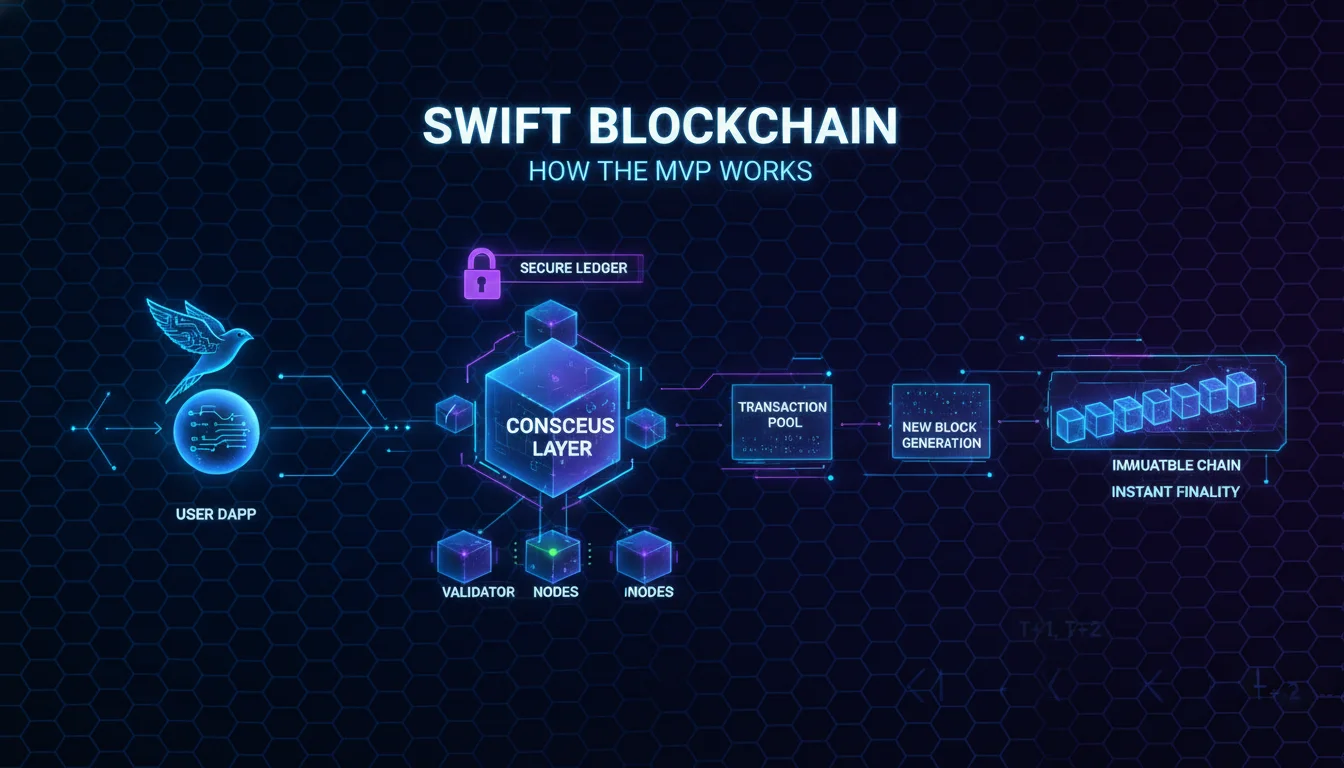
The MVP runs on open-source foundations using an Ethereum Virtual Machine (EVM)-compatible architecture based on Hyperledger Besu. Hyperledger Besu is an enterprise-grade Ethereum client that lets organizations run permissioned networks while staying compatible with the broader Ethereum ecosystem. Swift operates the ledger itself, handling orchestration of transaction workflows, validation of funding commitments, and coordination of interbank processes.
Banks run their own environments and keep full authority over keys, assets, funding, and settlement. That means this ledger doesn’t replace existing risk controls. It adds a shared visibility layer that synchronizes obligations as transactions move through the pipeline.
Step-by-Step Payment Flow
A cross-border payment on the Swift blockchain follows a defined sequence:
- A sending bank initiates a payment instruction through its existing payment application and Swift standards.
- The shared digital orchestration layer records and validates the interbank payment commitment as a tokenized deposit.
- The ledger sequences the transaction and coordinates funding between the sending and receiving institutions.
- Banks use their own environments to manage keys, assets, and funding, retaining full authority throughout.
- Final settlement occurs through real-time gross settlement (RTGS) systems, correspondent banking relationships, or other agreed mechanisms between participants.
This process supports real-time payments across institutions 24/7 while giving everyone a synchronized view of obligations.
Settlement Options and Finality
The ledger executes payments using tokenized deposits as the underlying representation of value. It builds on existing compliance processes and supports multiple settlement options. Here’s the key differentiator: final settlement doesn’t happen on the blockchain itself, it happens through banks’ existing settlement infrastructure. The blockchain handles orchestration; RTGS systems and correspondent relationships deliver finality.
Why Swift Chose Blockchain for Cross-Border Payments
Always-On Liquidity and Weekend Payments
Traditional correspondent banking often pauses overnight and on weekends. Swift’s ledger changes that by letting banks move tokenized deposits across borders 24/7 before completing final settlement through existing banking systems. Per Global Finance Magazine, participating banks can move funds for customers around the clock, including overnight and weekends, without compromising compliance, credit, risk, and control standards.
Meeting G20 Targets
Swift’s upgrades aim to help the industry meet Group of 20 international transaction targets. On its existing infrastructure, 75% of network payments already reach beneficiary banks within 10 minutes, or even seconds, according to on-chain and network data cited by Global Finance Magazine. The ledger is designed to push that further by enabling real-time payment commitments and better liquidity visibility. Swift says the MVP reduces reconciliation effort and improves interoperability across institutions.
Liquidity Management and Transparency
The ledger gives banks a synchronized view of obligations as transactions progress. That translates into better liquidity visibility and more flexible funding management. ANZ Managing Director Transaction Banking Lisa Vasic called the initiative “an important step in advancing real-time, always-on cross-border payment capabilities.” BNP Paribas Global Head of Cash Management Pierre Fersztand described it as “a significant milestone in the evolution of cross-border payments.”
“We are pleased to continue collaborating with Swift on the use of shared ledger technology to support greater interoperability in cross-border payments. This work is an important step in understanding how these capabilities may evolve over time in a way that complements existing infrastructure and meets the needs of clients globally.” – Carl Slabicki, Head of Commercial, Global Payments & Trade, BNY
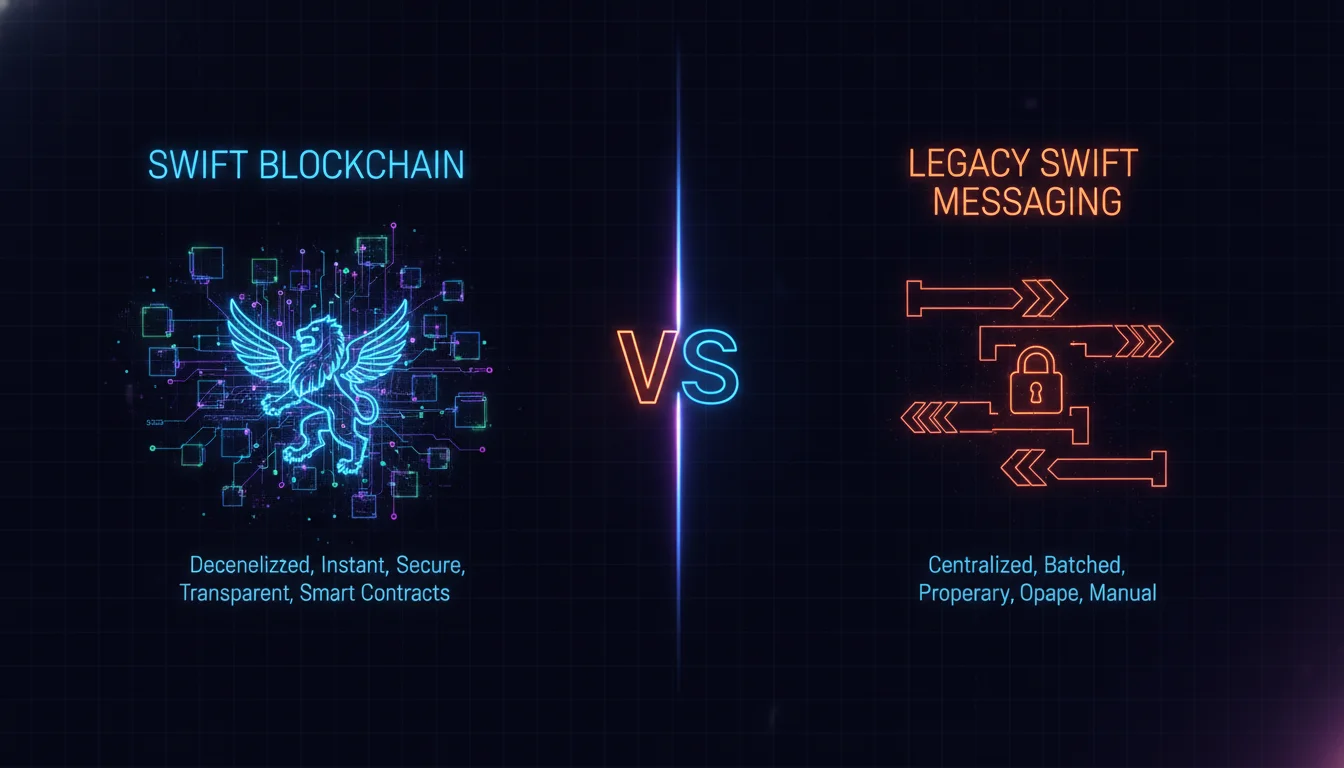
Swift Blockchain vs Legacy SWIFT Messaging
Messaging vs Settlement Orchestration
Legacy SWIFT is a global messaging system that lets banks communicate payment instructions securely. The Swift blockchain isn’t a replacement for that messaging layer, it’s an additional shared ledger that records and validates interbank payment commitments. This distinction matters: SWIFT messaging tells banks what to pay; the blockchain layer coordinates the actual value transfer using tokenized deposits.
Speed, Transparency, and Reconciliation
According to Swift, the ledger delivers faster payment execution, better liquidity visibility, and reduced reconciliation effort. Unlike the traditional model, where multiple intermediary messages can create delays and opacity, the shared ledger gives all participating banks a single synchronized view of a payment’s status. That cuts down on manual reconciliation and exception handling.
Interoperability Without Disruption
This system is built to interoperate with existing and emerging systems. Banks don’t have to abandon their current rails, compliance processes, or settlement mechanisms. Swift positions the ledger as an interoperable layer that works alongside them, avoiding the fragmentation seen in earlier digital money pilots and private networks. With more than 11,500 institutions connected across 200+ countries and territories, and over 40,000 active payment routes, Swift brings scale and reach that few competing networks can match.
| Dimension | Swift Blockchain Ledger | Legacy SWIFT Messaging |
|---|---|---|
| Settlement asset | Bank-issued tokenized deposits | Payment instructions; final settlement via correspondent/RTGS |
| Operating hours | 24/7, including overnight and weekends | Subject to banking hours and batch processing |
| Architecture | EVM-compatible shared ledger using Hyperledger Besu | Centralized messaging network |
| Finality | Orchestrated via existing RTGS/correspondent systems | Dependent on each bank’s settlement process |
| Key control | Banks retain full authority over keys and funding | Centralized security models |
| Compliance | Preserves existing compliance, credit, risk, and control standards | Compliance managed by each bank independently |
| Interoperability | Built to interoperate with existing and emerging systems | Already global but not designed for tokenized value |
Pilot Banks and Industry Reaction
The 17-Bank Pilot Cohort
Swift’s pilot includes 17 banks from six continents: ANZ, BNP Paribas, BNY, Citi, DBS, First Abu Dhabi Bank, FirstRand Bank Limited, HSBC, Itaú Unibanco, Lloyds Bank, Mashreq, MUFG Bank, OCBC, Standard Chartered, UBS, UOB, and Wells Fargo. According to BitcoinFoundation, the Brussels-based financial messaging cooperative announced the readiness in a blog post on Thursday, July 9, 2026.
What Banks Are Saying
Bank executives framed the ledger as a complement to existing infrastructure rather than a threat to it. Citi Head of Payments Debopama Sen said leveraging Swift’s “innovative blockchain based messaging infrastructure” lets Citi build interoperable payment solutions with greater speed, resilience, and security. That framing shows up across nearly every bank testimonial: this is additive infrastructure, not disruptive replacement.
From Prototype to Live Testing
The July 2026 launch came roughly ten months after Swift teased the ledger and tested a prototype with more than 30 financial institutions. The current pilot moves from concept to live transactions, with participating banks running the ledger against real-world cross-border payment flows. Swift expects this first use case to set a precedent for how blockchain-based payments coexist with regulated bank infrastructure.
Interoperability, Compliance, and Regulatory Context
Does the Swift Blockchain Weaken Compliance Standards?
No, preserving compliance is a defining feature of the design, not an afterthought bolted on later. Participating banks maintain their existing credit, risk, and control standards throughout every transaction. The ledger gives banks a more secure layer for bank-issued tokenized deposits on their own ledgers, according to Swift. This matters in a regulated environment where anti-money laundering (AML), know-your-customer (KYC), and sanctions screening simply cannot be bypassed.
Existing Rails and RTGS Integration
The ledger leverages existing compliance processes and supports multiple settlement options, including RTGS systems and correspondent banking relationships. Banks retain full authority over keys, assets, funding, and settlement. This design avoids building a parallel financial system and instead extends the trust and stability of established finance into digital money, as Swift Chief Business Officer Thierry Chilosi put it.
G20 Targets and Retail Payments Framework
Swift is also rolling out a retail payments framework with its community aimed at upfront transparency on fees, full value delivery, and a faster, more consistent consumer experience. Together with the ledger, those upgrades lay the groundwork for value to move in any regulated form, anywhere, with high security and resilience, according to Global Finance Magazine.
Roadmap and Future Use Cases
Programmable Money and Agentic Commerce
Swift’s Chief Business Officer Thierry Chilosi said the ledger creates “a foundation for future innovation in areas like programmable money and agentic commerce.” Programmable money is money with embedded rules executed by smart contracts. Agentic commerce refers to autonomous software agents initiating and settling payments on behalf of users. The smart-contract enforcement built into this architecture makes both use cases technically feasible on existing bank rails, not some hypothetical future stack.
Advanced Interbank Processes
According to Swift, the model can support advanced interbank processes spanning programmable corporate payment flows, foreign exchange payment-versus-payment (PvP), and cash movements for securities transactions. These capabilities build on the same principles of shared visibility and coordination without introducing competing parallel rails or fragmenting existing infrastructure.
Expansion and Next Phases
Following the initial go-live phase, Swift plans to expand the ledger’s functionality and availability. The MVP also gives institutions an environment to test 24/7 payment flows and gain real-world experience. Swift is working in parallel with banks internationally to define a roadmap of future functionality, including exploration of other on-chain settlement assets across more than 200 countries and territories.
Swift Blockchain vs Ripple and XRP
Does the Swift Blockchain Use XRP?
No, the Swift blockchain does not use XRP or any public cryptocurrency as a settlement asset. Some community commentary, including discussion on Reddit and crypto YouTube channels, has framed Swift’s ledger as a competitive response to Ripple’s XRP-based cross-border payment network. That framing misses the architectural point: Swift’s model uses bank-issued tokenized deposits settled through existing RTGS and correspondent rails, not a volatile public token requiring market liquidity. Ripple’s approach relies on XRP as a bridge asset between currency pairs; Swift’s approach keeps value entirely within bank-controlled, permissioned infrastructure. These are fundamentally different trust models, and conflating them misunderstands what each is trying to solve.
Swift Blockchain vs Alternative Blockchain Approaches
Shared Ledger vs Public Blockchains
Unlike public permissionless blockchains that require banks to adopt a new cryptocurrency or consensus mechanism, the Swift blockchain uses bank-issued tokenized deposits with final settlement through existing systems. This shared ledger model targets regulated financial institutions, not retail users or anonymous participants. Per Finovate, earlier digital money efforts were fragmented across pilots, private networks, and bank-specific systems; Swift’s approach gives banks one shared layer for moving tokenized value across borders.
Avoiding Fragmentation
The core problem this addresses is interoperability. Rather than asking banks to abandon existing rails, Swift positions the blockchain as an interoperable layer that works alongside them. This combines Swift’s own framing (a ledger “designed to interoperate with existing and emerging systems”) with Finovate’s observation that earlier efforts were fragmented across incompatible pilots. The result is a coordination layer that preserves regional compliance and settlement processes instead of overriding them.
What Swift Is Not Doing
Swift is not launching a new cryptocurrency. It’s not replacing correspondent banking with a public blockchain. It’s not requiring banks to hold volatile digital assets on their balance sheets. The Swift blockchain is a permissioned shared ledger for tokenized deposits, operated by Swift, with banks retaining control over their own environments. That distinction matters enormously for risk, compliance, and adoption speed among regulated institutions.
The Swift blockchain represents a pragmatic synthesis: it brings distributed ledger technology to the world’s largest payments network without forcing a choice between innovation and regulation. The 17-bank pilot, EVM-compatible architecture, and 24/7 tokenized deposit flows are early but tangible steps toward programmable money at global scale. As of 2026, this is one of the clearest signals yet that permissioned DLT, not public blockchains, will carry the first wave of institutional tokenized value.
Pros and Cons
Pros
- Enables true 24/7 cross-border payments, including weekends and overnight windows currently locked out by banking hours.
- Preserves existing compliance, AML, KYC, and risk control frameworks instead of requiring a rebuild.
- Built on open-source, EVM-compatible architecture (Hyperledger Besu), lowering integration friction for banks already familiar with Ethereum tooling.
- Backed by 17 major banks across six continents plus 40+ institutions in the broader design process, giving it real institutional weight.
- Improves liquidity visibility and reduces reconciliation work through a synchronized, shared view of obligations.
Cons
- Final settlement still depends on legacy RTGS and correspondent banking rails, so it isn’t fully on-chain settlement.
- Permissioned design excludes retail users and non-bank participants entirely, unlike public blockchain networks.
- Still in MVP/pilot phase as of this year, meaning production-scale reliability and edge cases remain untested.
- Tokenized deposits differ by jurisdiction, which could create interoperability friction as the pilot expands past the initial 17 banks.
Frequently Asked Questions
What is the Swift blockchain?
The Swift blockchain is a shared ledger operated by Swift to record, sequence, and validate interbank payment commitments using tokenized deposits. It enables 24/7 cross-border payments while preserving existing compliance and settlement rails.
How many banks are piloting the Swift blockchain?
17 banks from six continents are piloting live transactions on the Swift blockchain. The group includes ANZ, BNP Paribas, Citi, HSBC, UBS, Wells Fargo, and others.
Does the Swift blockchain use XRP or a public cryptocurrency?
No. The Swift blockchain uses bank-issued tokenized deposits, not a public cryptocurrency. Final settlement occurs through existing RTGS systems or correspondent banking relationships.
Is Swift blockchain replacing SWIFT messaging?
No. It’s an additional orchestration layer that works alongside existing Swift standards and bank payment applications. It coordinates value transfer, while messaging continues to handle payment instructions.
What technology is the Swift blockchain built on?
The MVP is built on open-source foundations using an Ethereum Virtual Machine (EVM)-compatible architecture based on Hyperledger Besu. Swift operates the ledger; banks operate their own environments.
When will Swift blockchain go live?
The Swift blockchain became ready for initial use in July 2026, with live pilot transactions underway. The MVP is planned to expand functionality and availability after this initial go-live phase.
Institutional infrastructure like this is exactly the kind of protocol-level shift we track closely at Digital Blockchains. If you’re building tokenized asset infrastructure, DAO tooling, or smart contract systems and want to work with a team that reads the whitepapers before writing the code, apply to the Genesis Cohort at digitalblockchains.com.