Which rollup service is best for blockchain projects is a question with no single answer: the right choice depends on your finality requirements, security model, team size, and budget. This guide breaks down every major rollup category so you can make a defensible architectural decision.
Key Takeaways
- No universal winner exists when deciding blockchain projects. Performance, security, and cost requirements drive the decision.
- Optimistic rollups (Arbitrum, OP Mainnet, Base) offer EVM compatibility and lower complexity but carry withdrawal delays up to 7 days.
- ZK rollups (zkSync, StarkNet, Polygon zkEVM) deliver faster finality and stronger cryptographic security but require more computational resources for proof generation.
- Rollup-as-a-Service platforms like Conduit and Caldera compress deployment from months to under 30 minutes, with testnet costs starting at $50/month.
- App-specific rollups provide maximum customization for projects needing dedicated throughput and custom execution logic, but demand significant engineering depth.
- Shared sequencers and L3 rollups are emerging options worth tracking if cross-rollup interoperability is a priority.
What Are Blockchain Rollups and Why Do They Matter?
A blockchain rollup is a Layer 2 scaling solution that processes transactions off-chain and then posts a compressed proof or summary back to the main Layer 1 blockchain. This approach dramatically reduces the computational burden on the base chain, cutting fees and increasing throughput without altering the underlying security model. As decentralized applications in DeFi, gaming, and identity verification scale, rollups have become the default scaling path for Ethereum and other Layer 1 networks.
The Blockchain Scalability Challenge
Ethereum’s native capacity sits at roughly 15 transactions per second, according to Cyfrin’s rollup guide. That ceiling creates a bottleneck during peak demand, forcing users into bidding wars for block space and pushing gas fees to unsustainable levels. Cyfrin explains that the blockchain trilemma – the trade-off between decentralization, security, and scalability – means any single Layer 1 chain cannot optimize all three simultaneously. Rollups break this deadlock by moving execution off-chain while anchoring security to the base layer.
How Rollups Solve the Problem
Rollups bundle thousands of transactions into a single batch, compute them in a separate environment, and then submit a tiny piece of data to the Layer 1 chain: either a compressed state update or a cryptographic proof. This design preserves the strong security guarantees of the main chain while boosting TPS by orders of magnitude. Projects can onboard millions of users without facing prohibitive costs or confirmation delays.
Optimistic Rollups: The Familiar Choice
Optimistic rollups are a rollup variant that assumes transactions are valid by default and relies on fraud proofs to challenge incorrect states. This “innocent until proven guilty” philosophy simplifies development by reusing existing Ethereum tooling almost unchanged. Because they are EVM-equivalent, teams can deploy Solidity smart contracts with minimal modifications.
How Optimistic Rollups Work
Transaction batches are posted to Layer 1 along with a bond. During a fixed dispute window – commonly 7 days – any observer can submit a fraud proof if they detect an invalid state transition. If the challenge succeeds, the malicious operator loses their bond and the state is rolled back. This mechanism keeps the system secure but introduces a real trade-off: withdrawals from an Optimistic rollup back to Layer 1 can take up to a week, which is impractical for applications requiring rapid settlement.
There is also a trust assumption worth naming explicitly. Most Optimistic rollups today run a single sequencer controlled by the core team. If that sequencer goes offline or censors transactions, users must rely on escape hatches built into the protocol. Decentralized sequencing is an active area of development, but it is not yet standard across major deployments.
Popular Optimistic Rollup Platforms
- Arbitrum One: Known for deep DeFi liquidity and a mature ecosystem. According to Tatum’s January 2026 data, it processed 26.74 TPS with 69.17 million transactions in 30 days.
- OP Mainnet (Optimism): A fast-growing chain with a strong focus on governance and public goods funding. It recorded 26.93 TPS and 58.69 million monthly transactions in the same period.
- Base: Built on the OP Stack, it has become a hub for consumer apps and low-fee transactions, reaching 111.86 TPS and 332.81 million transactions over 30 days as of January 12, 2026.
When to Choose Optimistic Rollups
Optimistic rollups excel for general-purpose dApps, NFT marketplaces, and gaming platforms where low fees and compatibility outweigh the need for instant finality. Their mature tooling and large developer communities make them the most accessible entry point for teams already fluent in Ethereum development. If you are asking which rollup service is best for blockchain projects that prioritize time-to-market and ecosystem depth, Optimistic rollups are usually the answer.
ZK Rollups: Security and Speed First
ZK rollups are a rollup type that uses zero-knowledge proofs to cryptographically verify each transaction batch before it is finalized on Layer 1. Instead of a challenge period, a validity proof mathematically guarantees correctness, enabling near-instant finality and faster withdrawals.
The Mechanics of ZK Rollups
A ZK rollup operator generates a succinct proof – often a SNARK or STARK – that proves all state transitions in a batch are valid. This proof is posted on-chain and verified by a smart contract. Because the proof itself is compact and quick to verify, the base chain’s workload stays low while confidence in correctness is immediate. The computational cost shifts to the prover, not the verifier.
Leading ZK Rollup Networks
- zkSync: An EVM-compatible ZK rollup with high throughput and low fees, designed to minimize friction for Solidity developers.
- StarkNet: Uses STARK proofs for maximum security and censorship resistance. Tatum’s January 2026 dashboard shows StarkNet handling 2.87 TPS, reflecting its focus on complex computation rather than raw transaction volume.
- Polygon zkEVM: Brings ZK scalability to the Ethereum Virtual Machine, letting developers use familiar tools without rewriting contracts.
- Lighter: A high-performance ZK rollup that processed 2,040 TPS and 5.06 billion transactions in 30 days as of January 2026, demonstrating the upper performance limits of ZK technology.
Ideal Use Cases for ZK Rollups
ZK rollups shine in enterprise solutions, high-security payment systems, and any application where finality cannot be compromised. The absence of a dispute window makes them well-suited for decentralized exchanges and protocols that settle large volumes continuously. The trade-off is proof generation complexity: STARK and SNARK circuits require specialized engineering knowledge that most Solidity teams do not have on day one.
“ZK rollups validate transactions using cryptographic proofs rather than dispute mechanisms. Each batch of transactions is mathematically proven to be correct before being finalized on Layer 1.” – Tatum, Best Blockchain Rollups Guide, January 2026
App-Specific Rollups and Custom Chains
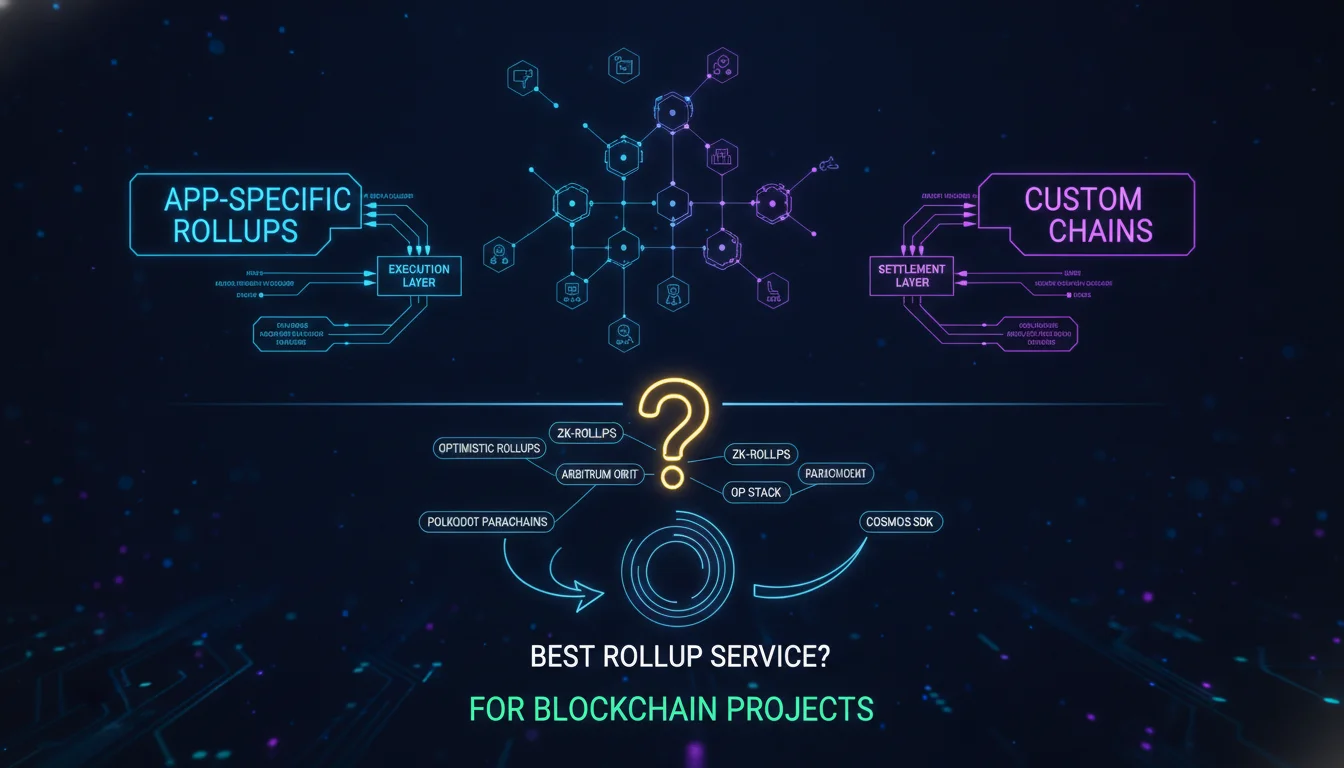
App-specific rollups are bespoke Layer 2 chains tailored to the needs of a single application or business. Unlike general-purpose rollups, these chains let teams customize every aspect: execution environment, fee models, governance, and data availability, for optimal performance and cost control.
What App-Specific Rollups Solve
By isolating a dApp on its own chain, developers avoid congestion from unrelated activity. This approach guarantees predictable throughput and can dramatically reduce operational costs for high-frequency applications like on-chain games or social networks. You set the rules. No one else’s traffic affects your users.
Tools for Building Custom Rollups
- Celestia: A modular data availability layer that offloads data storage, enabling highly efficient and sovereign rollups.
- Eclipse: Provides infrastructure for deploying customizable Layer 2 chains with flexible data availability and settlement options.
- Rollkit: A toolkit that supports building rollups with arbitrary execution layers.
These tools give teams full control, but they require significant engineering resources and ongoing maintenance. For most projects, the question of which rollup service is best for blockchain projects with custom requirements comes down to whether you have the protocol engineers to own the full stack long-term.
Developer Tooling Integrations
Custom rollup stacks typically integrate with standard Ethereum development environments. Hardhat and Foundry both work with EVM-compatible rollup frameworks, and most RaaS providers expose standard JSON-RPC endpoints so existing tooling requires minimal reconfiguration. If your team already has a Foundry-based testing suite, that investment carries over to any EVM-equivalent rollup deployment.
Rollup-as-a-Service (RaaS): Simplifying Deployment
Rollup-as-a-Service (RaaS) is a provider-managed platform that allows developers to launch and operate a custom rollup without building the underlying infrastructure from scratch. RaaS abstracts away the complexity of running sequencers, managing state commitments, and handling fraud or validity proofs, cutting time-to-market and operational overhead significantly.
How RaaS Accelerates Time-to-Market
According to Instanodes, building rollup infrastructure from scratch can take 6 to 9 months and cost millions in development. RaaS platforms cut this to under 30 minutes, enabling a single developer to spin up a testnet for as little as $50 per month, as noted by Conduit. That is not a marginal improvement. It is a structural shift in who can build production-grade L2 infrastructure.
“Instead of spending months building a chain or paying a team of developers millions of dollars, app builders are turning to RaaS providers to deploy rollups in minutes and for as little as $50 per month on testnet.” – Conduit, Ultimate Guide to RaaS Platforms
Top RaaS Providers Compared
- Conduit: Offers one-click deployment of customizable rollups with managed RPC nodes and indexing. Emphasizes partnership and post-launch support for teams that need ongoing operational help.
- Caldera: Provides a rollup engine and a cross-chain Metalayer, enabling interconnected purpose-built chains that settle on Ethereum.
- AltLayer: A decentralized RaaS protocol supporting appchains and elastic scaling Layer 2 solutions.
- Alchemy Rollups: The complete developer platform for building and scaling rollups, deeply integrated with Alchemy’s suite of infrastructure tools.
- QuickNode Rollups: Supports deployments on OP Stack, Arbitrum Orbit, and ZK frameworks with high-performance RPC endpoints.
- Arbitrum Orbit: A path for launching new chains within the Arbitrum ecosystem, with native access to Arbitrum’s security and liquidity.
These providers are featured in Alchemy’s Dapp Store, which lists 12 RaaS solutions across multiple chains as of 2026.
Shared Sequencers and Decentralized Sequencing
One emerging concern across all rollup types is sequencer centralization. Most production rollups today rely on a single sequencer run by the core team. Shared sequencer networks aim to fix this by distributing sequencing across multiple operators, improving censorship resistance and liveness guarantees. Projects like Espresso Systems are building in this direction, and several RaaS providers are beginning to integrate shared sequencing options. If long-term decentralization is a priority for your project, ask any RaaS vendor directly about their sequencer roadmap before committing.
Layer 3 Rollups: The Next Abstraction Layer
Layer 3 rollups settle on a Layer 2 rather than directly on Ethereum. The practical benefit is cost: by using an L2 as the settlement layer, L3 chains can achieve even lower fees and higher throughput for specific application domains. Arbitrum Orbit chains can be configured as L3s settling on Arbitrum One, and the OP Stack supports similar configurations. L3s are still early, but they are worth evaluating if your application needs dedicated throughput at minimal cost and you are already committed to a specific L2 ecosystem.
Evaluating RaaS for Your Project
When assessing a RaaS provider, consider long-term costs, dependency on the vendor, the level of customization allowed, and the security of the chosen rollup framework. For teams without dedicated protocol engineers, RaaS is often the most practical route to launch a scalable Layer 2. The governance structure of the underlying rollup framework also matters: understand who controls upgrades and whether there is a timelock or multisig protecting user funds.
Which Rollup Service Is Best for Blockchain Projects: Decision Framework
Answering which rollup service is best for blockchain projects requires a structured evaluation of your project’s specific demands. There is no universal winner. Each approach optimizes for a different slice of the scalability trilemma. The following steps will help you filter options systematically.
Step 1: Define Your Performance and Finality Needs
Start by quantifying the expected TPS and latency your dApp requires. If you need sub-second finality and high throughput, ZK rollups like zkSync or StarkNet are compelling. If a 7-day withdrawal delay is tolerable and you value Ethereum tooling compatibility, Optimistic rollups such as Arbitrum may be sufficient. Real-world performance data from Tatum shows Lighter (ZK) achieving 2,040 TPS, while Base (Optimistic) operates around 112 TPS – matching most consumer app needs comfortably.
Step 2: Assess Security Requirements
Applications handling high-value assets, such as custodial services or institutional trading, benefit from the cryptographic security of ZK proofs. Optimistic rollups rely on economic incentives and honest watchers, which is adequate for many use cases but introduces a trust assumption during the dispute window. App-specific rollups let you fine-tune security parameters but require you to stand up your own validator set and own the consequences of any misconfiguration.
Step 3: Calculate Cost and Resource Constraints
Development effort and budget are decisive factors. If you have a small team, RaaS platforms drastically reduce upfront investment. Conduit’s $50/month testnet plan and the ability to go live in under 30 minutes contrast sharply with the multi-month builds and million-dollar engineering costs of custom rollups cited by Instanodes. Long-term operational expenses and vendor lock-in must still be weighed against full infrastructure ownership.
Performance, Security, and Cost Comparison
The table below compares the four primary rollup service categories across critical dimensions. Use it as a starting point to shortlist solutions based on your priorities when evaluating which rollup service is best for blockchain projects at your current stage.
| Category | Example Platforms | Finality | Security Model | Development Complexity | Cost | Best For |
|---|---|---|---|---|---|---|
| Optimistic Rollup | Arbitrum, OP Mainnet, Base | ~7-day withdrawal delay | Fraud proofs + economic incentives | Low (EVM-equivalent) | Low gas fees; no infrastructure cost | General dApps, gaming, consumer apps |
| ZK Rollup | zkSync, StarkNet, Polygon zkEVM | Near-instant | Validity proofs (cryptographic) | Medium-high (prover complexity) | Moderate gas fees; prover costs | Enterprise, DeFi, payments, high-security apps |
| App-Specific Rollup | Celestia, Eclipse, Rollkit | Configurable | Configurable | High (full stack control) | High development and maintenance | Projects needing custom logic and dedicated throughput |
| RaaS | Conduit, Caldera, AltLayer, Alchemy | Depends on framework | Depends on framework | Very low (managed service) | $50+/month testnet; usage-based production | Teams wanting rapid deployment without infrastructure burden |
Pros and Cons
Pros
- Dramatic fee reduction: Rollups batch thousands of transactions into a single on-chain submission, cutting per-transaction costs by orders of magnitude compared to raw Layer 1 execution.
- Inherited security: Both Optimistic and ZK rollups anchor their security to Ethereum, meaning you get battle-tested consensus without running your own validator set.
- RaaS accessibility: Teams without dedicated protocol engineers can now launch production-grade L2 infrastructure in under 30 minutes for as little as $50/month on testnet.
- Flexible architecture: The modular rollup stack – separate execution, settlement, and data availability layers – lets teams mix and match components to match their exact requirements.
- EVM compatibility: Optimistic rollups and several ZK rollups support standard Solidity contracts and Hardhat/Foundry tooling, protecting existing engineering investments.
Cons
- Withdrawal delays: Optimistic rollups impose up to a 7-day challenge window before funds can be bridged back to Layer 1, creating friction for users who need fast exits.
- Sequencer centralization: Most production rollups today run a single sequencer, introducing a liveness and censorship risk that decentralized sequencing has not yet fully resolved.
- ZK proof complexity: Generating SNARK and STARK proofs requires specialized engineering knowledge and significant compute resources, raising the barrier for teams without cryptography expertise.
- Vendor lock-in risk: RaaS platforms abstract away infrastructure complexity, but that convenience comes with dependency on the provider’s roadmap, pricing, and uptime guarantees.
- Fragmented liquidity: Deploying on a custom or app-specific rollup means starting with zero liquidity and no existing user base, which is a real go-to-market challenge for DeFi protocols.
Frequently Asked Questions
What is rollup technology in blockchain?
A rollup is a Layer 2 scaling solution that processes transactions off-chain and submits a compressed proof or summary to the main chain. It increases throughput and lowers fees while inheriting the base layer’s security guarantees.
Which rollup service is best for blockchain projects with small teams?
RaaS platforms like Conduit and Caldera are the most practical choice for small teams, offering managed infrastructure and rapid deployment. They eliminate the need for dedicated protocol engineers and allow testnet launches for as little as $50/month, according to Conduit’s published pricing.
Are ZK rollups more secure than Optimistic rollups?
ZK rollups provide stronger security guarantees because they use mathematical proofs to validate every batch, removing the need for a dispute window. Optimistic rollups rely on economic incentives and honest watchers, which is still robust but introduces a trust assumption during the challenge period.
How long does it take to launch a rollup?
Using a RaaS provider, a rollup can be deployed in under 30 minutes, compared to 6 to 9 months for custom infrastructure, according to Instanodes. Testnet costs can be as low as $50 per month with services like Conduit.
What is the difference between a rollup and a sidechain?
A rollup inherits the security of its parent chain by posting proofs or compressed data on-chain, whereas a sidechain has its own consensus mechanism and independent security model. Rollups offer stronger trust minimization but carry different finality trade-offs depending on whether they use fraud proofs or validity proofs.
Can I change my rollup type after launch?
Migrating between rollup types is non-trivial and involves redeploying contracts and migrating state. Some RaaS providers support multiple frameworks – OP Stack, Arbitrum Orbit, ZK – and may allow switching during the design phase, but post-launch transitions are complex and rare in practice.