- Blockchain auditing is the systematic evaluation of a blockchain’s security, functionality, and compliance with industry standards.
- Blockchain auditing combines code review, consensus analysis, security testing, and regulatory verification to identify vulnerabilities before they cause financial loss.
- Unlike traditional audits, blockchain-based systems can embed controls into each transaction, enabling ongoing real-time monitoring instead of retroactive sampling.
- Leading blockchain auditing firms include CertiK, Hacken, Trail of Bits, Quantstamp, Sherlock, and OpenZeppelin, according to the Alchemy Dapp Store.
- Walmart’s blockchain-based food supply chain cut traceability time from seven days to 2.2 seconds, per ISACA.
- Certifications like Coursera’s Enterprise Blockchain & Auditing course build the skills required to work in this field.
Blockchain auditing is the systematic evaluation of a blockchain’s security, functionality, and compliance with industry standards. It combines code review, consensus analysis, and real-time ledger verification to catch vulnerabilities before they cause losses.
Key Takeaways
- Blockchain auditing covers three domains: technical infrastructure, smart contract code, and regulatory compliance.
- Audits split into two broad categories: protocol audits (base-layer infrastructure) and smart contract audits (application logic).
- Blockchain’s transparency and immutability let auditors shift from sampling historical records to continuous, real-time monitoring.
- Top blockchain auditing firms, including CertiK, Hacken, and Trail of Bits, each specialize in different chains and risk profiles.
- Failures like the WazirX $230 million breach show what happens when code review gets skipped or rushed.
- As of 2026, demand for blockchain auditing talent is growing as enterprises move supply chain, finance, and government workflows on-chain.
What Is Blockchain Auditing?
Definition and Core Objectives
Blockchain auditing is the process of evaluating a blockchain’s security, functionality, and compliance with industry standards. According to CertiK, it involves a thorough review of the blockchain’s design architecture and code to confirm everything operates as intended and stays free from vulnerabilities or weaknesses. A blockchain audit is also defined by BPM as a comprehensive evaluation process that examines the security, functionality, and regulatory compliance of blockchain systems. This systematic review analyzes both architectural design and underlying code to verify that every component operates according to spec and stays free of vulnerabilities.
The core objectives of blockchain auditing are threefold: confirm the blockchain functions as designed, verify its security controls can withstand attacks, and ensure the system meets relevant regulatory requirements. These objectives matter because immutability means errors or vulnerabilities can have severe consequences, potentially leading to financial losses or security breaches, as CertiK notes. For L1 founders and developers building on top of these base layers, blockchain auditing is a top priority because trustless systems force participants to stand by agreements, while decentralization ensures no one can tamper with them after the fact.
Deloitte frames blockchain auditing not just as a technical review but as an internal audit responsibility. Deloitte describes blockchain itself as a protocol that allows entities to store and share transactional information in a controlled and systematic way. Their three-part series, covering blockchain fundamentals, risk considerations, and auditing blockchain environments, shows that internal audit must provide traditional assurance while also acting as a trusted business advisor in anticipating and evaluating emerging risks. The definition therefore extends past code scanning into governance, data flows, and control effectiveness. Deloitte’s first installment also covers smart contracts, tokens, initial coin offerings (ICOs), and cryptocurrencies as concepts internal auditors need to understand before they can meaningfully evaluate a blockchain environment.
As blockchain networks grow more complex and interconnected, these audits serve as essential checkpoints for maintaining system integrity and preventing potential security breaches. – Ryan Davis, Partner, Assurance at BPM
Why Blockchain Audits Are Different From Traditional Audits
Blockchain audits differ from traditional audits because they embed controls into each transaction rather than checking a sample after the fact. Traditional audits rely on sampling, reconciliation, and point-in-time evidence collection. Blockchain auditing changes this by building the underlying foundations of auditing and internal control into each transaction, as Deloitte explains. The internal audit design can shift from a retroactive, point-in-time examination to an ongoing, real-time monitoring process informed by previous transactions. That’s a fundamental shift from detective work after the fact to continuous assurance during operations.
According to ISACA, auditing blockchain technology poses several challenges stemming primarily from its decentralized nature. The distributed ledger system spreads transaction records across multiple nodes, making it hard for auditors to access and verify data in a centralized manner. Immutability compounds this: once transactions are recorded, they can’t be altered, which makes traditional audit trails obsolete. Auditors have to adapt to new tools and techniques for analyzing blockchain data effectively.
Another differentiator is cryptographic proof. INTOSAI Journal states that blockchain transparency lets all network participants see the history of transactions in real time, increasing traceability. Digital signatures on transactions provide undeniable proof of who sent a message, a property called non-repudiation. This irrefutability means auditors can automate evidence collection directly from the chain instead of relying on client-provided documents.
The Role of Internal and External Auditors
Deloitte positions internal audit as the third line of defense, entrusted with giving the board and management comprehensive assurance while maintaining independence and objectivity. In a blockchain environment, internal auditors must not only test controls but also evaluate whether the chain’s own consensus and smart contract logic replace or supplement traditional controls. That requires understanding distributed ledger technology, smart contracts, tokens, ICOs, and cryptocurrencies at a working level, not just conceptually.
External auditors and independent firms bring specialized expertise in blockchain technology and Web3. Per CertiK, blockchain audits are conducted by experienced auditors or specialized firms with expertise in blockchain technology and Web3, using advanced tools and techniques to assess integrity and recommend improvements. Their role extends to verifying the system is trustworthy and secure for every party involved.
INTOSAI Journal observes that blockchain adoption in public and private institutions will produce new assurance and audit services, since both internal audit and external auditors can pull real-time reports. That points to a convergence: internal auditors focus on ongoing control effectiveness, while external auditors provide independent attestation over smart contracts, protocol logic, and financial representations. Coursera’s Enterprise Blockchain & Auditing course specifically trains people to audit permissioned blockchain networks and evaluate roles, access, identity, governance, and data flows for audit readiness.
Core Components of a Blockchain Audit
Technical Infrastructure and Consensus Review
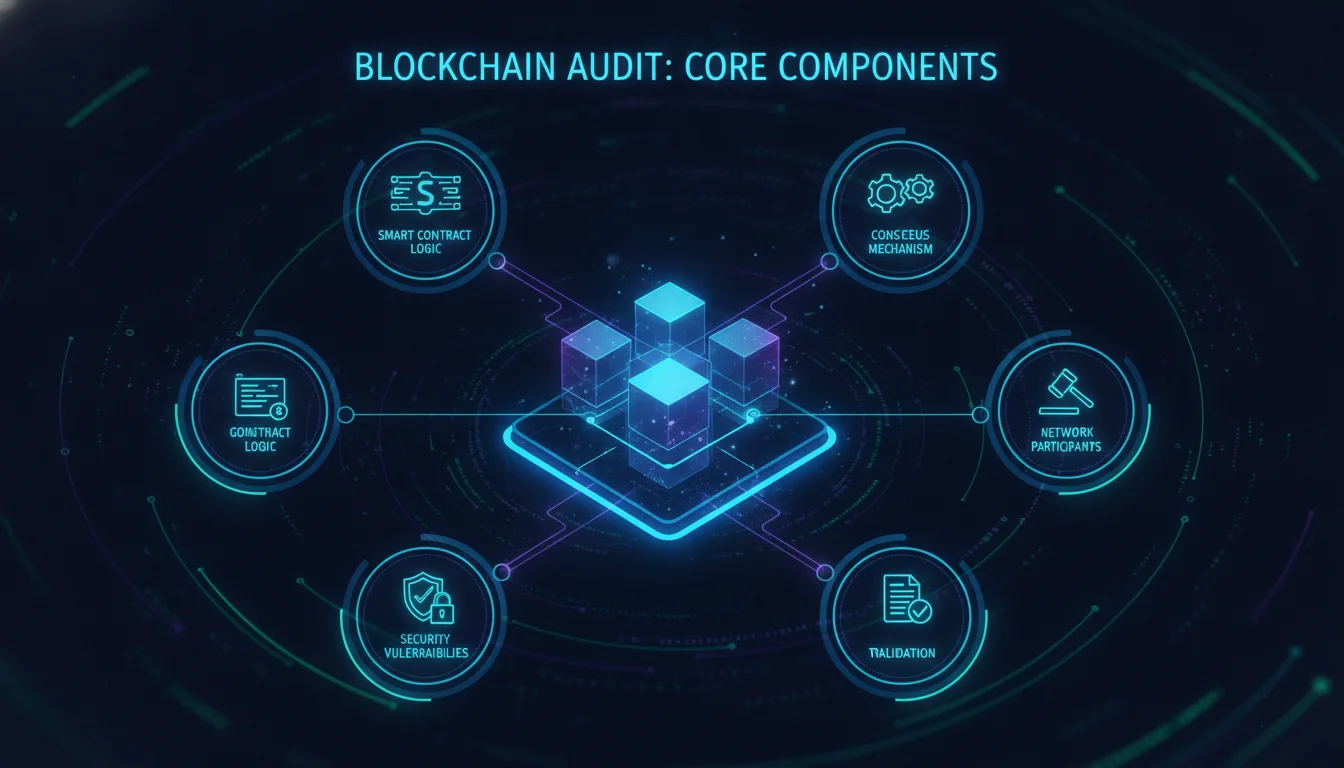
A blockchain audit’s technical infrastructure component evaluates network protocols, consensus mechanisms, and data storage systems for weaknesses that could compromise integrity. BPM describes this as examining the blockchain’s technical framework, including network protocols, consensus mechanisms, and data storage systems. Auditors analyze scalability and performance metrics because throughput constraints in decentralized architectures can compromise system integrity, as highlighted in a Frontiers in Blockchain mini review. The consensus mechanism, whether proof of work, proof of stake, or a permissioned variant, has to be evaluated for resistance to manipulation and failure modes.
Consensus vulnerabilities aren’t theoretical. The Frontiers review identifies persistent technical risks, notably 51% consensus vulnerabilities, which occur when an attacker controls the majority of network hashrate and can rewrite transaction history. Blockchain auditing therefore includes a threat model assessing whether the consensus layer can be subverted by malicious validators, miners, or coordinated cartels. Auditors also evaluate node distribution, network topology, and fallback procedures if a node goes down.
INTOSAI Journal adds that distribution and decentralization are core features: the network can function as a database integration layer, allowing shared use between organizations and external collaborators. An audit must verify that this integration layer doesn’t introduce unauthorized access or data leakage, particularly when the blockchain serves government agencies or regulated enterprises.
Smart Contract and Code Analysis
Smart contracts are computational codes that run autonomously and reliably on the blockchain, as defined by INTOSAI Journal. They automate predefined rules and remove the need for complex reconciliation processes between parties. Because smart contracts hold funds, manage identity, and execute business logic, their code becomes a direct target for attackers. Code analysis sits at the heart of most blockchain auditing engagements for exactly this reason.
BPM breaks code analysis into two complementary activities: automated scanning and manual code review. Automated scanning uses static analysis tools to catch common vulnerability patterns: reentrancy, integer overflow, access control errors, and unchecked external calls. Manual review involves senior auditors reading the contract line by line to spot logic flaws, business rule misalignments, and hidden backdoors that automated tools miss. CertiK emphasizes that experienced auditors use advanced tools and techniques to assess integrity, but no single tool replaces human judgment.
Astra’s Top 11 Blockchain/Crypto Auditing Companies article reinforces this: a blockchain security audit is a thorough review of smart contracts, blockchain protocols, and associated code meant to identify vulnerabilities. The same article notes that in 2023, WazirX, one of India’s leading crypto exchanges, suffered a $230 million breach, a single failure that triggered a force majeure event and widespread user panic. That breach is a clear example of why code analysis isn’t optional: a single smart contract flaw can drain millions in seconds.
Security Testing and Compliance Verification
Security assessment is the third pillar of blockchain auditing. BPM describes rigorous testing of security measures to reveal possible vulnerabilities in access controls and encryption protocols, including penetration testing and threat modeling scenarios. Penetration testing simulates real-world attackers trying to exploit known and unknown weaknesses, while threat modeling maps how an adversary could move from a low-privilege position to full compromise. In blockchain systems, this extends to testing key management, oracle manipulation, and cross-chain bridge vulnerabilities.
Compliance verification evaluates how well the system aligns with relevant regulatory requirements and industry standards. Firms like Hacken position themselves as end-to-end blockchain security and compliance partners for digital assets, as listed in the Alchemy Dapp Store. Compliance checks may include anti-money laundering (AML), know-your-customer (KYC) integrations, data privacy under GDPR, and securities law considerations for tokenized assets. A compliant audit doesn’t just pass code checks; it demonstrates the network’s governance and tokenomics meet regulatory expectations in the jurisdictions where it operates.
Security testing and compliance verification matter most for permissioned enterprise blockchains. Coursera’s course lists privacy, KYC, data policies, and regulatory alignment as explicit focus areas, teaching auditors to assess these with clear governance guardrails. Blockchain auditing has evolved from a purely technical exercise into a multidisciplinary assurance practice.
The Blockchain Auditing Process Step by Step
1. Scope the Engagement and Prepare Documentation
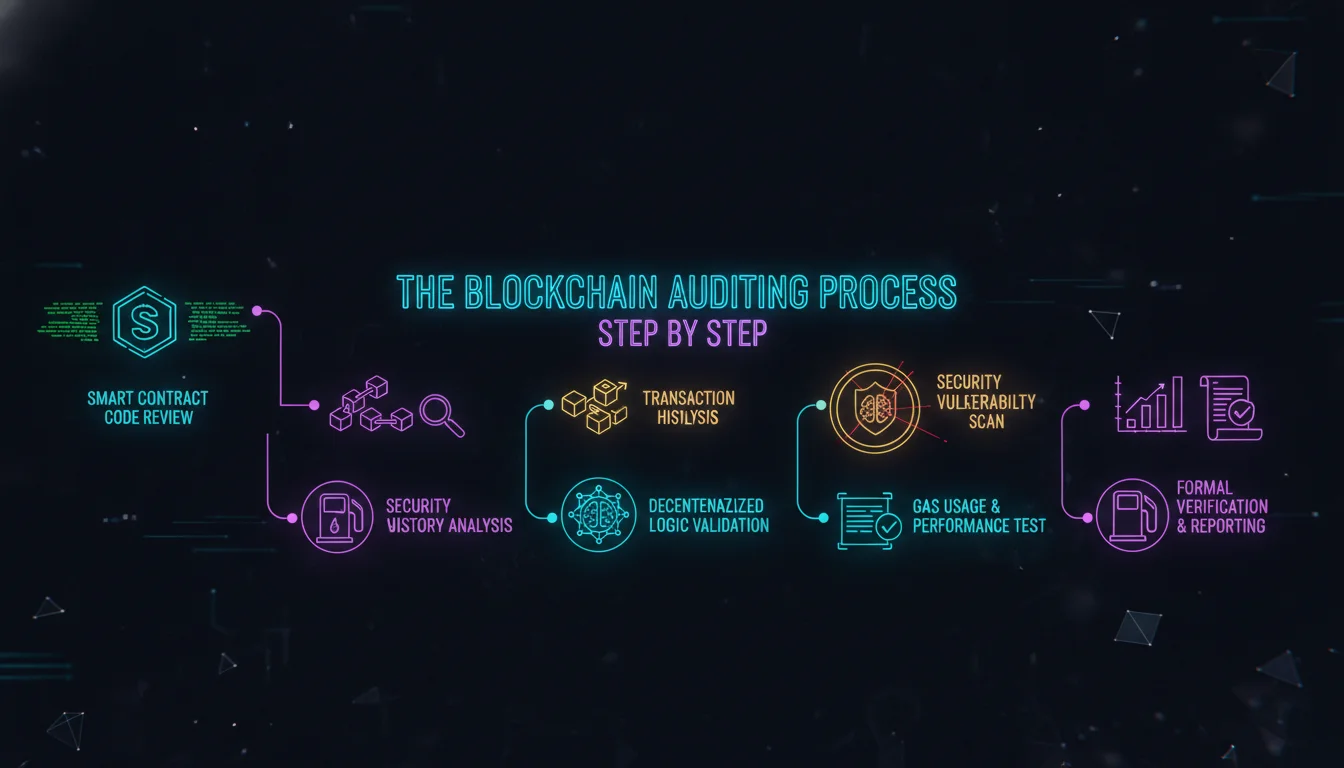
Scoping a blockchain audit means defining the target upfront, whether that’s an L1 protocol, a smart contract suite, a permissioned network, or a full decentralized application. The scope determines which codebases are in review, which testnets get used, and which standards apply. Deloitte’s approach includes drafting an internal audit program as part of its third installment on auditing blockchain environments, stressing that the program must be designed before testing begins.
Pre-audit preparation also means gathering documentation: whitepapers, architecture diagrams, threat models, deployment scripts, and prior audit reports if any exist. For permissioned blockchains, auditors must review identity management policies, role-based access control (RBAC), and governance charters, as taught by Coursera. A clear scope prevents the common pitfall of auditing only the core token contract while ignoring upgradeable proxy patterns or external integrations.
2. Run Automated Scanning and Manual Code Review
Here’s the core execution phase, which typically follows this sequence:
- Step 1: Run automated vulnerability scanners across the entire codebase to flag known issues, dependency vulnerabilities, and gas inefficiencies.
- Step 2: Review the output and manually confirm each finding, eliminating false positives and prioritizing true positives by severity.
- Step 3: Conduct a line-by-line manual review of smart contracts, focusing on business logic, state transitions, access controls, and external call interactions.
- Step 4: Test consensus mechanisms and node behavior through stress tests, fork simulations, and validator rotation scenarios.
- Step 5: Simulate attacks, such as reentrancy, flash loan manipulation, and oracle price spoofing, in a controlled testnet environment.
A simplified reentrancy check that automated scanners flag looks like this in Solidity:
function withdraw(uint amount) public {
  require(balances[msg.sender] >= amount);
  (bool sent, ) = msg.sender.call{value: amount}("");
  require(sent, "Failed to send Ether");
  balances[msg.sender] -= amount;
}
Notice the external call happens before the balance update. That ordering is exactly the kind of pattern manual reviewers hunt for during blockchain auditing, since automated tools can miss context-dependent reentrancy paths. BPM notes that code analysis involves both automated scanning and manual code review processes, and CertiK adds that auditors use advanced tools and techniques to assess integrity. The combination of automated breadth and manual depth is the industry standard: a fully automated audit misses logic flaws, while a purely manual audit is too slow and expensive for large codebases.
3. Report Findings, Remediate, and Monitor Continuously
After testing, auditors produce a report classifying findings by severity: critical, high, medium, low, and informational. Each finding includes a description, the affected code or component, potential impact, and recommended remediation. The project team fixes the issues, and the auditor re-reviews the changes to verify closure. This loop continues until every critical and high finding is resolved.
Blockchain auditing doesn’t end with a static report, though. Deloitte’s key insight is that the internal audit design can shift from a retroactive, point-in-time examination to an ongoing, real-time monitoring process. Once deployed, auditors can configure automated alerts on contract events, monitor on-chain balances, and verify upgradeable contracts haven’t changed without authorization. Sherlock, an audit marketplace and smart contract coverage protocol built on Ethereum, extends this by offering coverage, meaning auditors have a financial stake in the security of the code they review.
Continuous monitoring is also enabled by blockchain’s transparency. INTOSAI Journal states that auditors can develop automated procedures to pull evidence directly from the chain. That dramatically cuts the time required for evidence collection and lets audit firms offer continuous assurance services rather than annual point-in-time audits.
Types of Blockchain Audits
Protocol Audits vs. Smart Contract Audits
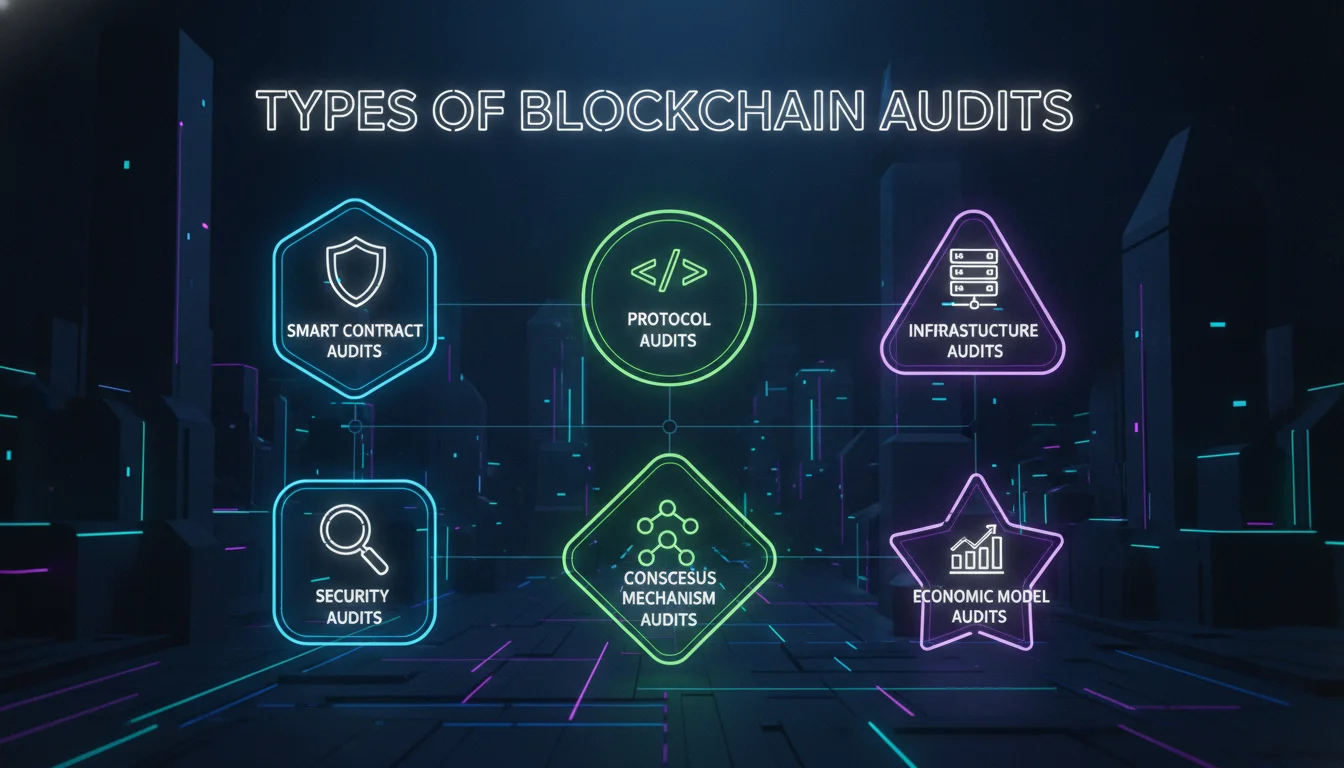
BPM divides blockchain audits into two main categories: protocol audits and smart contract audits. Protocol audits evaluate the fundamental blockchain infrastructure, examining the core technology that supports the entire system: consensus algorithm, networking layer, cryptographic primitives, and block validation rules. A protocol audit asks whether the blockchain itself can be trusted to order transactions, resist forks, and maintain liveness under adverse conditions.
Smart contract audits, by contrast, focus on the application layer: the dApps, DeFi protocols, NFT marketplaces, and token contracts that run on top of a base layer. These audits review each contract’s business logic, its interaction with other contracts, and its exposure to external data via oracles. Because smart contracts are immutable once deployed, a smart contract audit often serves as the last line of defense before user funds get committed.
Some firms specialize in one type. Trail of Bits, for example, is known for securing the world’s most targeted web3 organizations and products, per Alchemy. Quantstamp provides smart contract audits and security services for web3 projects. OtterSec specifically audits smart contracts across multiple chains. Knowing which type of audit you need matters: a protocol-level vulnerability can invalidate the security of every contract built on top of it.
Permissioned vs. Permissionless Network Audits
Blockchain networks fall into two broad categories: permissionless and permissioned. Permissionless networks, like Ethereum and Bitcoin, let anyone join, validate transactions, and deploy code without approval. Permissioned networks, such as Hyperledger Fabric deployments used by enterprises like Walmart and IBM, restrict participation to known entities with assigned roles. Coursera’s Enterprise Blockchain & Auditing course focuses specifically on auditing permissioned blockchain networks, teaching auditors to evaluate roles, access, identity, governance, and data flows for audit readiness.
The audit approach differs significantly between the two. In permissionless networks, auditors rely on public block explorers, on-chain analytics, and open-source code reviews. In permissioned networks, auditors must obtain credentials, review membership services, and test role-based access controls. Data privacy is a bigger concern in permissioned networks because sensitive business data may sit on-chain or in private data collections. An audit must verify private data isn’t leaked to unauthorized peers and that consensus ordering doesn’t expose confidential transaction patterns.
Financial Statement and Internal Control Implications
Blockchain auditing also intersects with financial statement audits. Deloitte’s series argues that with blockchain, the underlying foundations of auditing and internal control can be embedded into each transaction. That has real implications for how internal controls get designed and tested. Instead of sampling a subset of transactions months after year-end, auditors can verify all transactions in real time, using the blockchain as a source of truth. The Frontiers in Blockchain mini review offers a concrete example: PwC achieved a 90% temporal reduction in reconciliation protocols through automated transaction authentication on distributed ledgers.
This shift doesn’t eliminate the need for auditors, but it changes what they do. They move from manual reconciliation and sample testing to evaluating the controls embedded in smart contracts, the integrity of the consensus mechanism, and the accuracy of oracles that feed external data on-chain. They also assess whether management has appropriate controls over private keys, since a compromised key can irrevocably transfer assets even if the blockchain itself is secure. For public companies, blockchain-based financial reporting may eventually allow continuous auditing instead of quarterly reviews, but only if the regulatory framework evolves to recognize cryptographic attestations as valid audit evidence.
How Blockchain Technology Transforms Audit and Control
Real-Time Assurance and Embedded Controls
Blockchain transforms audit and control by replacing historical, sampled evidence with a transparent, tamper-resistant ledger that records every transaction as it happens. Traditional audit evidence is historical: invoices, bank statements, and ledgers describing what happened weeks or months ago. Blockchain flips this by providing a transparent and tamper-resistant record, as ISACA notes, cutting the need for complex reconciliation since transactions are securely recorded and visible to permissioned participants. Auditors can query the blockchain at any moment and get an up-to-date view of balances, ownership, and transaction history.
Deloitte’s third installment describes how internal audit design can shift from a retroactive, point-in-time examination to an ongoing, real-time monitoring process. In practice, this means smart contracts can enforce segregation of duties automatically: a payment over a threshold requires two signatures, a transfer to a blacklisted address gets blocked, an oracle update requires multiple independent sources. These embedded controls execute at the protocol level, meaning they can’t be bypassed by human error or override. The auditor’s job becomes verifying that these embedded controls are coded correctly and that no backdoors exist in upgradeable contracts.
INTOSAI Journal emphasizes hyper transparency and auditability: blockchain lets all network participants see the transaction history in real time, increasing traceability. Users can thoroughly audit transactions, which matters especially for government applications where much information must be public. Transparency doesn’t rule out privacy, though. Zero-knowledge proofs and confidential transactions can hide amounts while still letting auditors verify integrity, meaning auditability gets built into the data layer rather than bolted on later.
Supply Chain and Traceability Use Cases
One of the most cited use cases for blockchain auditing is supply chain traceability. ISACA describes how Walmart partnered with IBM to use the IBM Food Trust platform, built on Hyperledger Fabric, to track food product provenance from farm to fork. Each transaction in the supply chain gets recorded on an immutable ledger, letting all parties verify the authenticity and integrity of products. The system records each step of the journey, creating an audit trail that’s inherently tamper-resistant.
The value here is measurable. ISACA reports that Walmart’s blockchain solution significantly improved mango traceability in the U.S., cutting the time needed to trace origin from seven days to just 2.2 seconds. In China, Walmart applied blockchain to track pork, boosting authenticity and transparency. From an auditing lens, a supply chain auditor can verify the origin, custody, and handling of goods almost instantly, instead of relying on paper records that can be forged or delayed.
For blockchain auditing, supply chain use cases show how an auditor can verify not just financial transactions but physical asset movements. Smart contracts can automatically trigger payments when goods reach a certain location, and auditors can confirm terms were met by inspecting immutable event logs. This cuts fraud risk and enables continuous compliance monitoring for industries like food safety, pharmaceuticals, and luxury goods.
Machine Learning and Anomaly Detection
The Frontiers in Blockchain mini review highlights machine learning-powered anomaly detection as a major enhancement to audit efficacy. When transaction data gets recorded immutably on a blockchain, machine learning models can be trained to flag unusual patterns: sudden balance movements, round-trip trades, unusual gas usage, addresses with high-risk exposure. Because the data is standardized and cryptographically signed, the models operate on a clean, tamper-evident dataset, improving accuracy and reducing false positives compared to traditional data pipelines.
This capability enables comprehensive audit sampling and continuous monitoring, per the review. Traditional audits sample a fraction of transactions due to resource constraints. With machine learning on blockchain data, auditors can analyze the entire population while focusing human attention on anomalies. A DeFi protocol audit, for instance, may use ML to detect flash loan attacks in real time, alerting the team before a vulnerability gets fully exploited. The same models can work retrospectively to identify a breach’s root cause, as in the WazirX incident, where a single failure led to a $230 million loss.
These techniques require new skills, though. Auditors must understand not only accounting and controls but also data engineering, statistical modeling, and the specific quirks of on-chain data, such as internal transactions, proxy contracts, and reverted calls that may not show up in simple balance views. The integration of machine learning into blockchain auditing is still evolving, but it points toward more effective, real-time assurance.
Top Blockchain Auditing Companies
Marketplaces and Specialty Firms
The blockchain auditing market has grown fast. Alchemy’s Dapp Store lists 104 blockchain auditing companies across popular Web3 ecosystems, including Aptos, Arbitrum, Avalanche, Base, Bitcoin, BNB Chain, Cosmos, Ethereum, Solana, and many others. That figure reflects rising demand for security review as the industry matures. Among these, several firms stand out for specialization and market presence.
Sherlock is an audit marketplace and smart contract coverage protocol built on the Ethereum blockchain. Instead of a traditional client-auditor relationship, Sherlock pools capital and pays auditors based on the security of covered protocols. CertiK is one of the largest blockchain security auditors, combining formal verification with AI-powered security solutions. Hacken is an end-to-end blockchain security and compliance partner for digital assets. These names appear consistently across rankings, including Astra’s top 11 list.
Enterprise-Focused Security Teams
Beyond the large marketplaces, specialized security teams offer deep technical reviews. Trail of Bits secures the world’s most targeted web3 organizations and products, with a reputation for rigorous research and formal methods. Quantstamp provides smart contract audits and security services for web3 projects. OpenZeppelin is best known for its open library for smart contract development but also runs security audits. Consensys Diligence, PeckShield, SlowMist, and Armors round out the top rankings, each with different chain specializations.
The choice of auditor depends on the project’s chain, language, and risk profile. For Ethereum-based DeFi protocols, firms like Trail of Bits and Quantstamp are often preferred. For cross-chain ecosystems, Hacken and CertiK offer multichain coverage. For coverage against exploit losses, Sherlock’s marketplace model adds an insurance-like layer. Astra advises projects to talk to an expert about what’s overkill for a protocol’s specific architecture, rather than choosing a firm purely by brand recognition.
Comparison of Leading Providers
| Company | Specialty | Notable Feature | Chain Focus |
|---|---|---|---|
| CertiK | Formal verification, AI-powered security | One of largest blockchain security auditors | Multichain |
| Hacken | End-to-end security & compliance | Digital asset compliance partner | Multichain |
| Trail of Bits | Security research | Securing targeted web3 organizations | Ethereum, others |
| Quantstamp | Smart contract audits | Security services for web3 projects | Ethereum, BNB |
| Sherlock | Audit marketplace and coverage protocol | Built on Ethereum | Ethereum |
| OpenZeppelin | Smart contract templates and security | Open library for smart contract development | Ethereum |
Source: Alchemy Dapp Store and Astra.
Pros and Cons of Blockchain Auditing
Pros
- Catches critical vulnerabilities like reentrancy and access control flaws before deployment, when fixes are cheap.
- Enables continuous, real-time monitoring instead of annual point-in-time reviews, per Deloitte’s framework.
- Cryptographic evidence collection reduces reliance on client-provided documents and speeds up audit cycles.
- Builds trust with users, investors, and regulators, which matters for token launches and DAO treasuries.
- Machine learning applied to on-chain data allows full-population analysis rather than sampling a fraction of transactions.
Cons
- Immutability means a missed bug in a deployed contract often can’t be patched, only mitigated or migrated away from.
- Decentralized architecture makes evidence collection harder since records live across multiple nodes rather than one server.
- Regulatory gaps across jurisdictions leave gray areas that no audit scope can fully resolve.
- Quality varies widely across the 104 firms Alchemy lists, so brand recognition alone is a poor selection filter.
- Audits are a snapshot of code at review time. Upgrades, new integrations, or governance changes can reopen risk that a prior audit never covered.
Risks and Challenges in Blockchain Auditing
Decentralization and Evidence Access
Decentralization is the source of blockchain’s trust, but it complicates auditing. ISACA explains that the distributed ledger system spreads transaction records across multiple nodes, making it difficult for auditors to access and verify data in a centralized manner. An auditor can’t just request the general ledger from a single server; they have to query multiple nodes, reconcile potential forks, and account for network latency. For permissioned networks, access may be restricted by governance rules, requiring auditors to obtain special credentials and navigate complex data-sharing agreements.
Immutability also creates a paradox: once a transaction is recorded, it can’t be altered, which is excellent for audit evidence but problematic for correcting errors. If a smart contract has a bug, the flawed transaction is permanently on-chain. Auditors must therefore focus on pre-deployment detection rather than post-hoc correction, which means blockchain auditing has to be more forward-looking than traditional audit, which often documents and reports errors after they occur.
INTOSAI Journal adds that availability is a feature: since all participants have a local network copy, the ledger can be accessed through other nodes if one node becomes unavailable. This resilience is a benefit, but it also means an auditor must verify copies stay consistent across nodes, a challenge when network partitions occur. Consensus fork events can create temporary states where different nodes disagree on the canonical chain, making it critical for auditors to understand the blockchain’s finality guarantees.
Consensus Vulnerabilities and 51% Attacks
The Frontiers in Blockchain review identifies 51% consensus vulnerabilities, self-executing contract exposures, and throughput constraints as persistent technical risks in this space. In a proof-of-work blockchain, an attacker who controls 51% of network hashrate can double-spend, censor transactions, and rewrite recent history. In proof-of-stake systems, the equivalent risk is a cartel of validators controlling a supermajority of stake. Blockchain auditing must evaluate the economic cost of such an attack, the distribution of mining or staking power, and whether slashing mechanisms or checkpoints exist to mitigate the risk.
Other consensus-related risks include long-range attacks, nothing-at-stake problems, and finality gaps. Auditors examine whether the consensus protocol has been formally verified, whether client implementations are tested against adversarial conditions, and whether governance mechanisms can be captured by a small group. These aren’t purely theoretical. Several smaller chains have suffered 51% attacks, resulting in lost funds and eroded trust. A thorough blockchain auditing engagement specifically tests the network’s response to a simulated 51% attack or validator cartel.
Persistent technical risks remain, notably 51% consensus vulnerabilities, self-executing contract exposures, and throughput constraints in decentralized architectures, which collectively compromise system integrity. – Frontiers in Blockchain, Auditing in the blockchain: a literature review
Regulatory Gaps and Cross-Border Complexity
Regulatory gaps in cross-border blockchain applications are another major challenge identified by Frontiers in Blockchain. A blockchain network may span dozens of jurisdictions, each with different rules for securities, money transmission, data privacy, and consumer protection. An auditor must determine which regulations apply, how they conflict, and whether the blockchain’s design can comply with all of them at once. This is especially difficult for permissionless networks, where participant identity is pseudonymous and enforcement is unclear.
The WazirX breach reported by Astra, at $230 million in user funds, shows how regulatory ambiguity can amplify a security failure. The exchange invoked force majeure and sought legal protection across jurisdictions, leaving users uncertain about recovery. Blockchain auditing that integrates compliance verification can flag such operational and legal risks before they materialize, but no audit eliminates the underlying regulatory uncertainty. As BPM notes, compliance verification evaluates alignment with relevant regulatory requirements and industry standards, but those standards are still evolving.
For auditors, this means keeping up-to-date knowledge of regulatory developments, working with legal counsel, and documenting assumptions about applicable law. The absence of clear rules doesn’t mean absence of risk; it means the auditor’s professional judgment matters even more when opining on a system’s compliance posture.
Education, Certifications, and Careers in Blockchain Auditing
Professional Certifications and Training
As blockchain auditing matures, formal training programs have emerged to meet demand. Coursera offers Enterprise Blockchain & Auditing, a course within the