Blockchain pentesting is a structured security assessment that simulates real-world attacks against decentralized systems to expose vulnerabilities before malicious actors do. It covers smart contracts, consensus layers, node infrastructure, APIs, and off-chain integrations.
Key Takeaways
- Blockchain pentesting goes far beyond smart contract auditing. It covers the full stack: nodes, APIs, wallets, bridges, and off-chain services.
- Most blockchain failures come from logic errors and weak assumptions, not broken cryptography.
- Effective blockchain pentesting combines manual analysis with targeted automated tooling. Automated scanners alone miss incentive-driven abuse and subtle logic flaws.
- Reentrancy, access control gaps, and consensus manipulation are the vulnerability classes attackers return to most often.
- As of 2026, regulatory frameworks including MiCA and DORA are beginning to mandate formal security testing for blockchain deployments.
- Regular testing cadence matters. A single pre-launch audit is not a security program.
What Is Blockchain?
Blockchain is a distributed digital ledger that records transactions across many computers simultaneously, with no single authority controlling the data. Each transaction is grouped into a block, cryptographically linked to the previous one, forming an append-only chain. That structure makes retroactive tampering computationally expensive, which is the source of blockchain’s integrity guarantees.
Key Features of Blockchain
- Decentralization: Control is distributed across network participants rather than held by a central operator.
- Immutability: Once data is written, altering it requires rewriting every subsequent block and outpacing the rest of the network. In practice, mistakes stick around permanently.
- Transparency: All transactions are visible to network participants, creating an auditable trail.
Types of Blockchains
- Public Blockchains: Open to any participant. Bitcoin and Ethereum are the canonical examples.
- Private Blockchains: Permissioned access, typically deployed within a single organization for internal workflows.
- Consortium Blockchains: Governed by a group of organizations, combining elements of both public and private models.
Understanding Blockchain Pentesting
Blockchain pentesting evaluates how a blockchain system actually behaves when someone pushes it in ways it was not designed for, not how the architecture diagrams say it should behave. The distinction matters. Most failures do not come from broken cryptography or someone rewriting the ledger. They come from smart contracts, nodes, APIs, and off-chain services behaving unexpectedly once real users and real money are involved.
Because transactions on most chains cannot be reversed, a single exploitable logic error can be abused repeatedly. Attackers are financially motivated to keep pulling on the same thread. That reality shapes everything about how pentesting for blockchain systems should be conducted.
Objectives of Blockchain Pentesting
- Identify Vulnerabilities: Discover weaknesses in smart contracts, APIs, node configurations, and off-chain integrations.
- Assess Resilience: Evaluate how well the system withstands adversarial inputs and maintains data integrity under pressure.
- Provide Recommendations: Deliver actionable remediation guidance prioritized by exploitability and impact.
How Blockchain Pentesting Works: The Mechanics
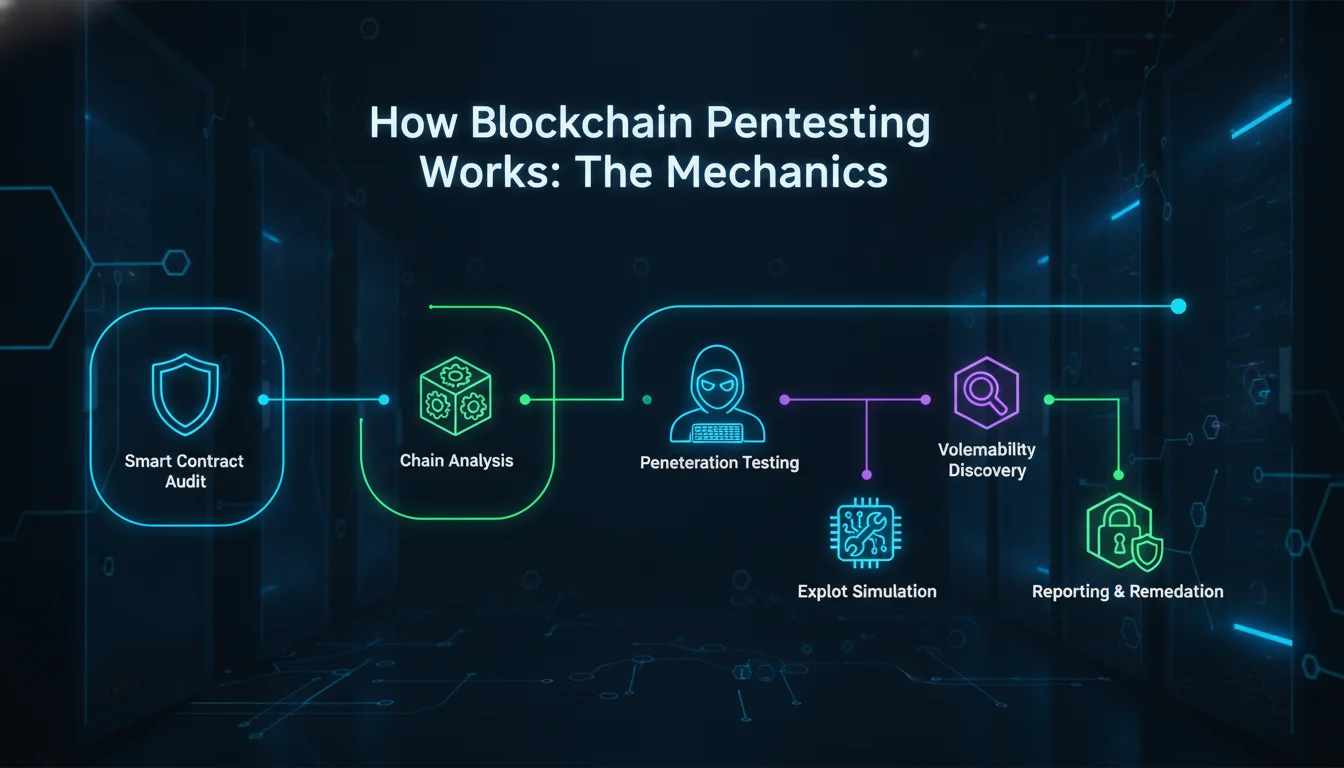
Blockchain pentesting operates across multiple distinct layers, each requiring different skills and tooling. Understanding the mechanics at each layer is what separates a thorough engagement from a checkbox exercise.
Layer 1: Smart Contract Analysis
Smart contracts are immutable after deployment on most chains. That immutability is both a security property and a liability. A tester reads the contract logic carefully, looking for assumptions that break under adversarial conditions: call order dependencies, trusted input assumptions, single-use flows that can be triggered repeatedly.
The analysis combines static review with dynamic interaction. Static tools like Slither and Mythril can surface known vulnerability patterns quickly. But they miss incentive-driven abuse. A tester who understands DeFi economics will probe whether a flash loan can manipulate an oracle price within a single transaction, something no static scanner models.
Here is a minimal Solidity example of a reentrancy-vulnerable withdrawal function:
// VULNERABLE: state update happens after external call
function withdraw(uint256 amount) external {
 require(balances[msg.sender] >= amount, "Insufficient balance");
 (bool success, ) = msg.sender.call{value: amount}("");
 require(success, "Transfer failed");
 balances[msg.sender] -= amount; // too late
}

// FIXED: state update before external call (checks-effects-interactions)
function withdraw(uint256 amount) external {
 require(balances[msg.sender] >= amount, "Insufficient balance");
 balances[msg.sender] -= amount; // update first
 (bool success, ) = msg.sender.call{value: amount}("");
 require(success, "Transfer failed");
}
The fix is one line reordered. The exploit, if missed, can drain a contract entirely.
Layer 2: Consensus and Node Infrastructure
Consensus vulnerabilities rarely announce themselves during calm, happy-path testing. They surface when something is stressed, lagging, or behaving inconsistently. A pentester probes validator concentration, timing assumptions, and how the network handles delays or partitions.
Node configuration is frequently overlooked. Exposed RPC endpoints, unauthenticated admin interfaces, and misconfigured peer discovery settings are all real attack surfaces. An attacker who can isolate a node from the rest of the network can manipulate what that node considers the canonical chain state.
Layer 3: Network and API Layer
Blockchain networks depend on peer communication to stay synchronized. If that layer is weak, attackers can isolate nodes, delay message propagation, or flood the network with noise. The goal is not always immediate fund theft. Often it is disrupting availability, degrading reliability, or manipulating how transactions spread through the network.
APIs sitting in front of blockchain infrastructure behave like regular web APIs, with all the same vulnerabilities: broken authentication, input validation failures, rate limiting gaps, and IDOR. According to research from NetSPI, Web2 bugs in Web3 systems are a consistent source of critical-impact findings, because off-chain components often have privileged access to on-chain operations.
Layer 4: Off-Chain and Integration Points
Oracles, bridges, relayers, and custodial services all represent integration points where on-chain and off-chain logic meets. These boundaries are where assumptions from both worlds collide. A bridge that trusts a centralized relayer without verification, or an oracle that can be manipulated within a single block, creates systemic risk that no amount of smart contract hardening can fix.
Blockchain Pentesting Methodologies
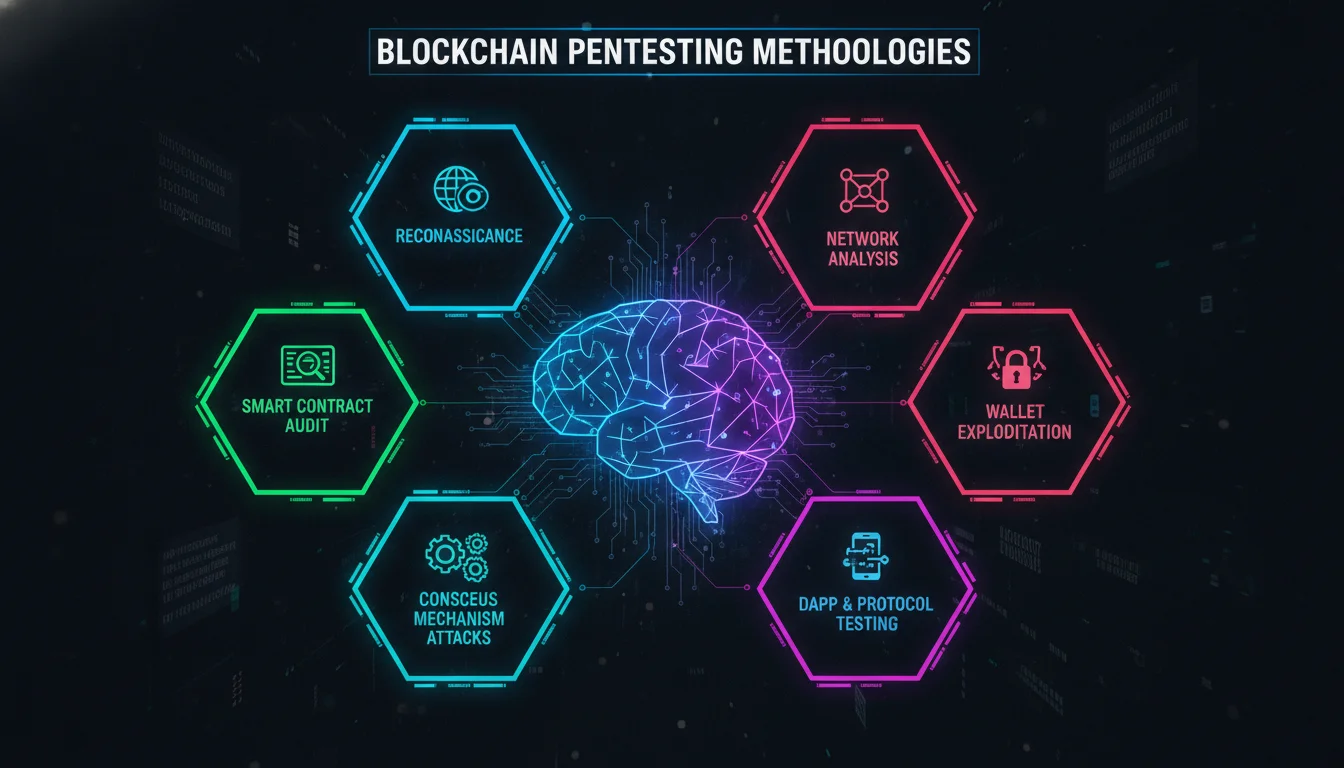
Blockchain pentesting methodologies combine automated tools and manual analysis across a structured engagement lifecycle. The following steps reflect how a rigorous engagement runs in practice.
- Information Gathering: Collect data about the blockchain system, including architecture diagrams, deployed contract addresses, node topology, API documentation, and known dependencies. On-chain data from Etherscan or similar explorers supplements what the team provides.
- Threat Modeling: Map the gathered information to realistic attack scenarios. Who are the likely adversaries? What do they want? Which components sit between them and that goal? This step shapes where testing effort concentrates.
- Testing: Execute penetration tests across all identified layers. Smart contract interaction, node probing, API fuzzing, and network-level attacks all run in parallel or sequence depending on scope.
- Reporting: Document every finding with proof-of-concept evidence, severity rating, and specific remediation guidance. A finding without a reproduction path is not actionable.
- Remediation Verification: After the team applies fixes, retest the specific findings to confirm the vulnerability is closed and no regression was introduced.
Common Vulnerabilities in Blockchain Systems
Blockchain systems tend to break in predictable places, even when the technology feels new. Most failures trace back to logic errors, weak assumptions, and components around the chain behaving in ways nobody planned for.
Smart Contract Vulnerabilities
Smart contracts are self-executing programs with terms written directly in code. Common vulnerabilities include:
- Reentrancy Attacks: A malicious contract calls back into the original contract before the first transaction completes, potentially draining funds. The DAO hack in 2016 remains the canonical example.
- Integer Overflow and Underflow: Mathematical operations that exceed storage capacity produce unexpected results. Solidity 0.8.x introduced built-in overflow checks, but older contracts and custom math libraries remain exposed.
- Access Control Issues: Weak or missing access controls let unauthorized callers manipulate contract state or withdraw assets. Missing
onlyOwnermodifiers and unprotected initializer functions are common culprits. - Oracle Manipulation: Contracts that read price data from on-chain sources can be manipulated within a single transaction using flash loans, causing the contract to act on a false price.
- Self-Destruct Vulnerabilities: Contracts that expose
selfdestructto unauthorized callers can be permanently destroyed, locking or destroying funds.
Consensus Mechanism Vulnerabilities
Consensus mechanisms are critical for maintaining blockchain integrity. Vulnerabilities include:
- 51% Attacks: A single entity that controls more than half of a network’s hash power or stake can manipulate transaction ordering and double-spend. Smaller proof-of-work chains are particularly exposed.
- Sybil Attacks: Creating multiple fake identities to gain disproportionate influence over the consensus process.
- Network Partitioning: Disrupting communication between node groups creates inconsistencies in chain state, which can be exploited for double-spend or finality manipulation.
- Validator Concentration: When a small number of validators control a large share of stake, the practical decentralization guarantees weaken significantly.
Network Vulnerabilities
The network layer is susceptible to several attack classes:
- DDoS Attacks: Flooding the network with traffic to disrupt normal operations and degrade availability.
- Man-in-the-Middle Attacks: Intercepting communication between nodes or between users and RPC endpoints to steal credentials or manipulate data.
- Node Isolation (Eclipse Attacks): Surrounding a target node with attacker-controlled peers so it only sees a manipulated view of the network.
- Exposed RPC Endpoints: Unauthenticated or misconfigured JSON-RPC endpoints can expose administrative functions to the public internet.
Cryptographic Vulnerabilities
Cryptographic weaknesses are less common but catastrophic when found. Weak random number generation in key derivation, reuse of nonces in signing schemes, and improper implementation of elliptic curve operations have all led to real fund losses. These are not theoretical. On-chain data has confirmed multiple wallet drains traced to predictable entropy sources in key generation.
Blockchain Pentesting vs. Smart Contract Auditing: Key Differences
Blockchain pentesting and smart contract auditing are related but distinct disciplines. Conflating them leaves significant attack surface uncovered.
| Dimension | Smart Contract Audit | Blockchain Pentesting |
|---|---|---|
| Primary Focus | Contract code logic and security | Full system: contracts, nodes, APIs, off-chain |
| Methodology | Static analysis, formal verification, code review | Active exploitation, dynamic testing, network probing |
| Scope | Solidity/Rust source code | Entire deployment stack including infrastructure |
| Web2 Coverage | Minimal or none | Full: APIs, authentication, cloud config |
| Timing | Pre-deployment (code review phase) | Pre- and post-deployment, ongoing |
| Output | Code-level findings with fix suggestions | Exploitability-ranked findings across full stack |
| Regulatory Value | Limited | Satisfies MiCA, DORA, VARA requirements |
As the Salusec research team notes, Web3 penetration testing covers centralized exchanges, cryptocurrency wallets, DeFi, and GameFi applications. It addresses middleware security and anti-tampering issues at the boundary where Web2 and blockchain logic meet. A smart contract audit does not touch those layers.
Tools Used in Blockchain Pentesting
Effective blockchain pentesting uses a layered toolset. No single tool covers the full attack surface.
| Tool | Category | Primary Use |
|---|---|---|
| Slither | Static Analysis | Detect known Solidity vulnerability patterns |
| Mythril | Symbolic Execution | Find reachable vulnerabilities through path analysis |
| Echidna | Fuzzing | Property-based fuzzing for Solidity contracts |
| Foundry (forge) | Testing Framework | Write and run exploit proof-of-concept tests |
| Ethernaut | Training / CTF | Practice exploiting real vulnerability patterns |
| Burp Suite | Web / API Testing | Test dApp frontends and API layers for Web2 bugs |
| Hardhat | Development / Testing | Local chain simulation for dynamic testing |
| Tenderly | Simulation / Debugging | Simulate transactions and trace execution paths |
Manual analysis remains the most important component. Automated tools surface known patterns efficiently, but they do not model attacker incentives or catch subtle logic flaws that only appear under specific call sequences.
How to Perform Blockchain Pentesting: A Practical Walkthrough
Blockchain pentesting in practice follows a structured sequence. Here is how a real engagement runs from scoping through remediation.
Step 1: Define Scope and Rules of Engagement
Before any testing begins, document exactly what is in scope: specific contract addresses, node endpoints, API domains, and off-chain services. Establish what is out of scope. Agree on whether testing will run against a mainnet fork, a staging environment, or production. Get written authorization. This is not optional.
Step 2: Gather On-Chain and Off-Chain Intelligence
Pull deployed contract source from Etherscan or the project’s repository. Map all external calls, dependencies, and oracle integrations. Identify the node infrastructure: which RPC endpoints are exposed, which are authenticated, and which admin interfaces are reachable. Document the API surface and any custodial or bridge components.
Step 3: Build a Threat Model
Map realistic adversaries to the system. A DeFi protocol faces different threats than a private consortium chain. For a DeFi protocol, the primary adversary is a financially motivated attacker with access to flash loans and MEV infrastructure. For a private chain, the threat model shifts toward insider risk and node compromise. Threat modeling determines where testing effort concentrates.
Step 4: Execute Smart Contract Testing
Run static analysis tools first to surface known patterns quickly. Then shift to manual review, reading the contract logic line by line with the threat model in mind. Write Foundry or Hardhat tests to prove exploitability for any finding. A finding without a working proof-of-concept is not a confirmed vulnerability.
// Foundry test demonstrating reentrancy exploit
contract ReentrancyTest is Test {
 VulnerableVault vault;
 AttackContract attacker;

 function setUp() public {
 vault = new VulnerableVault();
 attacker = new AttackContract(address(vault));
 vm.deal(address(vault), 10 ether); // seed vault
 }

 function testReentrancyDrain() public {
 vm.deal(address(attacker), 1 ether);
 attacker.attack{value: 1 ether}();
 // attacker should now hold vault's funds
 assertGt(address(attacker).balance, 9 ether);
 }
}
Step 5: Test the Network and Infrastructure Layer
Probe exposed RPC endpoints for unauthenticated access. Test whether admin functions are reachable from the public internet. Attempt node isolation by manipulating peer connections. Check whether the network degrades gracefully under load or whether availability collapses in ways that could be exploited.
Step 6: Test APIs and Off-Chain Components
Treat the API layer as a standard web application pentest. Test for broken authentication, IDOR, input validation failures, and rate limiting gaps. Pay special attention to any API endpoint that triggers on-chain transactions or has privileged access to contract admin functions.
Step 7: Document and Report
Every finding needs: a clear description, reproduction steps, proof-of-concept code or transaction hash, severity rating, and specific remediation guidance. Organize findings by severity. Deliver a technical report for the engineering team and an executive summary for leadership.
Step 8: Retest After Remediation
Fixes introduce regressions. After the team applies patches, retest every finding to confirm closure. Check that the fix does not open a new attack path. This step is frequently skipped and frequently regretted.
Pros and Cons of Blockchain Pentesting
Pros
- Finds real exploitability: Unlike theoretical audits, pentesting confirms whether a vulnerability can actually be used to cause harm, not just whether it looks concerning in code review.
- Covers the full stack: A proper engagement tests smart contracts, nodes, APIs, and off-chain components together, exposing vulnerabilities that only appear at integration boundaries.
- Satisfies regulatory requirements: As of 2026, frameworks including MiCA, DORA, and VARA are requiring formal penetration testing for blockchain deployments. A completed engagement provides the audit trail regulators need.
- Builds investor and user confidence: A published pentest report from a credible firm signals operational maturity to institutional investors and users who have learned to ask for it.
- Prioritizes remediation effort: Findings ranked by exploitability and impact let engineering teams fix what matters most first, rather than treating all issues as equally urgent.
Cons
- Point-in-time coverage: A pentest reflects the security posture at a specific moment. Code changes, dependency updates, and infrastructure modifications after the engagement are not covered.
- Requires deep expertise: Effective blockchain pentesting demands knowledge of Solidity or Rust, DeFi economics, network protocols, and traditional web security simultaneously. Generalist pentesters miss blockchain-specific attack classes.
- Cost and time investment: A thorough engagement across a complex DeFi protocol takes weeks and carries significant cost. Teams with limited budgets may be tempted to scope down in ways that leave critical surface untested.
- Cannot guarantee zero vulnerabilities: No pentest finds everything. Novel attack patterns, zero-days in dependencies, and economic exploits that only become viable at scale may not surface during a bounded engagement.
- Immutability amplifies missed findings: Unlike traditional software, you cannot patch a deployed smart contract. A vulnerability missed in testing may be permanently exploitable unless the contract is upgraded or replaced.
Common Mistakes in Blockchain Pentesting
Most blockchain security failures are preventable. These are the mistakes that show up repeatedly across engagements.
Treating Audits and Pentests as Interchangeable
A smart contract audit reviews code. A pentest attacks a running system. Teams that complete an audit and consider themselves done have left the node infrastructure, APIs, and off-chain components entirely untested. According to research on Web2 bugs in Web3 systems, off-chain components with privileged on-chain access are a consistent source of critical findings that audits never touch.
Scoping Only the Smart Contracts
The contracts are one layer. The RPC endpoints, admin dashboards, oracle integrations, bridge relayers, and custodial services around them are equally exploitable. Narrow scope produces a false sense of security.
Skipping Remediation Verification
Fixes introduce regressions. A patch that closes a reentrancy vulnerability might introduce an access control gap. Without retesting, you do not know whether the fix worked or what it broke.
Running Only Automated Tools
Automated scanners catch known patterns. They do not model attacker incentives, understand DeFi economics, or recognize logic flaws that only manifest under specific call sequences. Automated tools are a starting point, not a conclusion.
Testing Only Pre-Launch
A single pre-launch audit is not a security program. Blockchain systems evolve. New contracts get deployed, integrations get added, and dependencies get updated. Each change potentially introduces new attack surface. Regular testing cadence is the only way to maintain meaningful coverage.
Ignoring the Economic Attack Surface
DeFi protocols face a class of attacks that have no equivalent in traditional software security: flash loan manipulation, sandwich attacks, MEV extraction, and governance attacks. These require testers who understand the economic incentives of the protocol, not just the code.
A Realistic Scenario: DeFi Lending Protocol Engagement
Consider a DeFi lending protocol preparing for a mainnet launch. The team has completed a smart contract audit and believes the contracts are secure. They engage a blockchain pentesting team for a full-stack assessment.
During information gathering, the pentesters identify an admin API endpoint that allows the protocol owner to pause all borrowing. The endpoint uses API key authentication, but the key is hardcoded in the project’s public GitHub repository. The finding is critical: any attacker who finds the key can pause the protocol, preventing users from repaying loans and triggering liquidations.
The smart contract audit found nothing wrong, because the pause function itself is correctly implemented in Solidity. The vulnerability exists entirely in the off-chain infrastructure. The fix is straightforward: rotate the key, remove it from the repository, and implement proper secrets management. But without the pentest, the team would have launched with a publicly accessible admin kill switch.
The same engagement finds a secondary issue: the protocol’s price oracle reads from a single on-chain source with no circuit breaker. A tester demonstrates that a flash loan of sufficient size can manipulate the oracle price within a single transaction, allowing an attacker to borrow against artificially inflated collateral and exit before the price corrects. The fix requires adding a time-weighted average price (TWAP) oracle and a circuit breaker that rejects price movements beyond a defined threshold within a single block.
Neither finding would have appeared in a smart contract audit scoped only to the lending contract code.
2026 Outlook: Where Blockchain Pentesting Is Heading
As of 2026, the blockchain security landscape is shifting in several meaningful directions.
Regulatory pressure is increasing. MiCA, DORA, and VARA are all moving toward requiring formal penetration testing as part of compliance programs for blockchain-based financial products. According to Hacken’s Q2 2026 Security and Compliance Report, the industry recorded 67 incidents and $764 million in losses in a single quarter, with the majority traced to operational failures rather than cryptographic breaks. That data point is driving institutional demand for structured security programs, not one-time audits.
The attack surface is expanding. Cross-chain bridges, Layer 2 sequencers, restaking protocols, and intent-based architectures all introduce new integration boundaries that did not exist two years ago. Each new primitive requires testers to develop new mental models for how it can be abused.
The tooling is maturing. Foundry has become the dominant testing framework for Solidity developers, and its fuzzing capabilities are increasingly used in security engagements. Formal verification tools are moving from academic research toward practical deployment on production contracts. But manual expertise remains the limiting factor. The number of practitioners who can competently test a complex DeFi protocol across all layers is still small relative to the number of protocols that need testing.
“Blockchain systems are often described as secure by default, but real deployments rarely behave that way. Most failures do not come from broken cryptography or rewriting the ledger. They come from smart contracts, nodes, APIs, and off-chain services behaving unexpectedly once real users and real money are involved.” – Software Secured, Blockchain Penetration Testing Guide
“WEB3 penetration testing not only uncovers vulnerabilities in your network, applications and cloud services but also focuses on middleware security and anti-tampering issues in the combined parts of Web2 and blockchain in your application.” – Salusec Web3 Penetration Testing
Best Practices for Effective Blockchain Pentesting
Effective blockchain pentesting requires more than running the right tools. These practices separate thorough engagements from superficial ones.
Test the Full Stack, Not Just Contracts
Scope every engagement to include node infrastructure, APIs, off-chain services, and integration points alongside smart contracts. The most critical vulnerabilities often live at the boundaries between layers.
Engage Practitioners with Blockchain-Specific Experience
Blockchain pentesting requires understanding Solidity or Rust, DeFi economics, consensus mechanisms, and traditional web security simultaneously. A generalist pentester who has never read a DeFi whitepaper will miss the economic attack surface entirely.
Use Automated Tools as a Starting Point
Static analysis and fuzzing tools surface known patterns efficiently, freeing manual testers to focus on complex logic and economic attack scenarios. Run them first, then go deeper manually.
Establish a Regular Testing Cadence
Test before launch, after significant contract upgrades, after adding new integrations, and on a scheduled basis regardless of changes. The threat landscape evolves continuously. Your testing program should too.
Require Proof-of-Concept for Every Finding
A finding without a working exploit or reproduction path is not a confirmed vulnerability. Require proof-of-concept evidence for every critical and high-severity finding before accepting the report.
Map Testing to Regulatory Requirements
If your protocol operates in jurisdictions covered by MiCA, DORA, or VARA, structure your testing program to produce the documentation those frameworks require. A pentest that satisfies regulatory requirements and improves security simultaneously is more valuable than one that does only one.
Frequently Asked Questions
What is blockchain pentesting?
Blockchain pentesting is the process of simulating real-world cyberattacks against blockchain systems to identify vulnerabilities and assess their resilience against potential threats. It covers smart contracts, consensus mechanisms, node infrastructure, APIs, and off-chain integrations, not just contract code.
How is blockchain pentesting different from a smart contract audit?
A smart contract audit reviews source code for logic errors and known vulnerability patterns, typically before deployment. Blockchain pentesting actively attacks a running system across all layers: contracts, nodes, APIs, and off-chain services. The two are complementary, not interchangeable. Teams that complete only an audit leave significant attack surface uncovered.
Why is blockchain pentesting important?
Because transactions on most chains cannot be reversed, a single exploitable vulnerability can be abused repeatedly until the contract is upgraded or replaced. Blockchain pentesting uncovers weaknesses before attackers do, protecting user funds and protocol integrity. As of 2026, regulatory frameworks including MiCA and DORA are also beginning to require formal penetration testing for blockchain-based financial products.
What are the most common vulnerabilities found during blockchain pentesting?
The most common findings include reentrancy vulnerabilities in smart contracts, access control gaps that allow unauthorized callers to trigger privileged functions, oracle manipulation via flash loans, exposed or unauthenticated RPC endpoints, and Web2 vulnerabilities in dApp frontends and APIs. Logic errors and weak assumptions are more common than cryptographic failures.
How often should blockchain pentesting be conducted?
At minimum, before any mainnet launch and after significant contract upgrades or new integrations. For active protocols handling substantial value, a scheduled testing cadence independent of code changes is appropriate. The threat landscape evolves continuously, and a single pre-launch engagement is not a security program.
What tools are used in blockchain pentesting?
Common tools include Slither and Mythril for static analysis, Echidna for property-based fuzzing, Foundry for writing and running exploit proof-of-concepts, Burp Suite for API and frontend testing, and Tenderly for transaction simulation and execution tracing. Manual analysis by practitioners with blockchain-specific expertise remains the most important component of any engagement.