Blockchain solutions development is the process of designing, building, and deploying distributed ledger software that delivers immutability, traceability, and automation. It spans feasibility analysis, architecture selection, smart contract engineering, security auditing, and integration with existing business systems.
Key Takeaways
- solutions development covers feasibility study, architecture design, development, security auditing, deployment, and ongoing integration.
- ScienceSoft has completed 4,200+ software development initiatives and has provided blockchain development services since 2020.
- BDS (Idealogic Group) has shipped 50+ production blockchain projects and 200+ smart contracts with zero exploits since 2020.
- PixelPlex launches private blockchains in 8 weeks with a 99.99% uptime SLA and reduces DAO operational overhead by up to 40%.
- Unicsoft has launched 50+ dApps and works with 40+ blockchain protocols, including a MakerDAO analytics tool tracking $5 billion in collateral.
- Costs vary by solution type, tech stack, and sourcing model. Audit-first teams cost more per hour but reduce total spend by avoiding rework and exploits.
What Is Blockchain Solutions Development?
Definition and Core Components
this type of development is an end-to-end engineering discipline that extends basic blockchain coding into a full delivery lifecycle: feasibility analysis, platform selection, smart contract coding, security auditing, decentralized application (dApp) integration, and post-launch maintenance. According to QED Vault, blockchain development solutions refer to end-to-end services that help businesses create, implement, and manage blockchain applications, including consulting, custom blockchain development, smart contract creation, dApp development, and system integration.
The goal is to provide secure, decentralized, and transparent systems that reduce reliance on intermediaries and improve trust between participants. Unlike traditional centralized applications, blockchain-based software records data on a distributed ledger shared among network participants. Each new transaction is cryptographically linked to the previous one, making the ledger append-only and extremely difficult to alter. That property is why enterprise teams pursue this kind of development for supply chain traceability, financial settlement, identity management, and compliance-heavy workflows.
Difference Between Blockchain Development and Traditional Software Development
Traditional software development follows a client-server model: a central database stores state, an application server processes logic, and clients request data. Blockchain software turns that model inside out. There is no single source of truth owned by one operator. Network nodes maintain replicated state, and consensus rules determine which transactions are valid. A smart contract is a self-executing program stored on a blockchain that automatically enforces the terms of an agreement when predefined conditions are met.
This architectural shift changes the entire engineering lifecycle. Blockchain developers must handle gas costs, transaction finality, on-chain storage limits, and upgradeability constraints that do not exist in standard CRUD applications. Security mistakes are also more costly: a bug in a deployed smart contract can drain funds irreversibly. That is why audit-first development has become a core practice in blockchain solutions, not an optional add-on.
Types of Blockchain Solutions
ScienceSoft organizes blockchain solutions into three broad categories: blockchain networks, blockchain-based transaction platforms, and blockchain-based assets. Blockchain networks are secure, scalable permission-based or permissionless decentralized ecosystems with minimized downtime. Blockchain-based transaction platforms are peer-to-peer platforms with no single point of failure for transparent, fast, and safe multi-party transactions, including decentralized marketplaces, DeFi platforms, NFT marketplaces, and security token issuance platforms. Blockchain-based assets are programmable crypto assets built on blockchain that may represent digital money, tradeable assets, utilities, governance rights, and more, including cryptocurrencies, tokenized assets, NFTs, and crypto wallets.
Each category demands a different mix of engineering capabilities. A private supply chain network may prioritize access control and throughput, while a DeFi protocol requires composable smart contracts and deep liquidity design. Understanding the solution type is the first decision point in any solutions development engagement.
Pros and Cons of Blockchain Solutions Development
Pros
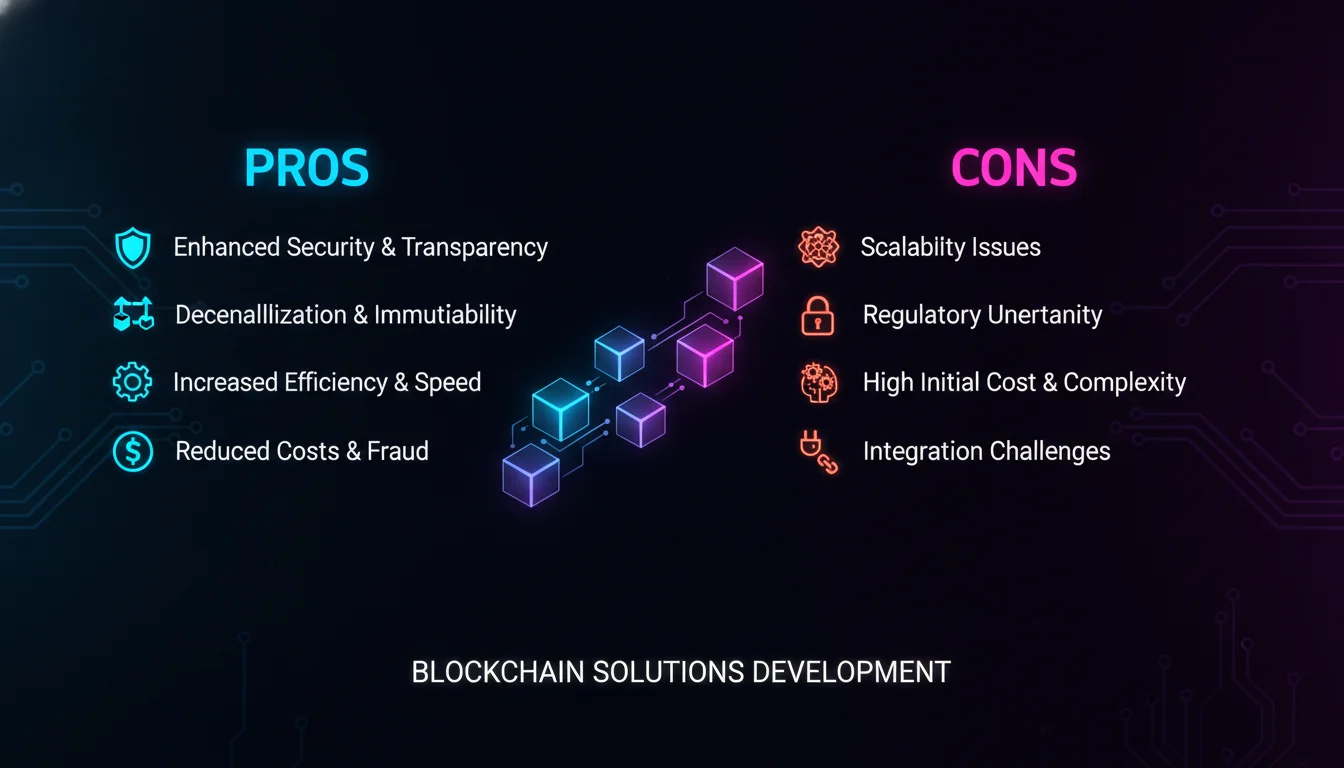
- Immutability and auditability: Every transaction is cryptographically linked and append-only, giving compliance teams a tamper-evident record without a central administrator.
- Reduced intermediary costs: Smart contracts automate settlement, escrow, and compliance checks that previously required third-party services, cutting operational overhead.
- Composability: On public chains, protocols can interact with each other directly. A lending protocol can plug into a DEX, a stablecoin, and an oracle without custom integration work.
- Transparent governance: On-chain voting and proposal systems give stakeholders verifiable participation records, which is difficult to replicate in traditional corporate structures.
- Global accessibility: Permissionless networks allow anyone with a wallet to participate, opening markets that geographic or banking restrictions would otherwise close.
Cons
- Irreversibility of bugs: A vulnerability in a deployed smart contract can drain funds permanently. Audit-first development is essential, not optional, which adds upfront cost.
- Gas costs and throughput limits: Public chains impose transaction fees and block size constraints that do not exist in traditional databases. High-frequency use cases may need Layer 2 solutions.
- Regulatory uncertainty: Tokenized assets and DeFi protocols face evolving rules across jurisdictions. Architecture decisions made today may require costly rework as regulations clarify.
- Talent scarcity: Senior Solidity and Rust engineers are rare. Hiring or outsourcing to a team with verifiable mainnet experience is harder than staffing a standard web project.
- Longer development cycles: Audit gates, testnet phases, and formal verification add time that standard software projects skip. Expect longer timelines than equivalent web2 builds.
The Blockchain Solutions Development Process
Step 1: Feasibility Study
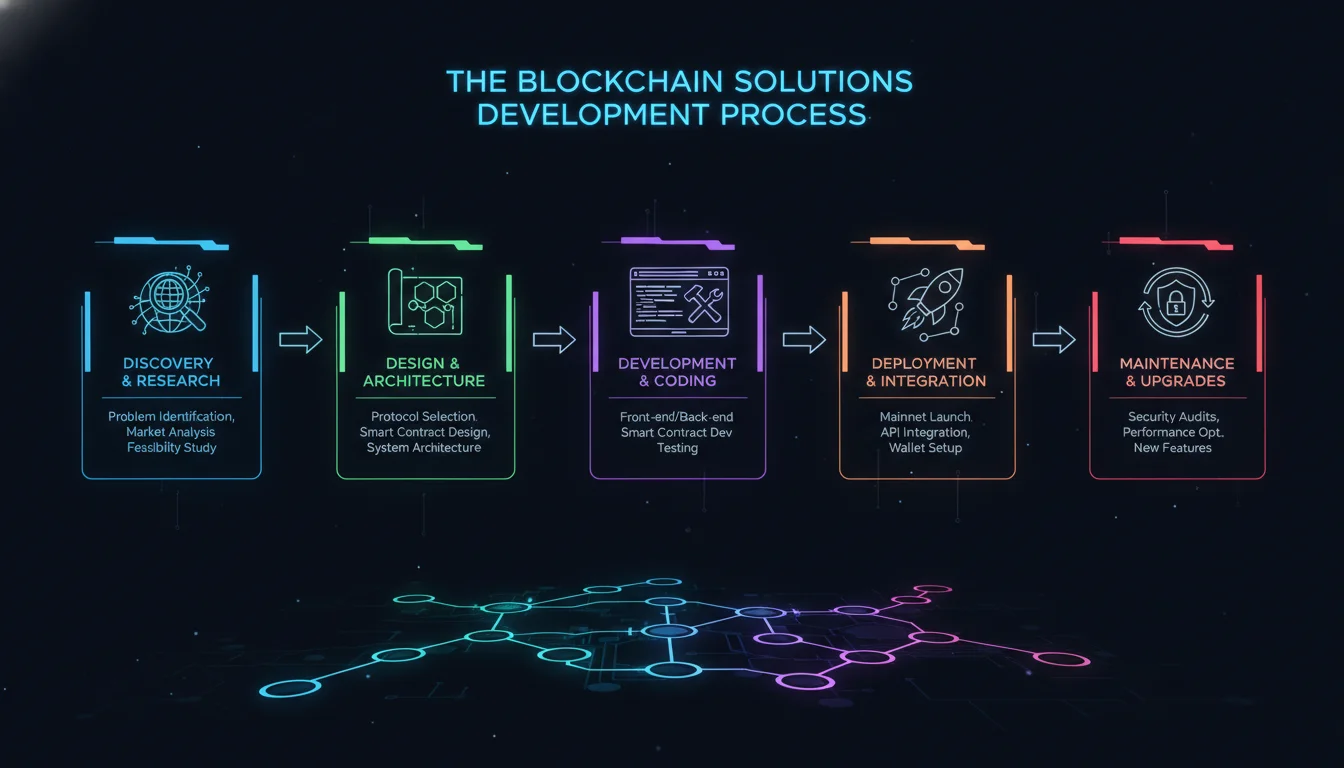
Every serious this type of development engagement starts with a feasibility study, not a token launch. ScienceSoft’s process begins by analyzing whether a blockchain solution is viable and worth the client’s investment. The consulting team asks whether the business has cross-company workflows that require automated accountability, whether it deals with a continuous supply of assets, whether it wants to remove a third-party or centralized authority from its processes, or whether it handles sensitive documentation shared between multiple organizations.
If any of those answers is a confident yes, the team proceeds to research the business specifics and compile tangible benefits. A case-by-case approach is essential because some viable use cases do not fit neatly into the questions above. The output of this phase is a high-level cost breakdown and ROI calculation before any code is written.
Step 2: Conceptualization and Architecture Design
After confirming the business case, the blockchain architect builds a solid technical brief that describes high-level requirements for the blockchain solution and the client web or mobile apps that will interact with it. The team decides how blockchain will be incorporated into current business processes and IT systems. This phase includes choosing the architecture type, the consensus mechanism, and the blockchain platform.
PixelPlex approaches this phase with a two-week Discovery Sprint for blockchain consulting. According to PixelPlex, 98% of scopes move straight to build after the sprint. The sprint includes business case and workflow analysis, technical feasibility study, project estimation, and roadmap creation. A tight conceptualization phase reduces the risk of building the wrong thing on an expensive distributed ledger.
Step 3: Development, QA, and Security Auditing
Development is where smart contracts, dApp frontends, and integration layers are built. BDS, the blockchain development division of Idealogic Group, uses Solidity and Rust for EVM chains and Solana. Their stack includes React and Next.js frontends wired to on-chain backends with ethers.js and wagmi, IPFS storage, and The Graph indexing. Automated testing, formal verification, and gas optimization are part of the build pipeline from the first commit.
QA in this kind of development includes unit testing, integration testing, testnet deployment, fuzzing, and third-party audits. BDS runs Slither, Mythril, and Echidna in CI from day one and requires an independent third-party audit before any mainnet deploy. PixelPlex reports 100% JIRA adoption for scope and timeline tracking, which keeps quality gates visible across distributed teams.
Here is a minimal example of a Solidity smart contract with access control and a pause mechanism, two features that every production contract should include:
// SPDX-License-Identifier: MIT
pragma solidity ^0.8.20;

import "@openzeppelin/contracts/access/Ownable.sol";
import "@openzeppelin/contracts/security/Pausable.sol";

contract ProductionVault is Ownable, Pausable {
 mapping(address => uint256) public balances;

 event Deposited(address indexed user, uint256 amount);
 event Withdrawn(address indexed user, uint256 amount);

 constructor() Ownable(msg.sender) {}

 function deposit() external payable whenNotPaused {
 balances[msg.sender] += msg.value;
 emit Deposited(msg.sender, msg.value);
 }

 function withdraw(uint256 amount) external whenNotPaused {
 require(balances[msg.sender] >= amount, "Insufficient balance");
 balances[msg.sender] -= amount;
 (bool success, ) = msg.sender.call{value: amount}("");
 require(success, "Transfer failed");
 emit Withdrawn(msg.sender, amount);
 }

 function pause() external onlyOwner { _pause(); }
 function unpause() external onlyOwner { _unpause(); }
}
Notice the checks-effects-interactions pattern in withdraw: balance is decremented before the external call. That single ordering decision prevents reentrancy, the vulnerability that drained The DAO in 2016. This is the kind of detail that separates production-grade blockchain solutions development from tutorial code.
Step 4: Integration, Deployment, and Post-Launch Support
Once the solution passes audits, it is integrated with relevant systems and deployed to production. For public networks, deployment means mainnet smart contract addresses and proper event indexing. For private networks, deployment includes node configuration, role-based access, and SLAs. PixelPlex launches private blockchains in eight weeks with a 99.99% uptime SLA and 60+ staking pools deployed.
Post-launch support is where many generic agencies fall short. BDS emphasizes CI/CD pipelines, monitoring dashboards, alerting, runbooks, gas-cost tracking, and SLA-backed support as production-grade requirements. They also staff the same architect, developers, and auditor from kickoff through post-launch incident response 18 months later. That continuity matters: the engineer who wrote the contract is the fastest person to diagnose an anomaly in it.
Choosing a Blockchain Platform and Tech Stack
Public vs Private vs Permissioned Networks
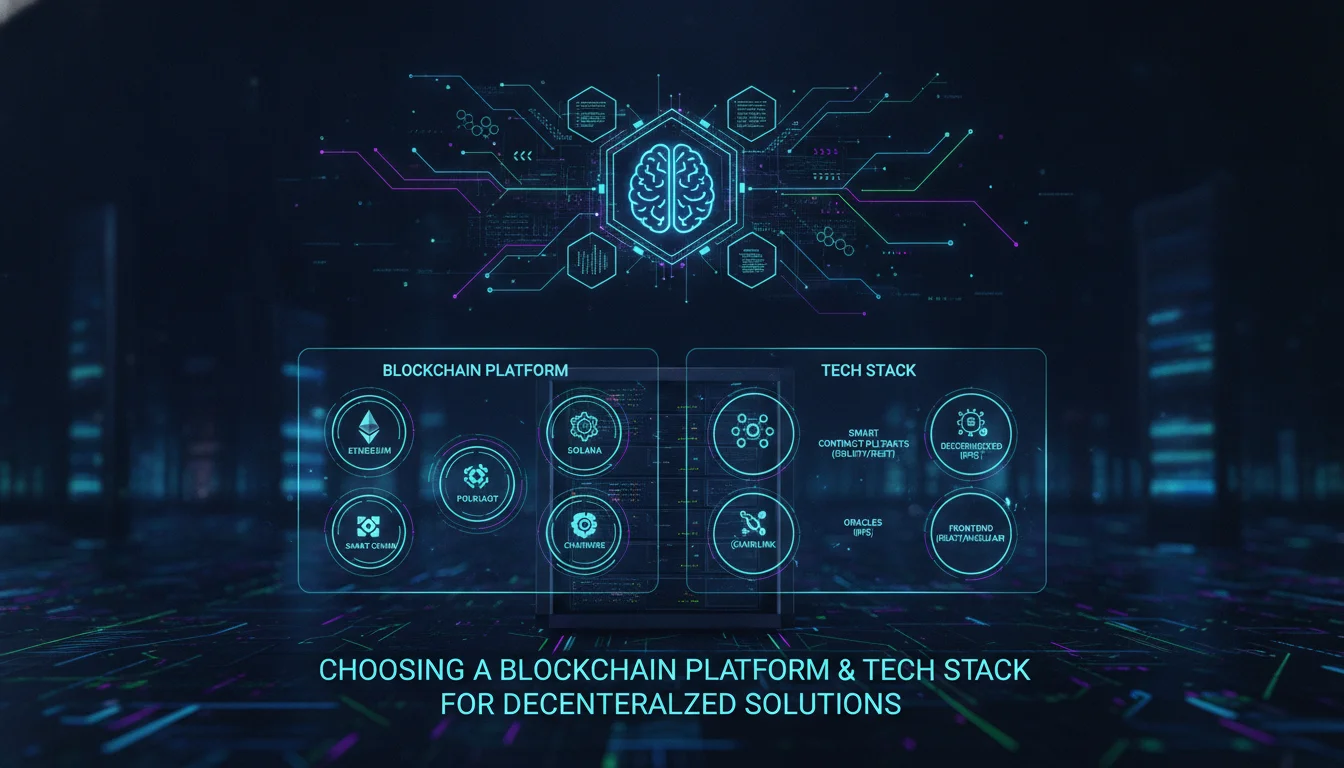
Platform selection is one of the most consequential decisions in blockchain solutions development, and it cannot be reversed cheaply after deployment. A public blockchain is a permissionless network where anyone can participate in transaction validation without a central authority. Ethereum, Solana, and Polygon are examples commonly used for DeFi, NFTs, and tokenized ecosystems. A private blockchain is a distributed ledger with role-based access control, where only authorized nodes can validate transactions. A permissioned blockchain is a hybrid model that restricts write access but may allow public read access, making it suitable for consortia and regulated industries.
Unicsoft reports experience working with 40+ blockchain protocols, including Hedera Hashgraph, Solana, Ethereum, Cardano, and Hyperledger. Newwave Solutions also builds on Ethereum, Polygon, Binance Smart Chain, and Cardano. The choice of platform depends on transaction throughput, finality, smart contract language support, ecosystem tooling, and regulatory requirements.
Programming Languages and Tools
Solidity is the dominant language for EVM-compatible chains, while Rust is used for Solana and high-performance protocols. BDS reports Solidity and Rust expertise across six or more networks, with gas optimization of 40-70% on smart contracts. Frontend teams typically use React and Next.js with libraries like ethers.js and wagmi. The Graph provides indexed event data, while IPFS handles decentralized storage for metadata and off-chain content.
Security tooling includes static analyzers like Slither, symbolic execution tools like Mythril, and property-based fuzzing with Echidna. Formal verification is applied to critical logic such as treasury management and governance contracts. These tools reduce the risk of reentrancy, arithmetic overflow, access control failures, and other smart contract vulnerabilities that have caused billions in industry losses.
Consensus Mechanisms and Scaling Considerations
Consensus mechanisms determine how network participants agree on the state of the ledger. Public chains may use proof-of-stake, proof-of-work, or novel consensus mechanisms. Private chains often use practical Byzantine fault tolerance or RAFT variants for faster finality and higher throughput. Blockchain solutions development must match the consensus model to the use case: a consumer DeFi app may tolerate Ethereum’s settlement time, while a high-frequency trading venue needs a faster private or Layer 2 network.
Scaling considerations now include Layer 2 rollups, account abstraction for better wallet UX, and cross-chain interoperability protocols. BDS specifically calls out Layer 2 scaling, account abstraction, and cross-chain interoperability as practical guidance for innovation leadership. These technologies move blockchain solutions from demo-ready to production-ready by reducing gas costs, abstracting private keys, and enabling asset movement between ecosystems.
Key Blockchain Solutions Development Services
Smart Contract Development
Smart contract development is the core of most blockchain solutions development engagements. It involves writing, testing, optimizing, and deploying self-executing code that governs token transfers, lending pools, governance votes, NFT minting, and custom business logic. BDS delivers smart contracts in Solidity and Rust on six or more networks, handling architecture, gas optimization, automated testing, and independent security audits. PixelPlex provides gas-efficient code and third-party audits across leading blockchains, with automated testing and formal verification for critical logic.
A production-grade smart contract is not just a compiled Solidity file. It includes access control roles, pause mechanisms, upgradeability patterns, event emissions, and thorough documentation. Gas optimization alone can reduce transaction costs by 40-70%, which directly improves user adoption and protocol margins.
Decentralized Application (dApp) Development
A dApp is a client-side application that interacts with smart contracts through a blockchain provider. Full-stack dApp development includes wallet authentication, transaction signing, state management, event indexing, and off-chain storage. BDS uses React and Next.js with ethers.js and wagmi, IPFS storage, and The Graph indexing to deliver responsive interfaces. Unicsoft has launched 50+ dApps across DeFi platforms, decentralized exchanges (DEXs), gaming, wallets, supply chain management, and staking or borrowing and lending.
dApp development differs from traditional frontend work because the backend state lives on-chain. Developers must handle transaction confirmation times, gas estimation, block reorganizations, and wallet connectivity errors. Account abstraction is increasingly used to simplify user onboarding by allowing smart contract wallets with social recovery and bundled transactions.
Enterprise Blockchain and Tokenization
Enterprise blockchain development focuses on private networks, data integrity, and back-office automation. Typical use cases include supply chain traceability, trade finance, healthcare records, and KYC/AML compliance. ScienceSoft offers blockchain for supply chain, insurance, lending, personal health records, and provenance and traceability. Unicsoft’s enterprise blockchain services include asset tokenization, wallet development, blockchain security auditing and testing, and AML and KYC compliance.
Tokenization is the process of representing real-world assets such as real estate, commodities, securities, or loyalty points as programmable tokens on a blockchain. Unicsoft’s MakerDAO analytics tool structures data from the MakerDAO dApp, with $5 billion in collateral and $2 billion DAI in circulation at the time of the case study. That demonstrates how on-chain data and tokenized assets can be made legible for enterprise reporting without building a separate data warehouse.
How Much Does Blockchain Solutions Development Cost?
Cost Factors
Blockchain solutions development costs depend on solution type, chosen tech stack, project scope, integration complexity, and sourcing model. ScienceSoft notes that costs vary depending on solution type, tech stack, and other factors, and offers a free calculator to estimate development budgets. Custom smart contract logic, cross-chain bridges, formal verification, and third-party audits all add cost. Private network infrastructure and ongoing node operations also contribute to total cost of ownership.
Hourly rates vary widely by geography and provider maturity. S-PRO’s directory lists blockchain development companies with hourly rates from under $25 for Newwave Solutions in Hanoi, Vietnam, to $50-$99 for Andersen Inc. and Sigma Software Group. Mid-range providers like S-PRO and Computools charge $25-$49 per hour. These rates are not the full picture: a senior team with audit-first processes may cost more per hour but reduce total spend by avoiding rework and exploits.
Pricing Models and Benchmarks
Providers use several pricing models for blockchain solutions development engagements. Fixed-scope sprints are common for MVP delivery. PixelPlex promises MVP delivery in nine weeks and private blockchain go-live in eight weeks. Their blockchain consulting uses a two-week sprint, and 98% of projects move straight to build. Unicsoft offers a DeFi platform accelerator as an exclusive solution to speed time-to-market.
Time-and-materials models suit projects with evolving requirements, while dedicated teams work for long-term product development. ScienceSoft lists four sourcing models: in-house, team augmentation, partial outsourcing, and full outsourcing. In-house gives the most control but the highest fixed cost. Team augmentation lets existing product teams add blockchain specialists without building a full department. Partial and full outsourcing shift delivery risk to the vendor while reducing overhead.
ROI and Efficiency Gains
Blockchain solutions development should be justified by measurable business outcomes, not technology enthusiasm. ScienceSoft’s feasibility study includes high-level cost breakdowns and ROI calculations before implementation begins. PixelPlex reports that full-cycle DAO development can reduce operational overhead by up to 40% through on-chain voting, proposal systems, secure treasury management smart contracts, and customizable governance frameworks.
BDS highlights operational savings that show up on the balance sheet, such as automated compliance and tokenized assets. They also report 95% client retention and $50 million in assets secured on-chain, which indicates that production-grade delivery reduces churn and rework. A properly scoped blockchain solution can eliminate manual reconciliation, reduce fraud, and accelerate settlement cycles.
Top Blockchain Solutions Development Providers Compared
Provider Profiles
The blockchain development market includes specialist firms, enterprise software consultancies, and Web3-native engineering teams. S-PRO’s directory of best 21 blockchain development companies lists providers like S-PRO, Computools, Andersen Inc., Newwave Solutions, EbizON Digital, and Sigma Software Group. S-PRO itself was founded in 2014, has 50-249 employees, and operates in the USA, Ukraine, Poland, and Switzerland. Andersen Inc. has been providing blockchain development services for over a decade with 1,000-9,999 employees and counts Samsung among its cases.
BDS is the blockchain development division of Idealogic Group, a technology company with 10+ years of experience in digital product engineering. Based in Estonia, its 50+ engineers have delivered over 50 projects on Ethereum, Solana, Polygon, and Hyperledger since 2020. PixelPlex has 13 years of core team blockchain experience, 47 blockchain projects launched, and 160+ Web3 experts. Unicsoft positions itself as a top-rated blockchain development company with certified partnerships and 50+ dApps launched.
Comparison Table
| Provider | Key Metrics | Core Services | Notable Differentiator |
|---|---|---|---|
| ScienceSoft | 4,200+ software projects; blockchain services since 2020 | Blockchain networks, transaction platforms, assets; feasibility to deployment | ROI-focused feasibility study and cost calculator |
| BDS (Idealogic Group) | 50+ projects; 200+ smart contracts; $50M+ assets secured; zero exploits since 2020 | Smart contracts, DeFi, enterprise DApps, Web3 infrastructure | Audit-first with Slither/Mythril/Echidna in CI |
| PixelPlex | 13 years experience; 47 projects; 160+ Web3 experts; MVP in 9 weeks | Smart contracts, Web3, public/private blockchain, DAO, NFT | 8-week private blockchain go-live with 99.99 percent uptime SLA |
| Unicsoft | 50+ dApps launched; 40+ blockchain protocols | DApps, asset tokenization, enterprise blockchain, security auditing | MakerDAO analytics tool with $5B collateral tracked |
| S-PRO | Founded 2014; 50-249 employees; $25-$49/hour | White-label and custom blockchain, NFT platforms, crypto wallets | 5-stage blockchain development methodology |
How to Evaluate a Blockchain Development Partner
Start by verifying production experience on the specific blockchain networks relevant to your project. Ask for deployed mainnet contracts, security audit reports, and client retention data. BDS reports 95 percent client satisfaction and 95 percent client retention, which signals that projects are delivered on time and maintained after launch. PixelPlex reports 100 percent JIRA adoption for scope and timeline tracking, giving clients visibility into delivery progress.
Next, assess security practices. A credible provider should use automated analysis tools, formal verification for critical logic, and independent third-party audits before mainnet deployment. BDS explicitly states that generic agencies treat audits as a final box to tick, while audit-first engineering bakes threat modeling into the design phase. Finally, confirm that the team has senior engineers who will stay on the project through post-launch incident response, not a rotating bench of juniors.
“Generic agencies treat audits as a final box to tick. We bake threat modelling into the design phase, run Slither/Mythril/Echidna in CI from day one, and require an independent third-party audit before any mainnet deploy. The result: 500+ contracts shipped, zero exploits since 2020.” – BDS, Idealogic Group
Security and Compliance in Blockchain Solutions Development
Audit-First Development
Security is the most expensive line item in blockchain solutions development, and also the cheapest insurance. BDS states that the industry has lost over $3 billion to on-chain hacks, while their own 500+ contracts shipped have experienced zero exploits since 2020. That contrast is not an accident: BDS bakes threat modeling into the design phase, runs Slither, Mythril, and Echidna in CI from day one, and requires an independent third-party audit before any mainnet deploy.
A smart contract is a self-executing program stored on a blockchain that automatically enforces the terms of an agreement when predefined conditions are met. Once deployed, it is immutable unless upgrade patterns are built in. The cost of a post-deploy vulnerability is therefore catastrophic. Audit-first development treats security as a continuous process: static analysis, fuzzing, formal verification, peer review, and external audit all happen before the contract address is ever shared with users.
Regulatory and Compliance Considerations
Regulatory compliance is now a first-class concern in blockchain solutions development. For financial applications, AML and KYC checks, securities law, data privacy, and sanctions screening directly affect architecture. Unicsoft lists AML and KYC compliance as a core blockchain development service. Enterprise private networks often need role-based access control and audit trails that satisfy GDPR, HIPAA, or SOX requirements.
Tokenized assets and DeFi protocols face evolving rules in the United States, European Union, and other jurisdictions. A blockchain development partner should be able to recommend whether a permissionless or permissioned network fits the regulatory context, and how to implement compliance checks without destroying decentralization. Newwave Solutions holds ISO certification, a useful signal for enterprise buyers that require process maturity and documentation.
“Blockchain development solutions provide secure, decentralized, and transparent systems that reduce reliance on intermediaries and improve trust between participants.” – QED Vault, Blockchain Development Solutions overview
White-Label Blockchain Platforms and Accelerators
White-label blockchain platforms are a practical option for teams that need to ship quickly without building every component from scratch. Rather than writing a custom consensus layer or governance module, teams start from a pre-audited base and configure it for their use case. S-PRO explicitly offers white-label and custom blockchain solutions, covering NFT platforms, crypto wallets, stablecoins, and crypto banks. Unicsoft offers a DeFi Platform Accelerator as an exclusive solution designed to compress time-to-market for DeFi products.
The trade-off is flexibility. A white-label platform constrains your architecture to what the base layer supports. For standard use cases like token launches, NFT marketplaces, or staking pools, that constraint is acceptable. For novel protocol designs with custom consensus or non-standard tokenomics, a fully custom blockchain solutions development approach is the better path. The right choice depends on how differentiated your product needs to be at the protocol level.
Blockchain Solutions Development for Specific Industries
Blockchain solutions development looks different depending on the industry. Supply chain teams prioritize provenance tracking, role-based write access, and integration with ERP systems. Financial services teams focus on settlement finality, AML/KYC compliance, and regulatory reporting. Healthcare implementations require HIPAA-compliant data handling, patient consent management, and interoperability with existing health record systems.
ScienceSoft’s service catalog reflects this: they offer dedicated blockchain tracks for supply chain, insurance, lending, personal health records, and provenance and traceability. Each track carries different architecture defaults. A supply chain network may run on Hyperledger Fabric for permissioned access and high throughput. A DeFi lending protocol runs on Ethereum or a compatible Layer 2 for composability with existing liquidity. Matching the platform to the industry context is a core skill in blockchain solutions development, not a detail to resolve after the contract is signed.
Turning Blockchain Solutions Development into Business Outcomes
Blockchain solutions development is not a single deliverable. It is an engineering discipline that starts with a feasibility study and ends with a monitored, audited, and maintained production system. The providers analyzed here, including ScienceSoft, BDS, PixelPlex, Unicsoft, and S-PRO, demonstrate that the market has matured beyond token launch hype. Audit-first processes, formal verification, gas optimization, and post-launch SLAs are now table stakes.
To choose the right blockchain solutions development approach, start by asking whether a decentralized ledger genuinely solves a trust, transparency, or automation problem. Run a feasibility study. Select a platform and consensus mechanism that matches throughput, privacy, and regulatory needs. Then partner with a team that ships production code, not pitch decks. The difference between a demo and a $50 million asset-securing protocol is the discipline of the development lifecycle.
If you are building a protocol, tokenizing assets, or designing DAO infrastructure, apply to the Genesis Cohort at digitalblockchains.com. We work with serious builders who want production-grade blockchain solutions development, not hype cycles.
Frequently Asked Questions
What is blockchain solutions development?
Blockchain solutions development is the end-to-end process of designing, building, deploying, and maintaining software on a distributed ledger. It includes feasibility analysis, smart contract engineering, security auditing, and system integration.
How much does blockchain solutions development cost?
Costs vary by solution type, tech stack, integration complexity, and sourcing model. Hourly rates range from under $25 for some offshore teams to $50-$99 for established enterprise providers, but total cost depends on scope and security requirements.
How long does it take to develop a blockchain solution?
PixelPlex reports MVP delivery in nine weeks and private blockchain go-live in eight weeks. Larger projects with custom consensus mechanisms, complex tokenomics, and regulatory compliance can take six to twelve months or more.
What is the difference between a public and private blockchain?
A public blockchain is permissionless, allowing anyone to validate transactions without a central authority. A private blockchain restricts validation to authorized nodes with role-based access control and is often used for enterprise consortia and regulated industries.
Why is security auditing important in blockchain development?
Smart contracts are immutable once deployed, so vulnerabilities cannot be patched easily. Audit-first development using tools like Slither, Mythril, and Echidna, plus independent third-party audits, reduces the risk of irreversible fund loss.
Which programming languages are used for blockchain development?
Solidity is the primary language for EVM chains like Ethereum and Polygon. Rust is used for Solana and high-performance protocols. Frontend development often uses React and Next.js with ethers.js or wagmi for wallet connectivity and transaction management.