Blockchain testing is the structured process of evaluating decentralized applications, smart contracts, and blockchain networks to ensure they operate securely, functionally, and efficiently under various conditions. It uniquely addresses the challenges of immutability and distributed consensus.
Key Takeaways
- testing verifies the security, functionality, and performance of decentralized systems. It is essential for protecting assets and ensuring reliable transaction processing.
- The immutability of blockchain data demands thorough pre-deployment testing. Vulnerabilities in smart contracts or consensus logic can lead to irreversible losses.
- Comprehensive this type of testing covers multiple types: functional, security, performance, API, interoperability, and consensus mechanism validation.
- Leading tools such as Hardhat, Truffle, and Hyperledger Caliper integrate with CI/CD pipelines to automate this kind of testing workflows.
- According to TestGrid, the crypto industry saw over $3.4 billion in theft between January 2025 and early December 2025. Rigorous testing is the primary defense against such exploits.
Blockchain has moved well past its cryptocurrency origins. Today it runs mission-critical systems in finance, supply chain, healthcare, and gaming. The global blockchain market is projected to reach $1,431 billion by 2030 from $31 billion in 2024, according to TestGrid. At that scale, quality assurance is no longer optional.
What Is Blockchain Testing?

Defining Blockchain Testing
blockchain is the systematic verification and validation of blockchain-based systems, including their smart contracts, consensus algorithms, node communications, and user interfaces. Unlike traditional software testing, it must account for the decentralized and immutable nature of the ledger. Every transaction recorded on-chain is permanent. A flaw in a deployed smart contract can be exploited with no possibility of rollback, which makes pre-deployment validation not just a best practice but a hard requirement for asset protection.
Key Concepts in Blockchain Testing
To test blockchain applications effectively, you need to understand several core concepts. Smart contracts are self-executing programs that run on the blockchain. Testing them involves both static analysis and dynamic execution. Consensus mechanisms like Proof of Work (PoW) or Proof of Stake (PoS) define how nodes agree on state. Testing must simulate adversarial conditions against these mechanisms. Gas fees represent the computational cost of operations on networks like Ethereum. Performance testing includes gas optimization. DApps combine on-chain smart contracts with off-chain frontends, requiring end-to-end testing across both layers.
The Scope of Testing in Decentralized Systems
testing goes beyond verifying individual functions. It covers the entire ecosystem: nodes, wallets, API gateways, and oracles. Interoperability between different blockchains and legacy systems must be validated. Regulatory compliance, especially in financial applications, demands testing for data privacy and auditability. According to TestMu, the worldwide blockchain technology market was worth USD 10.02 billion in 2022, with experts predicting an 87.7% annual growth rate through 2030. That expansion trajectory makes scalable testing practices a strategic necessity, not an afterthought.
The Importance of Rigorous Testing

Security Breaches and Financial Losses
The immutability of blockchains is a double-edged sword. While it prevents tampering, it also means exploited vulnerabilities drain funds permanently. According to TestGrid, the crypto industry saw over $3.4 billion in theft between January 2025 and early December 2025. Smart contract flaws, such as reentrancy attacks or integer overflows, are frequently the root cause. These incidents make the case clearly: this type of testing must include rigorous security auditing and penetration testing before a single line of code touches mainnet.
“Smart contracts are computer programs that execute automatically on a blockchain once certain conditions are met. If you deploy to production with bugs, you are out of luck, because most cannot be patched once deployed. Simple mistakes can liquidate wallets in seconds.” – Prescient Security
Regulatory and Compliance Needs
As governments introduce regulations for digital assets, including the EU’s Markets in Crypto-Assets (MiCA) framework, blockchain systems must demonstrate compliance with anti-money laundering (AML) and know-your-customer (KYC) requirements. Testing must verify that on-chain records align with off-chain legal obligations without compromising decentralization. This adds a distinct layer of complexity to the this kind of testing process, requiring auditors to validate both technical soundness and legal conformity simultaneously.
Industry-Specific Stakes
The risk profile varies sharply by sector. In banking and financial services, a failed transaction validation can trigger cascading settlement failures. In healthcare, data integrity on-chain directly affects patient records and audit trails. Supply chain applications depend on oracle accuracy and cross-chain interoperability. Each vertical demands a tailored testing strategy built on the same foundational principles but tuned to its specific threat model and compliance requirements.
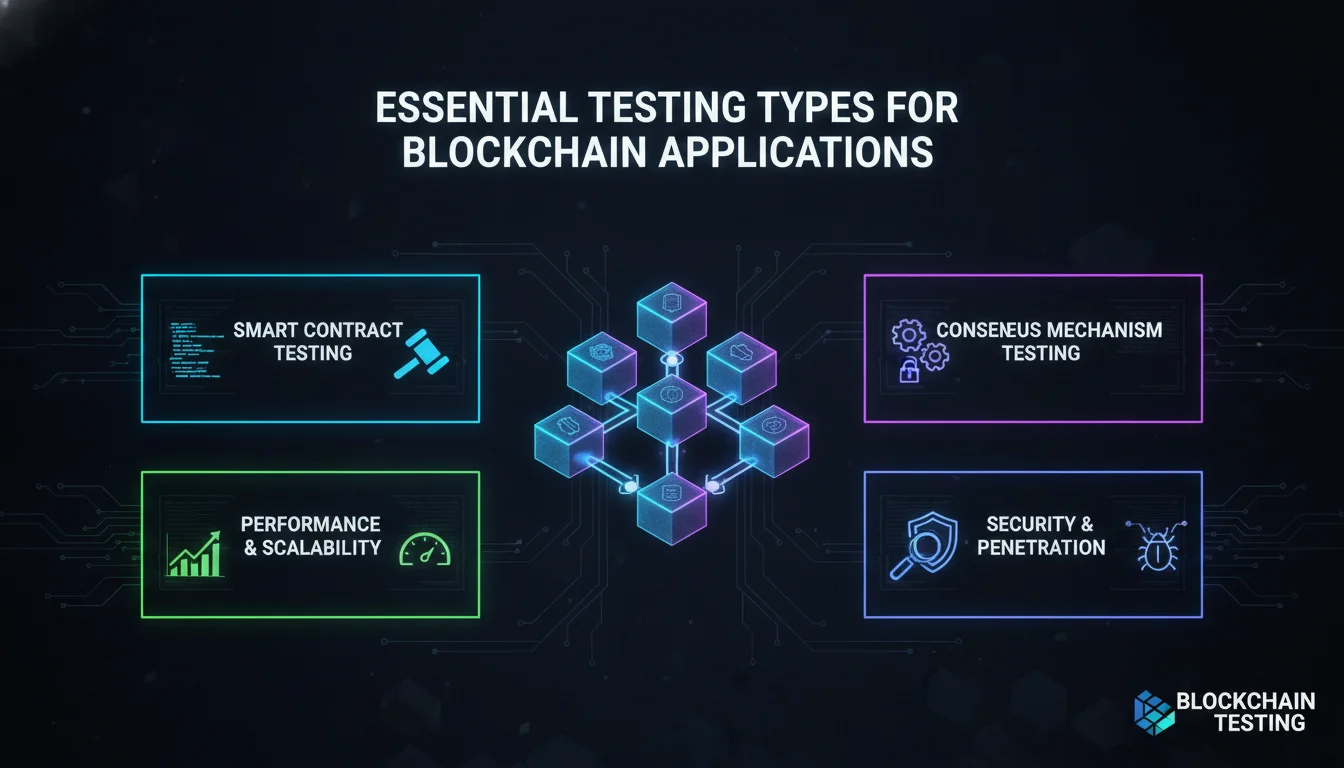
Essential Testing Types for Blockchain Applications
Functional and Security Testing
Functional testing confirms that smart contracts and dApps execute their intended logic correctly. Test cases must cover all possible states, including edge cases like insufficient gas or failed transactions. Security testing targets vulnerabilities such as reentrancy, front-running, and access control flaws. Tools like Manticore use symbolic execution to explore code paths for exploits. Penetration testing, as offered by firms like NetSPI, evaluates the entire deployment from on-chain contracts to off-chain APIs. NetSPI’s blockchain pentesting addresses people, process, and technology gaps, combining human-led expertise with AI-accelerated scanning across more than 15,000 engagements (source).
Web2 Bugs in Web3 Systems
One underappreciated attack surface is the off-chain infrastructure surrounding a blockchain deployment. As NetSPI’s research highlights, attackers frequently exploit Web2 vulnerabilities in Web3 systems: SQL injection in indexing services, insecure API keys in backend relayers, and misconfigured cloud storage holding wallet credentials. A smart contract can be mathematically sound while the surrounding infrastructure bleeds data. blockchain must extend to these off-chain components with the same rigor applied to Solidity code.
Performance and Scalability Testing
Performance testing measures how well a blockchain handles load. Metrics like Transactions Per Second (TPS), latency, and block time are critical. Bitcoin averages roughly 10 minutes per block, while Ethereum settles around 12 seconds. Those differences dramatically affect user experience and application design. Performance testing tools such as Hyperledger Caliper simulate high-volume scenarios to identify bottlenecks. Scalability testing also examines how the network behaves as nodes are added or removed, ensuring consistent throughput under real-world conditions.
Specialized Testing Areas
Beyond functional and performance, several specialized tests are vital for comprehensive testing:
- API testing validates the interfaces that dApps use to interact with nodes and external services.
- Interoperability testing checks cross-chain communication, vital for bridging assets between networks.
- Consensus mechanism testing verifies that the network reaches agreement under stress and adversarial conditions.
- UX testing ensures that wallets and dApp interfaces are intuitive and resilient.
- Regression testing confirms that upgrades or forks do not break existing functionality.
- Gas cost testing optimizes smart contract code to reduce transaction fees.
Pros and Cons of Blockchain Testing Approaches

Pros
- Catches irreversible vulnerabilities before deployment, preventing permanent fund loss.
- Automated test suites in CI/CD pipelines provide continuous coverage with minimal manual overhead.
- Formal verification and symbolic execution can mathematically prove contract correctness for high-value logic.
- Performance benchmarking with tools like Hyperledger Caliper gives concrete data for architectural decisions.
- Security audits by specialized firms cover the full stack, from Solidity to off-chain infrastructure.
Cons
- Reproducing bugs that occur only under specific distributed network conditions is resource-intensive and difficult.
- Formal verification requires specialized skills and is not yet standard practice across most teams.
- Test environments, even mainnet forks, cannot perfectly replicate every real-world network condition.
- Rapid protocol upgrades and EIP changes require continuous maintenance of test suites.
- Gas cost optimization and security auditing add significant time and cost to release cycles.
How to Test Blockchain Applications: A Step-by-Step Process
Step 1: Understand the Blockchain Architecture
Begin by mapping the system. Identify the consensus algorithm (PoW, PoS, or other), the smart contract logic, the network topology (public, private, or consortium), and off-chain components like oracles. This understanding informs test strategy and environment setup. For Ethereum-based projects, familiarity with relevant EIPs, such as EIP-1559 for gas mechanisms, is essential for designing accurate test cases.
Step 2: Design Comprehensive Test Cases
Develop test scenarios that cover functional requirements, edge cases, and negative paths. Include tests for smart contract interactions, token transfers, gas consumption, and event emission. Security test cases should target known attack vectors like reentrancy, overflow and underflow, and unauthorized access. Because this type of testing must account for the chain’s permanence, even improbable edge cases warrant scrutiny.
Step 3: Set Up a Representative Test Environment
Use local blockchain emulators such as Ganache or Hardhat Network to create a controlled, fast environment. For integration testing, deploy to test networks like Sepolia (Ethereum) that mirror mainnet conditions without real assets. Mainnet forking, supported by Hardhat, allows testing against real-world state. This is particularly valuable for verifying complex DeFi protocols where live liquidity pools and oracle prices affect contract behavior.
Step 4: Execute Tests and Monitor Metrics
Run automated and manual tests. For smart contracts, use unit test frameworks like Truffle Test or Hardhat’s built-in environment. Perform security scans with static analysis tools like Slither or MythX. During performance testing, monitor TPS, latency, and resource usage. Log all failures for analysis. Automated this kind of testing integrates into CI/CD pipelines through plugins and scripts, enabling continuous feedback on every commit.
Step 5: Analyze Defects and Iterate
Because blockchain state is immutable, any defect found after deployment can be catastrophic. Analyze root causes rigorously. If the bug is in a smart contract, determine whether a proxy upgrade path can address it. Otherwise, the entire contract may need replacement, which is costly and operationally complex. Re-test after every change to confirm no regression. This iterative loop is the foundation of effective blockchain testing.
Automation in Blockchain Testing
CI/CD pipelines can integrate blockchain testing tools to run automated tests on every commit. Frameworks like Hardhat and Truffle support scripting, and platforms like TestGrid offer no-code automation for end-to-end testing. Some aspects, such as consensus mechanism robustness and UX evaluation, still require manual expertise. The goal is to maximize automated coverage while reserving human judgment for creative security testing and nuanced user experience scenarios.
Key Metrics for Performance Testing
Transaction Throughput (TPS)
TPS measures the number of transactions a blockchain can process per second. High TPS is critical for payment networks and exchanges. Performance testing under realistic load helps developers tune parameters like block size and gas limits. Different consensus algorithms yield vastly different TPS capabilities, so benchmarking against the target network’s expected throughput is an essential part of any blockchain testing strategy.
Latency and Block Time
Latency is the time between submitting a transaction and its confirmation. Block time is the interval at which new blocks are added. Bitcoin averages roughly 10 minutes per block. Ethereum settles around 12 seconds. Testing latency involves measuring how quickly nodes reach consensus and how network congestion affects confirmation times under load.
Resource Consumption and Gas Costs
Every transaction consumes computational resources, reflected in gas fees. Gas cost testing helps optimize smart contract code for efficiency, lowering fees and increasing throughput. Tools like Hardhat Gas Reporter profile gas usage at the function level. Performance testing must also account for storage and bandwidth demands on nodes, especially for networks with high transaction volumes. Reducing unnecessary storage writes and using efficient data structures can cut gas costs substantially.
Popular Tools and Frameworks for Blockchain Testing
Smart Contract Development and Testing Suites
Several frameworks streamline smart contract development and testing. Hardhat offers a flexible environment with a built-in local Ethereum network, a console for debugging, and an extensive plugin system. Truffle provides a complete suite with testing, deployment, and asset pipelines. Both integrate with libraries like Web3.js and ethers.js for frontend interaction. These tools form the foundation of modern blockchain testing workflows.
Security Analysis and Penetration Testing Tools
Static analysis tools like Slither and Mythril scan Solidity code for common vulnerabilities. Manticore uses symbolic execution for deeper analysis across all reachable code paths. For comprehensive penetration testing, specialized firms like NetSPI offer human-led, AI-accelerated services that cover the full blockchain stack, from smart contracts to node infrastructure. Incorporating these tools into the blockchain testing pipeline substantially reduces exploit risk.
“NetSPI identifies and addresses people, process, and technology gaps across deployments to help organizations support and protect blockchain solutions, bringing proven methodology from over 15,000 engagements and decades of manual testing experience.” – NetSPI
Performance Benchmarking Tools
Hyperledger Caliper is a dedicated blockchain performance benchmarking tool that supports multiple platforms, including Hyperledger Fabric, Ethereum, and others. It measures TPS, latency, and resource utilization under configurable loads. Performance metrics gathered through Caliper inform architectural decisions and capacity planning before production deployment.
Comparison Table: Blockchain Testing Tools
| Tool | Type | Key Features | Best For |
|---|---|---|---|
| Hardhat | Development & Testing | Local Ethereum network, Solidity debugging, plugin ecosystem | Smart contract unit testing, deployment |
| Truffle / Ganache | Development & Testing | Built-in compilation, migration, testing; Ganache for personal blockchain | End-to-end DApp development |
| Manticore | Security Analysis | Symbolic execution, binary code analysis, vulnerability detection | Auditing smart contracts for exploits |
| Slither | Static Analysis | Fast Solidity analysis, vulnerability reports, custom detectors | Continuous security scanning in CI |
| Hyperledger Caliper | Performance Benchmarking | Configurable workloads, multi-platform support, detailed metrics | Performance and scalability testing |
| TestGrid | End-to-End Testing | No-code automation, AI-powered test creation, cross-chain validations | User acceptance and regression testing |
Challenges Unique to Distributed Ledgers
Immutability and Irreversibility
Once a transaction or smart contract is deployed on a public blockchain, it cannot be altered. This permanence demands zero tolerance for bugs. Testing must be exhaustive because a single flaw can lead to fund loss or data corruption. Some newer platforms use proxy patterns or governance votes to upgrade contracts, but these mechanisms add complexity and introduce their own security risks. In blockchain testing, immutability is the foremost constraint. There is no undo button.
Decentralization and Node Synchronization
Testing in a truly decentralized environment is hard. Nodes may run different software versions, have varying latency, and process transactions at different speeds. Reproducing bugs that occur only under specific network conditions requires simulating multiple independent nodes, which is resource-intensive. This inherent variability makes consistent blockchain testing difficult but essential for production confidence.
Smart Contract Vulnerabilities
Blockchain testing must address a specific set of attack vectors. Reentrancy occurs when a contract makes an external call that re-enters the original function before state updates complete. Integer overflows and underflows can corrupt arithmetic logic. Front-running exploits transaction ordering in the mempool. Oracle manipulation corrupts price feeds that contracts depend on. Formal verification and symbolic execution are increasingly used to prove contract correctness mathematically, but they require specialized skills and are not yet standard practice across most teams.
Evolving Standards and Upgrades
Blockchain protocols undergo frequent upgrades. Ethereum’s transition from PoW to PoS is the most prominent example, but EIPs continue to change gas mechanics, opcode behavior, and security assumptions. Testing must account for backward compatibility and ensure systems function correctly after hard forks. Regression testing becomes a continuous operational need, and test suites must be maintained to reflect the latest protocol versions. Keeping blockchain testing aligned with protocol evolution is a persistent challenge for any production team.
Best Practices for Blockchain Testing
Shift-Left Testing and Early Auditing
Integrate testing from the earliest design phase. Simulate smart contracts using formal models before writing code. Perform security audits early and often, preferably by third-party experts. As Prescient Security notes, treating testing as optional until deployment is how millions get lost in seconds. Shifting left in blockchain testing minimizes the cost and risk of late-discovered flaws, when fixing them is still cheap and reversible.
Comprehensive Test Coverage
Aim for full branch coverage in smart contracts, including all modifier paths and require statements. Extend testing to off-chain components, API gateways, and user interfaces. Use gray-box testing to understand both internal state transitions and external API behaviors. No single type of blockchain testing is sufficient. A layered strategy combining functional, security, and performance tests yields the most robust results.
Continuous Monitoring and Upgradability
For systems that allow upgrades via proxy contracts, implement thorough migration tests. Monitor live networks for anomalies using on-chain analytics tools. Establish incident response plans for potential exploits, because even the best testing cannot eliminate all risks. Continuous blockchain testing through production monitoring complements pre-deployment efforts and closes the gap between theory and real-world behavior.
Automate and Audit Continuously
Automate repetitive tests such as regression suites and performance benchmarks. Platforms like TestGrid use AI to generate test cases and adapt to application changes. Such tools can reduce release cycles while improving coverage. Automated blockchain testing accelerates feedback loops and frees engineers to focus on complex scenarios that require human judgment, like adversarial consensus testing or novel attack vector research.
The Future of Blockchain Testing
As blockchain adoption accelerates through 2026 and beyond, testing will become more deeply integrated into DevSecOps pipelines. Zero-knowledge proofs and layer-2 scaling solutions introduce new testing challenges that current tooling is only beginning to address. Formal verification may become standard for high-value contracts as tooling matures. AI-assisted test generation, already appearing in platforms like TestGrid, promises to automate complex scenario creation at scale. The goal of blockchain testing remains constant: delivering secure, resilient decentralized systems in a threat environment that never stops evolving.
Frequently Asked Questions
What is blockchain testing?
Blockchain testing is the process of verifying and validating blockchain-based applications, smart contracts, and network configurations to ensure they function securely, accurately, and efficiently. It covers everything from unit testing smart contracts to full-system integration and performance assessments.
Why is blockchain testing important?
Because blockchain transactions are irreversible, any vulnerability can lead to permanent loss of assets or data. Thorough testing prevents exploits, ensures regulatory compliance, and builds user trust in decentralized applications.
What are the main types of blockchain testing?
Core types include functional testing, security testing, performance testing, API testing, interoperability testing, consensus mechanism testing, and UX testing. Each addresses different risks inherent in decentralized systems.
Which tools are commonly used for blockchain testing?
Popular tools include Hardhat, Truffle, Ganache, Manticore, Slither, Hyperledger Caliper, and TestGrid. They range from local development networks to comprehensive security analysis and performance benchmarking platforms.
How do you test smart contracts?
Smart contract testing involves unit testing with frameworks like Hardhat or Truffle, static analysis with Slither or Mythril, and symbolic execution with Manticore. It should cover all execution paths, gas consumption, and known attack vectors including reentrancy and integer overflow.
What are the biggest challenges in blockchain testing?
The main challenges are immutability (no easy rollback after deployment), decentralization (difficult to reproduce distributed bugs), and the complexity of consensus mechanisms and cryptographic protocols. Rapid protocol evolution also requires continuous test suite maintenance.
Ready to build production-grade blockchain systems with security baked in from day one? Apply to the Genesis Cohort at Digital Blockchains and work alongside engineers who treat testing as a first-class discipline.