Key Takeaways
- Blockchain technology benefits span enhanced security, transparency, traceability, efficiency, cost savings, and automation.
- A decentralized, immutable ledger removes the need for third-party verification, cutting fraud and administrative overhead.
- Smart contracts enable automated, self-executing agreements that speed up processes across finance, supply chain, and insurance.
- Despite the advantages, blockchain adoption faces real hurdles: energy use, scalability limits, and regulatory uncertainty.
- The enterprise blockchain market reached $12.77 billion in 2025, and adoption keeps expanding into supply chains and digital identity systems.
- Roughly 60% of organizations still cite regulatory uncertainty as a top barrier to deployment, according to 2026 industry surveys.
Blockchain technology benefits are the practical advantages a distributed, cryptographically secured ledger delivers over centralized databases: tamper-resistant records, real-time transparency, and automated trust without a middleman.
What is Blockchain Technology?
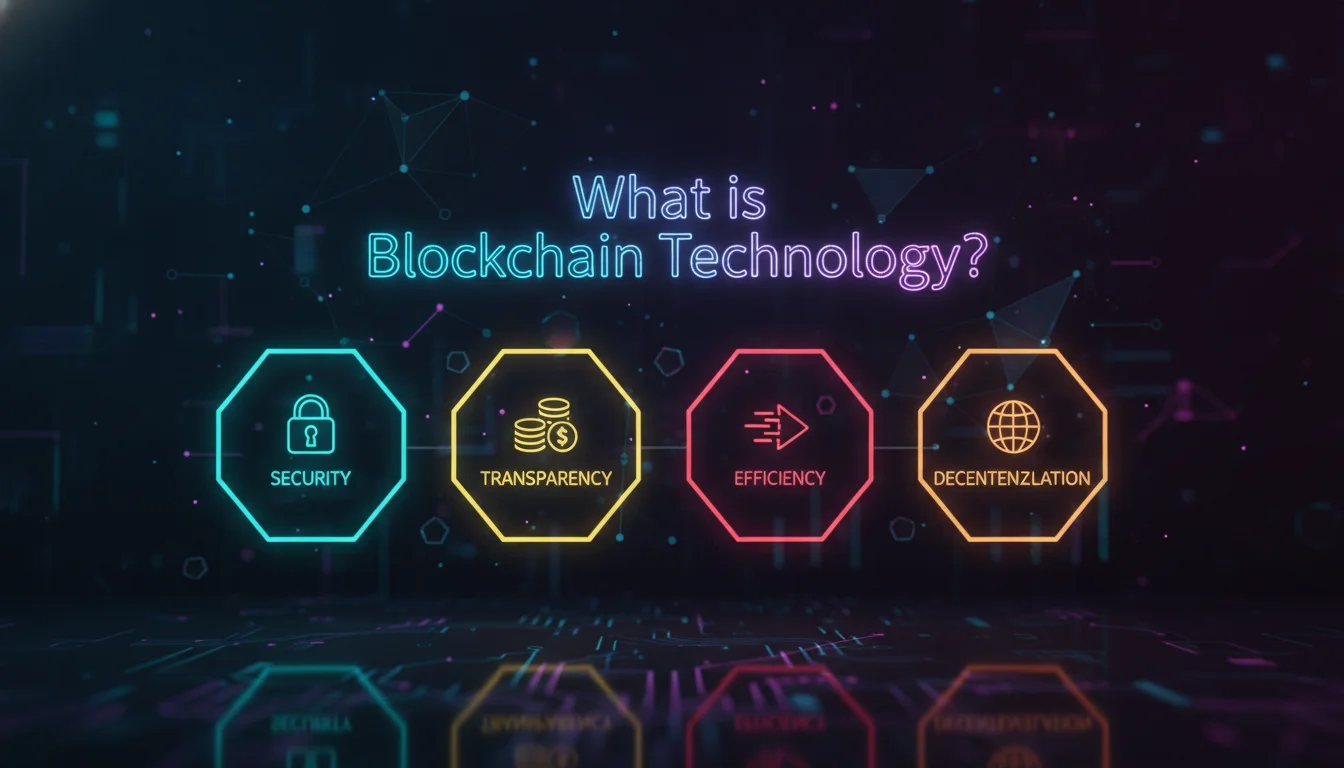
Blockchain is a distributed digital ledger that records transactions across a network of computers rather than on one central server. Each transaction gets grouped into a block, cryptographically linked to the one before it, forming a chain that’s difficult to alter after the fact. Once data lands on the chain, changing it requires network consensus, which is what makes the ledger tamper-resistant in the first place. According to Amazon Web Services (AWS), this structure creates a chronologically consistent, unalterable record for tracking orders, payments, and accounts.
Traditional databases sit under one authority’s control. Blockchain flips that. Every participant, or node, holds a full copy of the ledger, which kills the single point of failure problem and means no one entity can quietly rewrite history. The system relies on cryptographic hashes and consensus mechanisms, Proof of Work or Proof of Stake being the two most common, to validate new transactions before they’re added. That’s the mechanism behind most of the blockchain technology benefits we’ll cover below.
How Does a Blockchain Work?
A transaction gets initiated and broadcast to the network. Nodes validate it against pre-defined rules, and once verified, it’s bundled with other transactions into a block. That block receives a unique hash referencing the previous block’s hash, chaining everything together securely. If a node tries to push an invalid block, the rest of the network simply rejects it, keeping the ledger intact. This process, as detailed by Grant Thornton, delivers a level of trust and resilience that traditional centralized databases simply can’t match, since no single node going offline takes down the whole network.
“There’s really a shift in the way that some technologists are thinking about this, in regards to how we can use smart contracts and the technology of blockchain, which is especially helpful for things like immutability: the ability to lock something in and say that this cannot be changed from here on out.” – Sean Roberts, Advisory Manager, Grant Thornton
Key Components of Blockchain
- Distributed Ledger: A shared, synchronized database spread across multiple sites, countries, or institutions.
- Smart Contracts: Self-executing code stored on-chain that automatically enforces terms when conditions are met.
- Consensus Mechanisms: Rules by which the network agrees on transaction validity, keeping every copy of the ledger identical.
Types of Blockchain Networks
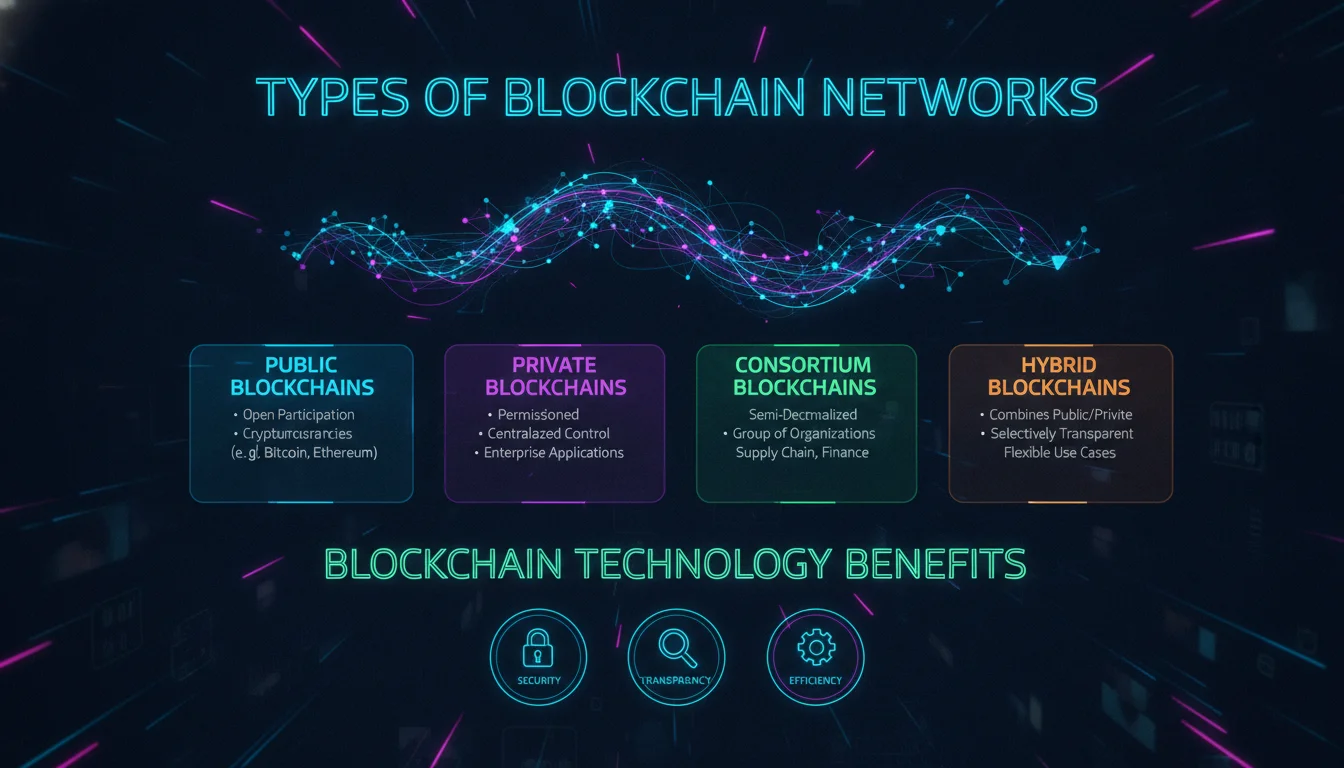
Blockchain networks fall into three main categories: public, private, and consortium, each trading off decentralization for control and speed differently. Public blockchains like Ethereum are open to anyone and fully decentralized, which maximizes trust but sacrifices throughput and privacy. Private blockchains restrict participation to a single organization, trading decentralization for speed and confidentiality, which is why many enterprises pilot blockchain internally before opening access. Consortium blockchains sit in between: a group of pre-approved organizations jointly manage the network, a model that fits well for supply chain groups or banking coalitions that need shared trust without full public exposure. Choosing the right type has more impact on realized blockchain technology benefits than almost any other architectural decision, since a mismatch between use case and network type erases most of the cost and speed advantages a business is chasing.
Blockchain Technology Benefits: A Comprehensive Overview
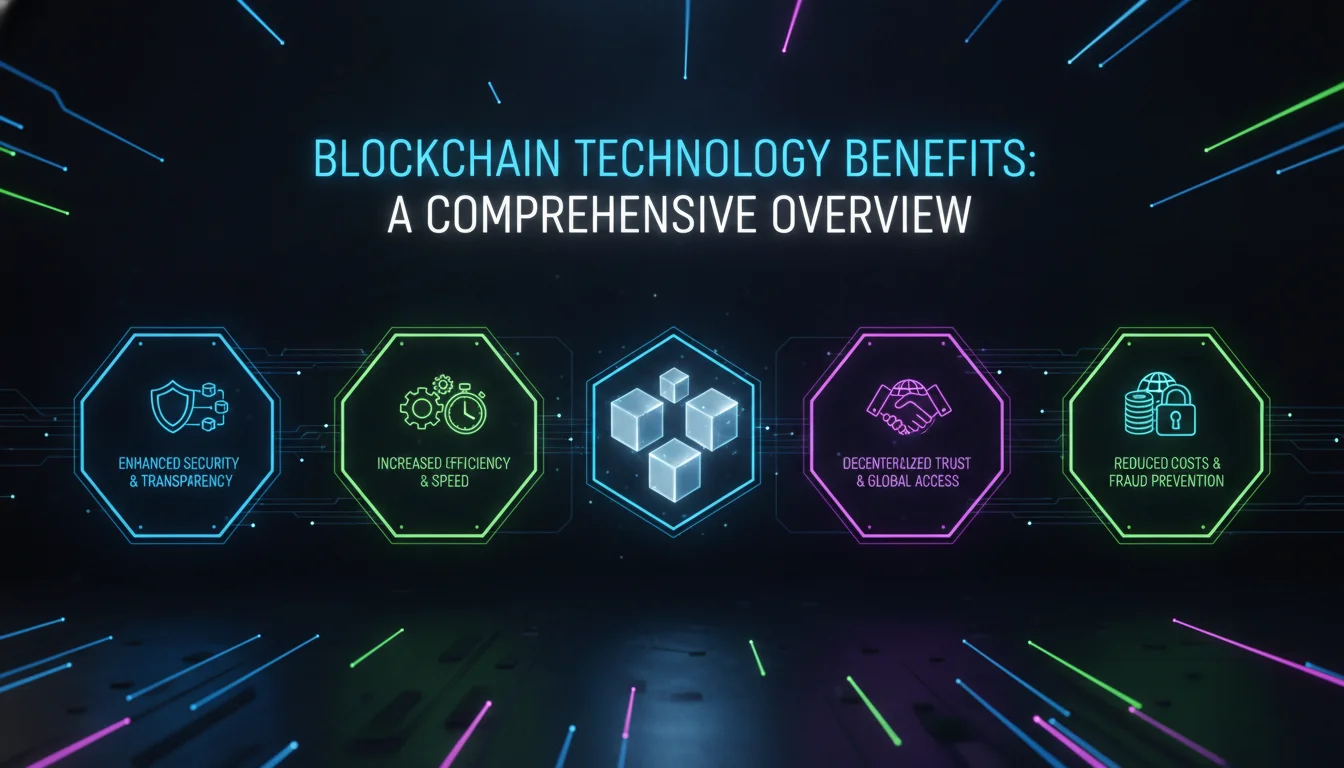
The core blockchain technology benefits extend across industries by fixing fundamental weaknesses in traditional record-keeping. Security, transparency, traceability, efficiency, and automation work together to build a trustless environment where parties can transact without a middleman standing in the way. Below, we break down each core advantage.
Enhanced Security and Data Integrity
Blockchain secures data through cryptography, decentralization, and immutability working in tandem. Every transaction is encrypted end-to-end and linked to the previous one, creating a chain that’s computationally infeasible to tamper with. According to IBM, the network’s distributed architecture, where data lives on multiple nodes rather than a single server, makes it extremely difficult for hackers to compromise the system. This design also blocks unauthorized access and fraud, since altering a record would require controlling a majority of the network’s computing power.
Once data is written to the blockchain, it becomes effectively permanent. That permanence matters most in healthcare and legal documentation, where maintaining accurate historical records is both a compliance requirement and a trust necessity. The combination of encryption and immutability is one of the clearest blockchain technology benefits because it ensures records stay tamper-proof and verifiable years down the line.
Transparency and Traceability
Every participant with permissioned access sees the same information at the same time, which kills the data silos common in traditional systems. All transactions are time-stamped and permanently recorded, giving auditors a complete trail to follow. This level of transparency, as noted by GeeksforGeeks, improves accountability and simplifies auditing and compliance work considerably.
Traceability shows up most clearly in supply chains. Blockchain documents an asset’s provenance at every step, letting businesses verify authenticity and quickly pinpoint where contamination or counterfeiting entered the chain. In the food industry, for example, blockchain can trace a product back to its origin in seconds instead of days, cutting waste and safety risk considerably.
Efficiency, Speed, and Automation
Traditional processes drag through layers of intermediaries and manual paperwork, and that’s where delays and errors creep in. Blockchain strips these layers out by enabling direct peer-to-peer transactions and automating verification. Settlement that once took days can now happen in near real-time. Smart contracts push this further, automatically executing predefined actions, like transferring funds or updating records, once conditions are met, with zero human intervention required. IBM points to insurance as a clear example: a smart contract can automatically settle a claim once all required documentation is submitted, eliminating the usual administrative lag.
How Blockchain Technology Benefits Reduce Costs
Blockchain technology benefits reduce costs primarily by cutting out intermediaries and automating manual tasks that would otherwise require staff, paperwork, and reconciliation cycles. For enterprises, that’s one of the most compelling reasons to invest in the technology at all.
Lowering Transaction and Administrative Costs
In cross-border payments, blockchain eliminates the need for correspondent banks and reduces forex fees in the process. Delubac notes that fewer intermediaries combined with automation make transactions faster and less costly than in centralized systems. Administrative expenses also drop because shared, immutable ledgers remove the need for repeated reconciliations and auditing. Contract management gets more efficient too, since terms embedded in smart contracts self-execute, cutting legal and processing costs along the way.
Expanding Financial Inclusion
Blockchain enables secure financial services without traditional banking infrastructure standing in the way, which matters most for the unbanked. Digital wallets and decentralized finance (DeFi) platforms let anyone with a smartphone access savings, loans, and payments. Cross-border remittances become cheaper and faster, directly benefiting migrant workers and their families. This democratization of finance flows straight from the blockchain technology benefits of decentralization and reduced dependency on intermediaries.
Real-World Applications of Blockchain Benefits
Across sectors, organizations are putting these advantages to work to solve problems that have persisted for decades. The examples below show how the theoretical benefits translate into tangible outcomes.
Supply Chain and Food Safety
Blockchain provides end-to-end visibility, building trust between trading partners and enabling faster responses when disruptions hit. Research published in PMC documents blockchain’s role in monitoring the distribution, storage, and administration of COVID-19 vaccines, preserving integrity across complex cold chains. In the food sector, companies use the technology to track produce from farm to shelf, reducing waste and tracing contamination sources almost instantly.
Finance and Payment Processing
Global payment systems are adopting blockchain to settle transactions faster and more securely. By bypassing intermediary banks, blockchain-based payments lower costs and reduce error risk. Smart contracts automate escrow and contract execution, tying payments directly to verifiable deliverables. Grant Thornton’s specialists point out that blockchain’s immutability is especially valuable for lease accounting under FASB and IASB standards, where tamper-proof records ensure compliance without extra manual checks.
Healthcare and Legal Records
Patient data and legal documents demand both privacy and unalterability, a combination that’s hard to pull off with legacy systems. Blockchain secures these records while giving patients control over who gets access. Hospitals and law firms are exploring digital identity solutions built on blockchain to verify credentials and manage consent, cutting fraud and administrative delays in the process.
Blockchain vs. Bitcoin and Cryptocurrency: What’s the Difference?
Blockchain and Bitcoin are not the same thing: blockchain is the underlying ledger technology, while Bitcoin is just one application built on top of it. Bitcoin uses a public blockchain to record transactions and enforce a fixed supply cap, but the same ledger technology also underpins supply chain tracking, digital identity, and enterprise data systems that have nothing to do with currency. Cryptocurrency is a subset of what blockchain enables, not a synonym for it. Confusing the two is one of the most common misunderstandings we run into when talking with founders exploring the space, and it’s worth clearing up before evaluating any blockchain technology benefits for a specific business case.
Blockchain Technology Benefits vs Traditional Systems
The table below contrasts key features of blockchain with conventional database systems, showing why many organizations are adopting the technology despite higher initial complexity.
| Feature | Traditional Database | Blockchain Technology |
|---|---|---|
| Security | Centralized, single point of failure | Decentralized, cryptographic, tamper-proof |
| Transparency | Limited, controlled access | Full visibility for all permissioned participants |
| Traceability | Logs can be altered or deleted | Immutable audit trail, time-stamped |
| Efficiency | Intermediaries slow processes | Peer-to-peer, automated via smart contracts |
| Cost | High administrative and third-party fees | Reduced intermediaries, lower transaction costs |
Pros and Cons
Pros
- Tamper-resistant records secured by cryptography and consensus, not a single administrator
- Full transparency for permissioned participants, which simplifies audits and compliance reporting
- Automated execution through smart contracts, cutting administrative lag in claims, escrow, and contract management
- Lower transaction and reconciliation costs from removing intermediaries
- Expanded financial access for unbanked populations via digital wallets and DeFi
Cons
- High energy consumption on Proof-of-Work networks like Bitcoin
- Scalability limits on public chains as transaction volume grows
- Regulatory uncertainty that still slows enterprise deployment decisions in 2026
- Lost private keys mean permanently lost assets, with no recovery process
- High development costs due to a persistent shortage of specialized blockchain talent
Challenges and Considerations for Blockchain Adoption
Blockchain adoption faces real hurdles even where the benefits are clear: energy consumption, scalability ceilings, and regulatory uncertainty top the list. Decision-makers need to weigh these limitations honestly against the upside before committing budget.
Scalability and Energy Consumption
Proof-of-Work blockchains like Bitcoin require enormous computational power, which drives high energy consumption and has drawn plenty of criticism. That criticism has pushed a broader shift toward more efficient consensus mechanisms like Proof of Stake, which secures the network through staked capital rather than raw computation. Public blockchains also face scalability issues: as transaction volumes grow, networks can get congested and processing slows down. Layer-2 solutions and sharding are emerging to relieve these bottlenecks, though neither is a complete fix yet.
Regulatory Uncertainty and Complexity
Regulatory frameworks are still evolving in 2026, and that creates real uncertainty for enterprises trying to plan multi-year deployments. Roughly 60% of organizations cite regulatory uncertainty as a top barrier to blockchain deployment, according to 2026 industry surveys referenced by Kanerika. On top of that, the technology’s inherent complexity demands specialized talent, and development costs remain high as a result. Losing a private key can mean irretrievable asset loss too, a risk that simply doesn’t exist in traditional systems.
“If you design this appropriately, you shouldn’t even know that you’re on a blockchain. Really, from an architectural point of view, we’re looking to design user experiences where users don’t know about the complexity of the blockchain.” – Malcolm Silberman, Innovation Director, Grant Thornton
Career Paths in Blockchain
Blockchain careers span development, security auditing, protocol architecture, and compliance, and demand has stayed strong as enterprise adoption expands. Solidity and Rust developers build smart contracts and protocol-level logic; security auditors review code for exploits before mainnet deployment; and compliance specialists help enterprises navigate the same regulatory uncertainty covered above. As of 2026, the skill combination in highest demand pairs traditional software engineering with an understanding of consensus mechanisms, cryptographic primitives, and tokenomics design. Builders who understand both the technical and economic layers of a protocol tend to have the most leverage in this market.
The Future of Blockchain Technology in 2026
The enterprise blockchain market reached $12.77 billion in 2025, and it keeps growing as use cases expand well beyond cryptocurrency. Emerging applications include decentralized identity (DID), tokenized real-world assets, and central bank digital currencies (CBDCs). Interoperability between different blockchains is improving, and hybrid models that blend public and private networks are gaining traction. As standards mature and energy-efficient consensus models go mainstream, blockchain technology benefits will become accessible to a much broader range of industries than they are today.
This is where Digital Blockchains focuses its work: helping serious builders turn protocol-level advantages into working infrastructure, not just whitepaper promises. If you’re building a protocol, a DAO, or a tokenomics model and want to work with a team that treats security and sustainable design as non-negotiable, apply to the Genesis Cohort at digitalblockchains.com. Learn more about our approach on the studio page or see how we structure engagements on the process page.
Frequently Asked Questions
What are five benefits of blockchain technology?
The five most cited benefits are enhanced security, transparency, traceability, efficiency and speed, and cost reduction through automation and removal of intermediaries. Together, these advantages are why enterprises across finance, supply chain, and healthcare keep investing in the technology despite implementation complexity.
What are blockchain advantages and disadvantages?
Advantages include decentralization, tamper-proof records, and faster settlement without intermediaries. Disadvantages include high energy use on certain consensus models, scalability challenges, regulatory gray areas, and the complexity of building and maintaining blockchain-based systems.
Is blockchain 100% safe?
No technology is 100% safe, but blockchain’s cryptographic design and decentralization make it extremely resilient against tampering and single points of failure. Real risk tends to concentrate at the application layer and in private key management, not in the core protocol itself.
Is blockchain technology a good career?
Yes, demand for blockchain developers, protocol architects, and security auditors has remained strong in 2026, driven by enterprise adoption across finance, supply chain, and healthcare. Builders who combine software engineering skills with an understanding of tokenomics and consensus design tend to have the strongest career options.
How does blockchain improve supply chain management?
Blockchain provides real-time traceability, reduces fraud, and enables rapid identification of contamination sources across a supply chain. All parties see a shared, immutable record of goods movement, which cuts disputes and speeds up response time when something goes wrong.
What industries benefit most from blockchain?
Finance, supply chain, healthcare, insurance, and government records see the most immediate gains from enhanced transparency, automation, and reduced intermediary costs. These industries share a common trait: multiple parties that need to trust shared data without a single party controlling it.
Final Thoughts
The blockchain technology benefits of security, transparency, efficiency, and automation are reshaping how global commerce handles trust. Challenges like scalability and regulatory uncertainty haven’t gone away, but the technology’s trajectory through 2026 points toward wider, more sustainable adoption across industries that need shared, verifiable data. Businesses that integrate blockchain strategically, rather than chasing hype, stand to reduce costs, build trust with counterparties, and create value streams that legacy infrastructure simply can’t support.