Blockchain investment is the allocation of capital to assets, companies, or protocols built on distributed ledger technology, spanning cryptocurrencies, equities, ETFs, DeFi protocols, and tokenized real-world assets. Each method carries a distinct risk and return profile requiring careful evaluation.
Key Takeaways
- investment spans cryptocurrencies, blockchain company stocks, ETFs, DeFi, and venture capital, each with unique risk profiles.
- Spot crypto ETFs now provide regulated exposure without the complexity of self-custody.
- Decentralized finance (DeFi) can offer yields above 10%, but involves smart contract and platform risks.
- Diversification across multiple investment types can reduce portfolio volatility.
- Always use secure custody solutions and verify platform legitimacy before committing capital.
What is Blockchain Investment?
Understanding Blockchain Technology
A blockchain is a decentralized, immutable digital ledger that records transactions across a network of computers. According to Fidelity Investments, blockchains link data in groups called blocks, each with a unique cryptographic hash, creating a tamper-evident chain. This technology underpins cryptocurrencies like Bitcoin and Ethereum, but its applications extend to supply chain tracking, identity management, and settlement infrastructure. Understanding the tech is foundational to making informed this type of investment decisions.
Why Invest in Blockchain?
Investors are drawn to blockchain for its potential to reshape traditional industries. Major financial firms and governments are exploring blockchain-based solutions for payments and settlement. As Invesco notes, digital assets have reached meaningful scale and are increasingly considered a viable alternative asset class within diversified portfolios. This growing adoption can drive long-term value for early this kind of investment. Blockchain.com, operating since 2011, reports over 95 million wallets created and more than $1.1 trillion in transaction volume processed through its platform, metrics that underscore the ecosystem’s expansion.
Risks and Considerations
blockchain carries significant risks. Prices of crypto assets are highly volatile, capable of double-digit percentage swings in a single day. Regulatory frameworks remain uncertain across jurisdictions, which could adversely affect asset values. Security is a paramount concern: as Fidelity explains, losing your private key means losing total access to your funds with no recourse, because there are no organizations like the Securities Investor Protection Corporation (SIPC) to insure crypto holdings. Investors must also watch for scams, phishing attacks, and unvetted DeFi protocols. Thorough research and robust security practices are mandatory.
Investing Directly in Cryptocurrencies
Buying and Holding Cryptocurrencies
The most direct investment is purchasing cryptocurrencies like Bitcoin (BTC) or Ethereum (ETH) on an exchange. Platforms such as Blockchain.com support over 5,700 tradable assets, enabling users to buy with fiat currency and store them in a custodial or self-custodial wallet. This buy-and-hold strategy, often called “HODLing,” bets on the long-term appreciation of the asset. It requires a high risk tolerance, but has historically delivered outsized returns for early adopters.
Staking and Yield Generation
Beyond simple holding, investors can earn passive income by staking coins in proof-of-stake networks or through yield protocols. Blockchain.com advertises earning up to 10% APY on crypto holdings via staking services. Staking involves locking up tokens to support network operations and receiving rewards in return. Yields can outpace traditional savings accounts, but they are not risk-free. Token price drops can erode principal, and lock-up periods may limit liquidity when you need it most.
Risks of Direct Crypto Ownership
Direct ownership exposes you to full market volatility and the responsibilities of custody. Exchanges, even large ones, have been hacked or gone bankrupt, leading to total loss of customer funds. Self-custody in a non-custodial wallet eliminates third-party risk but shifts the burden of key management entirely to you. Losing a seed phrase means permanent loss. Always use reputable platforms, enable two-factor authentication, and consider cold storage for large holdings as part of your this type of investment plan.
Blockchain Stocks and ETFs
Publicly Traded Blockchain Companies
If direct crypto feels too risky, you can gain exposure through stocks of companies building the blockchain ecosystem. These include exchanges like Coinbase (listed on NASDAQ), mining firms, and hardware manufacturers. Blockchain Capital, a venture firm founded in 2013, counts Coinbase, Kraken, Aave, OpenSea, and Tether among its portfolio companies. Public markets let you invest in blockchain’s growth with familiar securities, often subject to regulatory oversight and meaningful liquidity.
Blockchain and Crypto ETFs
Exchange-traded funds (ETFs) bundle various blockchain-related stocks or hold crypto directly. According to justETF, there are currently 8 ETFs tracking blockchain indices, with total expense ratios (TERs) ranging from 0.45% to 3.50%. The Global X Blockchain ETF (BKCH) and the Amplify Transformational Data Sharing ETF (BLOK) are popular choices. Spot Bitcoin ETFs have also been approved in multiple jurisdictions, providing direct crypto price exposure inside a standard brokerage account. These vehicles simplify this kind of investment for traditional investors who want exposure without managing private keys.
How to Evaluate Blockchain Stocks
When picking individual blockchain stocks, look for companies with substantial revenue from blockchain operations, not just a token tie-in. Examine their competitive moat, management team, and regulatory compliance. Blockchain investment in equities can be less volatile than direct crypto, but still correlates with the digital asset market. Review quarterly reports, debt levels, and strategic partnerships before committing capital.
| Investment Method | Description | Risk Level | Liquidity | Potential Return |
|---|---|---|---|---|
| Direct Cryptocurrency | Buying Bitcoin, Ethereum, etc. | High | High | Variable; historically high peaks and troughs |
| Blockchain ETFs | Funds holding a basket of blockchain-related stocks or crypto | Moderate | High | Market-driven, aligns with equity and crypto markets |
| DeFi Yield Farming | Providing liquidity or staking in DeFi protocols | Very High | Medium | APY often exceeds 10%, but value can fluctuate |
| Tokenized Real-World Assets | Digital tokens representing real estate, bonds, or commodities | Moderate-High | Variable | Dividends/capital appreciation tied to underlying asset |
| Venture Capital | Funding early-stage blockchain startups | Extremely High | Low (lock-ups) | Can be many multiples if startup succeeds |
Decentralized Finance (DeFi) Opportunities
Yield Farming and Liquidity Provision
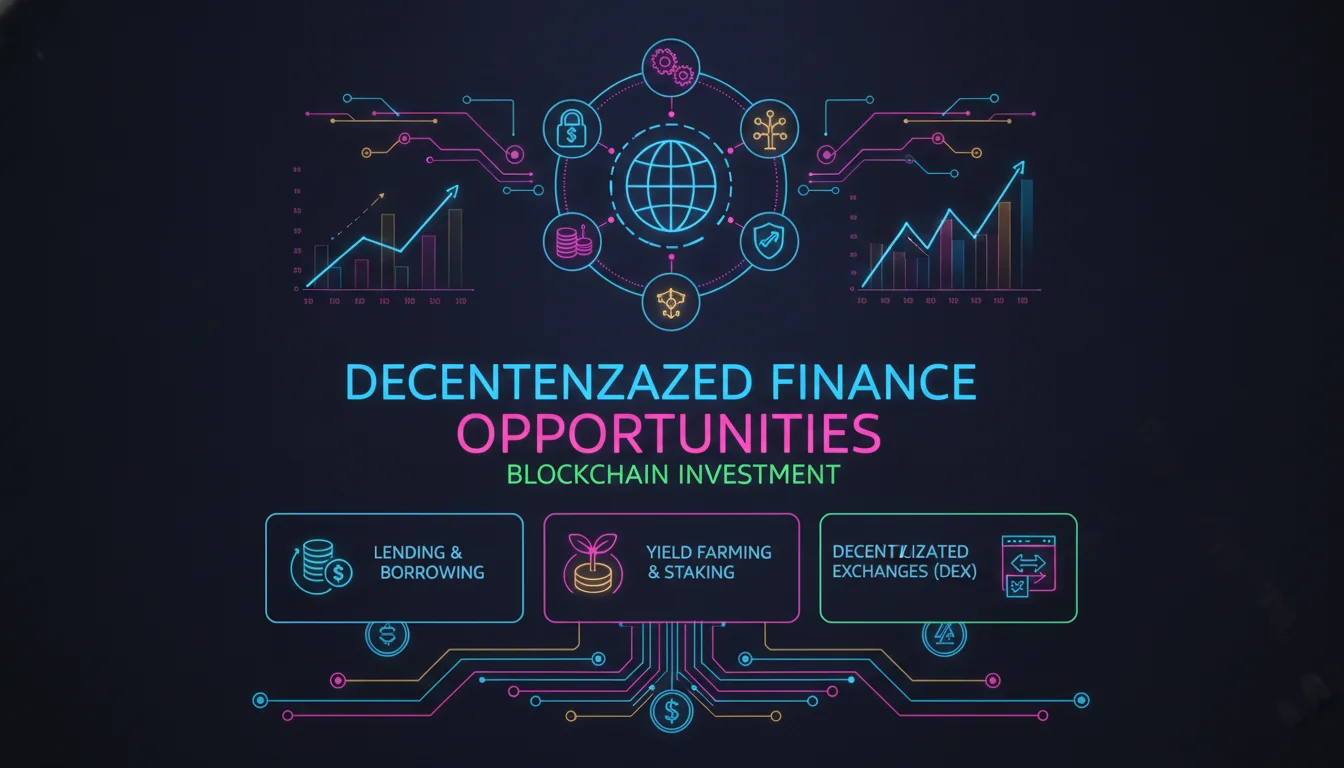
Decentralized finance enables blockchain investment through permissionless financial services. Yield farming involves providing cryptocurrency to decentralized exchanges (DEXs) like Uniswap or liquidity pools to earn trading fees and governance tokens. These returns can be attractive but are often paid in volatile tokens. Smart contracts automate these processes, removing intermediaries entirely from the equation.
Lending and Borrowing
Protocols such as Aave, part of Blockchain Capital‘s portfolio, allow users to lend crypto and earn interest or borrow against their holdings. Interest rates fluctuate based on supply and demand, often yielding higher returns than traditional banks. This form of blockchain investment generates passive income but requires vigilance. Loans can be liquidated if collateral value drops sharply, so position sizing matters.
DeFi Risks and Security
DeFi is rife with technical risks. Smart contract vulnerabilities have led to hundreds of millions in losses from hacks across the ecosystem. Rug pulls, where developers abandon a project after raising funds, cost investors dearly. Impermanent loss, where the value of deposited tokens changes relative to simply holding them, can erode profits even when fee income looks attractive. Always verify a protocol’s audit status and understand the code’s logic before staking significant capital. On-chain data from tools like DeFiLlama can help you assess total value locked and protocol health before committing funds.
Tokenized Real-World Assets
What are Tokenized Assets?
Tokenization converts physical or traditional financial assets into digital tokens on a blockchain. Real estate, fine art, carbon credits, and corporate bonds can be fractionalized and offered to investors globally. Blockchain investment in tokenized assets combines the familiarity of traditional assets with the efficiency and liquidity of digital markets, compressing settlement from days to minutes.
Benefits and Challenges
The main benefit is fractional ownership, lowering the barrier to entry for high-value assets like property. Settlement can occur in minutes instead of days, and 24/7 markets allow continuous price discovery. Regulatory compliance remains murky, though. Tokenized assets may be deemed securities, triggering strict rules. Custody solutions must also evolve to handle these novel instruments securely.
How to Access Tokenized Assets
Several platforms, such as Centrifuge and RealT, enable investment in tokenized real-world assets. Some brokerages and crypto exchanges are launching tokenized stock trading. Before investing, confirm the asset’s legal standing and the issuer’s reputation. As this sector matures, it could become a major pillar of blockchain investment for both retail and institutional capital.
Venture Capital and Private Equity in Blockchain
Investment Funds and Venture Capital
For accredited investors, venture capital (VC) is a way to back early-stage blockchain companies. Blockchain Capital has been doing this since 2013, counting Aave, Kraken, and OpenSea among its successes. VC funds provide diversification through a portfolio of startups, though they require long lock-up periods and high minimum investments. Blockchain investment through VC can yield outsized returns, but also total loss if the portfolio underperforms.
Direct Investment in Startups
Some retail investors gain exposure through initial coin offerings (ICOs) or token presales. These allow buying project tokens at an early stage, but the market is largely unregulated and prone to scams. Diligence is critical: examine the team’s track record, whitepaper, and community engagement. The high failure rate means only risk capital should be deployed here.
Risks and Rewards
VC in blockchain is illiquid and high-risk. Many projects never reach commercial viability, and tokens can lose all value. Successful early bets on protocols like Ethereum or Aave have produced returns that are difficult to replicate in traditional asset classes. A disciplined approach, relying on sector expertise and diversification across many bets, is essential for anyone pursuing this path.
Regulatory Developments Shaping Blockchain Investment (2025-2026)
Regulatory clarity is one of the most significant forces reshaping blockchain investment as of 2026. Spot Bitcoin ETF approvals in major jurisdictions have opened institutional capital flows that were previously constrained by compliance requirements. Governments across the US, EU, and Asia are actively developing frameworks covering digital asset classification, stablecoin issuance, and DeFi protocol oversight. The EU’s Markets in Crypto-Assets (MiCA) regulation represents the most comprehensive attempt yet to bring consistent rules to the space. For investors, this regulatory evolution cuts both ways: clearer rules reduce uncertainty and attract institutional money, but they can also impose compliance costs on protocols and restrict certain DeFi activities. Staying current with regulatory developments is not optional for serious blockchain investment practitioners. It is a core part of due diligence.
“Digital assets are playing an expanding role in the global economy. Large well-known companies are increasingly using blockchain-based solutions, including stablecoins for payments and settlement, and governments are exploring the strategic role of cryptocurrencies.” – Invesco, Digital Assets Investor Guide
Mining and Staking Infrastructure as an Investment
Mining and staking infrastructure represent a less-discussed but operationally intensive form of blockchain investment. Bitcoin mining requires significant capital expenditure in specialized ASIC hardware, cheap electricity, and cooling infrastructure. Returns depend on Bitcoin’s price, network difficulty, and energy costs, making it a leveraged bet on the asset’s appreciation. Proof-of-stake networks like Ethereum have shifted the calculus: staking requires holding tokens rather than running energy-intensive hardware, lowering the barrier to participation. Institutional staking-as-a-service providers now allow funds and family offices to earn staking rewards without managing validator nodes directly. Blockchain.com, for example, offers institutional staking services designed to earn rewards without operational complexity or direct risk exposure. For investors who want yield tied to network security rather than market speculation, staking infrastructure deserves a place in the analysis.
“Losing that private key may result in losing total access to your crypto, because there are no organizations, like the Securities Investor Protection Corporation (SIPC), to insure or protect your crypto.” – Fidelity Investments, Blockchain 101
How to Build a Blockchain Investment Strategy
Defining Your Risk Tolerance
A prudent blockchain investment strategy begins with understanding your financial goals and risk appetite. Crypto markets can lose substantial value in weeks. Determine what percentage of your total portfolio you are willing to allocate. Many advisors suggest keeping high-risk digital assets to a small slice of overall holdings. If you are risk-averse, focus on regulated products like ETFs or dividend-paying blockchain stocks rather than direct token exposure.
Diversification Across Sectors
Spread blockchain investment across multiple asset types and sectors. For example, combine a core holding in a spot Bitcoin ETF with a position in a blockchain equity fund, some DeFi stablecoin yield, and a small allocation to tokenized real estate. This mix can smooth returns and reduce exposure to any single point of failure. Monitor the correlation between crypto and equity markets. At times they move in tandem, which reduces the diversification benefit you might expect.
Staying Informed and Secure
The blockchain landscape evolves rapidly. Follow trusted news sources, audit reports, and on-chain analytics tools like DeFiLlama and CoinGecko. Always use hardware wallets or custodians with a strong security track record. Never share your private keys or seed phrases. Regularly rebalance your portfolio to maintain your target allocation.
A step-by-step approach to blockchain investment:
- Step 1: Open an account with a reputable exchange like Blockchain.com.
- Step 2: Complete identity verification (KYC).
- Step 3: Deposit fiat currency via bank transfer or card.
- Step 4: Purchase assets according to your plan: crypto, ETFs, or tokenized assets.
- Step 5: Transfer assets to secure storage, such as a hardware wallet like Ledger.
- Step 6: Set up alerts and review your portfolio quarterly.
Pros and Cons of Blockchain Investment
Pros
- High return potential: Early positions in protocols like Bitcoin and Ethereum have historically produced returns that dwarf traditional asset classes.
- Portfolio diversification: Digital assets can behave differently from equities and bonds, offering genuine diversification in certain market conditions.
- Multiple access points: From regulated ETFs to direct token ownership to VC funds, investors can choose the risk level that suits them.
- Passive income: Staking and DeFi lending can generate yield above what traditional savings instruments offer.
- 24/7 liquid markets: Unlike equities, crypto markets never close, enabling continuous price discovery and rapid position adjustments.
Cons
- Extreme volatility: Crypto assets can lose the majority of their value in a single bear cycle, wiping out portfolios that are over-concentrated.
- Custody risk: Losing a private key or seed phrase means permanent, unrecoverable loss of funds with no institutional backstop.
- Regulatory uncertainty: Shifting rules across jurisdictions can affect asset values, restrict access, or impose unexpected compliance burdens.
- Smart contract risk: DeFi protocols can be exploited through code vulnerabilities, leading to total loss of deposited funds.
- Scams and fraud: The space attracts bad actors. Rug pulls, phishing attacks, and fraudulent token launches remain common hazards.
Blockchain Investment Platforms and Tools
Centralized Exchanges and Wallets
Centralized exchanges (CEXs) like Blockchain.com offer an all-in-one solution for buying, selling, and storing crypto. Operating since 2011 with over 95 million wallets created and $537 million in equity capital raised, the platform provides user-friendly interfaces across more than 20 product lines. Other notable CEXs include Kraken and Coinbase, both part of the Blockchain Capital portfolio. For large holdings, cold storage wallets like Ledger or Trezor are recommended for enhanced security.
Decentralized Wallets and dApps
Self-custody advocates prefer decentralized wallets like MetaMask, which interact directly with blockchain networks. These wallets give you complete control over your keys and enable access to DeFi and decentralized applications (dApps). You bear full responsibility for security, though. Using a decentralized wallet is essential for deeper blockchain investment activities like yield farming or governance participation.
Research and Analytics Tools
To make informed decisions, use tools that track on-chain data. Platforms such as CoinGecko provide price data, while DeFiLlama aggregates total value locked across protocols. Analytics dashboards like Dune Analytics let you build custom queries to assess protocol health in real time. Combining fundamental analysis with on-chain metrics can sharpen your blockchain investment timing and selection process.
For a deeper look at how smart contracts power DeFi and tokenized assets, see our protocol infrastructure articles and explore how Digital Blockchains approaches token launches and DAO creation.
Conclusion
Blockchain investment in 2026 offers a diverse array of avenues, from holding digital currencies to earning yield in DeFi or backing the next generation of crypto startups. The opportunity is vast, and so are the risks. A balanced strategy that includes thorough research, robust security, and diversification across methods can help you approach this dynamic asset class with discipline. Whether via a regulated ETF or a self-custodied wallet, start small, stay informed, and never invest more than you can afford to lose. As infrastructure matures and institutional adoption grows, blockchain investment may become a standard component of modern portfolios.
If you are building in this space and want to go deeper, apply to the Genesis Cohort at digitalblockchains.com.
Frequently Asked Questions
What exactly is blockchain investment?
Blockchain investment is the allocation of capital to assets, companies, or protocols that utilize or develop blockchain technology. This includes purchasing cryptocurrencies, shares of blockchain firms, ETFs, and participating in DeFi protocols.
Can I invest in blockchain without buying cryptocurrency directly?
Yes. You can invest in blockchain via stocks such as Coinbase, ETFs like the Global X Blockchain ETF (BKCH), or through tokenized assets and venture capital funds. These options provide exposure to blockchain’s growth without requiring you to manage private keys or crypto wallets.
What is the safest way to start blockchain investment?
The safest approach is to use a regulated exchange or a spot Bitcoin ETF. These options minimize the risk of losing private keys and are often backed by trusted custodians with established compliance frameworks.
How much should I allocate to blockchain investments?
Financial advisors often recommend keeping high-risk digital assets to a small slice of overall holdings, with the exact amount depending on your risk tolerance and time horizon. If you are new to the space, starting with regulated products like ETFs before moving into direct crypto or DeFi is a sensible approach.
Are blockchain investments regulated?
Some blockchain investment products, such as ETFs and publicly traded stocks, are subject to securities regulations. Many crypto assets and DeFi protocols operate with limited oversight, though regulatory frameworks like the EU’s MiCA are actively changing this landscape as of 2026.
How do I avoid scams in blockchain investment?
Verify project teams, check for independent smart contract audits, use reputable platforms, and never share your private keys. Be skeptical of any promise of guaranteed high returns, and cross-reference claims against on-chain data from tools like DeFiLlama or Dune Analytics before committing capital.