Blockchain companies are organizations that build, invest in, or operate on distributed ledger technology to deliver crypto exchanges, mining infrastructure, smart contract platforms, tokenized assets, and Web3 services. They range from crypto-native startups to multinational financial institutions.
Key Takeaways
- Over 2,959 companies are tracked globally, spanning exchanges, mining, DeFi protocols, enterprise services, and development firms.
- The combined valuation of tracked this type of companies exceeds $1.07 trillion, according to Coinpedia, reflecting deep institutional integration.
- Top public players include Coinbase, Core Scientific, and Galaxy Digital. Enterprises like JPMorgan and Mastercard are embedding blockchain into core operations.
- Stablecoin adoption and real-world asset tokenization are the two fastest-moving structural shifts reshaping capital markets in 2026.
- Investors can access the sector through direct equity, ETFs like VanEck’s NODE, or token ecosystems with transparent on-chain fundamentals.
- When hiring a blockchain development partner, prioritize verifiable project history, dedicated Solidity or Rust developers, and recognized third-party awards.
Understanding Blockchain Companies

What Is a Blockchain Company?
A blockchain company is any business that builds on, operates within, or provides services for the blockchain ecosystem. This includes cryptocurrency exchanges like Coinbase, protocol developers such as Chainlink, mining operators like Core Scientific, and enterprise consultancies like Deloitte. The common thread is their reliance on distributed ledger technology to create, transfer, or secure digital value. As of 2026, the term covers a wide range of firms: from pre-product startups to multinational corporations embedding blockchain into legacy systems.
Why Blockchain Companies Matter in 2026
Blockchain has matured from niche innovation to core infrastructure. The combined valuation of tracked this kind of companies exceeds $1.07 trillion, according to Coinpedia, reflecting their growing economic footprint. These companies are driving real changes in payments, supply chain, and identity verification. Institutional adoption is accelerating: JPMorgan’s Kinexys platform now enables tokenized securities collateral, while Stripe processes USDC payments in over 50 countries.
Taxonomy of Blockchain Companies
blockchain can be categorized by their primary function within the digital asset ecosystem. This taxonomy helps investors, job seekers, and analysts navigate the growing list of nearly 2,959 firms tracked on platforms like CryptoJobsList.
- Exchanges & Trading Platforms: Coinbase, Binance, Kraken, BitMEX. These firms facilitate the buying, selling, and custody of cryptocurrencies.
- Custody & Infrastructure: Anchorage Digital (the first federally chartered digital asset bank), Blockchain.com (over 95 million wallets).
- Mining: Core Scientific, Bitfarms, Cipher Mining. Mining companies increasingly diversify into AI compute.
- DeFi & Protocols: Uniswap, Aave, Chainlink. Protocol-layer firms build the decentralized software foundation Web3.
- Enterprise & FinTech: Circle (USDC stablecoin), Block (Square, Cash App), MercadoLibre.
- Asset Management & Funds: Galaxy Digital, 21Shares, Strategy (formerly MicroStrategy).
- Development Services: ScienceSoft, Accenture. These firms provide consulting and custom blockchain development to other businesses.
Top Blockchain Companies by Market Segment
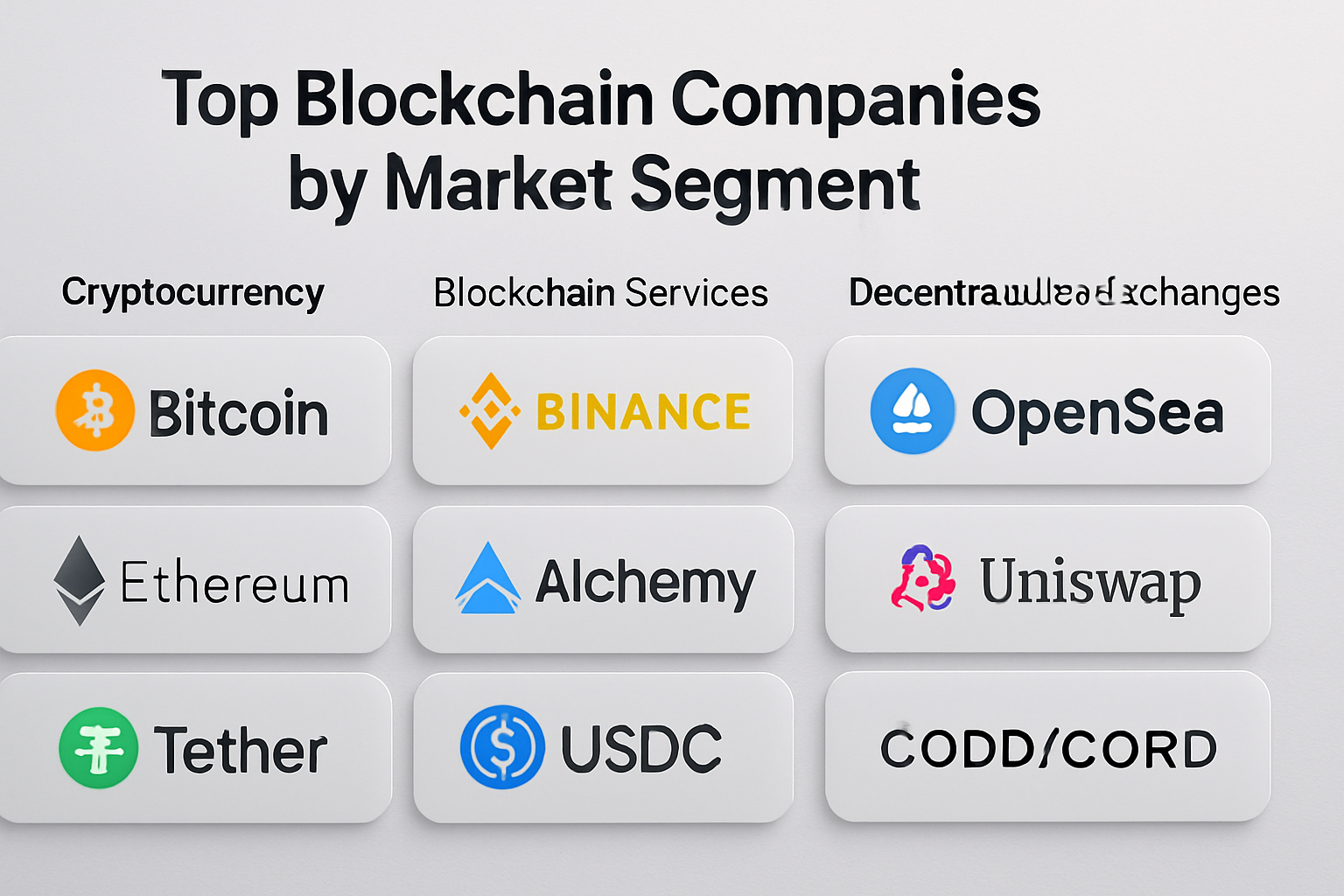
Digital Asset Exchanges and Custodians
Exchanges remain the most visible gateway to crypto. Coinbase, the largest U.S.-based exchange with 4,700 employees, serves millions of retail and institutional investors. Blockchain.com reports $1.1 trillion in transaction volume moved through its platform since 2011, cementing its role as a global infrastructure provider. These firms benefit from network effects and recurring trading fees. Anchorage Digital stands apart as the only federally chartered digital asset bank, giving it a regulatory moat that most competitors can’t replicate quickly.
Bitcoin Mining and Energy Infrastructure
Mining companies have evolved into diversified compute infrastructure firms. Core Scientific, holding 3.93% of the VanEck Onchain Economy ETF (NODE), is repurposing its data centers for AI workloads. Cipher Mining holds 6.42% of NODE and Bitfarms 1.10%, both showing how mining-origin firms are repositioning for broader compute demand. Kinder Morgan provides natural gas powering many of these operations. These firms sit at the intersection of energy markets and digital assets, which makes their revenue profiles more complex than pure crypto plays.
Crypto-Fintech and Payments
The lines between fintech and crypto are blurring fast. Block (formerly Square) employs 12,000 people and integrates Bitcoin directly into its Cash App. MercadoLibre, the dominant e-commerce platform across Latin America, embeds crypto services into its marketplace to deepen financial inclusion. Rain is building stablecoin payment infrastructure for global companies, and MoonPay bridges fiat and crypto for millions of users. Many of these firms serve as onramps for Web2 users entering Web3.
| Company | Sector | Key Metric | Founded | Employees |
|---|---|---|---|---|
| Coinbase | Exchange | 2.58% of NODE ETF | 2012 | 4,700 |
| Core Scientific | Mining | 3.93% of NODE, AI pivot | 2017 | N/A |
| Circle | Stablecoin | USDC issuer | 2013 | 1,050 |
| Block, Inc. | Fintech | Cash App Bitcoin integration | 2009 | 12,000 |
| Galaxy Digital | Asset Management | 4.35% of NODE holdings | 2018 | N/A |
| JPMorgan Chase | Banking | $1.2T assets, Kinexys | 1799 | N/A |
| Blockchain.com | Infrastructure | 95M wallets | 2011 | N/A |
| Rain | Payments | Stablecoin infrastructure | 2020 | 100 |
Enterprise Blockchain: How Fortune 500 Companies Are Adopting

JPMorgan’s Kinexys and Tokenized Collateral
JPMorgan Chase, with $1.2 trillion in assets, launched Kinexys to allow institutions to post tokenized securities as collateral and move them across venues. This reduces settlement friction and points toward a future where capital markets operate on programmable rails. While not a pure-play blockchain firm, JPMorgan’s initiatives set the tone for how traditional finance integrates distributed ledgers. Other banks are watching closely.
IBM, Amazon, and Mastercard’s Blockchain Services
IBM’s enterprise blockchain solutions, Amazon Managed Blockchain, and Mastercard’s crypto payment infrastructure all demonstrate how legacy tech firms are embedding distributed ledgers into their core offerings. Mastercard employs 38,800 people and supports digital asset transactions in 200+ countries. These companies may not be pure-play companies, but their massive user bases accelerate mainstream adoption faster than any startup could.
“The tokenization of financial assets is not a distant possibility. It is happening now, and the institutions building the rails today will define the market structure of tomorrow.” – VanEck Thematic Investing Research, 2025
The Nvidia–Block–Coinbase Connection
Nvidia, while not a blockchain company per se, provides the GPU infrastructure that powers both mining and AI workloads. Block and Coinbase directly integrate crypto into consumer and institutional products. According to VanEck, these firms are driving real-world blockchain adoption. Investors often consider Nvidia alongside this type of companies because its hardware underpins network security and protocol development.
Pros and Cons of Investing in Blockchain Companies

Pros
- Structural growth tailwinds: Real-world asset tokenization, stablecoin adoption, and institutional ETF inflows are expanding the addressable market for this kind of companies well beyond crypto trading.
- Diversified exposure options: Investors can access the sector through public equities (Coinbase, Block), ETFs like VanEck NODE, or direct token holdings, each with distinct risk profiles.
- Network effect moats: Firms like Coinbase (4,700 employees, millions of verified users) and Blockchain.com (95 million wallets) have defensible positions that are difficult for new entrants to displace.
- Regulatory clarity improving: The EU’s MiCA framework and U.S. ETF approvals in 2024-2026 reduce the policy risk that historically suppressed institutional capital allocation.
- AI convergence upside: Mining firms pivoting to AI compute, like Core Scientific, add a second growth vector that is less correlated with Bitcoin price cycles.
Cons
- Crypto price correlation: Most blockchain companies remain highly correlated with Bitcoin and Ethereum price movements, amplifying drawdowns during bear markets.
- Regulatory fragmentation: Jurisdictional inconsistency across the U.S., EU, and Asia creates compliance overhead and can restrict market access for smaller firms.
- Execution risk in pivots: Mining companies transitioning to AI compute face significant capital expenditure requirements and uncertain timelines to profitability.
- Token dilution risk: For protocol-layer blockchain companies, aggressive token emission schedules can erode value for early investors even when underlying usage grows.
- Talent concentration: The global pool of experienced Solidity and Rust developers remains small relative to demand, creating hiring bottlenecks for development-focused firms.
Blockchain Development Companies: Services and Selection
The Market for Blockchain Development
As of 2026, over 1,000 companies in the United States alone offer blockchain development services, ranging from smart contract coding to enterprise solution architecture. These firms help non-crypto-native businesses launch token platforms, integrate crypto payments, or build private chains. The global talent pool is expanding, with developers from India, Eastern Europe, and Latin America powering many projects. For context, the broader market for blockchain professional services is growing at a pace that outstrips the supply of credentialed developers, which means vendor selection matters more than ever.
Criteria for Choosing a Blockchain Development Partner
When vetting a provider, consider these factors carefully:
- Years of blockchain experience and number of completed, verifiable projects.
- Pricing transparency: many firms now offer cost calculators or fixed-scope engagements.
- Awards and recognitions, such as Clutch rankings or World Future Awards listings.
- Team composition: ensure they have dedicated Solidity, Rust, or Move developers on staff, not just generalist contractors.
ScienceSoft, for example, earned recognition as a DeFi leader at the Global FinTech Awards 2025 and has been listed as a top Solidity developer by Aciety multiple years running, according to ScienceSoft’s blockchain company guide.
Top Development Vendors in 2026
Based on ScienceSoft’s analysis, notable firms include: a 1989-founded U.S. firm with 500+ employees and multiple industry awards; an Estonian company listed among the World Future Awards Top 100 Blockchain & Crypto Companies 2024; and a New York-based Clutch 2024 award winner. These firms represent the service layer that enables enterprise adoption. A full comparison table is available in ScienceSoft’s original report.
“Choosing a blockchain development partner is less about finding the cheapest Solidity shop and more about finding a team that has shipped production contracts under real economic pressure.” – ScienceSoft Blockchain Development Guide, Q2 2026
How to Analyze Blockchain Companies for Investment
Key Metrics for Public Blockchain Stocks
Investors focusing on publicly traded blockchain companies should examine revenue growth, crypto asset exposure (as reflected in VanEck NODE ETF weightings), and diversification beyond pure crypto. Core Scientific’s transition to AI computing is a good example of revenue stream diversification that reduces Bitcoin price dependency. Standard financial ratios like P/E and debt-to-equity apply, but on-chain metrics add a layer of insight unavailable in traditional equity analysis.
Evaluating Private Blockchain Companies
For private companies, assess tokenomics (if applicable), on-chain activity, and team track record. The directory of 1,000+ blockchain startups at CryptocurrencyJobs provides a window into emerging projects. Look for transparent token distribution, active governance participation, and working products with real users. Many successful firms like Chainlink and Aave started as private ventures before launching tokens and building substantial protocol TVL.
Step-by-Step Investment Analysis Process
- Step 1: Assess the Team and Track Record – Research founding team backgrounds, prior exits, and advisory board credentials. Companies like Galaxy Digital or 0x often publish detailed technical roadmaps that signal execution discipline.
- Step 2: Examine On-Chain Metrics – Use blockchain explorers to analyze transaction volume, active addresses, and total value locked (TVL) if the company has a token. DeFi protocols like Aave show transparent TVL on DeFi Llama.
- Step 3: Review Financial Statements or Token Emissions – For public blockchain companies, analyze quarterly reports. For tokens, study emission rates, staking yields, and bonding curves to gauge inflation risk.
- Step 4: Gauge Competitive Positioning – Compare the company’s moat. Does it hold a regulatory license like Anchorage Digital’s federal charter? Or network effects like Coinbase’s verified user base?
- Step 5: Consider Macro Trends – Regulatory clarity, institutional adoption, and real-world asset tokenization can disproportionately benefit certain blockchain companies over others.
For a deeper look at how on-chain data informs investment decisions, see our guide to blockchain analytics and protocol evaluation.
Global Hubs for Blockchain and Crypto Activity
United States: Regulatory Powerhouse
The U.S. hosts the largest concentration of blockchain companies, with hubs in New York, San Francisco, and Texas. New York alone lists 171 blockchain companies on BuiltInNYC, spanning fintech, infrastructure, and security. Silicon Valley’s startup ecosystem continues to produce Web3 unicorns, while Wall Street’s institutional appetite drives demand for compliant custody and trading services. Texas has become a dominant mining state due to its deregulated energy grid and available land for large-scale data centers.
Asia-Pacific: Singapore and Hong Kong
Singapore is home to major protocols like Ocean Protocol and Router Protocol, along with exchange affiliate entities. The city-state’s clear regulatory framework attracts crypto funds and development teams. Japan hosts Ontology, and India continues to produce top-tier development outsourcing firms. These blockchain companies benefit from government support and a deep engineering talent pool that keeps development costs competitive.
Emerging Markets: LatAm and Africa
Latin America sees rising adoption through MercadoLibre and Bitso, while African fintechs are exploring stablecoin payments to bypass local currency inflation. Both regions represent high-growth frontiers, driven by remittance and financial inclusion use cases. Startups in these regions often focus on mobile-first wallets and DeFi lending for the unbanked, where traditional banking infrastructure is absent or unreliable.
Tokenization and Stablecoins: The Next Frontier
The Rise of Real-World Asset Tokenization
Tokenization converts physical assets like real estate, bonds, or commodities into blockchain-based tokens, and it’s reshaping capital markets. According to VanEck, platforms like JPMorgan’s Kinexys enable tokenized collateral, while projects like Plasma build purpose-built infrastructure for stablecoins. This trend expands the scope of blockchain companies well beyond purely digital assets and into multi-trillion-dollar traditional markets.
Stablecoin Adoption for Payments and Settlements
Stablecoins have evolved from a trading tool to a global settlement layer. Circle’s USDC, with a market cap exceeding $30 billion as of 2026, is used by Stripe for merchant payouts in 50+ countries. Rain’s infrastructure enables fintechs to embed stablecoin wallets into existing products, while Visa’s analysis shows monthly stablecoin borrowing reaching fresh highs in 2025. These developments make stablecoin-focused firms integral to global finance infrastructure.
Challenges and Opportunities
Regulatory fragmentation, scalability constraints, and user experience gaps remain real hurdles. Firms that bridge these gaps, such as Chainalysis for compliance and Plasma for UX, stand to capture significant value as tokenization scales. Institutional investors are increasingly allocating to funds that hold such infrastructure plays, which is a signal worth tracking.
Future Trends Reshaping Blockchain Companies
AI and Blockchain Convergence
The convergence of artificial intelligence and blockchain is gaining real momentum. Core Scientific’s shift to AI data centers, projects like 0G Labs building a decentralized AI operating system, and the use of blockchain for verifiable AI training data are reshaping both sectors simultaneously. These trends will create new categories of firms that blend compute networks with machine learning, a combination that neither sector could achieve independently.
Regulatory Clarity and Institutional Adoption
In 2026, major jurisdictions are moving toward comprehensive crypto frameworks. The EU’s MiCA regulation and U.S. ETF approvals provide tailwinds for publicly traded blockchain companies. This clarity encourages more institutional capital to flow into the space, benefiting asset managers like Galaxy Digital and 21Shares. As regulations mature, traditional financial institutions are accelerating their own blockchain projects rather than waiting on the sidelines.
Decentralized Physical Infrastructure (DePIN) and Beyond
DePIN (Decentralized Physical Infrastructure Networks) allows blockchain companies to incentivize the deployment of real-world hardware, from wireless networks to energy grids, using token rewards. This expands the sector beyond purely digital services and opens access to multi-trillion-dollar infrastructure markets. Helium (wireless) and Filecoin (storage) pioneered this model, and a new generation of projects is building on their lessons. If you’re building in this space, the Digital Blockchains studio works with protocol teams at the infrastructure layer.
Frequently Asked Questions
What is a blockchain company?
A blockchain company is an organization that uses blockchain technology, a decentralized and immutable ledger, to deliver products or services such as cryptocurrency exchanges, smart contract platforms, or tokenized assets. They range from pure crypto firms to traditional institutions integrating distributed ledgers into existing operations.
How many blockchain companies exist?
As of 2026, over 2,959 blockchain companies are tracked on platforms like CryptoJobsList, with thousands more operating in niche segments. The total includes exchanges, mining operations, protocol developers, and enterprise service providers across every major geography.
Which are the largest blockchain companies by revenue?
According to Investopedia, the top revenue-generating blockchain companies in 2026 include Nu Holdings, Coinbase, Core Scientific, Strategy (formerly MicroStrategy), MARA Holdings, and Riot Platforms. These firms benefit from diversified business models and sustained institutional demand.
How can I invest in blockchain companies?
Investors can buy stocks of public companies like Coinbase (COIN), Block (SQ), or Galaxy Digital (GLXY); invest in ETFs like the VanEck Onchain Economy ETF (NODE); or purchase tokens of protocols with strong on-chain fundamentals. Each approach carries a different risk profile and requires separate due diligence.
What are the differences between blockchain companies and crypto companies?
While often used interchangeably, “blockchain companies” typically refers to firms building infrastructure or enterprise solutions on distributed ledgers, whereas “crypto companies” usually focus on cryptocurrencies and token economies. In practice, most companies operate across both categories.
What skills are needed to work at a blockchain company?
Technical roles demand proficiency in Solidity, Rust, or Go for smart contract development, along with a solid understanding of consensus mechanisms and Web3 tooling. Non-technical roles often require knowledge of tokenomics, community management, or regulatory compliance. Many companies, including those listed on CryptocurrencyJobs, offer remote positions and structured internship programs.
Build With Us
If you’re building a protocol, launching a token, or architecting a DAO, the infrastructure decisions you make in the next 12 months will define your project’s trajectory. Apply to the Genesis Cohort at digitalblockchains.com and work directly with a team that reads whitepapers before breakfast and ships contracts before lunch.