Which blockchain is Core most aligned with is a question that cuts to the heart of Core’s architecture: it is a Bitcoin-secured, EVM-compatible Layer 1 that inherits Bitcoin’s security model while running Ethereum-standard smart contracts.
Key Takeaways
- Core’s Satoshi Plus consensus integrates Bitcoin miners and BTC stakers, making it deeply aligned with Bitcoin’s security model.
- Full EVM compatibility means Ethereum dApps deploy on Core with minimal code changes, aligning Core with Ethereum’s developer ecosystem.
- aligned with? Philosophically Bitcoin, technically Ethereum. It is a deliberate synthesis of both.
- Non-custodial Bitcoin staking via CLTV timelocks is the first live implementation of its kind, per Core DAO’s documentation.
- The CORE token powers gas, staking, and governance, mirroring the role ETH plays in Ethereum’s economy.
- Core Bridge, powered by LayerZero, connects Core to Ethereum, BNB Chain, and Avalanche, making it a cross-chain hub rather than an isolated network.
The Genesis of Core: A Bitcoin-Aligned Layer 1
Core blockchain launched on January 14, 2023, as a high-performance, EVM-compatible Layer 1 explicitly designed to extend Bitcoin’s functionality without compromising its foundational principles. According to Core DAO’s official documentation, the chain is positioned as Bitcoin’s complementary and hyper-scalable smart contract platform. Unlike most blockchains that treat Bitcoin as an afterthought, Core leans in hard, incorporating Bitcoin miners and BTC holders as integral parts of its security infrastructure. That foundational decision shapes every answer to this type of with.
The Vision Behind Core Chain
Core DAO, a decentralized group of contributors, built the chain to solve the blockchain trilemma: achieving decentralization, security, and scalability at the same time. The team envisioned a network where Bitcoin’s battle-tested security could protect a modern smart contract platform, unlocking BTC’s potential in DeFi without resorting to custodied wrapped assets on foreign chains. That vision is encoded directly into the Satoshi Plus consensus mechanism, which ties Core’s validator set to the Bitcoin mining ecosystem.
Satoshi Plus Consensus: Merging Proof-of-Work and Proof-of-Stake
Satoshi Plus is a tripartite consensus mechanism combining Delegated Proof of Work from Bitcoin miners, non-custodial Bitcoin staking from BTC holders, and Delegated Proof of Stake from CORE token holders. According to Core DAO’s documentation, the mechanism currently benefits from roughly 75% of all Bitcoin mining hash power through delegation. By allowing Bitcoin miners to delegate their hash power to Core validators, the chain inherits Bitcoin’s Proof-of-Work resilience while adding the throughput efficiency of PoS. No other blockchain has implemented this binding of external Bitcoin security to a programmable chain at this scale.
EVM Compatibility: The Ethereum Connection
At its execution layer, Core is fully compatible with the Ethereum Virtual Machine. Any dApp built for Ethereum deploys on Core with minimal code changes. Solidity, Remix, Truffle, Hardhat, and MetaMask all work natively. This alignment with Ethereum’s tooling is not accidental. It acknowledges Ethereum’s dominance as the premier smart contract platform and gives Core instant access to Ethereum’s developer libraries and best practices, while preserving Bitcoin’s security backbone underneath.
Which Blockchain Is Core Most Aligned With? A Multi-Faceted Analysis
Answering this kind of aligned with requires examining technical architecture, philosophical goals, and ecosystem-level integrations together. Core borrows from multiple chains, creating a layered alignment that cannot be reduced to a single counterpart. Below, we dissect its relationships with Bitcoin, Ethereum, and other prominent Layer 1s.
Core and Bitcoin: Security Inheritance and Asset Symbiosis
Core’s deepest alignment is with Bitcoin. The network does not simply fork Bitcoin’s code. It actively integrates Bitcoin miners as first-class validators and enables BTC holders to stake their assets without custody risk. The self-custodial staking mechanism, enabled by Bitcoin’s native CLTV timelocks, is the first live implementation of its kind according to Core DAO’s documentation. BTC never leaves the holder’s control. Stakers earn CORE token rewards in return for enhancing network security, keeping Bitcoin as the central asset of the ecosystem. coreBTC, a wrapped Bitcoin native to Core, maintains a 1:1 peg through overcollateralized smart contracts and a decentralized network of Lockers, Guardians, and Liquidators, further binding Core’s DeFi capacity to Bitcoin’s market depth.
Core and Ethereum: The Smart Contract Standard
While Bitcoin provides Core’s security DNA, Ethereum shapes its application layer. Core’s EVM compatibility means Ethereum’s programmability standard is replicated exactly on Core. Developers port existing Solidity contracts directly, and users interact via familiar wallets. According to competitor analysis citing DeFi Pulse data, over $30 billion in assets were locked in Ethereum-based DeFi protocols in 2023, representing the largest market for smart contracts. Core targets that liquidity and developer talent. The key differentiator: Core replaces Ethereum’s own consensus with a Bitcoin-anchored model, making it the right home for projects that want Ethereum’s programmability but with Bitcoin’s security thesis underneath.
Core and Other L1s: Avalanche, Solana, and Beyond
Core draws performance inspiration from high-throughput chains like Avalanche and Solana. Avalanche can process up to 4,500 transactions per second according to technical benchmarks cited in competitor analysis, and Core’s validator election process similarly targets rapid finality and low fees. However, Avalanche’s security relies on its own token and subnet architecture, whereas Core directly harnesses Bitcoin’s external hash power. Solana’s monolithic high-throughput model emphasizes raw performance, but Core’s EVM compatibility and Bitcoin staking offer a distinct value proposition. Core selectively borrows performance traits without abandoning its Bitcoin-centric identity.
| Feature | Core | Bitcoin | Ethereum | Avalanche | Solana |
|---|---|---|---|---|---|
| Consensus | Satoshi Plus (DPoW + BTC Staking + DPoS) | Proof of Work | Proof of Stake (post-Merge) | Avalanche Consensus (Snowman) | Proof of History + Proof of Stake |
| Smart Contracts | Yes (EVM) | No native SC | Yes (EVM) | Yes (EVM/Custom) | Yes (BPF VM) |
| Transaction Speed | Rapid finality | Limited throughput | Moderate | Very fast (up to 4,500 TPS) | Theoretically thousands TPS |
| Fees | Low | High during congestion | High during congestion | Low | Very low |
| Bitcoin Alignment | Highest (BTC staking, miner validation) | N/A (baseline) | Moderate (wrapped BTC, ETFs) | Low | Low |
| EVM Compatibility | Full | None | Full | Yes (C-Chain) | Partial (through Neon) |
The Bitcoin Integration: How Core Enhances BTC Utility
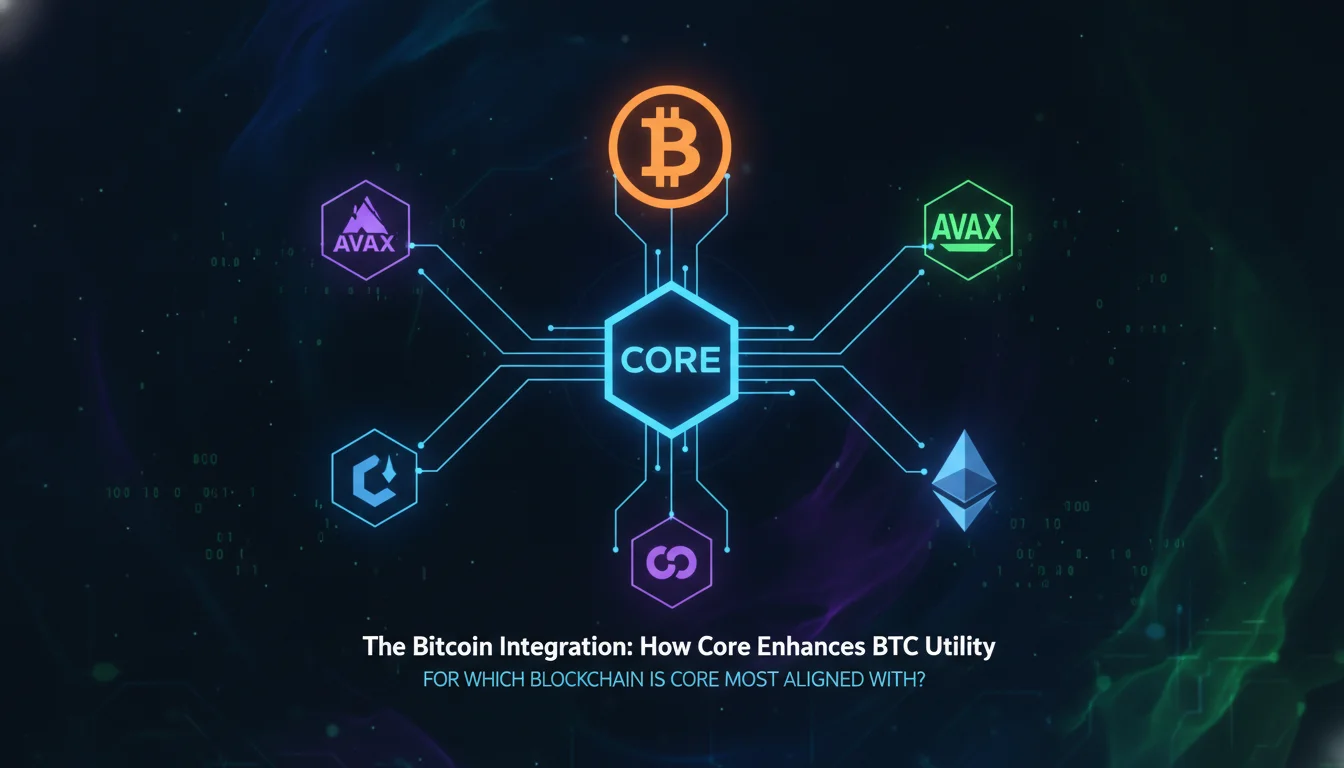
No analysis of the blockchain is core most aligned with is complete without a deep look at its Bitcoin-specific features. Core is not just Bitcoin-compatible. It actively expands what Bitcoin can do without touching Bitcoin’s base layer.
Non-Custodial Bitcoin Staking Explained
Traditional staking requires locking assets with a validator, often introducing custody risk. Core’s self-custodial Bitcoin staking sidesteps that entirely. Bitcoin holders retain control of their BTC while delegating it to Core validators via a time-locked script using Bitcoin’s native CLTV timelocks. The BTC is never under a third party’s control. Stakers earn CORE token rewards in return for enhancing network security. Per Core DAO’s documentation, this is the first live self-custodial staking mechanism for Bitcoin, aligning precisely with the BTC community’s ethos of self-sovereignty.
coreBTC: Native Bitcoin on Core Chain
Core introduced coreBTC as a wrapped Bitcoin asset native to the Core chain. Unlike wrapped BTC solutions that rely on custodians, coreBTC uses a decentralized network of Lockers, Guardians, Liquidators, Porters, and Relayers to maintain a trustless 1:1 peg. As Core DAO contributor Rich Rines explained:
“coreBTC provides a Bitcoin-equivalent in DeFi, allowing Bitcoin holders to maintain their asset’s value while accessing a variety of DeFi applications on the Core blockchain. It is a solution that bridges the gap between Bitcoin’s security and the endless possibilities of DeFi.”
This integration positions Core as the DeFi execution layer for Bitcoin, a role Ethereum once aspired to but could never fully claim given its separate consensus and no native BTC security integration.
“Core is a high-performance, EVM-compatible Layer 1 blockchain, designed to be Bitcoin’s complementary and hyper-scalable smart contract platform. By leveraging Bitcoin-native CLTV timelocks, Bitcoin mining hash power, and modern smart contract capabilities, Core unlocks Bitcoin as both the prime protector and central asset of a thriving decentralized application ecosystem.” – Core DAO Documentation
Step-by-Step: Staking BTC on Core
- Set up a compatible wallet: Install MetaMask or Unisat wallet and configure it for Core Chain (Chain ID: 1116, RPC: https://1116.rpc.thirdweb.com).
- Acquire BTC and bridge to Core: Use the Core Bridge, powered by LayerZero, to transfer Bitcoin from the Bitcoin network to Core. Alternatively, purchase BTC on a centralized exchange and withdraw to a Core-compatible address.
- Choose a staking validator: Visit the Core staking dashboard to review validator performance and fee structures.
- Delegate your BTC: Initiate a non-custodial delegation transaction. Your BTC remains locked in a time-locked contract on Bitcoin, but its voting weight secures Core validators.
- Earn CORE rewards: Depending on validator selection, you receive periodic CORE token rewards. You can redelegate or unlock your BTC at maturity.
Ethereum Alignment: Core as an EVM-Based Smart Contract Hub
Core’s security model runs on Bitcoin, but its execution environment runs on Ethereum logic. Full EVM compatibility means Core can host everything from simple ERC-20 tokens to complex DeFi protocols, all while benefiting from Bitcoin-grade security underneath.
dApp Migration and Developer Tools
For developers, moving an Ethereum dApp to Core is often as simple as changing the RPC endpoint and redeploying contracts. The entire Ethereum development stack, including Solidity, Hardhat, Truffle, Remix, and OpenZeppelin libraries, works unmodified. As confirmed by thirdweb’s direct support for Core, developers can build with wallets, tokens, and APIs exactly as they would on Ethereum. Core also supports EIP-7702, an account abstraction standard, signaling its commitment to tracking Ethereum improvement proposals as they mature.
Core’s Ecosystem: A Growing DeFi Landscape
According to CoinGecko’s Core Ecosystem category, dozens of tokens and projects are actively building on the chain, including bridged WETH, stablecoins like USDT and USDC, staking derivatives such as stCORE, and native DEXs like IceCreamSwap and ArcherSwap. Projects like Colend (lending) and ASX Capital (yield aggregation) are designed to put BTC liquidity to work in novel ways. This mirrors Ethereum’s early DeFi growth trajectory, but with a Bitcoin-native flavor throughout.
Cross-Chain Interoperability with Core Bridge
Core Bridge, built on LayerZero, enables asset transfers between Core and networks like Ethereum, BNB Chain, and Avalanche. This cross-chain capacity ensures Core is not an isolated Bitcoin outpost. It is a hub connecting the Bitcoin world with the broader DeFi universe. The philosophy is clear: Bitcoin is the base money, and Core provides the financial infrastructure layer on top.
CORE Tokenomics and Governance
Understanding which blockchain is Core most aligned with also means understanding how CORE, the native token, is structured and governed. The token is central to the entire ecosystem.
The CORE Token’s Role
According to the Reflexivity Research overview of Core DAO, the native CORE token supports decentralized governance, facilitates utility functions, and enables peer-to-peer transactions. CORE can be stored in wallets, used to pay gas fees, staked to participate in validator elections, and traded on digital asset exchanges. This mirrors the role ETH plays in Ethereum’s economy, reinforcing Core’s dual alignment.
Governance: Three Stages of Decentralization
Per CoinMarketCap Academy’s analysis, Core DAO has outlined three stages of governance decentralization. The first stage is off-chain governance, where resolutions pass with a majority of DAO voters. The second is limited on-chain governance, allowing changes to fixed parameters through on-chain voting. The third is full on-chain governance, giving CORE token holders complete control over protocol decisions. A precise timetable for each stage has not been publicly established. The progression reflects a deliberate, cautious approach to decentralization that prioritizes security over speed.
Comparative Analysis: Core Against Stacks and Rootstock
When asking which blockchain is Core most aligned with, it helps to compare Core against other projects that also claim Bitcoin alignment. Stacks and Rootstock are the two most relevant competitors in this space.
Core vs. Stacks
Stacks brings smart contracts to Bitcoin via a separate chain and its own Clarity language. Clarity is intentionally not Turing-complete, prioritizing predictability and auditability over flexibility. Core takes the opposite approach: full EVM compatibility and Solidity support. Stacks anchors its blocks to Bitcoin’s chain for security, but it does not integrate Bitcoin miners directly into its validator set. Core’s Satoshi Plus mechanism gives Bitcoin miners an active economic role in Core’s consensus, creating a tighter security coupling than Stacks achieves.
Core vs. Rootstock (RSK)
Rootstock is an EVM-compatible sidechain that uses merged mining with Bitcoin. This means Bitcoin miners can simultaneously mine RSK blocks, providing security without additional energy expenditure. Core’s approach is similar in spirit but distinct in execution: rather than merged mining, Core uses delegated hash power through Satoshi Plus, combining it with BTC staking and CORE staking in a single unified mechanism. Core is a sovereign Layer 1 with its own consensus, whereas RSK functions more as a sidechain dependent on Bitcoin’s base layer for finality. Both are Bitcoin-aligned, but Core’s architecture is more ambitious in scope.
Pros and Cons
Pros
- Bitcoin-grade security: Satoshi Plus harnesses roughly 75% of Bitcoin’s mining hash power, giving Core a security budget that most new L1s cannot match.
- Full EVM compatibility: Any Solidity developer can build on Core immediately, with no new language to learn and no tooling changes required.
- Non-custodial BTC staking: The first live self-custodial Bitcoin staking mechanism lets BTC holders earn yield without surrendering control of their assets.
- Cross-chain connectivity: Core Bridge via LayerZero connects Core to Ethereum, BNB Chain, and Avalanche, avoiding ecosystem isolation.
- Low fees and rapid finality: The validator election process is designed for high-speed block production and low transaction costs compared to Bitcoin and Ethereum mainnet.
Cons
- Ecosystem maturity: Core’s DeFi ecosystem is still early-stage compared to Ethereum’s deep liquidity and years of battle-tested protocols.
- Bitcoin miner dependency: Security relies partly on continued miner participation. If miners reduce delegation, Core’s security budget shrinks.
- Governance centralization risk: Full on-chain governance has not yet launched, meaning the protocol still relies on off-chain coordination for major decisions.
- Dual-chain complexity: Users and developers must understand both Bitcoin’s UTXO model and Ethereum’s account model to fully use Core’s features, raising the learning curve.
Which Blockchain Is Core Most Aligned With? A Technical and Philosophical Synthesis
After examining the technical layers, which blockchain is Core most aligned with resolves to a dual allegiance rather than a single answer.
The Dual Identity of Core
Core’s identity is split by design. It is a Bitcoin-secured network running Ethereum’s programmability. If forced to choose one, its philosophical and security alignment is overwhelmingly with Bitcoin. The chain was built to enhance Bitcoin’s value proposition, not compete with it. Yet in daily usage, a developer or user experiences Core as an Ethereum-like environment. This dual nature is Core’s core strength: it serves as a portal for Bitcoin holders into DeFi while giving Ethereum developers a new home that does not compromise on security. As Reflexivity Research describes it, Core is “the first Bitcoin-aligned EVM blockchain,” a label that captures the hybrid nature precisely.
Why Alignment Matters for Developers and Investors
For developers, alignment dictates tooling and required skillsets. Core’s EVM compatibility means any Solidity developer can build on it immediately. For investors and users, alignment determines narrative and network effects. Core’s Bitcoin narrative attracts those skeptical of Ethereum’s frequent upgrade cycles or its value capture model. Its Ethereum compatibility attracts builders who want access to the largest smart contract developer community. Both groups find something familiar here.
Future Directions: Deepening Bitcoin Alignment or Broadening EVM Adoption?
Core’s roadmap points toward continued Bitcoin integration. Expanded mining delegation, more liquid staking derivatives for BTC, and deeper cross-chain interoperability are plausible next steps based on the current trajectory. At the same time, the chain must attract EVM dApps to fuel ecosystem growth. The governance process, moving from off-chain voting toward full on-chain governance, will ultimately let the community decide this balance. The introduction of coreBTC and the Builder’s Incentive Program both signal a DeFi focus, but always with Bitcoin as the anchor asset.
Expert Insights and Market Outlook
What Analysts Say About Core’s Position
Industry observers have noted Core’s distinct value proposition. Its listing on major exchanges like Bybit and its inclusion in CoinGecko’s Core Ecosystem category reflect market recognition. Some analysts caution that Core’s long-term success depends on convincing Bitcoin maximalists that the chain genuinely enhances Bitcoin without centralizing it. The self-custodial staking mechanism is the strongest proof point in that argument. According to CoinMarketCap Academy, Core had processed over 5.7 million transactions and amassed 2 million unique addresses at the time of their analysis, alongside a social following of 1.6 million Twitter followers and 210,000 Discord members.
Key Indicators to Watch
- Hash rate delegation: The share of Bitcoin miners participating signals confidence from the Bitcoin community in Core’s security model.
- Total value locked in coreBTC: As a proxy for BTC flowing into Core DeFi, this metric shows whether Bitcoin holders trust the bridge mechanism.
- Ecosystem growth: Active dApp count, unique wallet addresses, and transaction volume indicate real-world adoption beyond speculative interest.
- Governance progression: Movement from off-chain to full on-chain governance will signal protocol maturity and genuine decentralization.
How to Add Core Blockchain to MetaMask
Getting started with Core is straightforward for anyone already using MetaMask. In MetaMask, go to Settings, then Networks, then Add Network. Enter the following details: Network Name: Core Blockchain, RPC URL: https://1116.rpc.thirdweb.com, Chain ID: 1116, Currency Symbol: CORE, Block Explorer URL: https://scan.coredao.org. Once saved, you can bridge assets via Core Bridge and interact with any dApp in the Core ecosystem immediately.
Frequently Asked Questions
What is the Core blockchain?
Core is an EVM-compatible Layer 1 blockchain that uses the Satoshi Plus consensus mechanism, integrating Bitcoin miners and BTC stakers to secure a smart contract platform. It launched on January 14, 2023, and aims to extend Bitcoin’s utility into DeFi without altering Bitcoin’s base layer.
How does Core’s Satoshi Plus consensus work?
Satoshi Plus combines Delegated Proof of Work using Bitcoin mining hash power, non-custodial Bitcoin staking via CLTV timelocks, and Delegated Proof of Stake using CORE tokens. This three-part mechanism elects validators and secures the network while aligning incentives across Bitcoin miners, BTC holders, and CORE stakers.
Which blockchain is Core most aligned with?
Which blockchain is Core most aligned with depends on the lens you use. Philosophically and from a security standpoint, Core is most aligned with Bitcoin. Technically and from a developer tooling standpoint, it is most aligned with Ethereum. It deliberately bridges both ecosystems rather than choosing one.
Can I use Ethereum dApps on Core?
Yes. Core’s full EVM compatibility means any Ethereum dApp deploys on Core with minimal changes. Wallets like MetaMask and development tools like Hardhat and Remix work natively without modification.
What is coreBTC and how does it differ from other wrapped Bitcoin?
coreBTC is a wrapped version of Bitcoin native to Core Chain, maintaining a 1:1 peg through a decentralized network of Lockers, Guardians, Liquidators, Porters, and Relayers rather than a centralized custodian. This trustless mechanism allows BTC to be used in Core’s DeFi applications while preserving the security guarantees Bitcoin holders expect.
Ready to build on the chain that bridges Bitcoin’s security with Ethereum’s programmability? Apply to the Genesis Cohort at digitalblockchains.com and work with a team that deploys smart contracts and designs tokenomics for protocols that actually ship.