Developing a blockchain is the process of designing, building, and maintaining a decentralized ledger system that uses cryptography and consensus mechanisms to secure data. This guide covers feasibility studies, step-by-step coding, and deployment best practices for 2026.
Key Takeaways
- Developing a blockchain means constructing a decentralized, immutable ledger from scratch, not just deploying apps on existing chains.
- A feasibility study is critical: many projects are better served by existing platforms like Ethereum or Hyperledger Fabric.
- Core components include block structure, consensus protocol, peer-to-peer networking, and an optional smart contract layer.
- According to Coursera, the median total salary for blockchain developers in the United States is $136,000 per year, reflecting strong demand for specialized skills.
- AI tools accelerate coding and auditing but cannot yet design a secure, novel blockchain autonomously.
- Governance design and tokenomics are as consequential as the technical architecture itself.
What Is Developing a Blockchain?
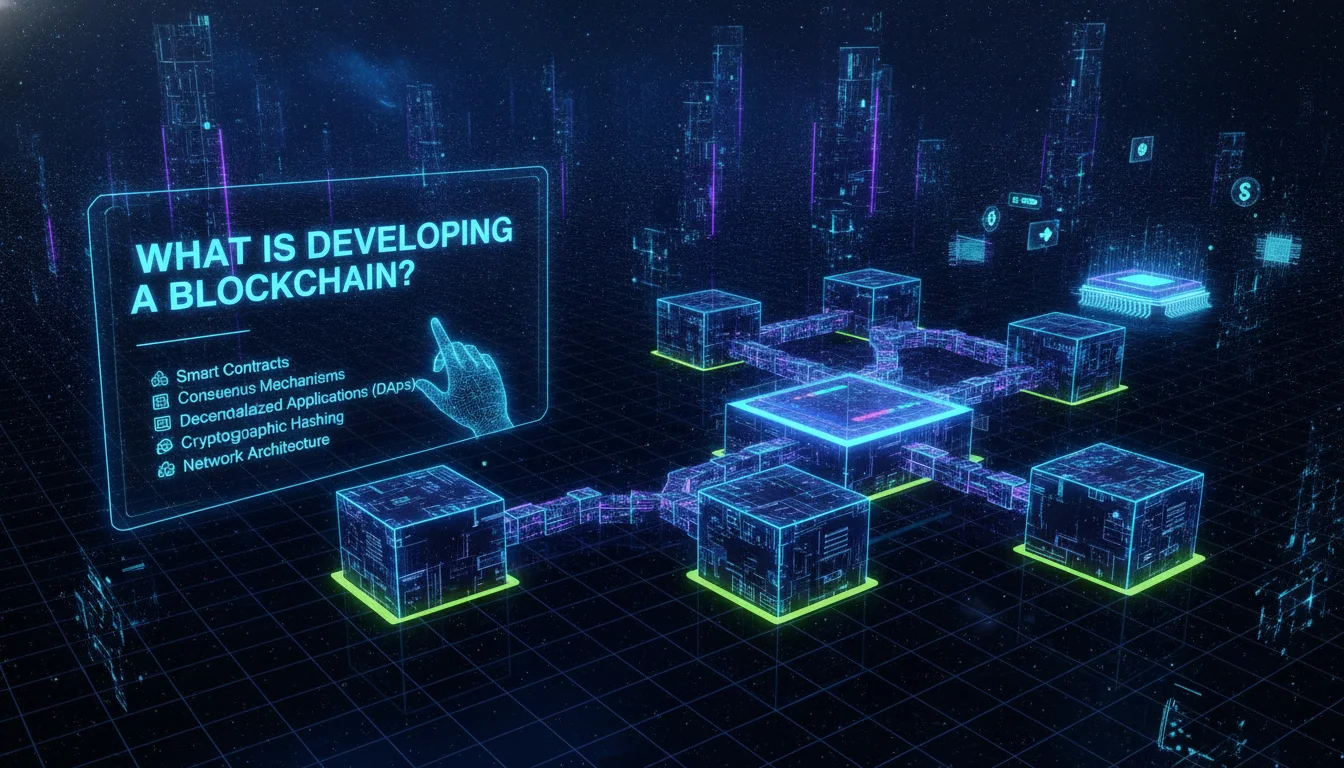
Developing a blockchain means constructing a new, standalone distributed ledger, complete with its own consensus mechanism, node network, and often a native cryptocurrency or token. This is distinct from building decentralized applications (dApps) on existing chains like Ethereum or Solana. When you take on this work, you become a core blockchain developer, responsible for the protocol itself, not just smart contracts.
According to Coursera, “blockchain development refers to building, maintaining, and designing blockchain applications and systems.” That definition covers everything from creating new consensus algorithms to designing data structures that stay tamper-proof. The process is inherently multi-disciplinary, combining cryptography, distributed systems, game theory, and software engineering.
The Difference Between Core and Application Development
Two broad specializations exist in this field. Core blockchain developers focus on the underlying protocol, networking, and consensus. They write code in languages like C++, Go, or Rust to handle block propagation, transaction validation, and fork resolution. Application-level developers write smart contracts and dApps using languages like Solidity or Vyper. While both groups work within the blockchain space, developing a blockchain at the protocol level is a fundamentally different discipline. This guide concentrates on core development, though many steps apply to both tracks.
Why Build a Blockchain from Scratch?
Existing blockchains meet most needs, but certain scenarios demand a custom solution. Enterprises with strict data privacy requirements may need a permissioned network where all nodes are known and credentialed. Projects requiring ultra-high throughput or a novel fee model might find off-the-shelf platforms insufficient. Developing a blockchain from scratch also gives full control over governance, upgrade mechanisms, and tokenomics: factors that can be decisive for long-term success in regulated industries.
Key Concepts for Blockchain Development
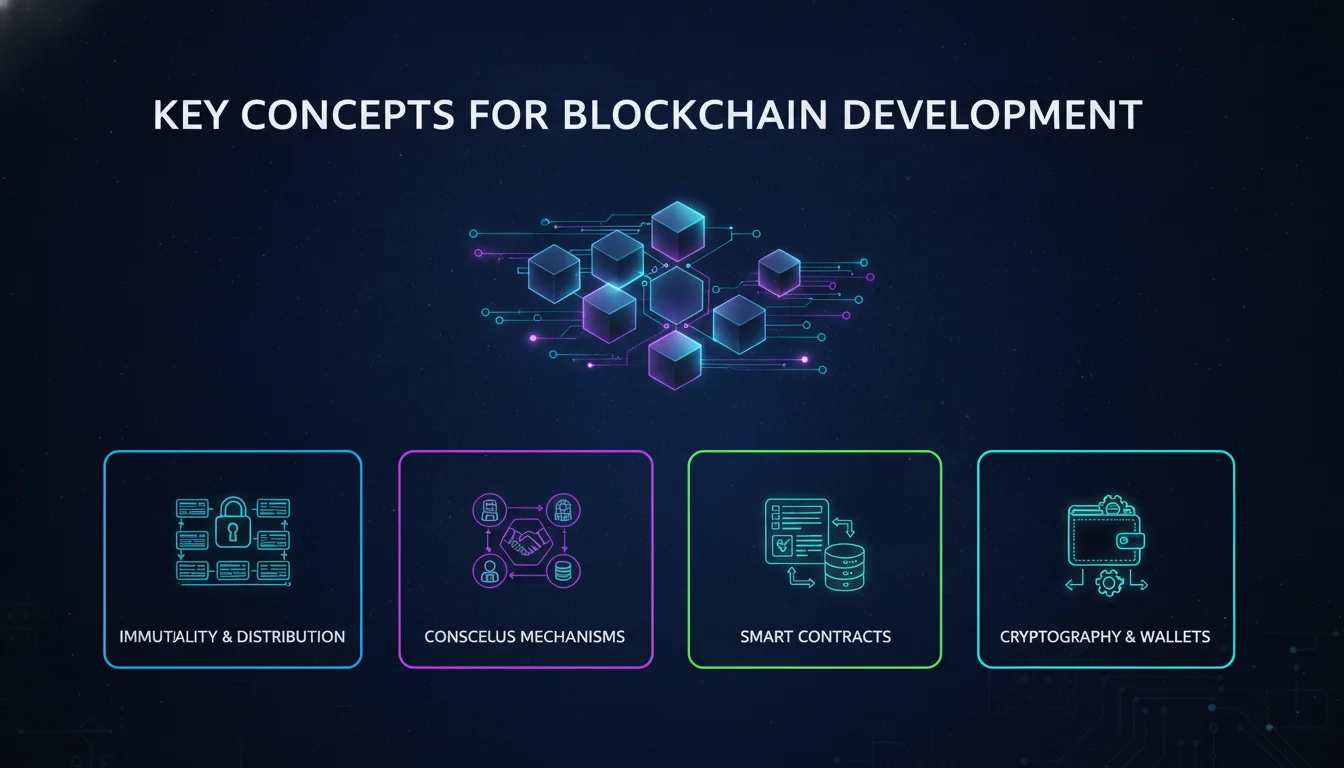
Before writing a single line of code, you need a firm grip on the foundational technologies. A blockchain is not a single invention but a synthesis of existing ideas: cryptographic hashing, peer-to-peer networking, and distributed consensus. These concepts are the building blocks every protocol engineer must internalize.
Decentralization and Trust
Decentralization is the property of a system where no single entity controls the network. In a blockchain, every full node stores a copy of the ledger, and updates are achieved through consensus rules. This eliminates single points of failure and reduces the need for trusted intermediaries. The EU Blockchain Observatory notes that decentralization ensures the ledger is maintained by a distributed network of participants, making it resilient and censorship-resistant.
Cryptographic Building Blocks
Cryptographic hash functions like SHA-256 and Keccak-256 are the glue of any blockchain. They take input data and produce a fixed-size, deterministic output. A tiny change in input produces a completely different hash, enabling immutability. Blocks contain the hash of the previous block, forming a chain that cannot be altered without detection. Digital signatures, such as ECDSA, prove ownership and authorize transactions without revealing private keys. These primitives are non-negotiable when developing a blockchain from the ground up.
Consensus Mechanisms
A consensus mechanism is the protocol that allows distributed nodes to agree on the state of the ledger. The choice of consensus is the single most critical design decision you will make. Proof of Work (PoW), used by Bitcoin, relies on computational puzzles to select block producers. Proof of Stake (PoS), adopted by Ethereum after the Merge, selects validators based on the amount of cryptocurrency they lock up. Other options include Delegated PoS (DPoS), Practical Byzantine Fault Tolerance (PBFT), and novel algorithms like Avalanche’s Snowball protocol. Each offers different trade-offs in security, speed, and energy efficiency.
Is Building Your Own Blockchain the Right Move?

Not every project needs a custom blockchain. Before committing engineering resources, a rigorous feasibility study can save months of wasted effort. According to ScienceSoft, the first step in developing a blockchain solution is to conduct a feasibility study, which includes assessing whether the problem genuinely requires the immutability, multi-party trust, and auditability that only a blockchain can provide.
When to Choose an Existing Platform
For most startups and enterprise consortia, an existing platform like Ethereum (or its L2s), Hyperledger Fabric, Cosmos, or Polkadot is sufficient. These platforms handle security, networking, and consensus out of the box. Building on them can compress time-to-market from years to weeks. If your primary need is to deploy smart contracts or issue tokens, you are not developing a blockchain: you are building on one. Only when you need to modify consensus rules, create novel fee markets, or implement custom privacy features should you seriously consider building from scratch.
Conducting a Feasibility Study
A proper feasibility study involves three stages: defining the business problem and stakeholders, identifying technical requirements such as throughput, finality, and permission model, and comparing off-the-shelf versus custom build options. Many projects begin with a proof-of-concept on a testnet before committing to a dedicated chain. This validates user adoption without overinvestment.
Architecture Decisions: Public, Private, or Consortium
Blockchains can be public (permissionless) like Bitcoin, private (permissioned) within an enterprise, or consortium-governed by a group of known entities. This decision affects node participation, data visibility, and regulatory compliance. A supply chain network might use Hyperledger Fabric to restrict access to known trading partners. Developing a blockchain for a consortium requires extra attention to identity management and certificate authorities.
Step-by-Step: Developing a Blockchain in 2026
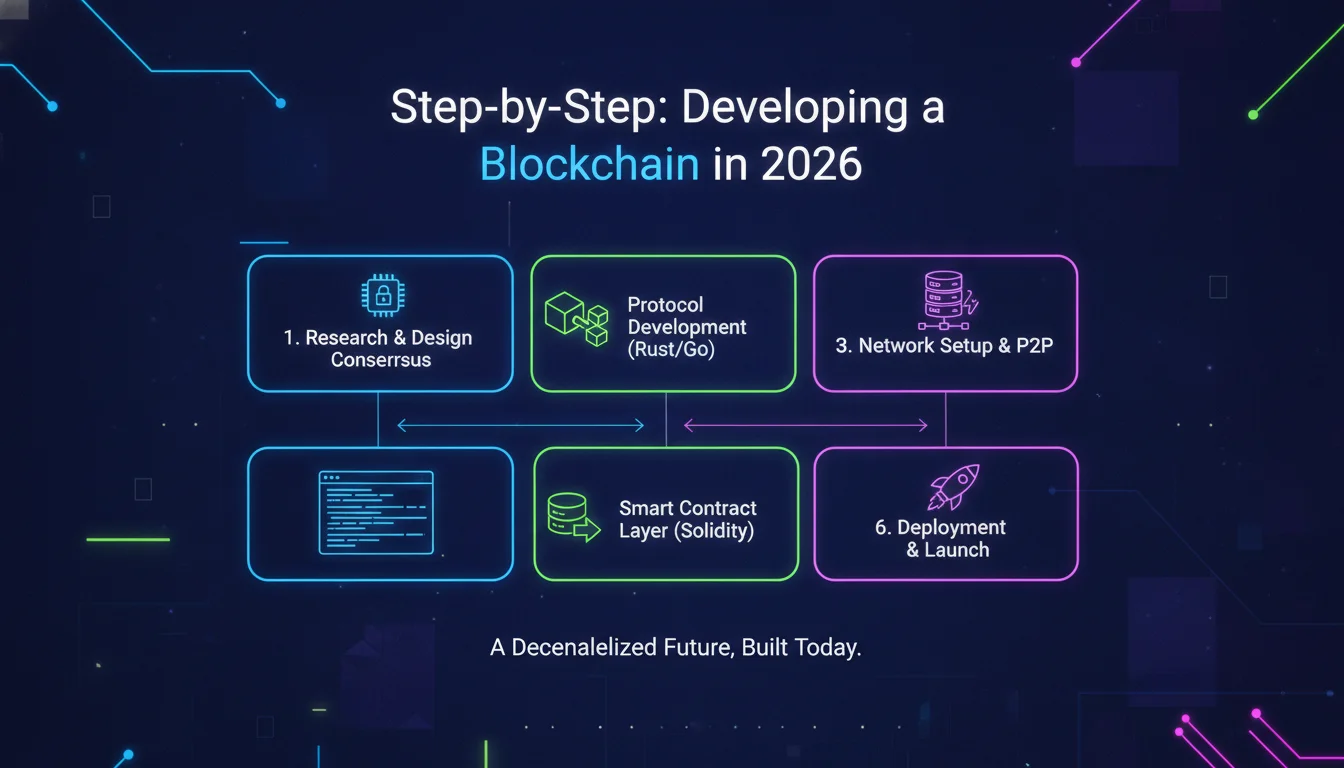
This section outlines a practical development process. While languages and tools evolve, the core sequence remains constant. You can follow these steps using Go, Rust, C++, or even Python for early prototyping. ScienceSoft’s development framework, drawn from their blockchain practice, structures this as four phases: feasibility, conceptualization, development and QA, then integration and deployment.
Step 1: Design the Block and Transaction Model. Define what a block contains: typically an index, timestamp, list of transactions, nonce, previous block hash, and current block hash. Also model the transaction structure: sender, receiver, amount, payload, and digital signature. Every block must have a clear validation routine before you move forward.
Step 2: Implement the Consensus Protocol. Code the rules that determine who can produce the next block and how the network resolves conflicts. If using PoW, set the difficulty adjustment algorithm. If using PoS, code the validator selection logic and slashing conditions.
Step 3: Build the Peer-to-Peer Network Layer. Use libraries like libp2p (Go/Rust) or standard sockets to enable node discovery, block propagation, and transaction gossip. Handle NAT traversal, peering, and message serialization. Node identity should be tied to cryptographic key pairs.
Step 4: Write the State Machine and Storage. The state machine defines how the ledger updates with each block. Choose a key-value store like LevelDB or RocksDB, or an embedded SQL engine. Implement Merkle-Patricia tries for efficient state proofs.
Step 5: Add Smart Contract Execution (Optional). If your blockchain will support custom logic, integrate a virtual machine such as the EVM or WASM and design a gas metering system. Languages like Solidity or Rust can compile to your VM’s bytecode.
Step 6: Test and Audit Thoroughly. Unit tests, integration tests, and fuzz testing are essential. Use frameworks like Foundry for Solidity or built-in testing libraries in Go. Engage external auditors before mainnet launch.
From Prototype to Testnet
Start with a local single-node implementation. Then spawn multiple nodes on a private network and simulate latency, packet loss, and Byzantine behavior. Once stable, launch an incentivized testnet to attract community validators. Many successful blockchains ran multiple testnets before their mainnet genesis, and that discipline pays off in fewer critical bugs at launch.
Deployment and Maintenance
Deploying a mainnet requires bootstrapping initial validators, distributing genesis block tokens, and monitoring node performance. Ongoing maintenance involves protocol upgrades, bug fixes, and responding to network attacks. Clear governance processes, whether on-chain or off-chain, are necessary to coordinate upgrades without contentious hard forks.
Programming Languages and Tools for Blockchain Development
The choice of programming language has long-term implications for performance, security, and developer ecosystem. According to Built In, most blockchain core engines are built in C/C++, Go, Java, Rust, Haskell, and Ruby, with some projects combining multiple languages for robustness. For smart contracts, high-level languages like Solidity, Vyper, or Rust are preferred.
Core Protocol Languages
Bitcoin and its derivatives are written in C++. The Ethereum main client (go-ethereum) is in Go, but other implementations use Rust, Java, and C#. Rust has gained significant traction for its memory safety guarantees: projects like Solana, Polkadot, and Near are built in Rust. Go is valued for its simplicity and concurrent programming model, making it a strong choice for developing a blockchain that requires high network throughput.
Smart Contract Languages and Frameworks
For EVM-compatible chains, Solidity remains the dominant language. Vyper offers a Pythonic syntax with strong typing and a smaller attack surface. Beyond Ethereum, Rust-based blockchains allow smart contracts written in Rust, such as Ink! for Polkadot. Development frameworks like Hardhat, Brownie, and Foundry streamline testing, deployment, and scripting. These tools are indispensable when developing a blockchain that supports programmable logic.
Popular Development Frameworks and IDEs
Truffle Suite provides a complete environment for smart contract compilation and migration. Hardhat (JavaScript/TypeScript) offers a flexible plugin system that most EVM teams now prefer. For core protocol development, IDEs such as VS Code with Rust Analyzer or GoLand are standard. Version control with Git and CI/CD pipelines on GitHub or GitLab are essential for any team collaboration at scale.
Tokenomics Design: The Economic Layer
Tokenomics is the economic architecture of your blockchain, and it deserves the same rigor as your consensus algorithm. A poorly designed token model can undermine an otherwise technically sound protocol. Getting this right requires thinking through supply mechanics, distribution schedules, and incentive alignment across all network participants.
Supply and Distribution
Decide early whether your token has a fixed supply, an inflationary issuance model, or a deflationary burn mechanism. Bitcoin’s fixed 21 million supply is a deliberate design choice that shapes its security model. Ethereum shifted to a variable issuance rate after the Merge, with burns introduced via EIP-1559 creating deflationary pressure under high usage. Your supply schedule directly affects validator incentives and long-term network security.
Incentive Alignment
Every participant in your network, including validators, developers, and end users, needs a reason to behave honestly. Staking rewards compensate validators for locking capital and running nodes. Treasury allocations fund protocol development. Vesting schedules for founding teams signal long-term commitment to the community. Misaligned incentives are one of the most common causes of protocol failure, often more damaging than technical bugs.
Governance Token Design
If your blockchain uses on-chain governance, the token doubles as a voting instrument. Consider vote-weighting models, quorum thresholds, and time-lock mechanisms that prevent governance attacks. Protocols like Compound and Uniswap have published their governance frameworks openly, and studying them before designing your own is time well spent.
Blockchain Governance Models
Governance is how a blockchain makes collective decisions about protocol upgrades, parameter changes, and treasury spending. It is one of the most underestimated design challenges in developing a blockchain, and one of the most consequential.
On-Chain vs. Off-Chain Governance
On-chain governance encodes voting directly into the protocol. Token holders submit proposals and vote, with outcomes automatically executed by the chain. Polkadot’s OpenGov system is a mature example. Off-chain governance relies on social consensus: developers propose changes via improvement proposals (similar to Ethereum’s EIP process), and miners or validators signal support through software upgrades. Both models have trade-offs. On-chain governance is faster but can concentrate power among large token holders. Off-chain governance is more deliberate but can stall on contentious issues.
Fork Coordination
Hard forks require all nodes to upgrade simultaneously. Soft forks are backward-compatible. Clear communication, long upgrade windows, and strong community buy-in are prerequisites for a successful fork. The history of Bitcoin Cash and Ethereum Classic shows what happens when governance breaks down: the chain splits, and both sides pay the price in security and liquidity.
The Role of AI in Developing a Blockchain
AI significantly accelerates certain tasks in blockchain development, but fully autonomous protocol design remains out of reach. Complex consensus design, security analysis, and economic incentive modeling still require human expertise. The People Also Ask question “Can AI make blockchain?” has a clear answer: not yet, and not without substantial human direction.
AI-Assisted Code Generation
Tools like GitHub Copilot and similar AI coding assistants can generate boilerplate code for block structure, cryptographic hashing, and simple consensus logic. For a developer prototyping a new chain, AI can meaningfully reduce initial coding time. That said, generated code must be reviewed meticulously, especially for consensus-critical sections where subtle bugs can lead to catastrophic failures or economic exploits.
Automated Auditing and Vulnerability Detection
AI-based static analysis tools, such as Slither for Solidity, detect common vulnerabilities including reentrancy, integer overflows, and unchecked return values. Fuzz testing with AI-generated inputs helps uncover edge cases that manual testing misses. These tools are valuable, but they cannot replace manual audits by experienced security researchers for production-grade code.
Limitations and Human Oversight
Designing a novel consensus algorithm or optimizing tokenomics involves game theory and economic modeling that current AI cannot reliably execute. AI also lacks the context of real-world regulatory requirements and user behavior patterns. For the foreseeable future, developing a blockchain will remain a human-driven process augmented by AI tools, not replaced by them.
Costs and Team Roles for Blockchain Projects
Building a blockchain from scratch is a capital-intensive endeavor. A full in-house team can cost millions of dollars per year. Smart planning and phased delivery can mitigate financial risk significantly.
Typical Team Composition
According to ScienceSoft, essential roles include a business consultant, blockchain architect, project manager, core blockchain developer, back-end developer, UX/UI designer, front-end developer, DevOps engineer, and QA engineer. For a minimal viable team, you need at least a blockchain architect and two core developers proficient in systems programming. Outsourcing or staff augmentation can reduce costs while accessing global talent pools.
“Blockchain development is the process of building software that functions within the blockchain platform and guarantees immutability and full traceability of data.” – ScienceSoft Blockchain Development Guide
Cost Estimation Breakdown
Costs vary widely based on complexity and geography. A simple permissioned chain might be built for $150,000 to $300,000, while a public, high-throughput network with custom consensus can exceed $1 million. These are rough ranges; ScienceSoft recommends using its online calculator for tailored estimates. Salaries for senior blockchain developers in North America average $136,000 per year according to Coursera, and contract rates for specialized protocol engineers run considerably higher.
“The median total salary for blockchain developers in the United States is $136,000 per year.” – Coursera, updated May 2026
Pros and Cons of Developing a Blockchain from Scratch
Pros
- Full protocol control: You define consensus rules, fee markets, governance, and upgrade paths without being constrained by another team’s roadmap.
- Custom privacy and permission models: Permissioned chains can enforce identity requirements that public networks cannot accommodate.
- Optimized performance: A chain built for a specific use case, such as high-frequency settlement or supply chain traceability, can outperform general-purpose platforms.
- Native tokenomics: You design the economic model from the ground up, aligning incentives precisely with your network’s goals.
- Long-term independence: No dependency on a third-party chain’s upgrade decisions, fee changes, or governance outcomes.
Cons
- High cost and time: Building a production-ready chain takes years and millions of dollars in engineering resources.
- Security burden: You own every vulnerability. There is no established community of auditors familiar with your codebase from day one.
- Cold-start problem: Attracting validators, developers, and users to a new chain is harder than deploying on an established network with existing liquidity.
- Governance complexity: Coordinating protocol upgrades across a decentralized validator set requires mature processes that take time to develop.
- Opportunity cost: The engineering hours spent building infrastructure could often ship more user value on an existing platform.
Comparison of Consensus Mechanisms
The consensus algorithm is the heart of any blockchain. The table below compares the most common mechanisms used when developing a blockchain, helping you match the right protocol to your use case.
| Consensus | Type | Energy Efficiency | Finality | Use Cases | Example Chains |
|---|---|---|---|---|---|
| Proof of Work (PoW) | Permissionless | Low (high energy) | Probabilistic | Public, high security | Bitcoin, Litecoin |
| Proof of Stake (PoS) | Permissionless | High | Probabilistic or BFT | Public, general | Ethereum, Cardano |
| Delegated PoS (DPoS) | Permissionless | High | Near-instant | High-throughput public | EOS, TRON |
| PBFT | Permissioned | Medium | Absolute | Enterprise consortia | Hyperledger Fabric |
| Avalanche (Snowball) | Permissionless | High | Sub-second | Scalable dApps, DeFi | Avalanche |
Choosing the Right Consensus
Public networks typically opt for PoW or PoS due to their sybil resistance properties. Permissioned networks can use lighter-weight protocols like Raft or PBFT, where validator identities are known in advance. For an enterprise supply chain consortium, PBFT offers fast finality and low overhead. For a public DeFi chain, PoS with slashing conditions provides the security guarantees users expect.
Beyond Consensus: L2 and Interoperability
Modern blockchain development increasingly focuses on Layer 2 scaling solutions, including rollups and sidechains, and cross-chain interoperability protocols like IBC and CCIP. If you are building a new chain, consider whether it should natively support interoperability standards from day one to avoid ecosystem isolation later.
Future Trends in Blockchain Development
The blockchain space evolves quickly. Developers must stay current with emerging trends that could influence the design of a new chain from the outset.
Zero-Knowledge Proof Integration
ZK-SNARKs and ZK-STARKs enable private transactions and scalable proofs without revealing underlying data. Integrating a zero-knowledge layer into a blockchain can attract privacy-focused applications and reduce on-chain data requirements. Several newer L1s are built with ZK proofs at the core. Expect ZK integration to become a standard consideration when developing a blockchain for the Web3 ecosystem over the next few years.
AI and Autonomous Agents
AI agents are beginning to use blockchains for financial operations and data storage. Future chains may be optimized for AI-to-AI transactions, requiring low fees and high throughput at the protocol level. While AI cannot yet develop a blockchain entirely, it will shape the use cases and, consequently, the technical requirements of chains built today.
Regulation and Compliance
As governments introduce clearer frameworks for digital assets, new blockchains must consider on-chain identity, KYC, and AML requirements without sacrificing decentralization. Hybrid architectures that combine permissionless settlement layers with permissioned data layers are emerging as a practical response to this tension.
Conclusion
Developing a blockchain is a serious undertaking that blends deep computer science with strategic business planning. From initial feasibility to mainnet launch, every decision, including consensus, programming language, tokenomics, and governance, carries lasting consequences. AI and improved tooling are lowering the barrier to entry, but human judgment remains irreplaceable at the protocol design level. Whether you choose to build on an existing platform or craft a brand-new chain, the work demands rigorous architecture, robust testing, and a clear understanding of the problem you are solving. Those who master developing a blockchain at the protocol level will be positioned at the front of the next wave of decentralized infrastructure.
Ready to build? Apply to the Genesis Cohort at Digital Blockchains and work alongside protocol engineers who have been through this process end to end.
Frequently Asked Questions
How do I develop my own blockchain?
Start with a feasibility study to confirm a custom chain is necessary, then design your block and transaction model, implement a consensus protocol, build the peer-to-peer network layer, and add optional smart contract execution. Testing on a private network before launching an incentivized testnet is essential before any mainnet deployment.
What is blockchain developing?
Blockchain developing is the process of designing, building, and maintaining decentralized ledger systems, including core protocol work such as consensus and networking, as well as application-layer work like smart contracts and dApps. According to Coursera, it encompasses building, maintaining, and designing blockchain applications and systems.
Which programming language is best for developing a blockchain?
Go, Rust, and C++ are the most common choices for core protocol development due to their performance and memory safety characteristics. According to Built In, most blockchain core engines use C/C++, Go, Java, Rust, Haskell, or Ruby. Solidity remains the standard for smart contracts on EVM-compatible chains.
How much does it cost to develop a blockchain?
Costs range from roughly $150,000 for a simple permissioned chain to over $1 million for a high-throughput public network with custom consensus. Team salaries, infrastructure, and security audits are the primary cost drivers, and senior blockchain developers in North America earn a median of $136,000 per year according to Coursera.
Can AI fully develop a blockchain?
No. AI tools assist with code generation, boilerplate, and static analysis, but cannot design novel consensus mechanisms, model tokenomics incentives, or navigate regulatory requirements autonomously. Human oversight remains essential for any production-grade blockchain protocol.
Do I need a cryptocurrency for my blockchain?
Not always. Permissioned blockchains often operate without a native currency, using alternative incentive models tied to business relationships between known participants. Public blockchains typically require a token to fund validator security and coordinate governance.