A blockchain developer is a software engineer who designs, builds, and maintains decentralized applications and smart contracts on distributed ledger technology, enabling secure, transparent, tamper-proof transactions without central intermediaries.
Key Takeaways
- Two distinct tracks exist: core protocol developers and application (dApp) developers, each requiring different skill sets.
- The median US salary for a developer sits at $136,000 per year, with senior roles and token packages pushing well above that.
- A structured 10-month roadmap takes you from programming basics to mainnet deployments and a professional portfolio.
- Solidity, Rust, and JavaScript are the three languages that cover the widest range of blockchain ecosystems.
- Security is non-negotiable: tools like Slither, Echidna, and Foundry are standard in any serious development workflow.
- Over 300 million blockchain wallet users globally signal sustained, long-term demand for Web3 engineering talent.
What Is a Blockchain Developer?

A this type of developer is a software professional who builds on decentralized ledger technology to create secure, transparent applications. Unlike traditional developers working with centralized databases, a this kind of developer designs systems where data is distributed across a peer-to-peer network, eliminating single points of failure. The role demands deep understanding of how blockchains operate: from consensus mechanisms like Proof of Work (PoW) and Proof of Stake (PoS) to cryptographic hashing and digital signatures.
The Foundation of Blockchain
A blockchain is a decentralized, immutable digital ledger that records transactions in blocks linked via cryptography. Each block contains a timestamp, transaction data, and a hash of the previous block, creating an unbreakable chain. This structure ensures that once data is recorded, it cannot be altered without invalidating all subsequent blocks. That property is what makes Bitcoin and Ethereum trustworthy at scale. According to the GSDC, Bitcoin alone has 82 million active wallet users, and overall blockchain wallet users exceed 300 million, representing roughly 3.9% of the global population.
Core Responsibilities
On any given day, a blockchain might design smart contracts, implement decentralized storage solutions, or optimize consensus algorithms. They work closely with front-end developers to integrate blockchain functionality into user-facing applications. Security is paramount: a single vulnerability can trigger multimillion-dollar exploits, so rigorous code audits using tools like Slither or Echidna are standard practice. Staying current with emerging standards such as EIP-4337 (account abstraction) and zero-knowledge rollups is part of the job description, not optional reading.
Types of Blockchain Developers

The field splits into two primary tracks: core blockchain development and application development, each with distinct skill sets and focuses.
Core Blockchain Developer
A core developer works at the protocol level, designing and maintaining the blockchain architecture itself. That means setting consensus protocols, determining block validation rules, and coding the network layer. These developers work with low-level languages like Rust, C++, or Go and need a solid foundation in distributed systems, cryptography, and peer-to-peer networking. A core developer contributing to Ethereum might work on client implementations like Geth or Nethermind, optimizing performance and ensuring consensus compatibility. The entire network depends on their code, so the stakes are exceptionally high and the compensation reflects that, often above $130,000 per year.
Application (dApp) Blockchain Developer
Application developers build decentralized applications that run on top of existing blockchains. They write smart contracts, which are self-executing programs that encode business logic, and connect them to web or mobile front ends. These developers commonly use Solidity (for Ethereum), Rust (for Solana), or Move (for Aptos and Sui). Understanding token standards like ERC-20, ERC-721, and ERC-1155, plus wallet integration via MetaMask or WalletConnect, is essential. The rise of DeFi, NFTs, and on-chain gaming has made this track extremely popular, with thousands of new projects launching every year.
Pros and Cons of Becoming a Blockchain Developer
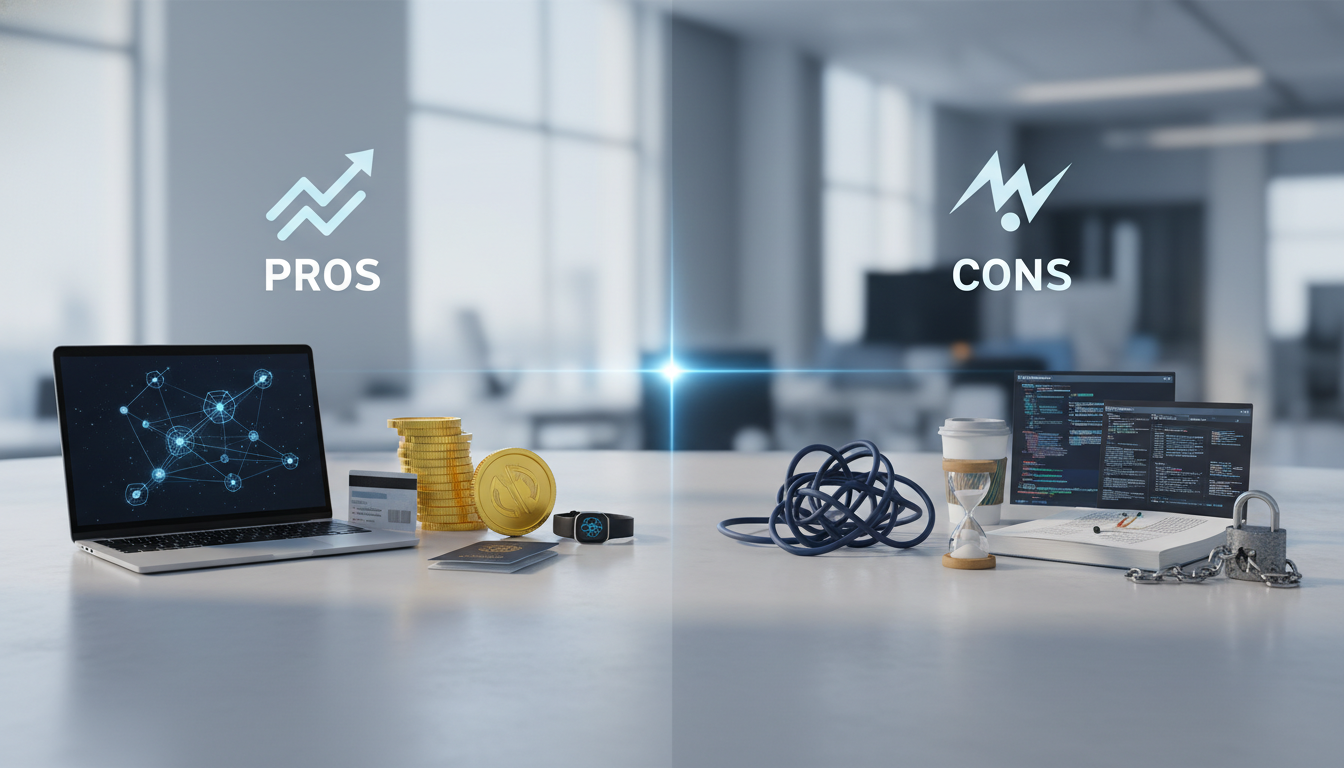
Before committing to this career path, it’s worth examining both sides honestly.
Pros
- High compensation: Median US salary of $136,000, with senior roles and token incentives pushing significantly higher.
- Strong demand: Over 350 active job listings on Indeed as of early 2026, spanning finance, healthcare, supply chain, and gaming.
- Meaningful work: You’re building infrastructure that removes intermediaries and gives users direct control over their assets.
- Remote-friendly: Most blockchain teams are distributed globally, offering genuine location flexibility.
- Rapid skill appreciation: Specializing in layer-2 scaling or zero-knowledge proofs can make you one of the most sought-after engineers in the market within 12-18 months.
Cons
- Steep learning curve: Cryptography, distributed systems, and new programming languages all at once is a serious cognitive load.
- High security stakes: A single bug in a deployed contract can result in irreversible fund loss. The pressure is real.
- Fragmented tooling: Each blockchain ecosystem has its own SDKs, testing frameworks, and deployment workflows, requiring constant context-switching.
- Market volatility: Hiring cycles in Web3 track crypto market sentiment more closely than traditional tech sectors.
- Constant re-learning: Protocol upgrades, new EIPs, and emerging chains mean your knowledge has a shorter shelf life than in most engineering fields.
How to Become a Blockchain Developer: A Step-by-Step Roadmap

Transitioning into a blockchain career is achievable with a clear roadmap. The journey breaks into three phases spanning roughly 10 months, a timeline consistent with expert guides and the this type of developer roadmap on roadmap.sh, which is followed by over 10,300 developers.
Phase 1: Learn Programming and Blockchain Basics (Months 1-3)
- Step 1: Master Programming Fundamentals. Start with JavaScript or Python. Focus on data structures (arrays, linked lists, hash maps), object-oriented programming, and asynchronous operations. This is your foundation for everything that follows.
- Step 2: Understand Blockchain and Cryptography. Learn how blockchains work: blocks, chaining, mining, consensus models. Study cryptographic primitives like hash functions (SHA-256), digital signatures (ECDSA), and public-key cryptography. The Coursera Blockchain Revolution specialization can teach these fundamentals in as little as two months.
Phase 2: Smart Contracts and dApp Development (Months 4-7)
- Step 3: Master Smart Contract Languages. Ethereum is the most established starting point. Learn Solidity, an object-oriented language for writing smart contracts, and practice on Remix, a browser-based IDE. Explore Vyper as a more security-focused alternative. For Solana, learn Rust. For Hyperledger Fabric, use Go or JavaScript.
- Step 4: Build and Test Your First dApp. Write a simple smart contract (a token or a basic voting system), compile and deploy it on a testnet like Sepolia. Build a frontend using React and ethers.js to interact with your contract. Test thoroughly using Hardhat or Foundry.
‘We’ve taken a stance that Hyperledger should support a variety of programming languages, ones that developers are very familiar with such as Java, Javascript, and Go Lang… it helps everybody to bring the blockchain to the developer and not have the developer go and overly bend or change to get to blockchain.’
Phase 3: Deploy, Professionalize, and Get Hired (Months 8-10+)
- Step 5: Deploy and Monitor on Mainnet. Move beyond testnets. Use node services like Alchemy or Infura for reliable network access. Implement CI/CD pipelines for automated testing and deployment. Monitor contracts using Tenderly for real-time alerts and transaction tracing.
- Step 6: Certify and Build a Portfolio. Earn credentials like the Certified Blockchain Professional to validate your skills formally. Contribute to open-source projects, participate in hackathons like ETHGlobal, and build a portfolio of deployed dApps with verifiable on-chain activity. Many hiring managers now check Etherscan before they check LinkedIn.
Core Technical and Soft Skills
A successful blockchain developer must master a blend of hard and soft skills that often go beyond traditional software engineering requirements.
Technical Skills
- Blockchain Architecture: Understanding how a decentralized network operates, from nodes and validators to governance models. Knowledge of consensus algorithms (PoW, PoS, PBFT) is essential.
- Cryptography: Proficiency in hash functions, digital signatures, Merkle trees, and zero-knowledge proofs. These are the building blocks of blockchain security.
- Smart Contract Development: Writing and deploying contracts with a focus on gas optimization and security. Familiarity with ERC-20, ERC-721, and ERC-1155 standards is expected.
- Data Structures: Blockchains are essentially linked lists with Merkle tree verification. Developers need to understand these structures at a deep level.
- Web3 and Frontend: Experience with ethers.js, web3.js, and wallet integration via MetaMask or WalletConnect is non-negotiable for dApp developers.
According to Toptal’s job description template, a strong blockchain developer should have practical knowledge of computer networking, distributed computing, and peer-to-peer protocols, as these directly determine the network’s resilience under load.
Soft Skills
- Problem-Solving: Blockchain introduces novel technical challenges, from handling exploits to designing scaling solutions, requiring creative, first-principles thinking.
- Communication: Explaining decentralized architectures to non-technical stakeholders is a daily necessity, not an occasional task.
- Adaptability: The ecosystem evolves fast. Developers must keep pace with new chains, updated standards, and shifting security practices.
Programming Languages for Blockchain Development
The blockchain space is polyglot. No single language covers every ecosystem, and a professional blockchain developer often needs fluency in 2-3 languages to stay effective across different platforms.
Solidity and Vyper
Solidity is the de facto language for Ethereum and EVM-compatible chains like Polygon, Binance Smart Chain, and Avalanche. It is statically typed, supports inheritance, and has the largest developer community in the smart contract space. Vyper offers a more Pythonic, security-first alternative, preferred by protocols that prioritize simplicity and auditability. Both are essential for any developer targeting the largest smart contract ecosystem.
Rust, Go, and JavaScript
Rust is the language of choice for high-performance blockchains like Solana, Polkadot, and Near. Its memory safety guarantees and raw speed make it ideal for building secure, scalable nodes. Go powers Hyperledger Fabric chaincode and many blockchain clients, including Go-Ethereum (Geth). JavaScript remains the bridge between frontends and smart contracts, and with Node.js it handles off-chain services cleanly.
Specialized Languages: Move, Cairo, and More
Emerging ecosystems often introduce purpose-built languages. Move, originally from Facebook’s Diem project, is now used by Aptos and Sui, designed specifically for secure asset management. Cairo powers StarkNet’s zero-knowledge virtual machine. Learning one of these positions a blockchain developer at the frontier of scaling technology, where competition for talent is thinner and compensation is higher.
Essential Tools for Blockchain Development
Modern blockchain development relies on a rich suite of tools that streamline coding, testing, and deployment. The roadmap.sh blockchain guide, followed by over 10,300 developers, serves as a solid visual reference for understanding which tools matter at each stage.
Development Frameworks and IDEs
- Hardhat: A flexible Ethereum development environment supporting custom plugins, advanced debugging, and network forking.
- Remix IDE: A browser-based Solidity compiler and deployer, ideal for quick prototyping and learning.
- Foundry: A fast, Rust-based toolkit for testing, fuzzing, and scripting. Increasingly the tool of choice for professional auditors.
- Truffle/Ganache: A mature suite that includes a local blockchain emulator for rapid iteration.
Testing and Security
- Slither: A static analysis tool that detects vulnerabilities and code issues in Solidity contracts.
- Echidna: A property-based fuzzer that generates random inputs to uncover edge cases before they reach production.
- Certora Prover: A formal verification tool that mathematically proves smart contract correctness, now integrating AI to accelerate specification writing.
AI-assisted tools are also entering the workflow. OpenAI’s Codex can autocomplete smart contract code, while automated auditing services reduce human error in routine checks. These technologies are still maturing, but they’re already making blockchain developer workflows measurably faster.
Node Services and Wallets
Rather than running a full node locally, most developers connect to blockchain networks via node-as-a-service providers like Alchemy, Infura, or QuickNode. For wallet integration, MetaMask remains the dominant browser extension. Rainbow and Phantom serve specialized chains and mobile-first users. Knowing how to integrate all three categories is a baseline skill, not a differentiator.
Blockchain Developer Salary and Job Outlook
The career outlook for a blockchain developer is strong, with compensation packages that rival top-tier Silicon Valley software roles.
Median Salary and Compensation
According to data compiled by Coursera, the median total salary for a blockchain developer in the United States is $136,000 per year. Senior developers and those in high-cost tech hubs can earn well above this figure, particularly when factoring in token-based incentives or equity in crypto startups. Freelance rates on platforms like Toptal and Upwork often exceed $100 per hour for experienced engineers.
Job Market Trends and Demand
As of early 2026, a search on Indeed shows over 350 active blockchain developer job listings in the US alone, spanning finance, healthcare, supply chain, and gaming. The demand is fueled by the continued growth of DeFi protocols, NFT marketplaces, and enterprise blockchain consortia like Hyperledger. With over 300 million blockchain wallet users worldwide, companies are racing to integrate Web3 features into existing products. Developers who specialize in layer-2 scaling solutions like Optimism and Arbitrum, or in zero-knowledge technology, are particularly sought after right now.
‘Blockchain developer roles consistently rank among the fastest-growing technical positions, with demand outpacing supply across both enterprise and startup sectors. Specializations in zero-knowledge proofs and layer-2 infrastructure command the highest premiums.’
Challenges and Rewards of a Blockchain Career
The blockchain industry offers real opportunities alongside real obstacles. Understanding both helps you prepare rather than get blindsided.
Comparison Table: Core Developer vs. dApp Developer
| Aspect | Core Blockchain Developer | dApp (Application) Blockchain Developer |
|---|---|---|
| Pros | Design foundational protocols; very high impact; direct involvement in blockchain evolution | Build customer-facing products; wide variety of projects (DeFi, gaming, NFTs); lower barrier to entry |
| Cons | Requires deep knowledge of low-level networking and cryptography; fewer job openings | Dependent on the stability of the underlying chain; high competition; must keep up with rapidly changing frontend libraries |
| Typical Tech Stack | C++, Rust, Go, P2P protocols | Solidity, JavaScript, React, ethers.js |
| Salary | Highly competitive; often above $130,000 | Strong earning potential; median around $136,000 |
How to Overcome the Learning Curve
The blockchain domain can feel overwhelming at first, but a structured approach cuts through the noise. Start with foundational programming, then move to blockchain-specific concepts. The 10-month roadmap above gives you a realistic timeline with clear milestones. Community involvement accelerates everything: join the Ethereum Discord, contribute to open-source projects on GitHub, and participate in hackathons like ETHGlobal. These activities build skills and professional networks simultaneously. Even experienced blockchain developers are continuously learning. The ecosystem never stands still, and that’s part of what makes it worth building in.
If you’re serious about building at the protocol or application layer, explore how Digital Blockchains approaches venture studio engagements and what our development process looks like in practice. Apply to the Genesis Cohort at digitalblockchains.com and build alongside engineers who are already deploying on mainnet.
Frequently Asked Questions
What does a blockchain developer do on a daily basis?
A blockchain developer primarily writes, tests, and deploys smart contracts and dApps. They review code for security vulnerabilities, monitor network performance, and collaborate with UX designers to integrate blockchain functionality into user-facing products. Daily tasks shift depending on whether the role is protocol-level or application-level.
How long does it take to become a blockchain developer?
It typically takes 6-12 months for someone with a software engineering background to become proficient. Beginners can learn the fundamentals in roughly 2 months through structured courses, but building a full portfolio with deployed, verifiable contracts takes closer to 10 months of consistent effort.
What is the average salary for a blockchain developer?
In the United States, the median total salary is $136,000 per year according to Coursera. Senior roles in major tech hubs command significantly higher compensation, especially when token packages and equity are included. Freelance rates average over $100 per hour for experienced engineers.
What programming languages should I learn for blockchain development?
Start with Solidity for Ethereum-based chains, then add Rust for Solana and Polkadot, and Go or JavaScript for Hyperledger Fabric and frontend integration. Python is useful for scripting and testing. A strong foundation in JavaScript and Python before moving to blockchain-specific languages will save you significant time.
Do I need a degree to become a blockchain developer?
A formal degree is not strictly required. A strong portfolio of deployed dApps, open-source contributions, and relevant certifications like the Certified Blockchain Professional can outweigh a computer science degree in many hiring contexts. Bootcamps and self-directed study are legitimate paths, provided the on-chain work is verifiable.
What are the biggest challenges faced by blockchain developers?
The steep learning curve, constant protocol evolution, and high security stakes are the top challenges. Developers must also manage fragmented tooling across different blockchains and address scalability constraints at the application layer. The demand and compensation levels reflect exactly how difficult these problems are to solve.