Key Takeaways
- Blockchain developer training opens doors to high-demand roles in Web3, DeFi, and enterprise blockchain infrastructure.
- Average salaries for blockchain developers can reach $185,000, with an estimated 3.5 million jobs unfilled by 2028, according to Blockchain Council data.
- Programs range from free self-paced courses through Alchemy University to paid certifications from EC-Council and Blockchain Council.
- A structured 10-month roadmap can take a motivated beginner from zero coding to job-ready.
- Combining hands-on projects with a recognized certification is the strongest signal to employers.
- University degree tracks exist too, but most working developers we’ve seen enter through self-paced or bootcamp-style programs instead.
Blockchain developer training is a structured educational path that teaches the technical skills needed to build, deploy, and secure blockchain applications. It’s become one of the fastest routes into Web3, DeFi, and enterprise blockchain roles as of 2026.
What Is Blockchain Developer Training?
developer training is coursework that covers smart contract development, consensus mechanisms, decentralized application architecture, and security auditing. It typically blends theory with hands-on coding, since employers care far more about deployed contracts than lecture attendance.
The Core Components of Training Programs
Most comprehensive this type of training programs cover three pillars: blockchain fundamentals (how distributed ledgers reach consensus), smart contract programming (primarily with Solidity), and tooling (Hardhat, MetaMask, Infura). Better programs also touch enterprise platforms like Hyperledger Fabric and R3 Corda, which prepares you for both public networks and permissioned, consortium-style deployments that banks and logistics firms actually use.
Who Should Enroll?
Good candidates include developers who already know JavaScript or Python, IT professionals curious about decentralized systems, and disciplined beginners willing to grind through fundamentals first. Prior object-oriented programming experience helps, but it’s not mandatory. Some programs, including Alchemy University’s bootcamp, start from zero and teach programming basics alongside blockchain concepts.
“The gap isn’t in blockchain theory, it’s in developers who can actually ship secure, gas-efficient contracts on a live network. That combination is rare, and it’s exactly what training programs need to prioritize.”
Why Pursue Blockchain Developer Training in 2026?
this kind of training pays off in 2026 because the talent gap is wide and salaries are climbing faster than most traditional software roles. According to the Blockchain Council, the global blockchain market is projected to reach $94 billion by 2027, growing at a 66.2% CAGR. With that kind of expansion, the talent gap keeps widening: an estimated 3.5 million blockchain developer jobs could go unfilled by 2028. Landing a role here means solid job security and premium pay, the average blockchain developer salary now sits around $185,000 per year.
Explosive Market Growth and High Salaries
Blockchain talent demand now spans 145+ countries, with enterprises like Microsoft, IBM, and KPMG actively hiring certified developers. Formal blockchain developer aligns you with what these employers actually list in job postings, from coding fungible tokens (ERC-20) to non-fungible tokens (ERC-721) and beyond.
Widening Skills Gap
Despite thousands of open roles, few developers combine cryptography knowledge, distributed systems fluency, and smart contract chops in one package. A reputable training program is the fastest way to close that gap and stop looking like every other JavaScript developer applying for the same role.
Core Skills Covered in Blockchain Developer Training Programs
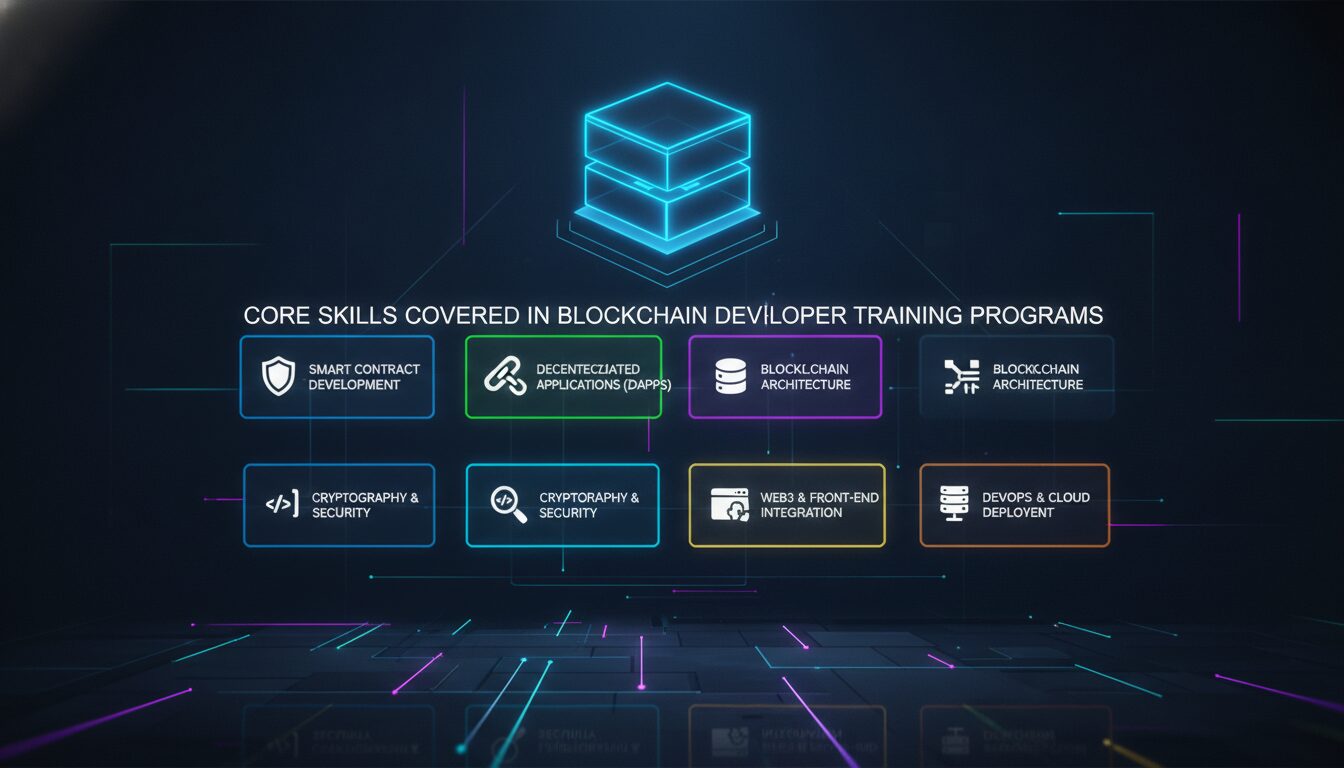
Core skills in developer training span smart contract languages, deployment tooling, and security auditing, regardless of which provider you choose. A quality curriculum won’t skip any of these three areas.
Programming Languages and Smart Contract Development
The primary language taught is Solidity for Ethereum and EVM-compatible chains, though many programs now also cover Vyper or Rust for Solana development. You’ll write, test, and deploy contracts that power DeFi protocols, NFT marketplaces, and DAOs, not just toy examples.
Development Tools and Frameworks
Hands-on work with Hardhat, Truffle, Ganache, and MetaMask is standard across nearly every program. These tools handle contract compilation, local chain simulation, and wallet interaction. Most courses also introduce Web3.js or ethers.js for connecting a frontend to deployed contracts.
Security and Enterprise Solutions
Increasingly, training includes security auditing against known attack patterns like reentrancy, plus enterprise modules on Hyperledger Fabric and R3 Corda. That dual focus means graduates can work at a startup shipping a token launch one year and at a Fortune 500 pilot program the next.
Top Blockchain Developer Training Platforms in 2026
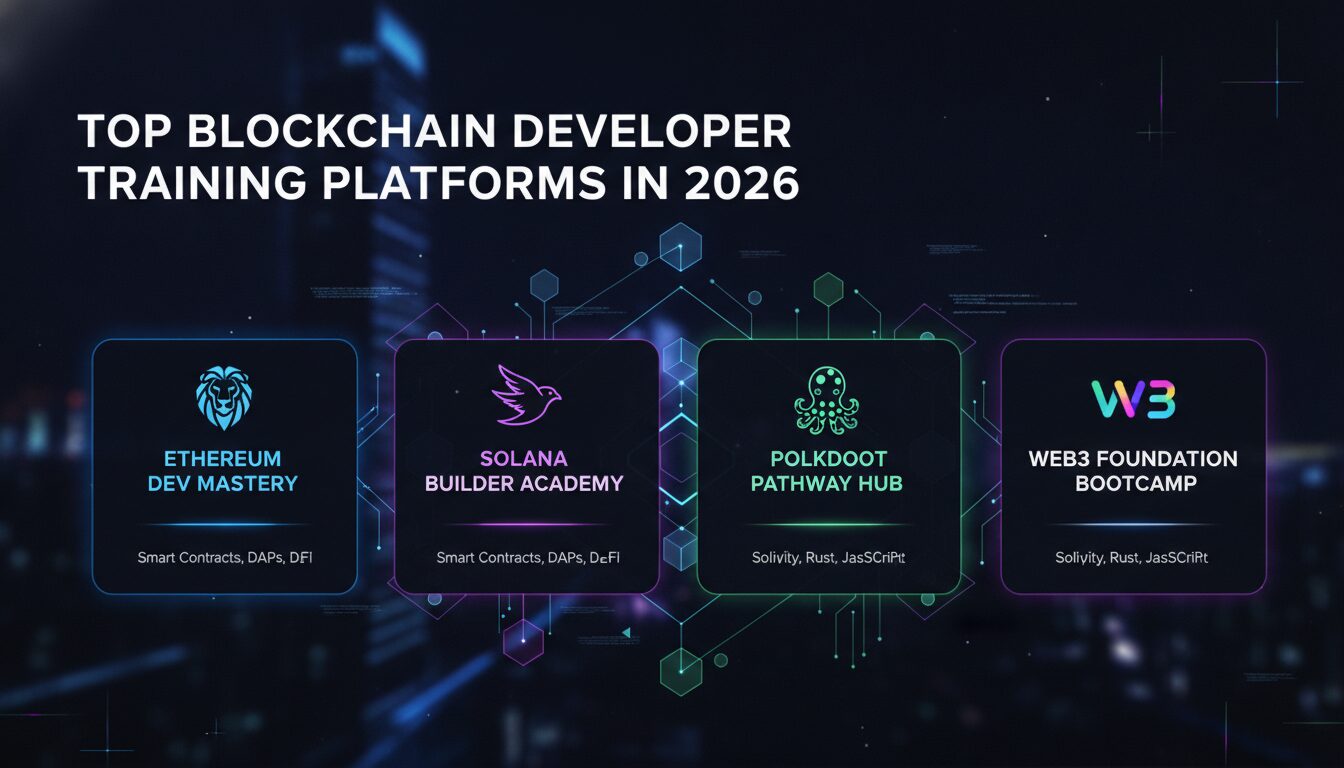
The strongest this type of training platforms in 2026 span free community courses, paid nanodegrees, and vendor-specific certifications. Here’s how the leading options compare on cost, format, and depth.
| Program Name | Provider | Format | Cost | Notable Features | Certification |
|---|---|---|---|---|---|
| Blockchain Developer Nanodegree | Udacity | Self-paced, 29 hours | $249/month or $999 one-time | Projects reviewed by mentors, Solidity + Hardhat | Udacity Certificate |
| Blockchain Developer Certification (BDC) | EC-Council | Instructor-led / Self-paced | Paid (inquire) | Multi-platform (Ethereum, Hyperledger Fabric, R3 Corda), AI integration, security labs | EC-Council BDC |
| Ethereum Bootcamp | Alchemy University | Self-paced, 91 lessons | Free | 28,000+ enrolled, JavaScript + Solidity, EVM deep dive | None |
| Certified Ethereum Expert™ | Blockchain Council | Self-paced, 10 hours | Paid (check website) | CPD accredited, 125,000+ professional network | Blockchain Council |
| Ethereum Developer Training | Blockchain Training Alliance | On-demand, 20+ hours | $299 | 11 hands-on labs, ERC-20/721, Web3.js, optional exam | Optional (BTA exam) |
Free vs. Paid Blockchain Developer Training
Free resources like Alchemy University and roadmap.sh, which has racked up 361,000 GitHub stars, are excellent for self-starters who can stay disciplined without deadlines. Paid programs, on the other hand, tend to offer structured mentorship, graded projects, and certificates that recruiters recognize on sight. Neither path is objectively better; it depends on whether you need external accountability.
University Degrees vs. Bootcamps and Self-Paced Tracks
A handful of universities now offer blockchain-focused electives or full certificate programs within computer science departments. These can work well if you’re already enrolled in a degree program, but the pace is slow, and the curriculum often lags behind what’s happening on mainnet. Most working developers we’ve seen enter the field through bootcamps, nanodegrees, or self-paced roadmaps instead, simply because they move faster and stay current with protocol upgrades.
A 10-Month Roadmap to Becoming a Blockchain Developer
Following a structured plan can take you from zero coding experience to job-ready blockchain developer in under a year. This roadmap combines milestones from top this kind of training curricula with realistic pacing for someone studying part-time.
Step 1: Learn Programming Fundamentals (Months 1-2)
Start with JavaScript, the default language of Web3 frontends, or Python if you prefer it. Focus on syntax, async/await, and error handling before touching blockchain-specific code. Free resources like Alchemy’s JavaScript course, enrolled by 35,000+ learners, provide a solid foundation.
Step 2: Understand Blockchain Basics (Month 3)
Enroll in a beginner module to grasp distributed ledger mechanics, consensus models (PoW, PoS), wallets, and transaction structure. Coursera’s “Blockchain Basics,” rated 4.6 out of 5 from over 7,800 reviews, is a popular entry point here.
Step 3: Master Solidity and Smart Contracts (Months 4-5)
Work through Solidity syntax, data types, modifiers, and event handling. Write simple contracts, then use Remix IDE to compile and deploy them on public testnets. The Alchemy Solidity course, with 12,000+ enrolled, is a solid free option for this stage.
Step 4: Learn Development Frameworks (Month 6)
Move into professional tooling: learn Hardhat for testing and debugging, connect to Ethereum mainnet and testnets through Infura or Alchemy, and interact with deployed contracts using ethers.js.
Step 5: Build Real dApp Projects (Months 7-8)
Apply everything you’ve learned: build a token contract, an NFT marketplace, or a simple DeFi lending protocol. Udacity’s nanodegree, for example, culminates in a collateralized loan smart contract project that mirrors real DeFi mechanics.
Step 6: Explore Advanced Topics (Month 9)
Study layer-2 scaling, account abstraction (ERC-4337), and enterprise chain architecture. Many current blockchain developer programs now fold in AI-assisted security audits and automated testing frameworks at this stage.
Step 7: Earn Certification and Prepare for Interviews (Month 10)
Choose a recognized certification, like EC-Council’s BDC or Blockchain Council’s Certified Ethereum Expert, to validate what you’ve built. Polish your GitHub portfolio and practice live coding interviews, since employers often ask candidates to write a smart contract on the spot.
How AI Is Changing Blockchain Developer Training
AI is changing developer training by automating code review, vulnerability detection, and personalizing the learning path itself. EC-Council’s BDC program now folds AI tooling directly into its curriculum rather than treating it as a bonus module.
AI-Assisted Learning and Development
Some platforms now offer AI tutors that review Solidity code, flag inefficient patterns, and generate boilerplate for common contract types. This can meaningfully cut the time from concept to testnet deployment, making structured this type of training more efficient than it was even two years ago.
Automated Security and Testing
Tools like Slither and Mythril have become staples in smart contract auditing, and newer AI-enhanced versions can simulate attack vectors and flag simple bugs automatically. Programs that embed these tools into coursework give graduates a real edge when it comes to shipping audit-ready code on day one.
According to Messari’s protocol research, smart contract exploits remain one of the largest sources of value loss in DeFi, which is exactly why security auditing has moved from an elective topic to a core module in most modern training tracks.
The Value of Blockchain Developer Certifications
Blockchain developer certifications matter because they give employers a quick, verifiable signal of your skill level without requiring a full portfolio review upfront. They’re rarely mandatory, but they shorten the distance between application and interview.
Industry-Recognized Credentials
Accreditations from organizations like Blockchain Council (CPD accredited) and EC-Council are explicitly listed as preferred qualifications by recruiters at larger firms. A known this kind of training certification on your resume can be the difference between getting a callback and getting filtered out by an ATS.
Certification vs. Hands-on Experience
Certifications open doors, but project experience is what closes the deal in interviews. The strongest approach combines both: earn a credential while building a GitHub portfolio with at least 3-4 polished dApp repositories. Career coaches inside blockchain training communities recommend this dual-track approach consistently, and it matches what we’ve seen work in practice.
Pros and Cons
Pros
- Strong salary ceiling, with average compensation around $185,000 for experienced blockchain developers.
- Multiple entry points exist, from free self-paced courses to structured, mentor-reviewed nanodegrees.
- Skills transfer across sectors: DeFi, enterprise supply chain, NFT infrastructure, and DAO tooling all draw from the same core curriculum.
- Certifications from EC-Council and Blockchain Council carry real recruiter recognition.
Cons
- Quality varies widely between providers, and some paid programs lag behind free alternatives in curriculum freshness.
- Self-paced tracks require serious discipline; without deadlines, many learners stall out around month three or four.
- Security auditing skills take longer to develop than basic contract writing, and shortcuts here create real financial risk in production.
- University programs often move too slowly to keep pace with protocol upgrades and new EIPs.
Get Started With Blockchain Developer Training Today
The path to a solid blockchain career is clearer now than it’s ever been. Whether you choose an intensive bootcamp, a free self-study plan, or an accredited certification, investing in blockchain developer in 2026 puts you closer to shipping real Web3 infrastructure. Start small, stay consistent, and within months you could be writing production smart contracts and earning a competitive salary doing it.
If you’re a serious builder looking to apply these skills to real protocol work rather than just tutorials, Apply to the Genesis Cohort at digitalblockchains.com. We work with developers who want to move past courses and into actual tokenomics design, smart contract architecture, and DAO infrastructure.
Frequently Asked Questions
What is the best blockchain developer training for beginners?
For absolute beginners, Alchemy University’s free Ethereum Bootcamp or Coursera’s “Blockchain Basics” are strong starting points because neither requires prior blockchain knowledge and both are fully self-paced. They let you test your interest before spending money on a paid program.
How long does it take to complete blockchain developer training?
Full-time intensive programs like a Udacity nanodegree can be finished in a few months of focused study, while self-paced roadmaps typically take around 10 months at 15-20 hours per week. Your timeline depends heavily on prior programming experience.
Is blockchain developer training free?
Yes, several solid free resources exist, including Alchemy University, roadmap.sh, and individual courses on platforms like edX. Paid programs still have an edge in structured mentorship and recognized certificates, which matters more once you’re job hunting.
What skills are required before enrolling in blockchain developer training?
Most programs expect intermediate JavaScript or Python knowledge, comfort with command-line tools, and basic object-oriented programming concepts. Some beginner-friendly courses, including Alchemy’s bootcamp, teach these fundamentals as part of the curriculum itself.
Which blockchain developer certification is most recognized?
The EC-Council Blockchain Developer Certification (BDC) and Blockchain Council’s Certified Ethereum Expert are among the most widely recognized, largely due to their accreditation and existing industry partnerships. Both show up frequently in job postings as preferred qualifications.
Can I get a job after completing blockchain developer training?
Yes. With a strong GitHub portfolio, a recognized certification, and the core skills taught in a comprehensive developer training program, you can target roles like Solidity developer, dApp engineer, or blockchain consultant, often at salaries exceeding $150,000.