Key Takeaways
- How to invest in bitcoin breaks down into three main paths: direct purchase, spot ETFs, and crypto retirement accounts, each with distinct custody and tax implications.
- Bitcoin is highly volatile and is not insured by the FDIC or SIPC; only allocate money you can afford to lose entirely.
- Regulated platforms such as Fidelity, Schwab, Coinbase, and Cash App provide entry points with varying custody models.
- Self-custody and cold storage are critical if you hold bitcoin directly; private key loss is permanent and unrecoverable.
- Spot bitcoin ETFs approved by the SEC in January 2024 offer a familiar brokerage account alternative without private key management.
- Dollar-cost averaging reduces timing risk for beginners investing with modest capital.
How to invest in bitcoin is the process of buying, holding, and securing bitcoin through a regulated exchange, brokerage, or spot ETF. Beginners should start small, prioritize security, and only commit capital they can afford to lose.
Crypto investing has moved from a niche technical pursuit to a mainstream portfolio topic, but the methods, custodians, and regulatory protections vary widely. This guide synthesizes guidance from Fidelity, Schwab, Investopedia, and community resources to explain in bitcoin across direct ownership, spot ETFs, retirement accounts, and small-dollar strategies. If you want deeper context on the underlying infrastructure, our blog covers protocol-level mechanics and tokenomics that inform every investment decision.
Understanding Bitcoin as an Investment

What Is Bitcoin?
Bitcoin is a decentralized digital currency introduced in January 2009 following a white paper published by the pseudonymous Satoshi Nakamoto. According to Investopedia, Bitcoin is the most well-known digital currency, operated by a decentralized authority rather than a central bank, and it is touted to lower transaction fees compared with traditional online payment methods. The Bitcoin Foundation has described Bitcoin as “digital gold” because of its scarcity and role as a store of value. Unlike government-issued currencies, Bitcoin is not backed by real assets or tangible securities; its value is determined by open-market supply and demand.
Bitcoin’s Supply and Market Position
Investopedia notes the maximum number of bitcoins in circulation is capped at 21 million, a fixed supply that differentiates Bitcoin from Ethereum’s Ether, which has no maximum supply cap. This scarcity is a core narrative behind bitcoin as an investment, but it does not eliminate volatility. According to Chris Brycki of Stockspot, Bitcoin has surged from nearly nothing to over $100,000 USD in the last two decades. Such price appreciation has attracted millions of investors, though drawdowns can be severe and should be expected by anyone researching this type of bitcoin.
Regulatory Milestones in the United States
The US regulatory landscape changed materially in 2024 when the SEC approved trading of spot bitcoin and ether exchange-traded funds. According to Schwab, the SEC’s relationship with crypto has historically been chilly, and the approval was seen as something of a reluctant fait accompli. SEC Chair Gary Gensler issued a direct caution at the time of approval:
“While we approved the listing and trading of certain spot bitcoin ETP shares today, we did not approve or endorse bitcoin. Investors should remain cautious about the many risks associated with bitcoin and products whose value is tied to crypto.” – SEC Chair Gary Gensler, January 2024
Fidelity and Schwab both emphasize that crypto assets are not insured by the FDIC or SIPC and carry a high risk of total loss. That regulatory context matters when you are deciding this kind of in bitcoin through any vehicle.
“Crypto as an asset class is highly volatile, can become illiquid at any time, and is for investors with a high risk tolerance. Crypto may also be more susceptible to market manipulation than securities.” – Fidelity Digital Assets disclosures
Key Ways to Invest in Bitcoin

Direct Ownership
Direct ownership means buying actual bitcoin on a crypto exchange or through a brokerage, then holding it in a wallet you control or a custodial account. Fidelity Crypto allows clients to buy, sell, and transfer bitcoin, ethereum, and solana within a Fidelity account, backed by cold-vaulted storage and monitored facilities. Direct ownership gives investors the ability to transfer crypto to a personal wallet and interact with the blockchain, but it also requires managing security or relying on a custodian. This is the most hands-on answer to the to invest in bitcoin.
Spot Bitcoin ETFs and Exchange-Traded Products
Investors who want a traditional brokerage experience can buy spot crypto ETPs, such as Fidelity’s FBTC, FETH, and FSOL, which seek to track crypto prices and trade within a brokerage account. Spot ETFs hold actual bitcoin in custody but trade as exchange-listed securities, making them accessible through standard investment accounts. Fidelity notes these products are not registered under the Investment Company Act of 1940 or regulated as commodity pools under the Commodity Exchange Act of 1936, so shareholders lack the protections of registered investment companies.
Retirement Account Exposure
Bitcoin can also be added to tax-advantaged retirement accounts. Fidelity Crypto for IRAs lets investors directly invest in crypto within a retirement account, while other providers offer spot bitcoin ETFs in Roth or traditional IRAs. This path defers or eliminates taxes on gains but may involve account eligibility restrictions and custodian limitations. Retirement accounts also carry contribution limits and early withdrawal penalties.
How to Invest in Bitcoin: Direct Ownership Step by Step
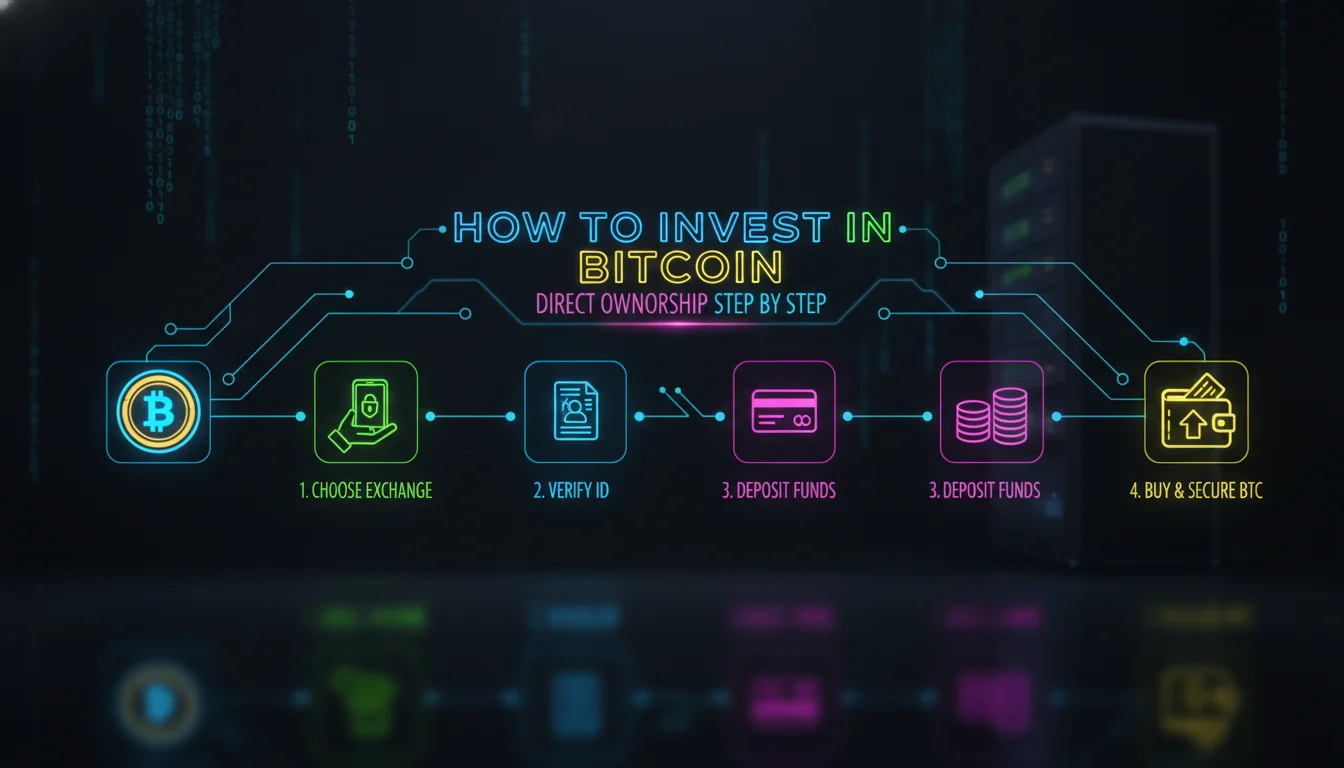
Step 1: Set Up a Trading Account
To execute direct ownership, choose a provider that offers crypto trading. According to Investopedia, any investor can purchase cryptocurrency from popular crypto exchanges such as Coinbase, apps such as Cash App, or through brokers. Full-service brokerages like Fidelity and Schwab now provide crypto services with integrated portfolio views. Open an account, complete identity verification, and enable two-factor authentication before funding.
Step 2: Execute Your First Bitcoin Purchase
Deposit funds via bank transfer, debit card, or wire, then place an order for bitcoin. Most platforms allow fractional purchases, so you can buy a fraction of one bitcoin without needing the full coin price. On Fidelity Crypto, you can trade alongside traditional investments and transfer bitcoin you already own elsewhere into the account. Always review transaction fees and spread before confirming a purchase, because costs reduce your invested amount directly.
Step 3: Move Bitcoin to Self-Custody
For long-term holders, moving bitcoin off an exchange into a self-custody wallet reduces third-party risk. Investopedia advises that any investor can purchase crypto from exchanges, but self-custody requires managing private keys. A non-custodial wallet gives you sole control over the private key; losing the key means losing access to funds permanently. This step is optional but strongly recommended for larger holdings.
How to Invest in Bitcoin Through Spot ETFs
What Are Spot Bitcoin ETFs?
Spot bitcoin ETFs are exchange-traded products that hold actual bitcoin in a trust or custodial structure and issue shares that trade on national securities exchanges. The SEC’s January 2024 approval allowed these vehicles to be used in widely held, actively traded investment products. Unlike futures-based products, spot ETFs aim to track live bitcoin prices rather than derivatives contracts. As of 2026, a number of major asset managers offer these products, though availability depends on brokerage and jurisdiction.
Benefits and Trade-offs of ETF Exposure
ETFs offer simplicity, liquidity, and the ability to hold bitcoin in a brokerage or retirement account without managing private keys. They carry management fees and may trade at premiums or discounts to net asset value. Fidelity states spot crypto ETPs are for investors with a high risk tolerance and invest in a single cryptocurrency, which could become illiquid. ETF exposure is not a low-risk way to learn bitcoin; it simply changes the custody and execution mechanism, not the underlying asset risk.
Examples of Spot Crypto ETPs
Fidelity offers FBTC, FETH, and FSOL as spot crypto ETPs. Schwab provides multiple ways into crypto, including ETF access for qualified clients. These products allow investors to integrate crypto into traditional portfolios with familiar reporting and tax statements, though they still carry the same underlying asset risks. When comparing ETPs, review expense ratios, sponsor reputation, and whether the fund holds actual bitcoin or uses derivatives.
How to Invest in Bitcoin Through Retirement Accounts
Crypto IRAs
Fidelity Crypto for IRAs enables direct investment in bitcoin within a tax-advantaged retirement account. This is a distinct method from buying spot ETFs inside an IRA, as it may involve direct crypto custody by the provider. The account structure can be a traditional IRA, Roth IRA, or rollover IRA depending on provider offering. Not all custodians allow direct crypto, and account features are subject to eligibility.
Tax Advantages and Restrictions
Gains within a traditional IRA grow tax-deferred until withdrawal; in a Roth IRA, qualified withdrawals may be tax-free. The IRS treats crypto as property, and early withdrawals or prohibited transactions can trigger penalties. Retirement accounts often have contribution limits and may restrict transfers to personal wallets. Fidelity notes offerings and account features are subject to eligibility, so verify before opening.
Selecting a Custodian
When evaluating a crypto IRA provider, consider whether the custodian stores assets in cold storage, provides insurance, and has regulatory standing. Fidelity began mining bitcoin in 2014 and established Fidelity Digital Assets in 2018, offering institutional-grade security infrastructure. Schwab also integrates crypto education and access through its brokerage platform. A reputable custodian reduces but does not eliminate counterparty risk.
Pros and Cons of Investing in Bitcoin
Pros
- Fixed supply: Bitcoin’s 21 million cap creates verifiable scarcity that no central authority can override.
- Multiple access points: Direct purchase, spot ETFs, and crypto IRAs mean you can learn how to invest in bitcoin through whichever vehicle fits your existing accounts.
- 24/7 liquidity: Bitcoin markets run continuously, unlike traditional equity exchanges with set trading hours.
- Institutional infrastructure: Fidelity, Schwab, and Coinbase now offer regulated custody, reducing the operational burden on individual investors.
- Dollar-cost averaging compatibility: Fractional purchases make consistent small-dollar investing straightforward on most platforms.
Cons
- Extreme volatility: Bitcoin can lose large percentages of value quickly, and drawdowns have been severe throughout its history.
- No FDIC or SIPC protection: Crypto is not insured by any government agency, and custodian insolvency could result in loss.
- Irreversible transactions: Blockchain transactions cannot be reversed once confirmed; sending to the wrong address is permanent.
- Private key risk: Self-custody requires managing private keys; losing them means losing funds with no recovery path.
- Regulatory uncertainty: The environment remains in flux, which can affect market prices and product availability.
- Fee drag on small purchases: Trading fees and spreads can erode a meaningful share of small investments.
Choosing a Platform: Brokerages, Exchanges, and Apps
Full-Service Brokerages
Full-service brokerages such as Fidelity and Schwab allow investors to buy bitcoin through integrated accounts that also hold stocks, ETFs, and retirement assets. Fidelity’s platform includes cold-vaulted storage, 24/7 virtual assistance, and transfer capabilities. Schwab provides education and multiple ways into crypto, with a long-standing brokerage brand. The primary trade-off is that not all crypto assets may be available, and crypto trading may be limited to certain clients.
Dedicated Crypto Exchanges
Dedicated exchanges like Coinbase offer a wider range of digital assets and advanced trading tools. According to Investopedia, any investor can purchase cryptocurrency from popular crypto exchanges such as Coinbase or through brokers. These platforms may have lower trading fees for high volume but require users to manage security diligently. If you choose an exchange, use strong passwords, two-factor authentication, and withdrawal allowlists.
Payment Apps and Peer-to-Peer Marketplaces
Payment apps such as Cash App allow small purchases quickly and conveniently. Peer-to-peer marketplaces connect buyers and sellers directly, but they carry higher fraud risk. Quora contributor Justice Långvall recommends holding purchased bitcoins in an address with a private key and keeping the private key secret with multiple copies. Always verify the identity of counterparties and use escrow where available.
How to Invest in Bitcoin as a Beginner: Full Walkthrough
Step 1: Assess Risk Tolerance and Budget
Before buying, determine an amount you are prepared to lose entirely. Schwab advises clients to approach cryptocurrency as a speculative investment outside traditional asset allocation models, given high volatility and minimal consumer protections. Start with a small sum to learn mechanics without overexposure. Treat any crypto allocation as genuinely at-risk capital, not a savings vehicle.
Step 2: Choose a Regulated Platform
Pick a regulated exchange, brokerage, or ETF provider that meets your security and accessibility needs. Fidelity Crypto offers cold storage and integrated portfolio views, while Cash App provides a simplified mobile experience. Verify the provider’s compliance with SEC, FINRA, or state money transmitter rules where applicable. The SEC’s approval of spot bitcoin ETFs in 2024 expands regulated choices but does not endorse bitcoin itself.
Step 3: Fund Your Account and Buy
Link a bank account or deposit cash, then execute a buy order. For direct ownership, select bitcoin and enter a dollar amount for a fractional purchase. For ETF exposure, buy shares of a spot bitcoin ETF through a brokerage account. After purchase, decide whether to keep assets with the custodian or transfer to self-custody. Keep records of cost basis and purchase date for tax reporting.
Step 4: Secure Your Holdings
Security is not optional when you figure out how to invest in bitcoin. Enable two-factor authentication on every account. For direct holdings above a threshold you consider significant, move bitcoin to a hardware wallet. Never share private keys or seed phrases. Review your custodian’s insurance and cold storage practices before committing large sums.
Storing Bitcoin Securely
Custodial vs Non-Custodial Wallets
A custodial wallet means a third party holds your private keys and is responsible for security. Fidelity uses cold-vaulted storage and monitored facilities to secure digital assets. Non-custodial wallets give you direct control over private keys, but you bear full responsibility. Lose the private key and funds become unrecoverable. The choice depends on your technical comfort and the amount invested.
Hardware Wallets and Cold Storage
Hardware wallets store private keys offline, making them resistant to online attacks. For large balances, cold storage is the industry standard. Justice Långvall on Quora recommends generating a bitcoin address and private key, keeping the private key secret, and maintaining multiple copies. Never store private keys digitally or share them. A hardware wallet from a reputable manufacturer is a practical way to self-custody bitcoin.
Institutional Security Practices
Fidelity states it secures digital assets with cold-vaulted storage, secure monitored facilities, and multi-layered protocols. Such practices reduce but do not eliminate risk. Crypto is not insured by the FDIC or SIPC, so investors must evaluate the custodian’s operational security, insurance coverage, and regulatory standing. The collapse or insolvency of a custodian could result in loss, even with institutional-grade protections in place.
Risks, Volatility, and Regulatory Considerations
Price Volatility and Market Transparency
Bitcoin can lose large percentages of value quickly, and the market is less transparent than public stock markets. Schwab notes crypto transactions are irreversible, consumer protections are minimal or nonexistent, and the market is not very transparent compared with stocks. Even spot bitcoin ETFs can become illiquid, according to Fidelity. Volatility has persisted even as institutional adoption has grown, so anyone learning how to invest in bitcoin must treat drawdowns as a structural feature, not an anomaly.
Irreversible Transactions and Consumer Protections
Blockchain transactions cannot be reversed once confirmed. If you send bitcoin to the wrong address or fall victim to fraud, there is no central party to reverse the transaction. Crypto assets are not insured by the Federal Deposit Insurance Corporation or the Securities Investor Protection Corporation. This is a key reason to start small, use reputable platforms, and double-check addresses before sending.
Regulatory and Tax Compliance
The SEC has continued to police the crypto industry for fraud, misleading marketing claims, and unregistered dealers, according to Schwab. In the US, the IRS treats crypto as property, meaning capital gains taxes apply to sales and exchanges. Maintain records of cost basis, dates, and proceeds. The regulatory environment remains in flux, which can affect market prices and product availability.
How to Invest in Bitcoin with $100 or Less
Fractional Ownership
Bitcoin is divisible to eight decimal places, so $100 can buy a fraction of a bitcoin. Most exchanges, including Coinbase and Fidelity Crypto, allow dollar-denominated purchases rather than whole-coin purchases. This lowers the barrier to entry, but fees may proportionally reduce your investment. Check the platform’s fee schedule before committing a small amount, because fee drag hits small purchases hardest.
Dollar-Cost Averaging
Dollar-cost averaging means investing a fixed dollar amount at regular intervals, reducing the impact of short-term volatility. For someone learning how to invest in bitcoin with modest capital, DCA through a payment app or exchange automates the process. It avoids trying to time the market, which even professionals find difficult. Consistent small buys build exposure over time without requiring a large upfront sum.
Fee Efficiency for Small Amounts
Small investments are more sensitive to trading fees, spread, and withdrawal costs. Compare fees across platforms; some payment apps charge a percentage that is high for small purchases, while brokerages may offer lower commissions. Check whether the platform charges network fees for transferring bitcoin to self-custody. Fees can erode a meaningful share of small purchases, so read the fee disclosure before buying.
Comparing Bitcoin Investment Approaches
Side-by-Side Comparison
The table below compares direct ownership, spot ETFs, and crypto retirement accounts across key features mentioned by Fidelity, Schwab, and Investopedia.
| Feature | Direct Bitcoin Purchase | Spot Bitcoin ETF | Crypto Retirement Account |
|---|---|---|---|
| Vehicle | Actual bitcoin held in exchange or wallet | ETP shares tracking spot bitcoin price | Direct crypto in tax-advantaged account |
| Custody | Exchange custody or self-custody | ETF custodian | IRA custodian |
| Tax treatment | Capital gains on sales; property treatment | Capital gains/losses; can be held in taxable or retirement | Tax-deferred or tax-free growth |
| Minimum investment | Fractional purchases allowed on many platforms | One share or fractional share | Varies by provider |
| Security | Depends on exchange/custodian or private key management | Fund custodian security | Custodian security; account protections |
| Liquidity | 24/7 markets, but transfer times vary | Exchange trading hours | Retirement account restrictions |
| Regulatory status | Varies; not SIPC/FDIC insured | Not 1940 Act registered | Retirement account rules apply |
Which Approach Fits Your Investor Profile?
Beginners often prefer spot ETFs or regulated brokerage crypto accounts because they do not require private key management. Experienced users may choose direct ownership with self-custody for maximum control. Retirement savers can select a crypto IRA for tax advantages. The best method depends on risk tolerance, technical comfort, and investment horizon. None of these approaches removes bitcoin’s underlying volatility, and that is the honest answer to how to invest in bitcoin safely.
Common Mistakes to Avoid
Common mistakes include investing more than you can afford to lose, ignoring security best practices, chasing short-term price spikes, and ignoring tax obligations. Always use two-factor authentication, avoid sharing private keys, and keep transaction records. Schwab recommends treating crypto as a speculative allocation outside the core portfolio. Learning how to invest in bitcoin responsibly means accepting that volatility and custody risk are permanent features of the asset, not temporary inconveniences.
For builders who want to go deeper than investing and actually deploy on-chain infrastructure, explore the Digital Blockchains studio and our work on protocol architecture and tokenomics design.
Ready to build with serious practitioners? Apply to the Genesis Cohort at digitalblockchains.com.
Frequently Asked Questions
How do I invest in Bitcoin as a beginner?
Open an account with a regulated exchange, brokerage, or app, verify your identity, fund the account, and buy a small fractional amount of bitcoin. Start with a modest sum and keep the asset with the custodian or move it to a hardware wallet once you understand private key management.
Is it worth putting $100 into Bitcoin?
It can be worth it as a learning experience, but bitcoin is highly volatile and not insured by any government agency. Only invest $100 if you are comfortable losing it entirely and have already covered emergency savings and core investments.
Can I invest in Bitcoin with $100?
Yes. Bitcoin is divisible to eight decimal places, and most platforms allow fractional purchases with dollar amounts as low as a few dollars. Watch fees carefully, as they can be proportionally higher on small buys and erode your position.
What if I put $1000 in Bitcoin 5 years ago?
The result depends entirely on the specific purchase date and sale date, since Bitcoin has experienced both dramatic appreciation and sharp drawdowns over any multi-year window. Past performance is not a guarantee of future returns, and Bitcoin’s history includes periods of severe loss as well as gains.
How do I invest in Bitcoin on Cash App?
Open Cash App, go to the Bitcoin tab, enable deposits, and buy bitcoin with a linked bank account or debit card. Cash App supports fractional purchases and lets you withdraw bitcoin to an external wallet for self-custody.
How do I invest in Bitcoin in the USA?
Use a US-regulated platform such as Fidelity, Schwab, Coinbase, or Cash App. Complete identity verification, fund in USD, then buy bitcoin directly or through a spot bitcoin ETF approved by the SEC in January 2024.