Key Takeaways
- Blockchain in manufacturing builds supply chain transparency through an immutable, shared ledger that every authorized partner can verify.
- Core benefits include better traceability, counterfeit prevention, automated smart contracts, and stronger regulatory compliance.
- According to a PwC Global Blockchain Survey, 24% of industrial manufacturing CEOs were planning, piloting, or implementing blockchain, and 62% of surveyed organizations already had a blockchain project underway.
- Private and consortium blockchains are typically the better fit for multi-organization manufacturing networks, not public chains.
- Pairing IoT sensors with blockchain enables real-time asset tracking and predictive maintenance.
- Interoperability with legacy ERP systems and lack of cross-partner trust remain the biggest adoption barriers.
Blockchain in manufacturing is the use of distributed ledger technology to secure, trace, and automate industrial processes. It creates tamper-proof records across supply chains, cutting fraud and speeding compliance.
What is Blockchain in Manufacturing?
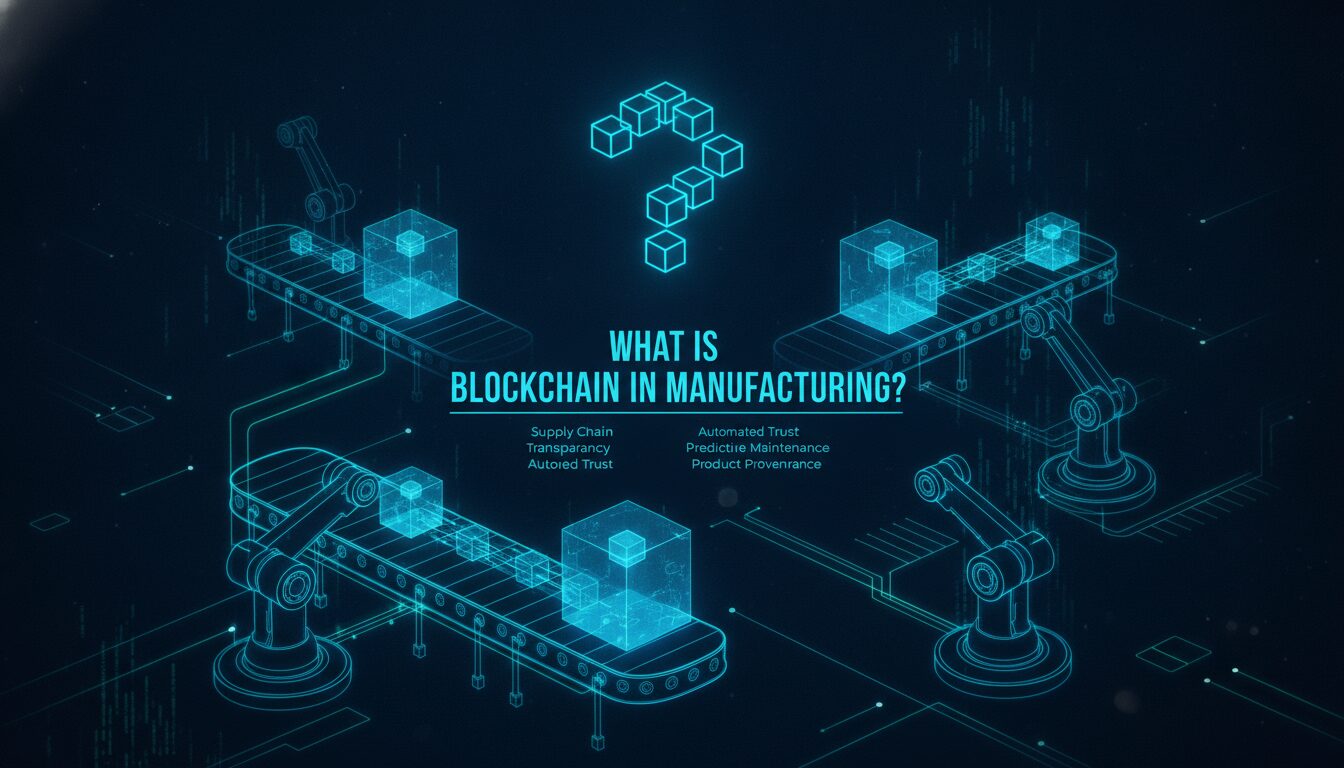
Defining Blockchain Technology
Blockchain is a digitally managed, distributed, and decentralized ledger used to record transactions in an immutable format, as defined in a 2022 MDPI Logistics study. Unlike a traditional database controlled by one entity, a blockchain is maintained by a network of participants, which makes the data tamper-resistant and verifiable by consensus. That structure builds trust between parties without needing a middleman to referee every transaction.
How Manufacturers Apply Blockchain
In practice, manufacturers apply blockchain across the entire product lifecycle, from raw material sourcing to after-sales service. It sits underneath track-and-trace systems, digital product passports, and automated procurement run through smart contracts. in manufacturing gives every stakeholder, from supplier to auditor, one shared source of truth. That single ledger cuts down on disputes and shortens audit cycles considerably.
Key Benefits of Blockchain in Manufacturing
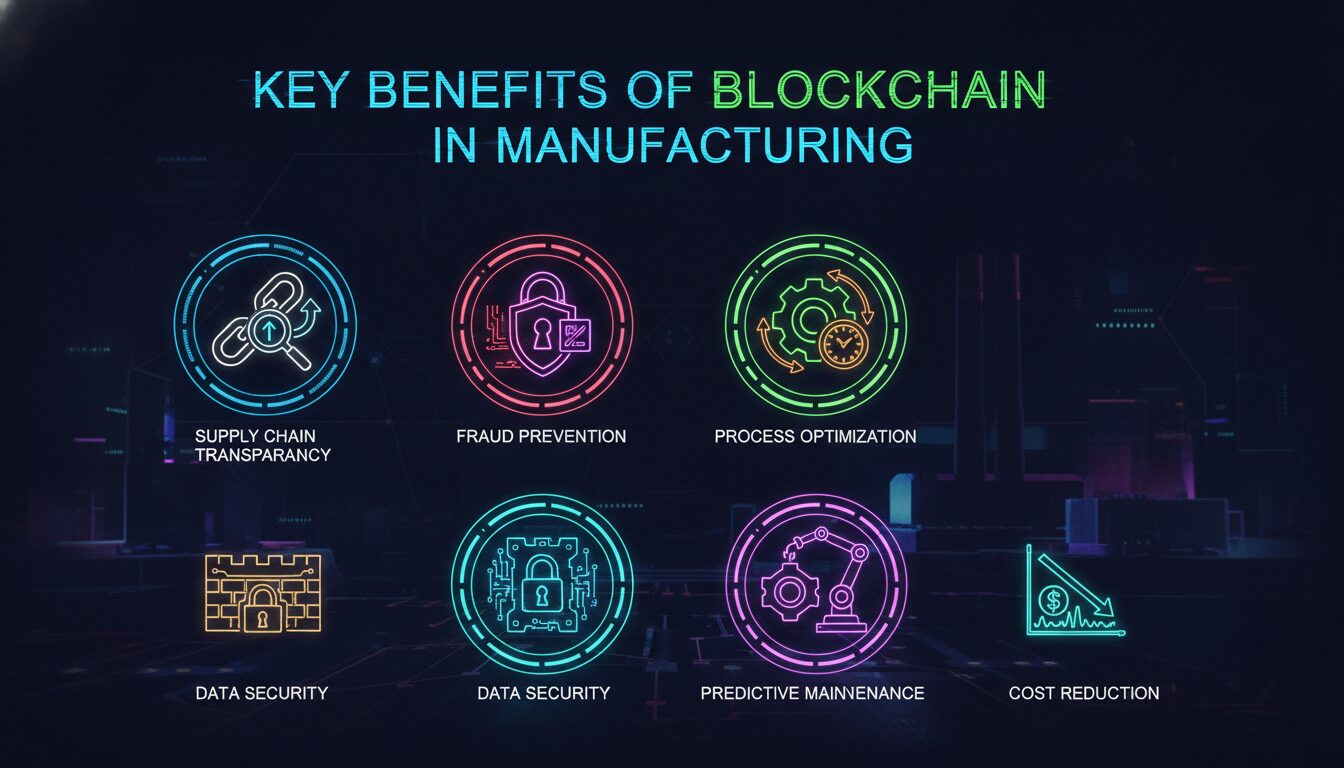
Enhanced Supply Chain Transparency and Traceability
The biggest advantage blockchain brings to manufacturing is end-to-end visibility that’s actually verifiable, not just claimed. this type of manufacturing gives you an unchangeable history of a component’s journey from supplier to factory floor to end customer. Blockchain introduces a decentralized, immutable ledger that lets all parties in the supply chain access and verify shared data in real time, according to ARB CPA. That matters most in regulated industries like aerospace and pharmaceuticals, where one bad component can trigger a recall that costs millions and takes weeks to trace under legacy systems.
Intellectual Property Protection and Counterfeit Prevention
Blockchain protects intellectual property by creating an immutable record of design ownership and licensing rights that can’t be quietly altered after the fact. As Kiran Makarla of Oracle puts it, immutable records of design files and patents give manufacturers real proof of ownership. Smart contracts take this further by automatically enforcing IP agreements, so only authorized parties can access proprietary specs or trigger production runs.
“By creating immutable records of design files and patents, blockchain provides irrefutable proof of ownership and usage rights.” – Kiran Makarla, Oracle Blockchain Blog
Automated Compliance and Quality Assurance with Smart Contracts
Smart contracts are self-executing code deployed on the blockchain that automate quality checks and regulatory sign-off. In this kind of manufacturing environments, these contracts release payment only when predefined quality parameters are met, or they flag a non-conforming shipment instantly, before it moves further down the line. That cuts manual inspection time and removes a lot of human error from the process. A PwC Global Blockchain Survey found that 45% of respondents cited lack of trust as a barrier to adoption, a gap smart contracts close directly by enforcing rules transparently, with no room for one party to fudge the numbers.
How Blockchain in Manufacturing Revolutionizes Supply Chains
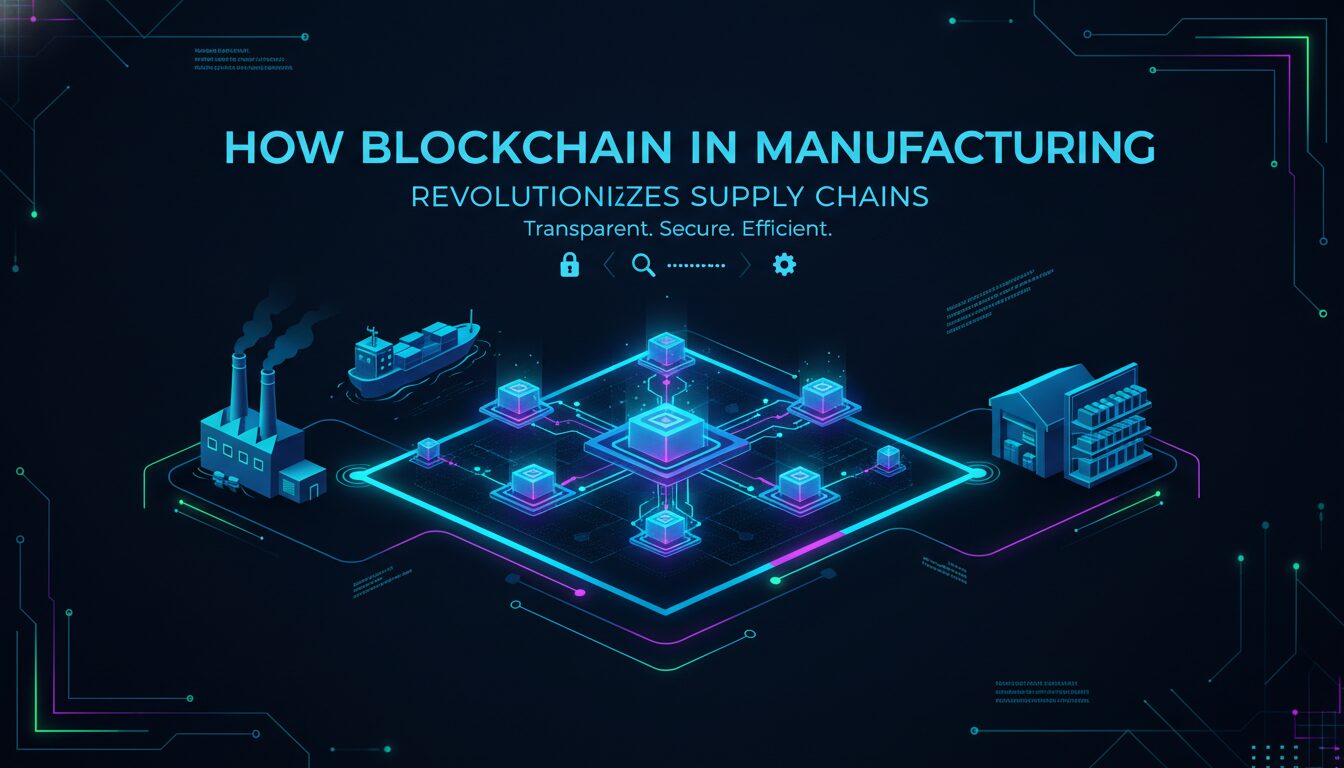
Real-Time Asset Tracking and Provenance
Blockchain revolutionizes manufacturing supply chains by pairing distributed ledgers with IoT sensors for live location and condition data on every asset. Each scan of a barcode or RFID tag logs a permanent entry, building what amounts to a digital thread for that part. The MDPI logistics review notes that IoT-blockchain integration, smart contracts, and asset tracking carry real upside for high-value goods moving through global supply chains. This kind of provenance is exactly what you need to back up certified sustainable or ethical sourcing claims with something more than a marketing statement.
Reducing Waste and Improving Quality Control
Pinpoint traceability lets manufacturers find the root cause of a defect fast, which cuts scrap and rework. Blockchain helps identify and address issues, like defective components or counterfeit parts, in a fraction of the time legacy systems allow, according to industry analysis of blockchain supply chain applications. When a quality issue surfaces, an immutable ledger lets a manufacturer isolate the affected batch in minutes instead of days. The same MDPI study walks through a cutting tool manufacturing scenario where blockchain traced every tool back to its raw material heat number, which sharply cut investigation time and improved recall precision.
Case Study: Autentica’s Digital Asset Ecosystem
Manufacturers like Autentica are already using blockchain to build a three-dimensional ecosystem where constituents can create, buy, and sell authentic digital assets, as reported by Oracle. This model doesn’t just fight counterfeits, it opens new revenue lines through digital product certificates and tokenized physical items. In an industry where counterfeit goods drain real money every year, blockchain in offers a scalable way to push back.
Overcoming Adoption Barriers for Blockchain in Manufacturing
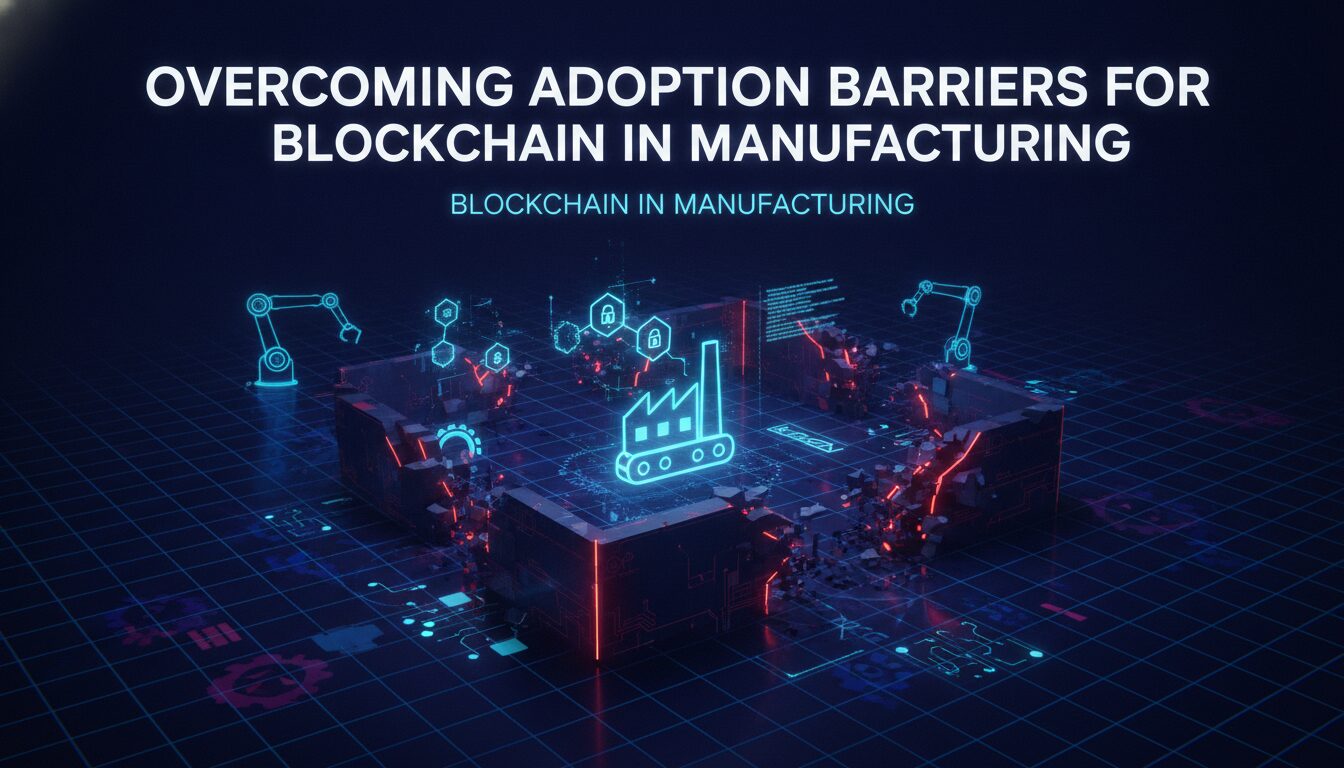
Lack of Trust and Interoperability
The biggest barrier to in manufacturing is trust between competing supply chain partners, not the technology itself. PwC’s Global Blockchain Survey found that 45% of respondents considered lack of trust a major obstacle to adoption. Building that trust takes a consortium governance model where competitors agree upfront on data-sharing rules and dispute resolution. On top of that, interoperability between different blockchain platforms and decades-old legacy ERP systems remains a real technical hurdle, not a solved problem.
Scalability and Regulatory Uncertainty
Public blockchains often struggle with transaction throughput, while private networks trade some decentralization for speed. Manufacturers have to pick an architecture that matches their actual constraints, not the one that’s trendiest. The regulatory picture is still shifting too, especially for cross-border transactions touching intellectual property and data privacy rules that differ by jurisdiction. Aligning with standards like ISO/TC 307, the technical committee governing blockchain and distributed ledger standards, is becoming close to mandatory for serious this type of manufacturing deployments.
Integration with Legacy Systems
Most factories still run on MES and ERP systems that are decades old, and bolting blockchain onto that stack without disrupting live operations takes careful sequencing. Pilot programs that start with non-critical processes are the more defensible path. According to the PwC survey, only 24% of industrial manufacturing CEOs had moved past planning into piloting or implementing as of the survey, which tells you how cautious this rollout has been, even with 62% of organizations already running some kind of blockchain project. Notably, the same survey found 12% of respondents said industrial manufacturing was a leader in blockchain adoption, trailing only financial services, which 46% of respondents pointed to as the sector out in front.
Future Trends Shaping Blockchain in Manufacturing
IoT-Blockchain Integration for Smart Factories
The convergence of IoT and blockchain is enabling autonomous machine-to-machine transactions on the factory floor. A CNC machine, for instance, could automatically order replacement tooling and verify its authenticity through a smart contract before installation. This this kind of manufacturing trend sits at the center of Industry 4.0, where data silos get eliminated and production starts optimizing itself in near real time.
Digital Twins and Predictive Maintenance
Digital twins are virtual replicas of physical assets, and they get more valuable once you secure and enrich them with blockchain data. In blockchain in, linking real-time operational data to the chain creates an immutable maintenance log that extends equipment life and protects resale value down the line. Blockchain doesn’t build the twin, it guarantees the integrity of the data feeding it, so simulation models are built on numbers nobody quietly altered.
Sustainability and Carbon Footprint Tracking
Regulators pushing ESG reporting are turning blockchain in manufacturing into a verification layer for sustainability claims that used to rely on self-reporting. Every energy input, waste stream, or recycled material gets logged immutably, giving brands a way to actually prove a carbon footprint number instead of asserting it. This angle is still underexplored relative to traceability use cases, but it’s gaining real traction, particularly alongside the EU’s Digital Product Passport initiative, which will require verifiable product-level sustainability data for a growing list of categories.
Additive Manufacturing and Design File Protection
3D printing raises a specific IP problem: once a design file exists digitally, it can be copied and printed anywhere, by anyone, with no physical supply chain checkpoint to catch it. Blockchain addresses this by timestamping and hashing design files at the point of creation, so any unauthorized print run can be traced back to a leaked or pirated file. For manufacturers shifting toward distributed, on-demand 3D printing networks, this kind of file-level provenance is quickly becoming as important as physical part traceability.
Comparing Blockchain Frameworks for Manufacturers
The right blockchain framework for most manufacturing deployments is a consortium or private permissioned chain, not a public one. Below is a comparison of the three primary frameworks used in manufacturing settings.
| Feature | Public Blockchain | Private Blockchain | Consortium Blockchain |
|---|---|---|---|
| Access | Permissionless, anyone can join | Permissioned, single organization controls | Permissioned, multiple known organizations govern |
| Scalability | Low throughput, high latency | High, but trade-offs in decentralization | Moderate to high, optimized for group |
| Consensus | Proof of Work/Stake, energy-intensive | Practical Byzantine Fault Tolerance, more efficient | PBFT or similar, tailored to trust environment |
| Trust Model | Trustless, fully decentralized | Trust in owner, centralized | Semi-trusted, governed by consortium members |
| Use in Manufacturing | Rare due to performance and privacy | Single-company supply chain visibility | Multi-party supply networks, ideal for blockchain in manufacturing consortia |
As the MDPI study confirms, private or permissioned blockchain is suitable for multi-organizational businesses such as supply chain and logistics, which is exactly why consortium models lead in blockchain in manufacturing collaborations.
“Private or permissioned blockchain is most suitable for multi-organizational businesses like supply chain and logistics.” – MDPI Logistics, 2022
Steps to Implement Blockchain in Manufacturing Operations
Implementing blockchain in manufacturing takes a structured, phased approach rather than a single big-bang rollout.
- Step 1: Identify the Pain Point. Pinpoint a specific problem, such as counterfeit components or slow audit cycles. Don’t try to replace every system at once.
- Step 2: Form a Consortium. Assemble key supply chain partners and agree on governance rules up front. Trust and collaboration are the foundation, according to PwC’s research.
- Step 3: Choose the Blockchain Platform. Evaluate platforms like Hyperledger Fabric, Corda, or Ethereum-based private networks against your scalability, privacy, and consensus needs.
- Step 4: Integrate IoT and Existing Systems. Connect sensors and ERP software through APIs so data feeds onto the blockchain automatically, without manual entry.
- Step 5: Pilot and Scale. Run a limited pilot to prove ROI, then expand gradually to more processes and partners.
With 62% of surveyed organizations already running a blockchain project, per PwC’s Global Blockchain Survey, manufacturing is set up for faster adoption through 2026 and beyond. As of 2026, the manufacturers moving first on transparency and traceability are the ones capturing the compliance and efficiency advantage before it becomes table stakes.
Pros and Cons
Pros
- Creates an immutable, shared record that cuts disputes between supply chain partners
- Speeds up defect and counterfeit investigations from days to minutes
- Automates compliance and payment triggers through smart contracts, reducing manual overhead
- Supports verifiable ESG and carbon footprint reporting demanded by regulators
Cons
- Integration with legacy MES and ERP systems requires significant planning and cost
- Cross-partner trust and governance agreements can slow consortium formation
- Public blockchain throughput limits make private or consortium chains a near-requirement
- Regulatory frameworks, including cross-border IP and data privacy rules, are still maturing
Frequently Asked Questions
What are the 4 types of blockchain?
The four main types are public, private, consortium, and hybrid blockchains. Public blockchains are permissionless and fully decentralized, private blockchains are controlled by one organization, consortium blockchains are governed by a group of members, and hybrid blockchains combine public and private features. Each fits a different manufacturing use case.
How big is the blockchain in manufacturing market?
Precise 2026 market sizing varies by source, but adoption momentum is clear. A PwC Global Blockchain Survey found 24% of industrial manufacturing CEOs were planning, piloting, or implementing blockchain, and 62% of organizations surveyed already had a project underway, driven largely by demand for transparency and anti-counterfeiting tools.
What is an example of blockchain in manufacturing?
Autentica is one example, using blockchain to create and trade authentic digital assets tied to physical products. Another is the cutting tool traceability system described in the MDPI logistics study, where every step from raw material to end use gets recorded immutably.
How does blockchain improve supply chain transparency?
Blockchain introduces a decentralized, immutable ledger that lets all parties in the supply chain access and verify shared data in real time. This lets authorized partners see a product’s exact journey, reduces disputes, and enables faster recalls of defective items without relying on a single central authority.
What are the challenges of adopting blockchain in manufacturing?
Key challenges include lack of trust among partners, cited by 45% of respondents in the PwC survey, plus interoperability with legacy systems, scalability limits, and regulatory uncertainty around cross-border data and IP rules. Overcoming these takes deliberate consortium governance and a phased rollout rather than a full-scale replacement.
Ready to move past pilots and build production-grade infrastructure? Apply to the Genesis Cohort at digitalblockchains.com and build with a team that ships protocol-level tokenomics and Web3 infrastructure, not slide decks.