Blockchain supply chain is a distributed ledger system that records every product transaction across a supply network, creating a permanent, transparent record from raw material to end consumer. It improves traceability, reduces fraud, and automates processes via smart contracts.
Key Takeaways
- supply chain is a shared, immutable ledger that records every product transaction, enabling end-to-end traceability and trust across all network participants.
- Companies adopting this technology can reduce administrative costs, eliminate counterfeits, and automate compliance reporting that currently consumes dozens of person-hours per month.
- Integration with IoT, AI, and smart contracts unlocks real-time tracking, predictive analytics, and self-executing agreements that trigger without human intervention.
- Supply chain disruptions cost organizations an average of $184 million annually. Blockchain mitigates that risk through enhanced, multi-tier visibility.
- Adoption challenges include scalability, interoperability, and regulatory uncertainty, but Layer-2 networks and industry consortia are maturing fast enough to address most of them.
How Blockchain Works in Supply Chains
What Is a Blockchain Supply Chain?
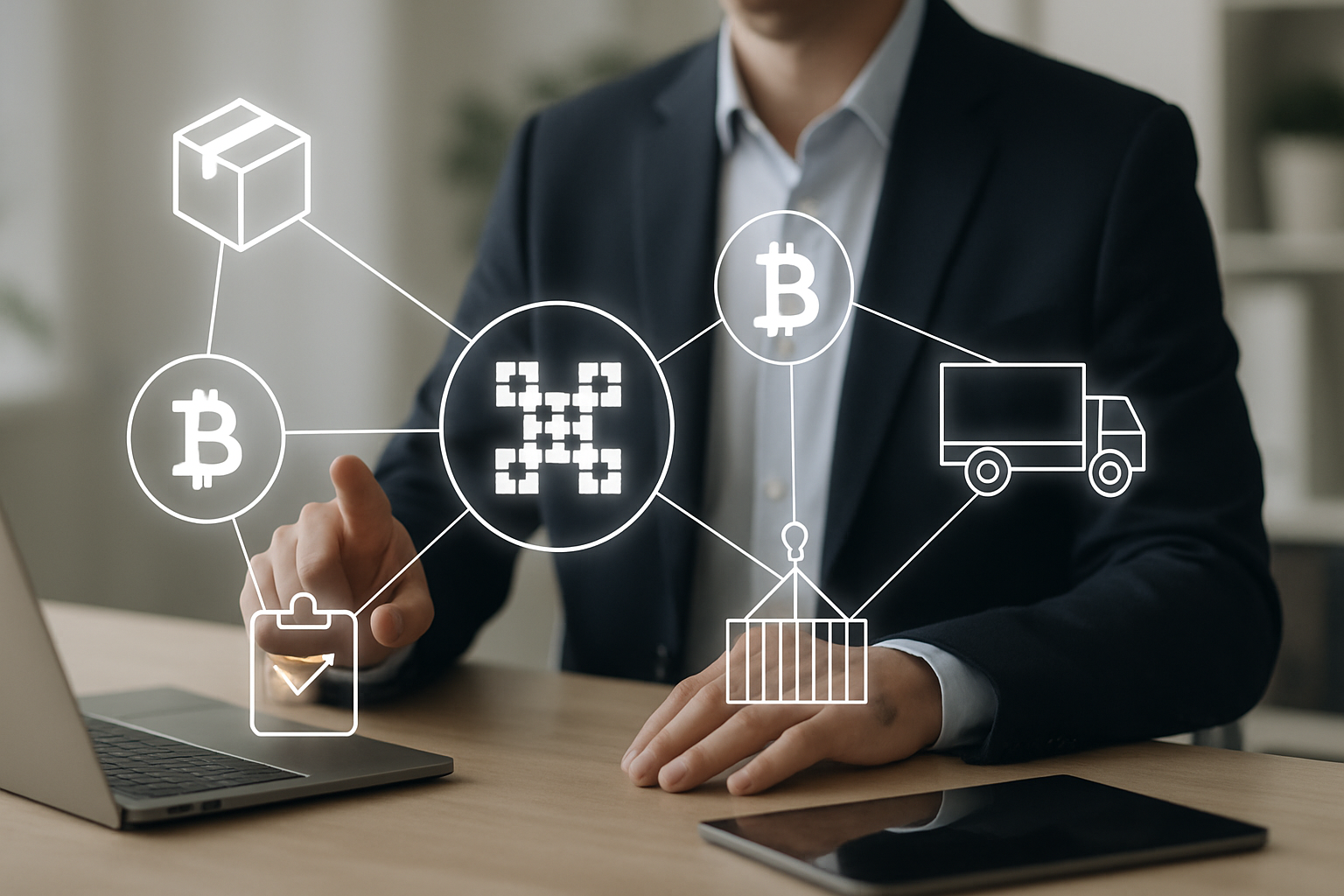
A this type of chain is a system where product information, ownership changes, and custody transfers are recorded on a distributed ledger shared by all network participants. Each transaction is grouped into a block, cryptographically linked to the previous one, and validated by consensus, making the history practically impossible to alter. This creates a single source of truth for everyone from raw material suppliers to end consumers. According to Deloitte, the technology is “a record of transaction data that relies on a shared ledger… inherently tamper-evident and provides a trusted shared and reliable way to record, validate, and view transactions across a complex system.”
Public vs. Private Blockchain for Supply Chain
Organizations typically choose between three architectures: public blockchains (open to anyone, fully transparent, but slower), private blockchains (permissioned, faster, controlled by a single entity), and consortium blockchains (governed by a group of pre-approved nodes). Most enterprise this kind of chain projects operate on a private or consortium model because they require higher throughput, data privacy, and the ability to restrict sensitive commercial information. A consortium of food manufacturers, logistics providers, and retailers can share shipment records without exposing proprietary pricing, which is exactly the kind of selective transparency that makes permissioned networks practical.
Consensus Mechanisms That Matter for Supply Chain
The choice of consensus mechanism directly affects throughput, finality time, and trust assumptions. Three models dominate enterprise deployments. Proof of Authority (PoA) assigns validation rights to pre-approved nodes, delivering sub-second finality and thousands of transactions per second. Hyperledger Fabric uses a variant of this model and is the backbone of IBM Food Trust. Practical Byzantine Fault Tolerance (PBFT) tolerates up to one-third of nodes acting maliciously, making it well-suited for consortia where participants are known but not fully trusted. Proof of Stake (PoS) variants appear in public-facing supply chain tokens where broader participation is desirable. For most enterprise blockchain supply deployments, PoA or PBFT wins on performance grounds: a PoA network can sustain 1,000-5,000 TPS with deterministic finality, compared to Bitcoin’s 7 TPS under Proof of Work.
Smart Contracts and Immutable Audit Trails
Smart contracts are self-executing code stored on the blockchain. When predefined conditions are met, such as a temperature sensor logging a breach or a shipment arriving at a geofenced location, the contract automatically triggers actions like releasing payment or flagging a non-compliance event. This eliminates manual reconciliation and creates an indisputable audit trail for regulators and auditors. Below is a simplified Solidity example of a shipment condition check:
// SPDX-License-Identifier: MIT

    }

        }
    }

    }
}
In production, the owner role would be replaced by a multi-sig or oracle contract (e.g., Chainlink) that aggregates IoT sensor feeds before writing to the chain, removing the single point of trust.
Key Benefits of Blockchain Supply Chain Solutions
Traceability and Provenance at Every Step
A blockchain supply chain provides a real-time, end-to-end view of every product’s journey. Each time goods change hands, from farm to processor, manufacturer to distributor, retailer to consumer, the event is recorded as a block with a timestamp, location, and custodial data. This chain of custody builds consumer trust and is particularly valuable in food safety, pharmaceuticals, and luxury goods. Companies like Nestlé and Walmart have used IBM Food Trust, a blockchain-based platform built on Hyperledger Fabric, to trace the origin of produce in seconds rather than days.
Fraud Reduction and Counterfeit Prevention
Immutability is the most direct weapon against counterfeits. Every record is permanent. If someone tries to tamper with a batch number or shipping document, the network instantly flags the discrepancy. According to a Logistics Bureau report, counterfeit products cost legitimate businesses over $2.2 trillion globally. By anchoring product identity on-chain, companies can verify authenticity at every handoff, cutting exposure to that figure significantly.
Operational Efficiency and Cost Savings
Manual paperwork and document errors still drain an estimated $550 billion from the shipping industry each year, according to Logistics Bureau data. A blockchain supply chain automates much of this through smart contracts and digital bills of lading, reducing processing times from days to minutes. Environmental compliance reporting, which currently requires an average of 89 person-hours per month under traditional workflows, becomes a near-instant ledger query. That alone justifies the technology investment for heavily regulated industries.
Pros and Cons of Blockchain Supply Chain Technology
Pros
- End-to-end traceability: Every custody transfer is recorded permanently, giving all participants a verifiable product history from origin to delivery.
- Fraud and counterfeit resistance: Cryptographic product IDs make it computationally infeasible to forge records without detection across the network.
- Automated compliance: Smart contracts execute reporting and payment triggers automatically, reducing the 89 person-hours per month currently spent on manual environmental reporting.
- Cost reduction: Eliminating manual reconciliation and paper-based documentation cuts operational overhead across shipping, customs, and finance teams.
- Multi-party trust without a central authority: Consortium and permissioned models let competing companies share data without exposing proprietary details to a single controlling entity.
Cons
- Integration complexity: Connecting blockchain to legacy ERP systems like SAP S/4HANA or Oracle Cloud requires middleware investment and careful API design.
- Garbage-in, garbage-out risk: The ledger is only as accurate as the data entered. If a supplier inputs false information at the source, the blockchain records that falsehood permanently.
- Consortium governance overhead: Getting competing organizations to agree on data standards, node permissions, and upgrade schedules is a political and operational challenge that slows deployment.
- Regulatory ambiguity: GDPR’s right-to-erasure conflicts with blockchain’s immutability, requiring off-chain storage architectures that add design complexity.
- Upfront cost: Full-scale enterprise deployments with IoT integration can run into the millions before ROI materializes, typically within 18-24 months.
Real-World Blockchain Supply Chain Examples

Food Safety and Freshness Tracking
As of 2026, IBM Food Trust connects over 200 organizations, enabling them to trace a head of lettuce from field to shelf in under 2.5 seconds. This speed is critical during contamination outbreaks, where pinpointing the source quickly can save lives and millions in recall costs. Walmart reported reducing the time to trace mangoes from 7 days to 2.2 seconds using the platform, a result that has been widely cited in the industry as a proof point for blockchain’s operational value.
Pharmaceutical Serialization
The pharmaceutical industry faces strict regulations like the Drug Supply Chain Security Act (DSCSA) in the U.S. Blockchain supply chain systems allow manufacturers, wholesalers, and pharmacies to verify the unique identifier of every drug package, ensuring no counterfeit or diverted medicine enters the legitimate supply chain. MediLedger is already operational in this space, tracking billions of units annually across major pharmaceutical distributors and manufacturers.
Luxury Goods Authentication
Brands including LVMH, Prada, and Cartier use the Aura Blockchain Consortium to issue digital certificates of authenticity for handbags, watches, and jewelry. Each item receives a unique digital twin on-chain, which owners can access via NFC tags to view its full provenance, including raw material sourcing and manufacturing details. This approach boosts resale value and gives buyers confidence that what they’re purchasing is genuine.
Overcoming Blockchain Supply Chain Challenges
Scalability and Throughput Limits
Early public blockchains processed only 7-15 transactions per second, far below the thousands required by global supply chains. As noted by Deloitte, technical improvements such as sharding, sidechains, and Layer-2 solutions now enable high-performance networks capable of handling 10,000+ TPS. Enterprises are increasingly adopting these innovations to run blockchain supply chain applications at scale without sacrificing the auditability that makes the technology worth deploying in the first place.
Interoperability Between Existing Systems
A major hurdle is integrating blockchain with legacy ERP systems like SAP and Oracle. Many companies run dozens of disparate platforms simultaneously. Middleware solutions and standardized APIs, including GS1 standards for barcodes and RFID, act as bridges, allowing data from IoT sensors and back-office software to flow onto the blockchain without replacing current investments. Platforms like Chainstack and Kaleido have built specifically for this integration layer, reducing deployment timelines from years to months.
Regulatory and Data Privacy Concerns
Global supply chains must comply with GDPR, CCPA, and other privacy regulations that grant individuals the right to erasure, a concept that sits in tension with blockchain’s immutability. Private and consortium blockchains address this by storing personally identifiable information off-chain and recording only cryptographic hashes on-chain. Auditors can verify the data without seeing the raw content, preserving both privacy and provability. This architecture is now standard practice in enterprise blockchain supply chain design.
Blockchain and IoT: A Powerful Combination
How IoT Sensors Feed the Blockchain
IoT devices, including temperature loggers, GPS trackers, and accelerometers, generate continuous data streams as goods move through the supply chain. When that data is written directly to a blockchain supply chain, it becomes tamper-proof and instantly accessible to all permitted parties. According to IBM, the blockchain-in-IoT market grew from $30 million in 2018 to $113 million, and projections placed it above $3 billion with a compound annual growth rate near 93% by 2024. That trajectory reflects how seriously enterprises are treating the convergence of these two technologies.
Automated Cold Chain Monitoring
For temperature-sensitive products like vaccines or fresh seafood, smart contracts can be linked directly to IoT sensors. If the temperature deviates beyond a safe range, the contract automatically files an insurance claim, reroutes the shipment, or reduces payment to the carrier, all without human intervention. This cuts spoilage rates significantly and eliminates the disputes over responsibility that currently slow down claims processing by weeks.
Reducing Invoice Disputes
IoT data stored on a blockchain serves as a single, unalterable source of truth for shipping conditions, delivery times, and custody handovers. When both buyer and seller trust the same data, invoice reconciliation that once took weeks happens in real time. Pilot programs with major logistics firms have shown reductions in Days Sales Outstanding (DSO) of up to 30%, which translates directly to improved working capital for all parties in the chain.
| Aspect | Traditional Supply Chain | Blockchain Supply Chain |
|---|---|---|
| Data Integrity | Manual entry, siloed databases, prone to errors and fraud | Immutable ledger, cryptographically secured, single version of truth |
| Traceability | Limited to one-up/one-down visibility; 60% of firms lack visibility beyond tier-1 suppliers | Full chain-of-custody from raw material to end consumer in near real-time |
| Dispute Resolution | Lengthy manual audits, invoice discrepancies, legal costs | Instant verification via shared ledger, automated via smart contracts |
| Counterfeit Risk | High; $2.2T lost globally to fake goods | Severely reduced through cryptographic product IDs and provenance tracking |
| Compliance Reporting | Average 89 person-hours/month for environmental reporting alone | Automated reporting with tamper-proof audit trails |
| Scalability | Mature but requires heavy manual interventions | Maturing quickly; Layer-2 solutions and consortium chains handle thousands of TPS |
Blockchain vs. Traditional ERP Systems in Supply Chain
Where ERP Falls Short
Enterprise Resource Planning systems like SAP S/4HANA and Oracle Cloud manage internal operations effectively but fail to connect across company boundaries. They rely on centralized databases that each party maintains separately, leading to data silos and reconciliation overhead that compounds with every additional trading partner. A Deloitte survey found that CEOs now rank supply chain visibility as their top strategic priority, something ERP alone cannot deliver because it was never designed for cross-organizational trust.
Complementing, Not Replacing, Legacy Systems
Blockchain does not displace existing ERP investments. Instead, it sits as an integration layer, connecting external partners while the ERP continues to run core financials and inventory. Middleware solutions from platforms like Chainstack or Kaleido allow data to flow between SAP modules and a private blockchain network, so organizations can adopt blockchain incrementally without a full system replacement. This incremental path is how most enterprises actually get to production.
Tokenomics and Supply Chain Financing
One underexplored angle is how token-based models can restructure supply chain financing. In a tokenized supply chain, invoices, purchase orders, and warehouse receipts become on-chain assets that can be fractionalized, traded, or used as collateral in DeFi lending protocols. A small supplier waiting 60-90 days for payment can instead tokenize a confirmed purchase order and access liquidity within hours. Projects like Centrifuge have demonstrated this model, connecting real-world assets to on-chain capital pools. The tokenomics design matters here: governance tokens can align incentives across consortium members, while utility tokens can automate payment rails between parties who don’t share a banking relationship. For a deeper look at how token design affects protocol behavior, see our analysis of token launch architecture on the Digital Blockchains blog.
Measurable ROI in Early Deployments
Early adopters report concrete returns. A European pharmaceutical consortium using a blockchain supply chain to serialize drugs cut audit preparation time by 75% and reduced counterfeits to near zero within the first year of deployment. A global coffee brand traced beans from 380,000 farmers and increased premium sales by 12% because buyers could verify fair-trade claims instantly. These aren’t projections. They’re operational results from networks already running at scale.
What Does It Cost to Implement a Blockchain Supply Chain?
Implementation costs vary by scope, but the range is wide enough to matter for planning. A cloud-based pilot using a managed service like IBM Food Trust or Hyperledger Fabric on AWS can start under $50,000 for a proof of concept covering a single product line. A full-scale enterprise deployment with IoT sensor integration, ERP middleware, and multi-party consortium governance typically runs into the millions. Most practitioners find that ROI materializes within 18-24 months, driven primarily by fraud reduction, lower reconciliation costs, and faster dispute resolution. The 40+ documents and 200+ communications typically required for a single cross-border shipment represent a clear target for automation, and that’s where the financial case is easiest to build.
Future Outlook for Blockchain Supply Chains
AI and Blockchain: Predictive Risk Management
The fusion of artificial intelligence with blockchain is gaining real traction. AI algorithms analyze historical shipment data stored on-chain to predict delays, supplier failures, or demand spikes. Smart contracts then automatically adjust orders or reroute logistics before a disruption occurs. This proactive model is a significant step beyond the reactive approaches that cost businesses an average of $184 million per disruption annually, as reported by Logistics Bureau. The combination of immutable historical data and machine learning inference is one of the more technically interesting problems in applied blockchain right now.
“Blockchain allows the exchange of information to be greatly simplified and allows processes to be designed more quickly and securely. Applications based on blockchain offer a radical new communication pathway within complex supply chains thereby improving trust, security and speed.”
– Stefan Schrauf, Partner at PwC Germany, as quoted by PwC.
“The immutability and transparency of blockchain records fundamentally change the trust calculus in multi-party logistics. You no longer need a central clearinghouse to validate what happened. The ledger is the clearinghouse.”
– Hyperledger Foundation, Hyperledger Project Documentation.
Sustainability and ESG Compliance
Regulators in the EU (CSRD) and the US (SEC climate disclosure rules) are mandating detailed carbon reporting. A blockchain supply chain can automatically capture energy usage and emissions at each production step, creating a verifiable digital product passport. This lets companies back up sustainability claims with auditable data, reducing greenwashing risk and building the kind of brand trust that increasingly drives purchasing decisions in B2B and consumer markets alike. For builders thinking about how decentralized infrastructure supports ESG reporting, our overview of smart contract architecture at Digital Blockchains covers the technical patterns involved.
The Rise of Blockchain-Native Logistics Networks
By 2026, several industry consortia, including IBM Food Trust (food), Aura (luxury), and MediLedger (pharmaceuticals), have mature networks processing millions of transactions monthly. The longer-term goal is a plug-and-play logistics layer where smart contracts govern everything from letters of credit to customs clearance, eliminating the 40+ documents and 200+ communications typically required for a single cross-border shipment. That’s not a vision statement. It’s an engineering target that several of these networks are actively building toward.
Frequently Asked Questions
How does blockchain affect supply chain management?
Blockchain creates a shared, immutable ledger that gives all participants a single version of truth. It improves traceability, reduces fraud, automates manual processes through smart contracts, and cuts reconciliation costs significantly. The biggest operational shift is moving from reactive problem-solving to real-time visibility across every tier of the supply network.
What are the biggest barriers to adopting blockchain in supply chains?
Scalability, integration with legacy systems, regulatory uncertainty, and the need for industry-wide data standards top the list. Layer-2 networks, private blockchains, and consortium governance models are rapidly addressing the technical barriers. The harder problems are organizational: getting competing companies to agree on shared infrastructure takes time and political will.
Can blockchain work without cryptocurrency in the supply chain?
Yes. Most enterprise blockchain supply chain platforms use permissioned networks that do not involve a native cryptocurrency. Value is transferred in the form of trusted data, not tokens. Some networks do use stablecoins for automated cross-border payments, but that’s an optional layer, not a requirement.
What industries benefit most from blockchain supply chain solutions?
Food and agriculture, pharmaceuticals, luxury goods, automotive, and logistics see the greatest impact due to their need for provenance, compliance, and counterfeit prevention. These sectors also have complex, multi-party ecosystems where trust between participants is critical and currently expensive to maintain through traditional audit processes.
How much does it cost to implement a blockchain supply chain?
A pilot with a cloud-based managed service can start under $50,000, while a full-scale enterprise deployment with IoT integration may run into the millions. ROI typically materializes within 18-24 months, driven by fraud reduction and operational savings from eliminating manual reconciliation and paper-based documentation workflows.
Is blockchain the same as a tracking system like RFID?
No. RFID tracks physical location, while blockchain records provenance, ownership, and condition data in a tamper-proof way. They complement each other: RFID feeds location data onto the blockchain, creating a complete, trustworthy audit trail that neither technology could produce alone.
If you’re building supply chain infrastructure on-chain or designing tokenomics for a logistics protocol, apply to the Genesis Cohort at Digital Blockchains. We work with serious builders who are past the whitepaper stage and ready to deploy.