Blockchain voting is a digital voting system that records ballots on a tamper-proof, decentralized ledger, enabling real-time verification and transparent audits. It promises more accessible elections, though security experts remain sharply divided on its real-world vulnerabilities.
Key Takeaways
- voting records votes on an immutable ledger, letting voters verify their ballot was counted without revealing their identity.
- Pilot projects from West Virginia to Romania have tested the technology in live elections, with mixed results.
- Proponents cite remote accessibility and reduced administrative costs; critics warn of undetectable cyberattacks and the absence of a paper trail.
- As of 2026, over a dozen national and regional pilots have been documented, building a growing evidence base.
- Security researchers advocate for open-source, end-to-end verifiable systems before any binding national deployment.
What Is Blockchain Voting?

this type of voting is a method of casting and recording ballots using distributed ledger technology (DLT), where each vote is encrypted and added to a chain of blocks, creating an immutable and publicly verifiable record. Unlike traditional electronic voting machines that rely on centralized databases, the blockchain spreads data across a network of nodes, eliminating single points of failure. This architecture allows real-time auditing while preserving voter anonymity through cryptographic techniques.
The Core Principles: Decentralization and Immutability
Two properties define this kind of voting at a protocol level: decentralization and immutability. A decentralized network ensures no single authority controls the tally, reducing insider manipulation risk. Immutability means once a vote is recorded, it cannot be altered or deleted without detection, since any change requires network consensus and is immediately visible. According to the Chainlink Education Hub, this creates a “unified golden record” of every valid ballot, enabling independent verification by any participant.
How Blockchain Voting Differs from Internet Voting
Internet voting typically relies on a centralized server that can be compromised, making large-scale fraud feasible. blockchain adds a layer of cryptographic accountability: every transaction is time-stamped and linked to previous ones, forming a continuous audit trail. That said, researchers at the MIT Digital Currency Initiative caution that while blockchain improves transparency, it does not automatically solve endpoint security. Malware on a voter’s device can still alter a ballot before it ever reaches the chain.
How Blockchain Voting Works: A Step-by-Step Process
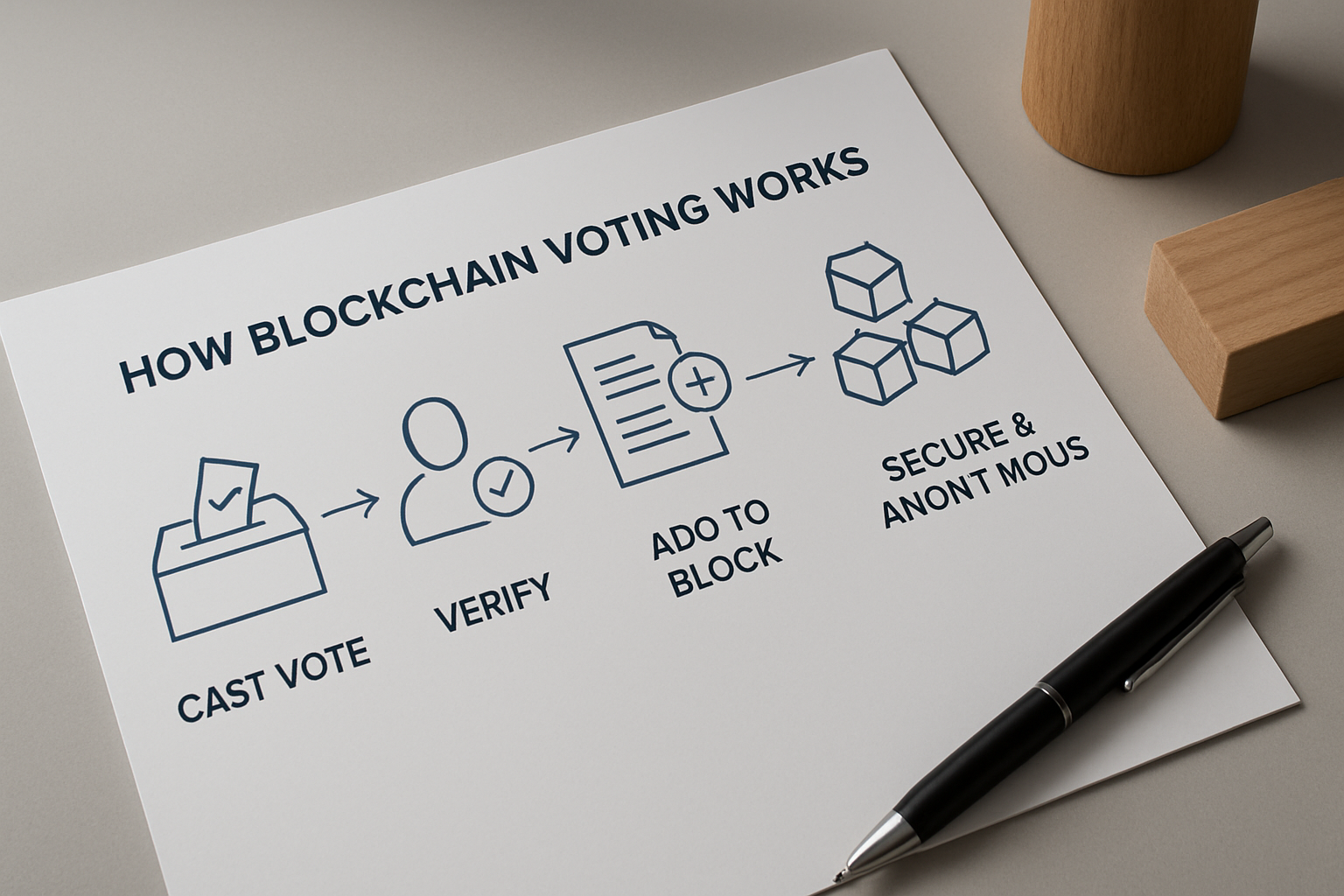
A typical voting workflow proceeds through several distinct stages, combining identity verification, ballot encryption, and public auditing into a single pipeline.
- Voter Registration and Identity Verification: The voter installs a voting app (such as Voatz, used in West Virginia) and submits biometric data, a fingerprint or facial scan, along with government-issued ID to an approved identity verifier.
- Ballot Issuance: Once identity is confirmed, the registrar issues the correct ballot type to the voter’s device, encrypted with a private key.
- Vote Casting and Encryption: The voter makes selections and signs the ballot with their private key. The encrypted vote is broadcast to the blockchain network.
- Consensus and Recording: Network validators verify the transaction’s authenticity and append it to a block. Each block is linked cryptographically to the previous one, forming an immutable chain.
- Verification and Audit: Voters receive a receipt, typically a cryptographic hash, confirming their vote was recorded. Public access to the blockchain lets anyone count the encrypted votes and verify the tally without revealing individual identities.
Cryptographic Methods: Zero-Knowledge Proofs and Beyond
The privacy guarantees in this type of voting depend heavily on the cryptographic primitives underneath. Zero-knowledge proofs (ZKPs) are the most promising tool here. A ZKP lets a voter prove their ballot is valid, that it was cast by an eligible voter and contains a legitimate selection, without revealing the actual vote content. zk-SNARKs, the same proof system used in Zcash and deployed across several Ethereum Layer-2 networks, can compress this proof to a few hundred bytes while remaining computationally verifiable in milliseconds. Homomorphic encryption is another approach: votes are encrypted in a way that allows the tally to be computed directly on ciphertext, so no individual ballot ever needs to be decrypted. Combining ZKPs with homomorphic tallying gives a system where the final count is publicly verifiable and individual votes remain permanently private, even from election administrators.
A Developer’s View: On-Chain Ballot Logic
For builders, the core voting logic typically lives in a smart contract. Here is a minimal Solidity example showing how a ballot can be issued, cast, and tallied on-chain:
// SPDX-License-Identifier: MIT

    }

    }

    }

    }

    }
}
This contract is intentionally minimal. A production system would replace msg.sender identity with a verified credential (using ERC-725 identity standards or a Merkle-proof whitelist), add ZKP verification for ballot privacy, and emit events for off-chain indexing. The key insight is that the tally function is public and callable by anyone, making the result independently verifiable without trusting the election authority.
The Role of Smart Contracts in Voting
Smart contracts automate election rules on-chain. A contract can enforce that only registered voters receive a tokenized ballot, automatically close the poll at a predetermined block height, and tally results without human interference. This cuts administrative overhead and eliminates manual counting errors. The Chainlink Education Hub notes that smart contracts can “automate critical parts of the voting process, from verifying voter eligibility to tallying results in real time.”
Real-World Example: The West Virginia Military Pilot
In 2018, West Virginia became the first U.S. state to test this kind of voting in a federal election, using the Voatz app for overseas military personnel. GovTech reports that voters scanned their thumbs and cast ballots on a smartphone, with each vote recorded on a public blockchain. Only two counties participated and turnout was small, but the pilot demonstrated technical feasibility: a voter’s ballot could be verified on-chain within minutes, even from remote deployments.
Real-World Blockchain Voting Pilots and Implementations
Governments worldwide have moved beyond theory, launching live blockchain pilots that reveal both promise and pitfalls. As of 2026, over a dozen national and regional pilots have been documented, offering a growing body of evidence on what works and what does not.
Romania: The EU’s First Blockchain Voting Reporting Tool
Romania was the first European Union country to use blockchain technology in a national election context. During the November 2023 parliamentary elections, the electoral authority deployed a reporting tool that recorded turnout data on a permissioned blockchain, updating every five seconds. According to Chambers and Partners, this made data “tamper-proof and real-time,” reducing post-election disputes and cutting administrative costs by eliminating physical minute-handling. The system did not replace paper ballots. It acted as a parallel, transparent record alongside the existing process.
Sierra Leone’s 2018 Presidential Election
Sierra Leone became the first nation to use a blockchain-based voting system in a presidential election. Swiss startup Agora provided the platform, recording votes on a custom blockchain and offering end-to-end verifiability. Critics noted the system covered only a fraction of polling stations, but it proved that voting could operate under real logistical pressure in a developing-nation context.
Other Notable Pilots: South Korea, Russia, and Beyond
- South Korea (2021): The National Election Commission launched a blockchain-based online voting system for private elections, focusing on transparent voter authentication and tamper-resistant logging.
- Russia (2019): Moscow’s municipal elections trialed a DLT-based system, though independent observers raised concerns about its opacity and the degree of central control retained by authorities.
- Estonia, Norway, Switzerland: These countries have experimented with blockchain for political party primaries and local referenda, often combining it with existing e-ID infrastructure that already covers the majority of their adult populations.
Pros and Cons of Blockchain Voting

this type of voting carries genuine technical advantages alongside serious risks. Any honest assessment has to hold both in view at the same time.
Pros
- Tamper-resistant records: Once a vote is appended to the chain, altering it requires rewriting every subsequent block across a distributed network, a computationally prohibitive task on large public chains.
- Remote accessibility: Eligible voters can cast ballots from any internet-connected device, removing physical barriers for military personnel, overseas citizens, and voters with disabilities.
- Real-time, public auditability: Anyone can query the ledger and verify the tally independently, without relying on a central authority or waiting for an official count.
- Reduced administrative overhead: Smart contracts automate eligibility checks, ballot issuance, and tallying, cutting the staffing and logistics costs associated with paper-based elections.
- Cryptographic voter receipts: Each voter receives a hash-based receipt confirming their ballot was included, a feature absent from most paper and electronic voting systems.
Cons
- Endpoint vulnerability: The blockchain itself may be immutable, but a compromised voter device can alter a ballot before it ever reaches the chain, and that attack may be undetectable after the fact.
- No paper trail for recounts: Most election laws require a physical ballot trail. Pure blockchain systems do not provide one, creating a legal gap in jurisdictions that mandate manual recounts.
- Scalability constraints: Public blockchains currently process only a few dozen transactions per second, far below the throughput required for a national election at peak voting hours.
- Privacy risks at low turnout: In small precincts, even pseudonymous on-chain data can be cross-referenced with public information to deanonymize voters.
- 51% attack exposure: Permissioned or small-scale networks are vulnerable to a majority validator attack that could rewrite election history.
- Remote coercion and vote buying: Removing in-person supervision makes it easier for third parties to coerce voters or purchase votes, a problem paper systems mitigate through the privacy of the polling booth.
Critical Security Concerns and Skepticism
Despite its potential, this kind of voting faces intense criticism from cybersecurity experts and election integrity advocates. The U.S. Vote Foundation has called it an “imminent threat to democracy,” arguing the technology introduces graver risks than it resolves.
“blockchain would greatly increase the risk of undetectable, nation-scale election failures.” – MIT Digital Currency Initiative, 2020 research paper on internet and voting security
Undetectable Manipulation and Malware
A this type of voting system is only as secure as the devices used to access it. Malware or zero-day exploits could alter a vote before it reaches the chain, and such attacks could be impossible to detect or reverse after the fact. The MIT Digital Currency Initiative’s 2020 paper concluded that blockchain “would greatly increase the risk of undetectable, nation-scale election failures.” Standard denial-of-service attacks could also disrupt voting windows entirely, disenfranchising large numbers of voters without leaving any trace on the ledger.
Voter Privacy and Ballot Secrecy
Blockchain records are pseudonymous, not anonymous. Advanced analytics could deanonymize voters, particularly in low-turnout precincts where the number of possible voters is small enough to make correlation attacks feasible. The U.S. Vote Foundation lists “large-scale, undetectable violations of voter privacy” as a primary concern. Without robust zero-knowledge proofs or cryptographic mixing protocols, blockchain voting risks exposing sensitive political choices to anyone with sufficient analytical capability.
51% Attacks and Network Centralization
If a single entity gains control of a majority of a network’s validation power, they can rewrite blockchain history and effectively alter an election outcome. Large public blockchains are expensive to attack at that scale, but permissioned or small-scale networks used for government elections may be far more vulnerable. This is not a theoretical concern: smaller proof-of-work chains have suffered 51% attacks in practice, with reorganizations confirmed on-chain within hours of the attack.
“An open-source system is necessary to have a fool-proof election.” – Brookings Institution analysis on blockchain and election transparency
Blockchain Voting vs Traditional Voting: A Comparison
| Feature | Paper Ballots (Hand-Counted) | Electronic Voting Machines (EVM) | Blockchain Voting |
|---|---|---|---|
| Immutability | Low (physical tampering possible) | Low (software can be altered) | High (cryptographically immutable) |
| Transparency | Medium (observers present; recounts possible) | Low (proprietary code, black-box) | High (public ledger, auditable by anyone) |
| Auditability | High (physical recount) | Low (may lack paper trail) | Very High (real-time, cryptographic verification) |
| Accessibility | Low (in-person only, physical barriers) | Low (in-person, limited hours) | High (remote, any device, 24/7) |
| Single Point of Failure | Yes (centralized ballot boxes) | Yes (server, tabulator) | No (decentralized network) |
| Cost Efficiency | Low (high logistics, staffing) | Medium (hardware, maintenance) | High (reduced physical infrastructure) |
| Paper Trail for Recounts | Yes | Partial (depends on system) | No (cryptographic receipt only) |
The Role of Open Source in Blockchain Voting
For blockchain voting to earn public trust, the underlying code must be transparent and publicly auditable. Open-source platforms let independent security researchers inspect for vulnerabilities, a practice entirely absent in proprietary voting machines. The Brookings Institution has emphasized that “an open-source system is necessary to have a fool-proof election.”
Notable Open-Source Initiatives
- Follow My Vote: Offers an end-to-end verifiable voting app that publishes source code for public review. Its system allows voters to audit the ballot box after the election closes.
- Democracy Earth Foundation: Builds open-source, decentralized governance tools on Ethereum, exploring quadratic and liquid voting models for organizations and communities.
- VotoSocial: A blockchain voting project focused on tamper-proof tallying for small organizations, released under an open license.
Challenges of Open-Source Adoption
Open source increases transparency but also exposes attack surfaces to adversaries who can study the code for exploitable weaknesses. Election commissions frequently lack the technical staff to maintain or customize such systems. Hybrid models, where a public open-source core is combined with certified hardware and formal security audits, are being explored as a practical middle ground between full transparency and operational security.
Challenges and Future Outlook for Blockchain Voting
As of 2026, blockchain voting remains an experimental technology with significant hurdles before it can be deployed in binding national elections.
Scalability and Transaction Speed
Public blockchains like Ethereum currently process only a few dozen transactions per second at the base layer, far below the thousands of ballots cast each minute in a large-scale national election. Romania’s reporting tool worked precisely because it recorded aggregated turnout data every five seconds rather than individual votes. For direct voting at scale, Layer-2 solutions such as Optimistic Rollups or ZK-Rollups, or purpose-built permissioned chains with higher throughput, are required. The trade-off is real: higher throughput on permissioned chains typically comes at the cost of decentralization, which is the property that makes the system trustworthy in the first place.
Legal and Regulatory Frameworks
Most election laws mandate a paper ballot trail for recounts, which pure blockchain systems do not provide. In the U.S., no federal certification standard for blockchain-based voting systems exists as of 2026. The European Union’s eIDAS regulation sets identity assurance levels that could theoretically be adapted for blockchain voting, but legal recognition lags well behind the technology. Any jurisdiction considering adoption needs to resolve this gap before a binding election, not after.
The Path Forward: Hybrid Systems and Liquid Democracy
The most credible near-term path is a two-step approach: first implement blockchain as a parallel reporting and audit layer, as Romania did in 2023, then gradually introduce direct voting once endpoint security is solved. Innovative models like liquid democracy, where voters can delegate their voting power on specific issues to trusted proxies, become technically practical with blockchain infrastructure and could enable more granular civic participation. These shifts must be weighed carefully against the documented risks of undetectable fraud that continue to concern security researchers.
Building on Blockchain Voting Infrastructure
If you’re building governance tooling, DAO voting systems, or protocol-level decision infrastructure, the lessons from electoral blockchain voting translate directly. On-chain governance already powers billions of dollars in protocol decisions across Compound, Uniswap, and Aave, using smart contract voting logic that shares its DNA with the electoral systems described here. The difference is that DAO governance operates in a permissionless environment where token-weighted voting replaces identity-verified balloting. For teams building serious governance infrastructure, understanding the cryptographic trade-offs, ZKPs versus homomorphic encryption, permissioned versus public chains, and token-weighted versus one-person-one-vote models, is foundational work. You can explore how Digital Blockchains approaches on-chain governance architecture through our studio page, and read our deeper analysis of DAO design and tokenomics in the blog.
Frequently Asked Questions
How does blockchain voting work?
Blockchain voting works by encrypting a vote into a transaction, broadcasting it to a network of nodes, validating it through consensus, and permanently recording it on a decentralized ledger. Voters can verify their ballot was included via a cryptographic receipt, but the vote’s content remains anonymous through encryption or zero-knowledge proofs.
Is blockchain voting secure?
Security depends entirely on the implementation. While the blockchain ledger itself is tamper-resistant, voter devices are vulnerable to malware that can alter a ballot before it reaches the chain. Researchers at the MIT Digital Currency Initiative argue that nation-scale attacks on such systems could be undetectable, making certain implementations less secure than paper ballots in high-stakes elections.
Which countries use blockchain voting?
Romania used a blockchain reporting tool in its 2023 parliamentary elections, and Sierra Leone piloted blockchain voting in its 2018 presidential election. South Korea, Russia, and Switzerland have tested it for private or local elections. As of 2026, no country uses blockchain voting as the sole method for all national ballots.
What are the main disadvantages of blockchain voting?
Key disadvantages include the risk of undetectable vote manipulation via compromised devices, potential privacy breaches through on-chain analytics, scalability limits that prevent handling millions of simultaneous votes, and the absence of a physical paper trail for manual recounts. Remote voting also removes the in-person supervision that deters voter coercion.
Can blockchain voting prevent election fraud?
It can reduce specific fraud types, such as post-election tally manipulation or ballot stuffing at counting centers, by ensuring an immutable on-chain record. However, it introduces new attack vectors including remote coercion, device-level malware, and vote-buying schemes that are harder to detect without in-person supervision.
Is blockchain voting used in the United States?
Only in limited pilots. West Virginia allowed military overseas voters to use the Voatz blockchain app in 2018. Several states have proposed legislation, but as of 2026, no state uses blockchain voting for mainstream elections due to unresolved security concerns and the absence of federal certification standards.