Blockchain network nodes are computers running protocol software that store, validate, and relay data across a decentralized ledger. They replace the central server found in traditional systems, letting thousands of independent machines agree on shared truth.
Key Takeaways
- Blockchain network nodes store, validate, and relay transactions without relying on a central authority.
- Full nodes verify the entire ledger independently; light nodes trust full nodes for transaction data.
- Archive nodes preserve every historical state and are typically run by block explorers and analytics firms.
- Mining nodes and validator nodes are subsets of node types with added consensus responsibilities.
- Anyone with the right hardware and connectivity can run a node, though rewards vary by role and network.
- As of 2026, node infrastructure is professionalizing, with managed providers coexisting alongside individual operators.
What Are Blockchain Network Nodes?

Definition and Core Purpose
A blockchain node is a computer or device running the protocol software of a blockchain network. According to Chainlink, a blockchain node is a stakeholder device that maintains a copy of the blockchain ledger and communicates with peers to validate transactions, protecting the security, integrity, and decentralization of the network. Put simply, a node is a connection point that receives, stores, verifies, and transmits data, as MoonPay defines it.
Every participant in a decentralized network runs one. Blockchain network nodes form the physical infrastructure of the system, standing in for the centralized server you’d find in a typical client-server setup. Instead of one authority holding the data, nodes collectively maintain the ledger, which makes the network resilient and hard to censor.
That redundancy is the whole point. Because the ledger exists on many machines at once, no single point of failure can take the network down. Nodes share the same protocol rules and constantly exchange information to stay in sync.
Peer-to-Peer vs Client-Server Architecture
Blockchain networks work differently than the apps most of us grew up using. In a traditional client-server model, a centralized server holds the data and clients request access to it. A blockchain flips this: it runs on a peer-to-peer architecture where every participant running a node contributes to the system’s stability and security. Chainlink puts it well, whether you’re looking at Bitcoin, Ethereum, or the Chainlink Network, nodes are the workhorses that keep data immutable, available, and resistant to censorship.
Nodes broadcast transactions to peers rather than routing them through a central company. This removes the need for a trusted middleman and lets participants who don’t know or trust each other agree on the state of a shared database. A node’s main job is to hold a copy of the distributed ledger and pass information along to other peers.
Each node stores a complete or partial copy of the chain, depending on its type. This distributed storage model makes the blockchain harder to corrupt or destroy. The more independent nodes exist on a network, the harder it becomes for any single actor to rewrite shared history.
Why Redundancy Creates Decentralization
Redundancy is what makes blockchains decentralized in the first place. MoonPay notes that a more distributed storage footprint makes a blockchain more resilient to data loss and tampering, since no single point of failure exists. Nodes constantly update their local ledger copies as new valid blocks arrive.
If one node drops offline, the network keeps running because other nodes hold identical data. When that node reconnects, it pulls the missing blocks from peers to catch up. This ongoing verification loop builds a trustless environment where strangers can agree on the state of a database without ever meeting.
Without nodes, transactions wouldn’t get processed and the network would be insecure and unable to communicate, as MoonPay’s research notes. Nodes are essential to any blockchain, whether it’s Bitcoin, Ethereum, or a newer network like Shardeum.
“Whether for Bitcoin, Ethereum, or the Chainlink Network, nodes are the silent workhorses that ensure data is immutable, available, and resistant to censorship.” – Chainlink Education
How Blockchain Network Nodes Work
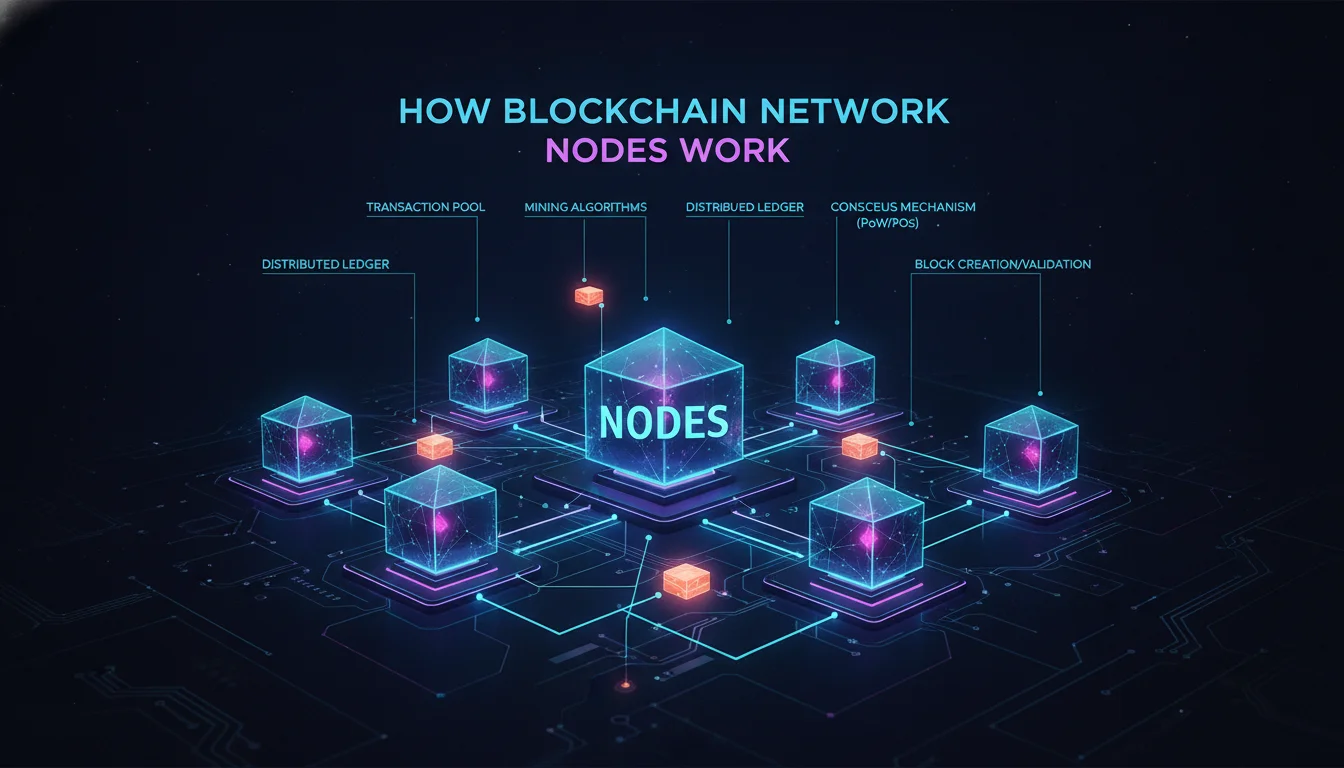
How does transaction validation happen in the mempool?
Transaction validation happens when a node pulls a pending transaction from the mempool and checks it against protocol rules before it ever reaches a block. When a user initiates a transfer, it’s first broadcast to the network and enters the mempool, a temporary holding area for pending transactions. According to MoonPay, nodes verify each transaction by confirming the sender has sufficient funds, the format is correct, and there’s no double-spending.
Once verified, a transaction sits in the mempool as valid until it’s bundled into a block. If it breaks the rules, the node rejects it and halts propagation, effectively quarantining bad data. This is how honest nodes eventually converge on the same version of history, a state we call consensus.
This validation happens independently at every node. Full nodes don’t trust outside sources; they check everything themselves. That independent verification is exactly what protects the network from invalid transactions and coordinated attacks.
Block Verification and Propagation
Once transactions are validated and bundled, they form a block that spreads across the network for further checking. Nodes receiving a new block verify it by checking each transaction inside and confirming it follows consensus rules. Once verified, the block gets added to that node’s local copy and relayed onward.
This propagation creates a ripple effect that syncs the entire network within seconds. Per Chainlink, when a new transaction or block appears, it’s sent to a handful of connected nodes first. Those nodes check the data against protocol rules, and if it’s valid, they save it and pass it along. Nodes are essentially the pathways information travels through globally.
Every node on the network verifies each new block before accepting it. That makes it extremely difficult for falsified data to slip through. Block verification is a core function of node operation, and it directly underpins the immutability of the ledger.
Consensus Mechanisms Across Networks
Consensus mechanisms are the protocols that get all nodes to agree on the current state of the chain. Blockchain network nodes play the enforcement role in these processes. Different chains use different mechanisms. In Proof-of-Work systems like Bitcoin, mining nodes compete to solve computational puzzles to validate transactions and add new blocks. In Proof-of-Stake systems like Ethereum, nodes are chosen to validate blocks based on how many coins they’ve staked as collateral.
Other approaches include Delegated Proof-of-Stake and Practical Byzantine Fault Tolerance, each with its own method for selecting which nodes participate in consensus. Every mechanism trades off security, speed, and energy use differently, but all of them depend on nodes to enforce the rules.
Without consensus, a distributed ledger has no single trustworthy state. Nodes implement the consensus algorithm and reject any block that breaks from it. That’s the mechanism that lets the network run without a central authority.
Types of Blockchain Network Nodes
Full Nodes
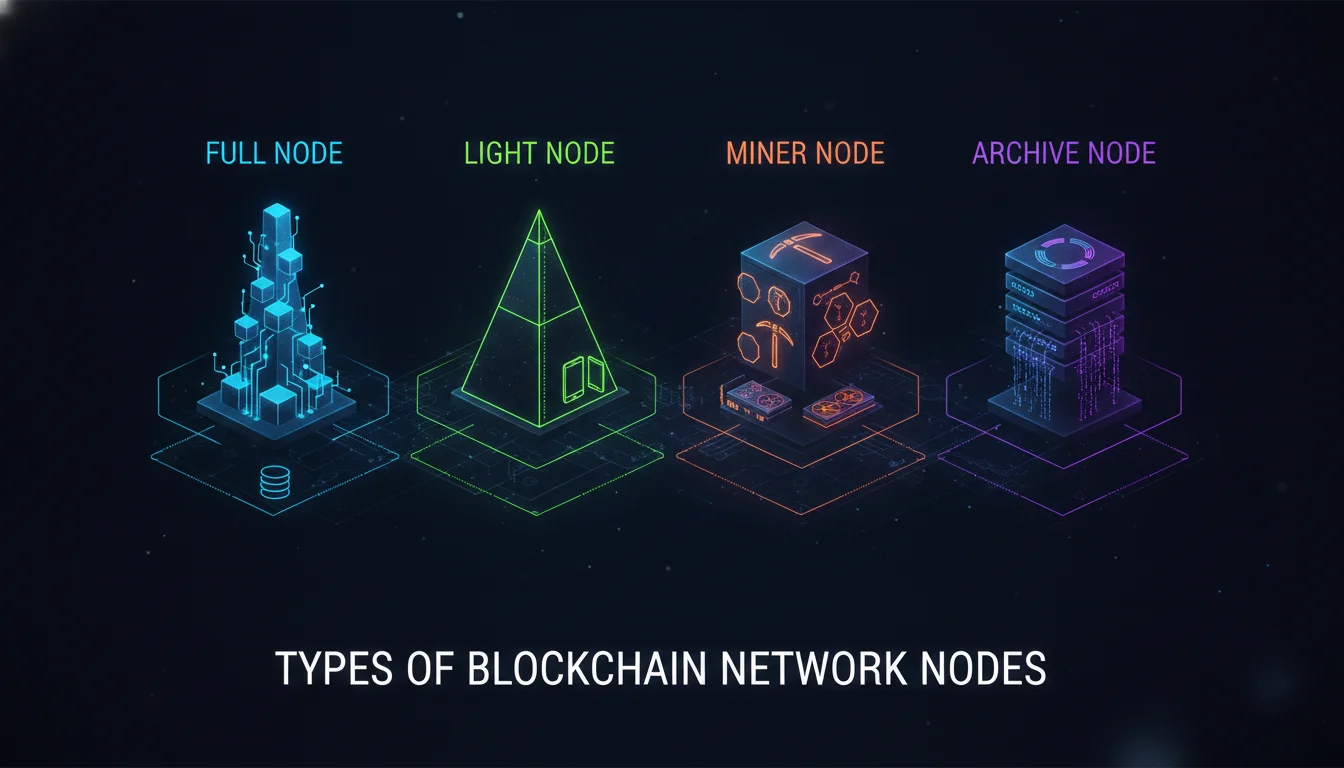
A full node is software that verifies blockchain transactions and stores the entire chain history from the genesis block to the most recent one. According to Utimaco, full nodes maintain a complete copy of the ledger and represent the most essential node type in the network, since they independently verify the entire blockchain history by downloading and storing every transaction and block.
Full nodes validate transactions and blocks by checking for inconsistencies like double-spending or invalid signatures before accepting them. They don’t trust external sources; they verify everything themselves. Developers and organizations that need high security and control over their blockchain transactions typically run full nodes.
These nodes form the foundation of the network. Stability depends on full nodes, which talk to each other constantly to maintain an accurate, current ledger state. Running one requires meaningful storage and bandwidth, since the entire chain has to stay available for validation.
Light Nodes (SPV Nodes)
Light nodes, also called Simplified Payment Verification (SPV) nodes, trade completeness for speed. Instead of downloading the entire chain, they only pull block headers, small pieces of data confirming a block’s validity, and lean on full nodes for actual transaction data when needed. This makes them a good fit for mobile wallets and low-storage devices, though they have to trust full nodes for accuracy.
According to Chainnodes, lightweight or SPV nodes don’t store the full chain the way full nodes do. Instead, they download only the blocks relevant to them. That makes them faster and more scalable, but less secure, since they depend on other nodes for accurate information.
Light nodes matter because they let users on low-resource devices participate in the network without running a full node. Plenty of mobile crypto wallets rely on light node tech to give users network access while conserving battery and data.
Archive Nodes
Archive nodes are essentially full nodes on steroids. A standard full node might prune old data to save disk space, but an archive node keeps every historical state of the chain. That lets you query the network’s state at any past point, like checking an account balance from years ago. Chainlink notes these nodes require massive storage, often measured in terabytes, and are typically run by block explorers, infrastructure providers, and analytics firms.
Archive nodes aren’t required for validating new blocks. Instead, they act as a complete historical record for applications that need deep data access. Their role is preserving the full state history, which makes them critical for auditing, research, and data indexing. These nodes commonly run in data centers with large disk arrays.
Cherry Servers notes that some node configurations retain far more historical information than standard setups, and these are often used to serve blockchain data to wallets, dApps, and backend services. Archive nodes are one example of that specialized configuration.
| Node Type | Data Stored | Primary Function | Use Cases |
|---|---|---|---|
| Full Node | Entire blockchain history | Independently verify all transactions and blocks | Enforcing network rules, high-security validation |
| Light Node (SPV) | Block headers only or relevant blocks | Verify transactions with minimal data | Mobile wallets, low-resource devices |
| Archive Node | Every historical state from genesis | Query past network states | Block explorers, analytics, infrastructure providers |
| Mining/Validator Node | Often full copy plus consensus duties | Propose and validate new blocks | Securing the network, earning rewards |
| RPC Node | Varies by configuration | Expose APIs for applications to query data | dApps, wallets, backend services |
Nodes vs. Miners vs. Validators
Mining Nodes in Proof-of-Work
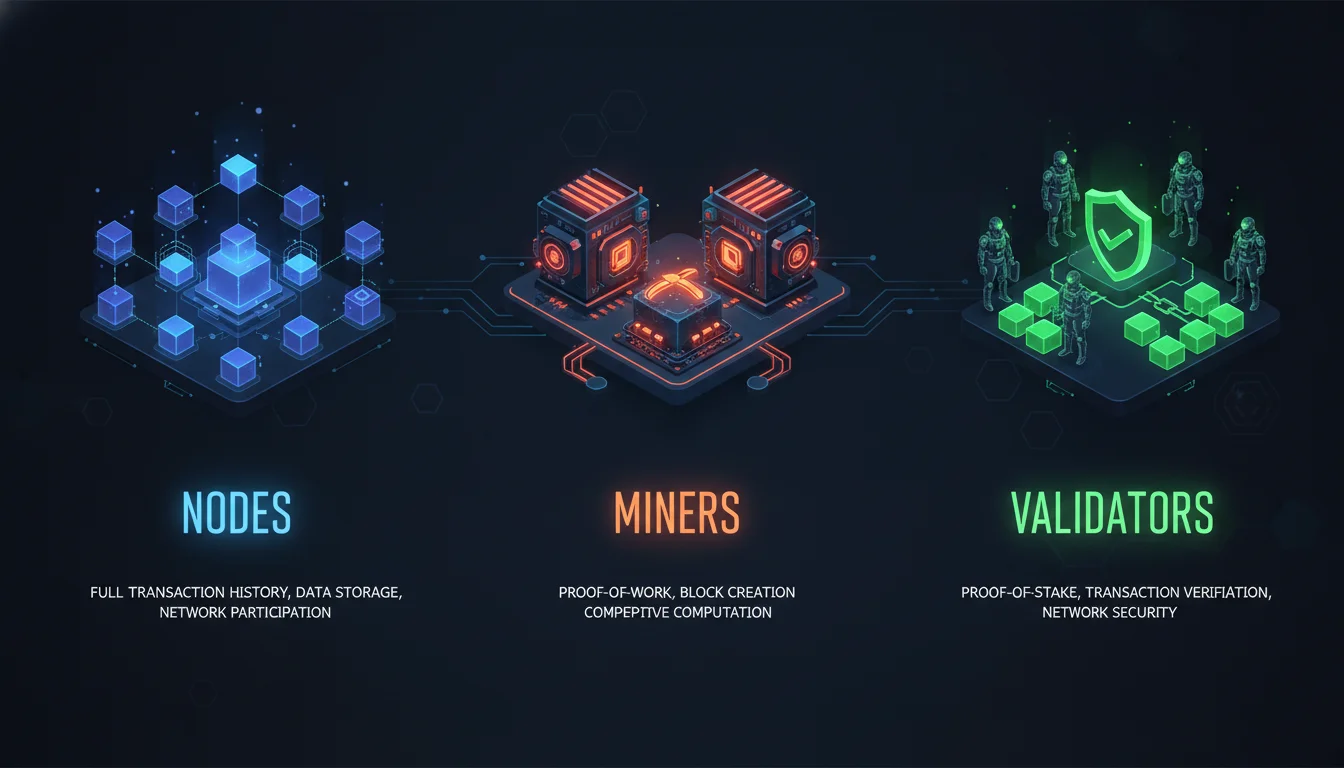
Mining nodes are full nodes that also compete to mine new blocks in Proof-of-Work systems, earning cryptocurrency for their work. According to Chainnodes, the more mining power a node controls, the greater its odds of being chosen to mine the next block and collect the reward. Mining nodes race to solve computational puzzles, and whoever solves it first adds the next block.
Mining nodes are a subset of blockchain network nodes. They perform the same validation work as regular full nodes but also join the consensus race. Because mining takes serious computational power, mining nodes typically require substantial hardware and electricity. Their job is to make producing a valid block computationally expensive enough to deter attackers.
Not every full node mines. You can run a full node purely to validate transactions without ever mining. The distinction matters: full nodes enforce rules, while mining nodes create new blocks under those rules.
Validator Nodes in Proof-of-Stake
In Proof-of-Stake systems, validator nodes take over the role mining nodes play in Proof-of-Work. Validators get selected to propose and attest to new blocks based on how many coins they’ve staked as collateral. MoonPay confirms that in PoS systems like Ethereum, nodes are chosen to validate blocks according to their staked amount. Validators earn rewards for correct validation, and their staked coins align their incentives with network security.
Validator nodes are still blockchain network nodes at their core, usually running full node software underneath. They sync the chain, verify transactions, and take part in consensus. Specific duties vary by network. On Ethereum, for instance, validators propose blocks and attest to blocks proposed by others.
The shift from PoW to PoS changes hardware requirements for consensus participation. PoS validators generally need less energy than mining rigs, but they must lock up a minimum stake as a security deposit. That economic incentive ties validator behavior to network health.
How Roles Overlap
Node, miner, and validator aren’t mutually exclusive terms. A mining node or validator node is simply a blockchain network node with extra consensus responsibilities layered on top. Every miner and validator runs node software, but not every node operator mines or validates. Full nodes, light nodes, and archive nodes don’t necessarily participate in block creation at all.
According to Coinbase, miner nodes create and propose new blocks, while validator nodes verify and approve new transactions. Full nodes, meanwhile, store the entire chain history, contributing to overall network security. This variety of node types is a defining feature of blockchain architecture.
Understanding how these roles overlap clarifies why the network needs so many different participants. Storage, validation, block creation, and data access are all separate jobs. That division of labor is what makes the system both secure and efficient.
Why Run a Blockchain Network Node?
Supporting Decentralization and Security
Running a node contributes directly to network decentralization and security by adding another independent verifier to the system. Nodes validate transactions and blocks, which makes it much harder for any single entity to alter the ledger. Chainnodes notes that nodes contribute to security by validating transactions and blocks, and they’re essential to decentralization by maintaining a distributed ledger every user can rely on.
When individuals run their own nodes, they cut their dependence on third-party services. Instead of trusting an outside provider to verify transactions, a node operator can check the blockchain’s state independently. That independence matters most in permissionless networks where minimizing trust is the entire design goal.
Shardeum makes the point that anyone, not just developers or technical experts, can help secure and maintain a blockchain network. By running a node, individuals add to decentralization while potentially earning rewards. That’s how the system is supposed to work: many independent participants, not a handful of centralized operators.
Earning Rewards and Transaction Fees
Some nodes earn rewards for participating in the network, though the amount and mechanism vary by role. Mining nodes in PoW networks collect block rewards and transaction fees. Validator nodes in PoS networks earn staking rewards for correctly validating blocks. Chainnodes confirms that nodes can earn rewards through transaction fees and block rewards, and running a node also helps promote adoption of the underlying technology.
Income potential varies widely by blockchain and node type. Mining rewards depend on a node’s computational power, while staking rewards depend on the amount staked and the network’s issuance schedule. Light nodes and full nodes that skip consensus generally don’t earn block rewards directly, though they still support the network’s overall value.
Weigh potential rewards against real operating costs. Hardware, electricity, bandwidth, and storage all require upfront and ongoing investment. For a lot of operators, the real motivation isn’t profit. It’s contributing to a network’s resilience and self-sovereignty.
Technical and Financial Considerations
Running a node involves real technical setup, ongoing maintenance, and non-trivial costs. Full nodes need enough storage to hold the entire chain, which keeps growing over time. Archive nodes need even more. Validators may need to stake a minimum amount of cryptocurrency. Shardeum outlines the process as choosing a network, preparing hardware, installing node software, configuring security, syncing with the chain, and maintaining uptime.
Operators also need to think about bandwidth, electricity, and cooling, especially for mining setups. Light nodes are cheaper to run but trade away security. The right node type depends on your goals, technical skill, and available resources. Many operators run nodes on dedicated servers or cloud infrastructure from providers like Cherry Servers, which offers bare metal servers built for blockchain workloads.
Despite the costs, running a node remains one of the most direct ways to participate in a blockchain network. It gives operators a voice in protocol changes and helps keep the network genuinely decentralized. Blockchain network nodes are the infrastructure of the decentralized web, and operating one is a form of digital citizenship.
How to Set Up a Blockchain Network Node
Follow These Steps to Launch a Node
Setting up a node breaks down into a handful of clear, sequential steps. Shardeum outlines the process as: choosing a blockchain network, preparing the required hardware, installing node software, configuring security settings, meeting staking requirements if applicable, syncing with the blockchain, and maintaining uptime and connectivity.
- Choose a blockchain network: Pick the network you want to support, whether that’s Bitcoin, Ethereum, or a newer network like Shardeum.
- Prepare hardware: Make sure you have sufficient storage, memory, and bandwidth. Full nodes need the full chain size; archive nodes need terabytes.
- Install node software: Download the official client for the blockchain and configure it to run as a node rather than just a wallet.
- Sync with the blockchain: The node downloads and verifies the entire chain history from peers, a process that can take hours or days depending on network and hardware.
- Configure security settings: Set up firewalls, restrict remote access, and secure private keys if the node is a validator or miner.
- Meet staking requirements: If running a PoS validator, deposit the minimum required stake and keep the node online.
- Maintain uptime and updates: Keep the node online as consistently as possible and update the software regularly to track protocol changes.
Every blockchain publishes its own documentation for node setup. Operators should follow official guides and understand the specific network’s requirements before starting.
Hardware and Staking Requirements
Hardware requirements vary widely depending on node type and blockchain. A full Bitcoin node needs enough disk space for the entire chain and enough bandwidth to stay synchronized. Archive nodes require massive storage capacity, often measured in terabytes, according to Chainlink. Validator nodes on PoS networks may require a minimum cryptocurrency stake as collateral, with the exact amount depending on the network.
Mining nodes in PoW networks need significant computational power and electricity, and greater mining power increases the odds of being selected to mine the next block. Light nodes, by contrast, can run on mobile devices since they only store block headers. Blockchain network nodes can therefore range from a phone running a light client to a data center server running an archive node.
Before buying hardware, calculate the total cost of ownership, including storage growth, bandwidth, and electricity. For PoS validators, the staked amount may be at risk if the node misbehaves or drops offline for too long. Proper planning matters here more than most people expect.
Hosting Options and Maintenance
Node operators can run hardware at home, use a virtual private server, or deploy on dedicated bare metal servers, and each option trades off cost, uptime, control, and security differently. Cherry Servers notes that custom or pre-built bare metal servers for blockchain workloads offer high uptime, instant support, and the ability to pay in crypto.
Maintaining a node means monitoring uptime, applying software updates, and keeping it in sync. If a node goes offline, it has to catch up with the network on reconnection by downloading missing blocks from peers. Regular updates matter because protocol changes can require software upgrades; skipping them risks operating on a minority fork.
For validators, downtime can mean missed rewards or outright penalties. Many operators rely on monitoring tools to flag connectivity issues early. Running a node is an ongoing responsibility, not a one-time setup task. Reliable hosting and proactive maintenance are what separate a useful node from a liability.
Security and Risks of Blockchain Network Nodes
Common Attack Vectors
Blockchain network nodes face several real security risks, including denial-of-service attacks, eclipse attacks, and malware. Because nodes are publicly reachable, attackers can attempt to overwhelm them with traffic to disrupt operation. A node knocked offline can’t validate transactions or participate in consensus, which chips away at the network’s overall resilience.
Eclipse attacks isolate a node from the rest of the network by surrounding it with malicious peers. The isolated node might then receive false information about the blockchain’s state. Full nodes that independently verify data are less vulnerable to this since they don’t trust outside sources, but light nodes are more exposed because they rely on full nodes for transaction data.
According to MoonPay’s research, node operators face real security challenges and need to actively protect their infrastructure. Blockchain network nodes should run up-to-date software, strong access controls, and active network monitoring to reduce the risk of compromise.
“A node ensures the integrity of transactions and blocks by maintaining a copy of the entire blockchain ledger, and is responsible for the network’s security, decentralization, and consensus processes.” – MoonPay Learn
Light Node Trust Assumptions
Light nodes trade security for efficiency, and that trade-off comes with real consequences. Because they only download block headers instead of the full chain, they rely on full nodes for accurate transaction data. That introduces a trust assumption: a light node trusts that the full nodes it connects to are being honest. Chainlink confirms light nodes must trust full nodes for data accuracy.
Chainnodes points out that lightweight nodes are less secure since they depend on other nodes for accurate blockchain information. That’s an acceptable trade-off for mobile wallets and low-resource devices, but it means light nodes aren’t suitable for high-value verification without extra safeguards.
Anyone who needs the highest level of trustlessness should run a full node instead. Full nodes let the operator independently verify every transaction and block, removing any need to trust a third party. That’s why full nodes are considered the backbone of the network.
Operational Security Best Practices
Securing a node comes down to basic operational security discipline. Keep node software current, use firewalls to limit access, and avoid exposing sensitive ports to the public internet. If the node holds private keys, as validators and miners do, store those keys securely, ideally in isolated environments or dedicated hardware modules.
Regular backups and monitoring matter just as much. Set up alerts for downtime, disk space, and unusual network activity. If a node gets compromised, you may need to resync from scratch, which eats up time. Shardeum emphasizes that maintaining uptime and connectivity is a core part of running a node well.
Finally, be cautious with third-party hosting providers. Dedicated servers can improve reliability, but they introduce a degree of dependence on the provider. The most decentralized blockchain network nodes are run by individuals spread across diverse geographic locations, which reduces the risk of coordinated attacks or regional infrastructure failures.
Pros and Cons of Running a Blockchain Network Node
Pros
- Contributes directly to network decentralization and censorship resistance.
- Removes dependence on third-party providers for transaction verification.
- Potential to earn block rewards, staking rewards, or transaction fees depending on node type.
- Gives operators a direct voice in protocol upgrades and governance discussions.
- Builds genuine technical understanding of how the underlying protocol actually works.
Cons
- Full and archive nodes require significant, growing storage and bandwidth investment.
- Mining nodes carry high electricity and hardware costs with no guaranteed return.
- Validator nodes risk slashing or missed rewards for downtime or misbehavior.
- Ongoing maintenance, monitoring, and software updates demand real time commitment.
- Light nodes sacrifice security for convenience, introducing trust assumptions.
What’s Missing From Most Guides: Layer 2 and Specialized Node Roles
How do Layer 2 networks change the role of nodes?
Layer 2 networks shift some transaction processing off the main chain but still depend on mainnet nodes for final settlement and security. As blockchain adoption grows, the demands on nodes increase rather than decrease. Full nodes must store ever-larger ledgers, and networks are exploring scaling approaches that change how nodes handle data rather than eliminating the need for them.
According to Chainlink, the future of blockchain infrastructure includes more specialized node types and improved hardware efficiency. Node software keeps evolving to cut storage and bandwidth requirements, which makes it easier for more people to run nodes. The shift to Proof-of-Stake on networks like Ethereum has already made validator participation more accessible than mining ever was.
The core role nodes play, validation and consensus, doesn’t change even as the surrounding technology scales. Nodes remain the foundation blockchain scalability gets built on top of.
The Future of Blockchain Network Nodes
Institutional Adoption and Node Providers
Institutional adoption has fueled real growth in node infrastructure providers. Companies like Cherry Servers offer dedicated bare metal servers optimized for blockchain workloads, while services like MoonPay’s stablecoin APIs depend on reliable node access underneath. These providers run many nodes on behalf of applications that need high uptime and low latency.
Chainlink notes that archive nodes are typically used by block explorers, infrastructure providers, and analytics firms, organizations that need deep historical data access. This professionalization has created a real market for managed node services, staking-as-a-service, and RPC endpoints. These services make it easier for developers to interact with blockchains without running their own infrastructure.
Still, over-reliance on centralized node providers can quietly reintroduce the trust assumptions blockchains were designed to remove. A healthy network depends on a diverse set of independent nodes. Institutional providers are part of the ecosystem, but they should complement individual operators, not replace them.
The Rise of Specialized Node Services
As of 2026, the trend points toward more specialized nodes tailored to specific applications. RPC nodes expose APIs for wallets and dApps, archive nodes handle data-heavy queries, and validator nodes secure consensus. Cherry Servers describes these as variations on the general term “node,” with differences coming down to software, data retained, and function performed.
Newer networks are designing node requirements with accessibility in mind from day one. Shardeum, for instance, aims to let anyone run a node and contribute to decentralization without needing enterprise-grade hardware. The direction is toward lower hardware barriers, better energy efficiency, and clearer reward structures.
Ultimately, the future of blockchain infrastructure depends on how many individuals and organizations are willing to operate nodes. The more independent participants running them, the more decentralized, secure, and resilient the network becomes. That’s the core promise of the technology, and nodes are what actually deliver it.
If you’re building protocol infrastructure or evaluating tokenomics for a new network, our team at Digital Blockchains works directly with founders on node architecture and consensus design. Apply to the Genesis Cohort at digitalblockchains.com to build with us.
Frequently Asked Questions
What is a blockchain node?
A blockchain node is a computer or device that connects to a blockchain network, maintains a copy of the ledger, and validates or relays transactions. It keeps the network decentralized and secure without needing a central authority.
What are the main types of blockchain network nodes?
The main types are full nodes, light nodes (SPV nodes), archive nodes, mining nodes, and validator nodes. Each serves a different function, from independent verification to block creation to historical data storage.
Do blockchain network nodes earn money?
Mining nodes earn block rewards and transaction fees in Proof-of-Work networks, while validator nodes earn staking rewards in Proof-of-Stake networks. Full and light nodes generally don’t earn direct rewards but still support network security.
Can anyone run a blockchain node?
Yes, anyone with the required hardware, software, and internet connection can run a node. Some networks require staking a minimum amount of cryptocurrency to run as a validator.
What is the difference between a full node and a light node?
A full node stores the entire blockchain and independently verifies all transactions, while a light node stores only block headers and relies on full nodes for transaction data. That makes light nodes faster but less secure.