Blockchain mining is the process of validating transactions and adding new blocks to a distributed ledger using specialized computers that compete to solve cryptographic puzzles and earn cryptocurrency rewards.
Key Takeaways
- mining secures proof-of-work networks by making transaction history computationally expensive to alter.
- Bitcoin mining uses ASIC hardware almost exclusively today; CPU and GPU mining are largely obsolete for major coins.
- Block rewards and transaction fees are the two income sources for miners; the 2024 halving cut Bitcoin’s reward to 3.125 BTC.
- Profitability hinges on electricity cost, hardware efficiency, mining difficulty, and coin price.
- Mining pools and cloud mining lower the barrier to entry by pooling hashrate and sharing rewards proportionally.
- Ethereum moved to proof-of-stake in 2022, but Bitcoin remains committed to proof-of-work.
What Is Blockchain Mining?
Definition and Core Purpose
this type of mining is the decentralized process of confirming and recording transactions on a proof-of-work network. According to Coinbase, mining is “the process by which networks of specialized computers generate and release new Bitcoin and verify new transactions.” The term combines two functions: creating new cryptocurrency units and maintaining the integrity of the distributed ledger. Without this kind of mining, a proof-of-work network like Bitcoin would have no mechanism to prevent double-spending or reach consensus among participants.
At its most fundamental level, blockchain solves the double-spend problem inherent to digital currencies. Because digital information can be copied, a decentralized system needs a way to ensure the same coin is not spent twice. mining achieves this by making it computationally expensive to alter transaction history. The more mining power a network has, the harder it becomes for any single actor to rewrite the ledger.
Mining as the Backbone of Proof-of-Work Consensus
this type of mining is the enforcement mechanism of the proof-of-work (PoW) consensus protocol. PoW requires miners to compete to solve a cryptographic puzzle, and the first to solve it earns the right to add the next block. This competition ensures that no single miner can control the blockchain unless they control more than 50% of the network’s computing power, a barrier that grows with each additional participant. Freeman Law explains that PoW “secures the network from any external attacks” by making validation costly and probabilistic.
Unlike proof-of-stake (PoS), where validators are chosen based on the number of coins they hold, PoW ties security to real-world energy expenditure. Bitcoin’s creator, Satoshi Nakamoto, outlined the concept in 2008, and the network launched in 2009. The PoW mechanism remains the foundation of Bitcoin and several other cryptocurrencies, even as newer networks adopt PoS for energy efficiency.
Why Mining Is Called “Mining”
The term draws an analogy to precious metal extraction. Just as gold miners expend physical effort to unearth gold, crypto miners expend computational effort to unlock new coins. Argo Blockchain notes that the metaphor is apt: “It takes ‘physical’ effort to mine for gold whereas it takes ‘computational’ effort to mine crypto.” This framing explains why this kind of mining is resource-intensive and why the supply of mined coins is finite, mimicking the scarcity of gold.
“If there weren’t Bitcoin miners, there would be no Bitcoin.” – Jaime Leverton, Hut 8 Mining, via Blockchain.com
How Blockchain Mining Works: A Step-by-Step Process
Transaction Broadcasting and Verification
When a user initiates a transaction on a blockchain network, it is broadcast to all participating nodes. These nodes collect pending transactions and verify their validity, checking that the sender has sufficient balance and that the transaction signature is authentic. Only after this initial verification does the blockchain competition begin.
Each transaction is grouped into a candidate block. Miners then work to find a valid hash for that block. The hash is a fixed-length alphanumeric string produced by a cryptographic function. According to Coinbase, the target is a 64-digit hexadecimal number, and miners race to guess a value below that target. The process involves trial and error: miners change a small piece of data called a nonce and repeatedly hash the block until a solution is found.
Solving the Cryptographic Puzzle
The core of blockchain mining is solving a cryptographic puzzle. A hash function takes any input and produces a unique output of fixed size. Miners must find an input that results in a hash meeting specific criteria, such as starting with a certain number of zeros. Because hash functions are one-way, there is no shortcut. Miners brute-force their way through trillions of possibilities per second.
The difficulty of this puzzle adjusts automatically to maintain a stable block time. For Bitcoin, the target is approximately 10 minutes per block. Fidelity explains that “mining difficulty is automatically adjusted higher or lower to maintain a specified block time.” If more miners join the network and blocks are found too quickly, difficulty increases. If miners leave, difficulty decreases. This self-regulating mechanism keeps the emission rate predictable.
Block Addition and Reward Distribution
Once a miner finds a valid hash, they broadcast the solution to the rest of the network. Other nodes verify that the solution is correct and that all transactions in the block are legitimate. If consensus is reached, the block is added to the blockchain, and the winning miner receives the block reward plus any transaction fees from the included transactions.
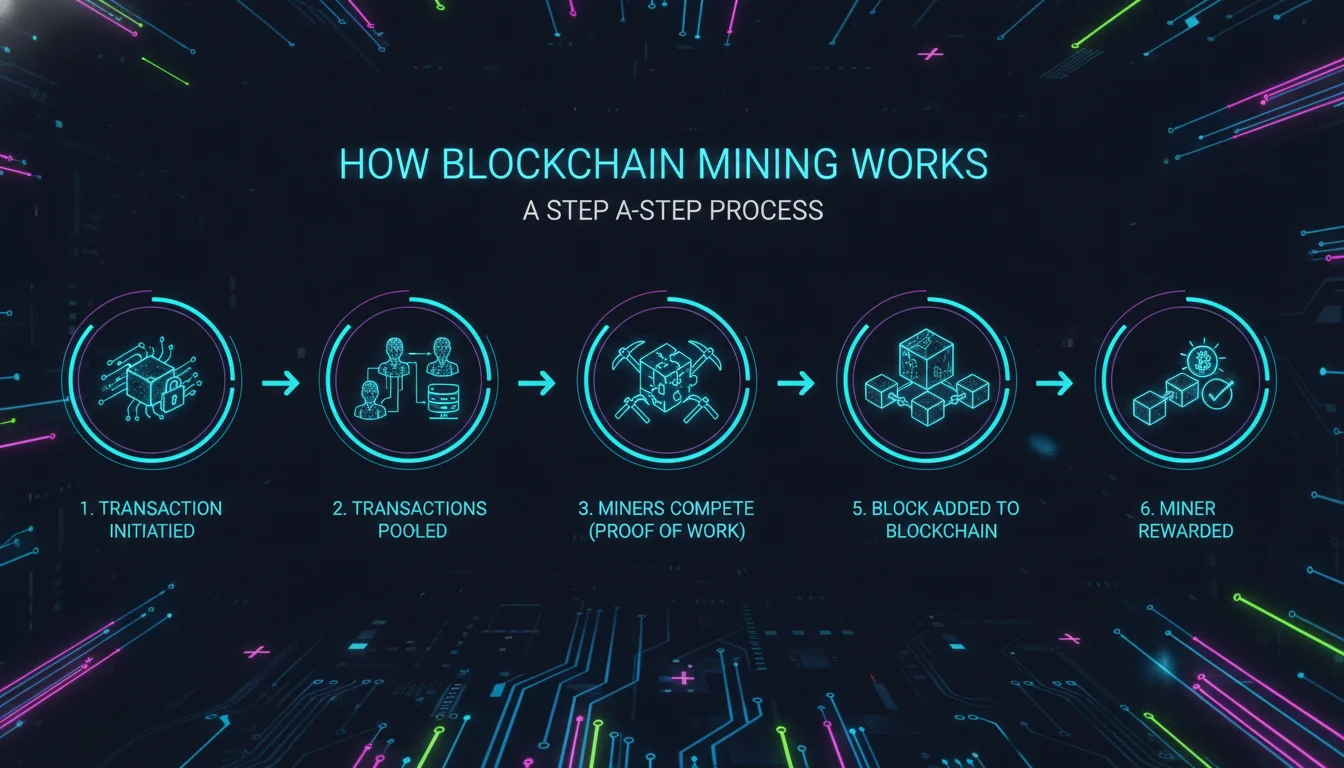
The entire blockchain mining cycle can be summarized in a numbered sequence:
- Step 1: A user broadcasts a transaction to the network.
- Step 2: Miners collect the transaction and verify its validity.
- Step 3: Miners compete to solve a cryptographic puzzle by finding a valid hash.
- Step 4: The first miner to solve the puzzle broadcasts the new block.
- Step 5: Other nodes verify the solution and the block’s transactions.
- Step 6: The block is added to the blockchain, and the miner receives rewards.
This entire cycle repeats roughly every 10 minutes on the Bitcoin network, creating a continuous chain of verified blocks.
The Economics of Blockchain Mining: Costs, Rewards, and Profitability
Block Rewards and Transaction Fees
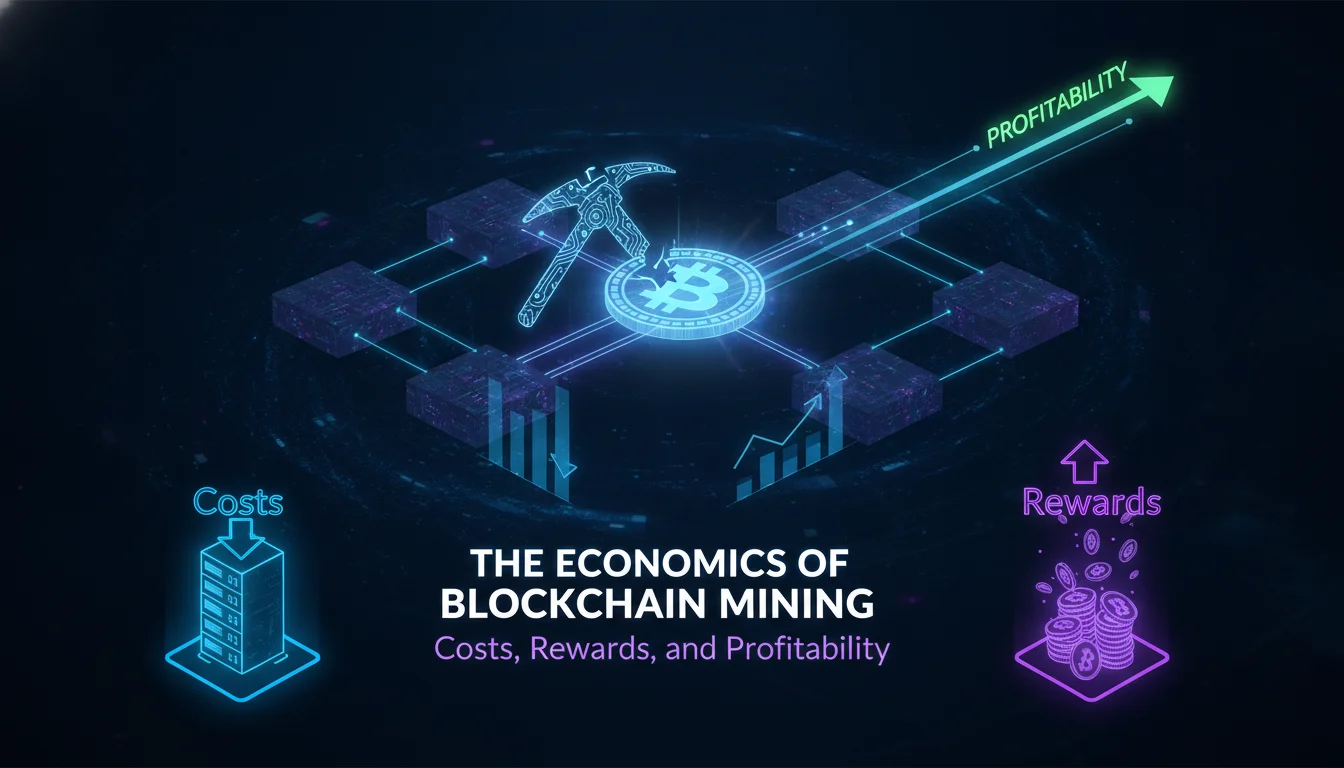
Miners earn income from two sources: block rewards and transaction fees. The block reward is a predetermined amount of new coins created with each block. For Bitcoin, the first block reward was 50 BTC. According to Blockchain.com, this reward halves roughly every four years. The 2024 halving reduced the reward to 3.125 BTC. Transaction fees are additional payments from users who want their transactions prioritized in the next block. As the block reward declines over time, transaction fees are expected to become the primary income source for miners.
The total supply of Bitcoin is capped at 21 million coins, and the final bitcoin is projected to be mined around the year 2140. This deflationary design creates scarcity and underpins Bitcoin’s value proposition. Once all bitcoins are mined, miners will rely solely on transaction fees to sustain their operations.
Mining Difficulty and Halving Events
Mining difficulty measures how hard it is to find a valid hash. The difficulty adjusts every 2,016 blocks on Bitcoin, aiming to keep block time at 10 minutes. As more miners join with more powerful hardware, difficulty rises, reducing individual profitability unless a miner upgrades or finds cheaper electricity. Halving events, where the block reward is cut in half, also compress margins. Each halving reduces the rate of new supply, which has historically preceded price increases, but also squeezes miners operating on thin margins.
According to Coinbase, the computing power required to mine one Bitcoin in 2024 is around 6 times higher than when the first blocks were mined in 2009. This exponential growth in difficulty explains why amateur blockchain mining is no longer profitable for hobbyists and why industrial-scale operations dominate the landscape.
Calculating Profitability: Hardware, Electricity, and Pool Fees
Profitability in blockchain mining depends on three main variables: hardware efficiency (hashrate per watt), electricity cost, and the current price of the mined cryptocurrency. Investopedia emphasizes that “profitability depends on factors like hardware efficiency, energy costs, and cryptocurrency prices.” Miners must subtract electricity costs, cooling costs, hardware depreciation, and mining pool fees from gross revenue. A common metric is the break-even price: the coin price below which blockchain mining becomes unprofitable.
For industrial miners, electricity is the dominant operating cost. This is why many large mining operations locate in regions with cheap hydroelectric, geothermal, or stranded energy. Cloud mining and mining pools introduce additional fees but lower the barrier to entry by pooling resources and sharing rewards proportionally.
“Bitcoin mining is a lot like running a big data center. Companies purchase the mining hardware and pay for the electricity required to keep it running (and cool). For this to be profitable, the value of the earned coins has to be higher than the cost to mine those coins.” – Coinbase Learn
Pros and Cons of Blockchain Mining
Pros
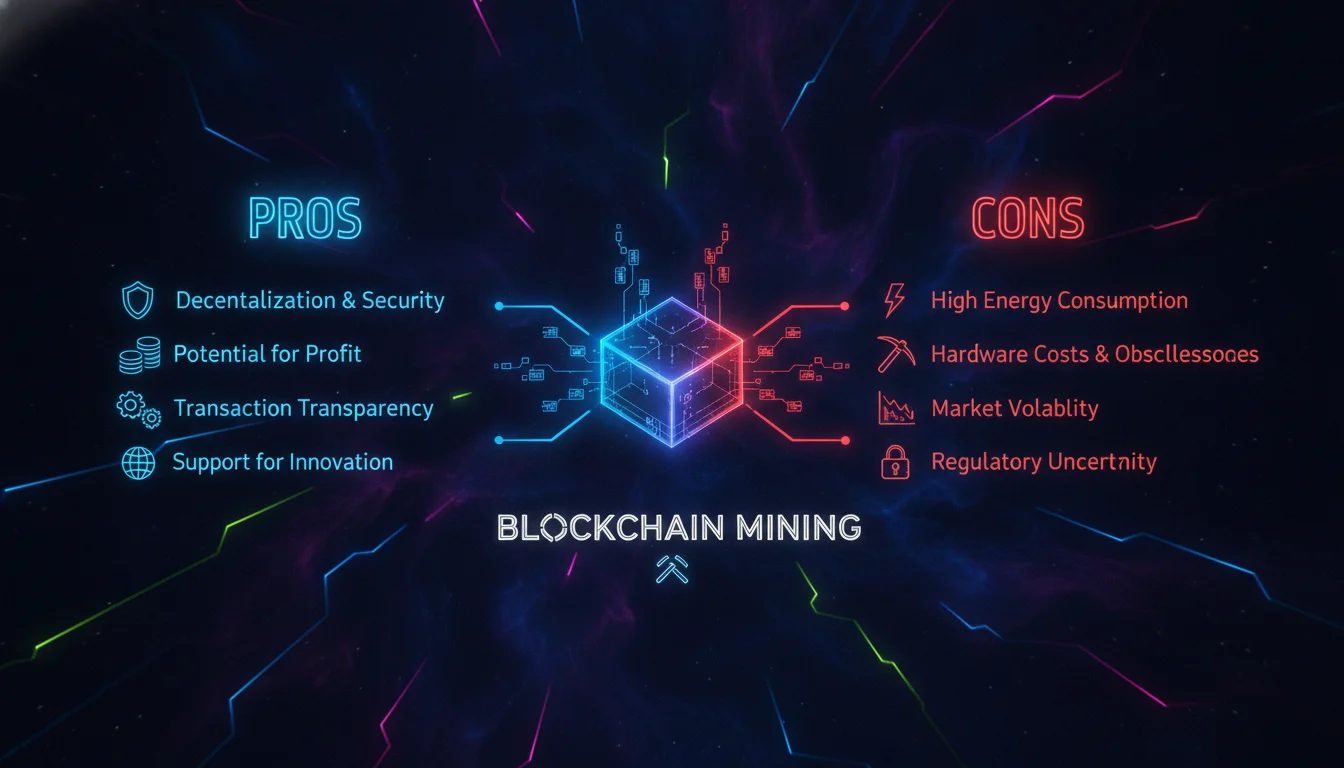
- Earns cryptocurrency rewards: Successful miners receive block rewards and transaction fees, providing direct exposure to crypto assets without buying on an exchange.
- Secures decentralized networks: Blockchain mining contributes real computational work that makes proof-of-work networks resistant to attack and censorship.
- Predictable emission schedule: Bitcoin’s difficulty adjustment and halving schedule create a transparent, rules-based monetary policy that miners can plan around.
- Renewable energy incentive: Economic pressure to minimize electricity costs pushes miners toward cheap renewable or stranded energy, which can accelerate clean energy development.
- Pool options reduce variance: Mining pools and cloud mining platforms let smaller participants earn more consistent income without owning industrial-scale hardware.
Cons
- High capital expenditure: ASIC miners are expensive, depreciate quickly, and become obsolete as newer models are released, requiring continuous reinvestment.
- Energy intensity: Blockchain mining runs hardware 24/7, and electricity costs can represent the majority of operating expenses for most operations.
- Regulatory risk: Jurisdictions can ban or restrict mining with little warning, as China demonstrated in 2021, potentially stranding expensive hardware investments.
- Rising difficulty: As more miners join the network, individual profitability shrinks unless a miner continuously upgrades hardware or secures cheaper power.
- Centralization pressure: The shift to ASICs has concentrated Bitcoin mining in the hands of large industrial operations, raising concerns about network decentralization.
Types of Mining Hardware
CPU Mining: The Early Days
In the early years of Bitcoin, blockchain mining was possible with a standard central processing unit (CPU) on a home computer. As the network grew, CPU mining became impractical due to rising difficulty. Freeman Law notes that “many find CPU mining to be too slow and impractical today because it takes months to accrue even a small amount of profit, given the high electrical and cooling costs.” CPU mining is now largely obsolete for major cryptocurrencies, though some altcoins with lower difficulty may still be mined this way.
GPU Mining: Maximizing Parallel Processing
Graphics processing units (GPUs) offered a significant performance jump over CPUs because they can perform many calculations in parallel. GPU mining became the standard for Ethereum and other altcoins, and demand for GPUs surged during the 2017 and 2021 crypto booms. Advanced Micro Devices (AMD), a major GPU manufacturer, saw its stock reach a decade high during one such period of elevated GPU demand for blockchain mining, according to Freeman Law. GPU mining remains viable for coins designed to be ASIC-resistant, though it faces diminishing returns for Bitcoin.
ASIC Miners: Purpose-Built Efficiency
Application-Specific Integrated Circuits (ASICs) are chips designed solely for mining a specific algorithm. Blockchain.com states that miners on the Bitcoin network “are almost always an ASIC miner.” ASICs offer far higher hashrates and energy efficiency than CPUs or GPUs, but they are expensive, generate significant heat, and become obsolete quickly as newer models are released. The shift to ASICs has centralized Bitcoin blockchain mining in the hands of large operations that can afford the capital investment.
| Mining Method | Hardware Used | Profitability Today | Best For |
|---|---|---|---|
| CPU Mining | Standard computer processor | Very low; often unprofitable | Experimental or low-difficulty altcoins |
| GPU Mining | Graphics cards in a rig | Moderate for ASIC-resistant coins | Ethereum Classic, Monero, some altcoins |
| ASIC Mining | Specialized integrated circuits | High for Bitcoin, but capital intensive | Bitcoin and other SHA-256 coins |
| Cloud Mining | Rented hashrate from a provider | Variable; depends on contract terms | Beginners who want exposure without hardware |
The Role of Mining Pools and Cloud Mining
How Mining Pools Work
Mining pools aggregate the hashing power of many miners to increase the chance of finding a block. When the pool successfully completes blockchain mining on a block, the reward is distributed among members based on their contributed hashrate, minus a small pool fee. Joining a pool smooths out income, providing more predictable payouts compared to solo mining, where a miner could go months without earning anything. Investopedia advises that “joining a mining pool can increase profitability by sharing workload and rewards.”
Cloud Mining and Hashrate Marketplaces
Cloud mining allows individuals to rent hashrate from a remote data center without owning hardware. Platforms like NiceHash operate hashrate marketplaces where buyers and sellers trade mining power. NiceHash describes itself as “the world’s leading hashrate marketplace,” offering a complete ecosystem of blockchain mining and hashrate solutions, from ASIC firmware to profitability calculators. Cloud mining reduces technical barriers but carries counterparty risk. Some providers have been accused of running fraudulent schemes or failing to deliver promised returns, so due diligence is essential before committing capital.
Choosing Between Solo and Pool Mining
Solo mining means a miner competes alone for the full block reward. For a Bitcoin solo miner with limited hashrate, the probability of finding a block is astronomically low, making pool mining the pragmatic choice. Pool mining offers smaller but more frequent payouts, which helps cover ongoing electricity costs. The choice depends on the miner’s hashrate, risk tolerance, and desired income stability. For most small and medium miners, joining a well-established pool is the recommended path.
Energy Consumption and Sustainability in Blockchain Mining
Why Mining Uses So Much Electricity
Blockchain mining consumes electricity because it requires continuous computational work. Each hash calculation uses energy, and miners run their hardware 24/7 to maximize chances of winning a block. The Bitcoin network’s total energy consumption has drawn comparisons to small countries, though exact figures vary by source. Fidelity notes that blockchain mining is “guesswork with a monetary incentive,” and that incentive drives massive investment in energy-hungry hardware. The energy use is inherent to proof-of-work security. It is the cost of decentralization.
Renewable Energy and Efficiency Innovations
In response to environmental concerns, many mining operations are shifting to renewable energy sources. Argo Blockchain highlights innovations such as immersion cooling and dynamic throttling to reduce energy overhead. Immersion cooling submerges miners in a dielectric fluid, improving heat dissipation and allowing for higher density without additional air conditioning. Some miners also use stranded energy from gas flares or excess hydroelectric power, turning waste into economic value. The industry is gradually becoming more efficient, but absolute energy consumption continues to grow as network hashrate increases.
The Environmental Debate
Critics argue that blockchain mining’s carbon footprint is unacceptable, especially when compared to proof-of-stake networks that use negligible energy. Proponents counter that mining incentivizes renewable energy development and stabilizes grids by absorbing excess supply. The debate remains unresolved, with no universal standard for measuring mining’s environmental impact. What is clear is that energy costs are the single largest operating expense for miners, so economic incentives already push the industry toward cheaper, often renewable, power sources.
Legal and Regulatory Landscape for Crypto Mining
Global Variations in Mining Legality
The legality of blockchain mining varies dramatically by jurisdiction. Some countries have embraced Bitcoin mining with state support, while others, including China, have banned it outright due to energy and financial stability concerns. The United States has a patchwork of state-level regulations, with Texas and Wyoming being mining-friendly due to cheap energy and favorable laws. In many nations, blockchain mining is neither explicitly legal nor illegal, leaving operators in a gray zone. This uncertainty affects investment decisions and the geographic distribution of hashrate.
Tax Implications and Compliance
Miners must navigate complex tax rules. In the United States, mined coins are generally treated as income at their fair market value on the date received, and later sales may trigger capital gains. Mining as a business may also be subject to self-employment taxes. Proper record-keeping is essential, as tax authorities increasingly scrutinize crypto transactions. Failure to report mining income can result in penalties and interest. Miners should consult tax professionals familiar with cryptocurrency regulations.
The Risk of Bans and Restrictions
Regulatory risk is a major factor for miners. Sudden bans or restrictions can render expensive hardware worthless or force relocation. China’s 2021 crackdown on mining led to a mass exodus of miners to North America and Central Asia, temporarily reducing the network’s hashrate but also increasing decentralization. The threat of future restrictions, especially those tied to energy consumption, remains a key consideration for anyone entering the blockchain mining space. Staying informed about local laws and geopolitical trends is critical.
Future of Blockchain Mining: Halvings, Difficulty, and Innovation
The Road to 2140 and the Last Bitcoin
Blockchain mining will continue to evolve as Bitcoin approaches its 21 million supply cap. The final bitcoin is expected to be mined around 2140, after which miners will rely solely on transaction fees. This transition will test the economic security model, as fee revenue must be sufficient to incentivize miners to keep securing the network. Some analysts worry about a fee market that could make transactions prohibitively expensive, while others believe layer-2 solutions like the Lightning Network will handle high volumes with low fees on-chain.
Technological Innovations: Immersion Cooling and Firmware
Hardware and software innovations are improving blockchain mining efficiency. Immersion cooling, as highlighted by Argo Blockchain, can extend hardware lifespan and reduce cooling costs. Custom ASIC firmware can optimize chip performance, unlocking higher hashrates at the same power draw. These incremental gains are critical in a competitive environment where every efficiency point matters. The development of more advanced ASICs will continue, but returns diminish as chip fabrication approaches physical limits.
The Shift Toward Alternative Consensus Mechanisms
While Bitcoin remains committed to proof-of-work, many newer blockchains are adopting proof-of-stake to eliminate blockchain mining altogether. Ethereum’s transition to PoS in 2022 drastically reduced its energy consumption and removed mining from its protocol. This shift raises questions about the long-term relevance of blockchain mining beyond Bitcoin. Bitcoin’s dominance and security model ensure that mining will remain a critical industry for the foreseeable future, even as the broader crypto ecosystem diversifies.
As of 2026, blockchain mining remains both a technical process and an economic activity that underpins the security and functionality of proof-of-work cryptocurrencies. From its origins with CPU mining to today’s industrial ASIC farms, the industry has matured but still faces challenges in energy consumption, regulatory pressure, and centralization. Understanding the mechanics, costs, and risks is essential for anyone considering participation, whether as a hobbyist, investor, or operator. As the sector evolves toward a fee-based model post-2140, the fundamental principles of blockchain mining, decentralized consensus through computational effort, will remain foundational to Bitcoin and similar networks.
If you’re serious about building in the proof-of-work or broader Web3 space, apply to the Genesis Cohort at Digital Blockchains and work alongside a team that reads the whitepapers and ships the infrastructure.
Frequently Asked Questions
How does blockchain mining work?
Blockchain mining works by having specialized computers solve cryptographic puzzles to validate transactions and add new blocks to the ledger. The first miner to solve the puzzle receives a block reward and transaction fees, and the process repeats roughly every 10 minutes on Bitcoin.
Does Bitcoin mining actually pay?
Bitcoin mining can pay, but profitability depends on electricity costs, hardware efficiency, mining difficulty, and Bitcoin’s price. Large-scale miners with cheap power often profit, while hobbyists with high electricity rates may lose money.
How long does it take to mine $1 of Bitcoin?
The time to mine $1 of Bitcoin varies widely based on your hashrate, electricity cost, and current network difficulty. With a typical home ASIC miner, it could take days or weeks, while industrial operations mine that amount in minutes. Profitability calculators can provide a specific estimate.
Can I still mine Bitcoin for free?
You cannot mine Bitcoin for free because blockchain mining requires electricity and hardware with ongoing costs. Some platforms offer “free” cloud mining trials, but they often come with hidden fees or are scams. Legitimate mining always involves real expenses.
What is the difference between proof-of-work and proof-of-stake?
Proof-of-work (PoW) requires miners to expend computational energy to secure the network, while proof-of-stake (PoS) selects validators based on the number of coins they hold and are willing to lock up. PoW is used by Bitcoin; PoS is used by Ethereum and many newer blockchains.
Is crypto mining legal?
Crypto mining is legal in many countries, but some jurisdictions have banned or restricted it due to energy use and financial concerns. Always check local regulations before investing in mining hardware, as legality can change rapidly.