Key Takeaways
- The best artificial intelligence crypto projects combine blockchain with real AI utility, spanning compute, data, and agent economies.
- Market leaders like Bittensor (TAO), Render (RENDER), and Virtuals Protocol (VIRTUAL) each dominate distinct AI niches.
- Investors should evaluate any candidate for the best artificial intelligence crypto label based on technology adoption, network usage, and team execution, not just hype.
- The total AI crypto market cap sat at roughly $20.5 billion as of mid-2026, according to CoinGecko.
- Newer entrants like Sentient (SENT) and Kite AI (KITE) are pulling attention away from older narrative-only tokens.
Best artificial intelligence crypto assets are tokens that power decentralized AI infrastructure, compute networks, intelligence markets, and autonomous agent economies with verifiable on-chain activity. This article ranks the top AI coins by market cap and use case.
What Are AI Crypto Coins?

AI crypto coins are digital tokens that fuel blockchain-based artificial intelligence ecosystems. Unlike general-purpose cryptocurrencies, their value is tied directly to AI-related services such as decentralized model training, GPU compute sharing, data indexing, and AI agent coordination. These tokens typically serve triple duty: medium of exchange, governance right, and staking collateral within their networks.
The Intersection of AI and Blockchain
The convergence of AI and blockchain tackles two real problems: centralized control of AI models and the lack of verifiable compute. By distributing AI tasks across decentralized nodes, these projects aim to build permissionless, censorship-resistant intelligence layers. Bittensor uses a subnet architecture to reward miners for producing useful machine learning outputs, while Render taps unused GPU power sitting idle around the world.
Categories of AI Crypto Projects
AI crypto projects fall into a handful of core categories:
- Decentralized compute networks: Platforms like Render and Akash Network supply distributed GPU and CPU resources for AI training and inference.
- Intelligence and model marketplaces: Protocols such as Bittensor enable decentralized model training and validation, creating an actual market for machine intelligence.
- AI agent economies: Virtuals Protocol and NEAR Protocol support autonomous AI agents that transact, execute tasks, and interact across chains.
- Data and oracle solutions: Chainlink and The Graph supply verifiable data and indexing for AI smart contracts.
Top AI Crypto Coins by Market Capitalization
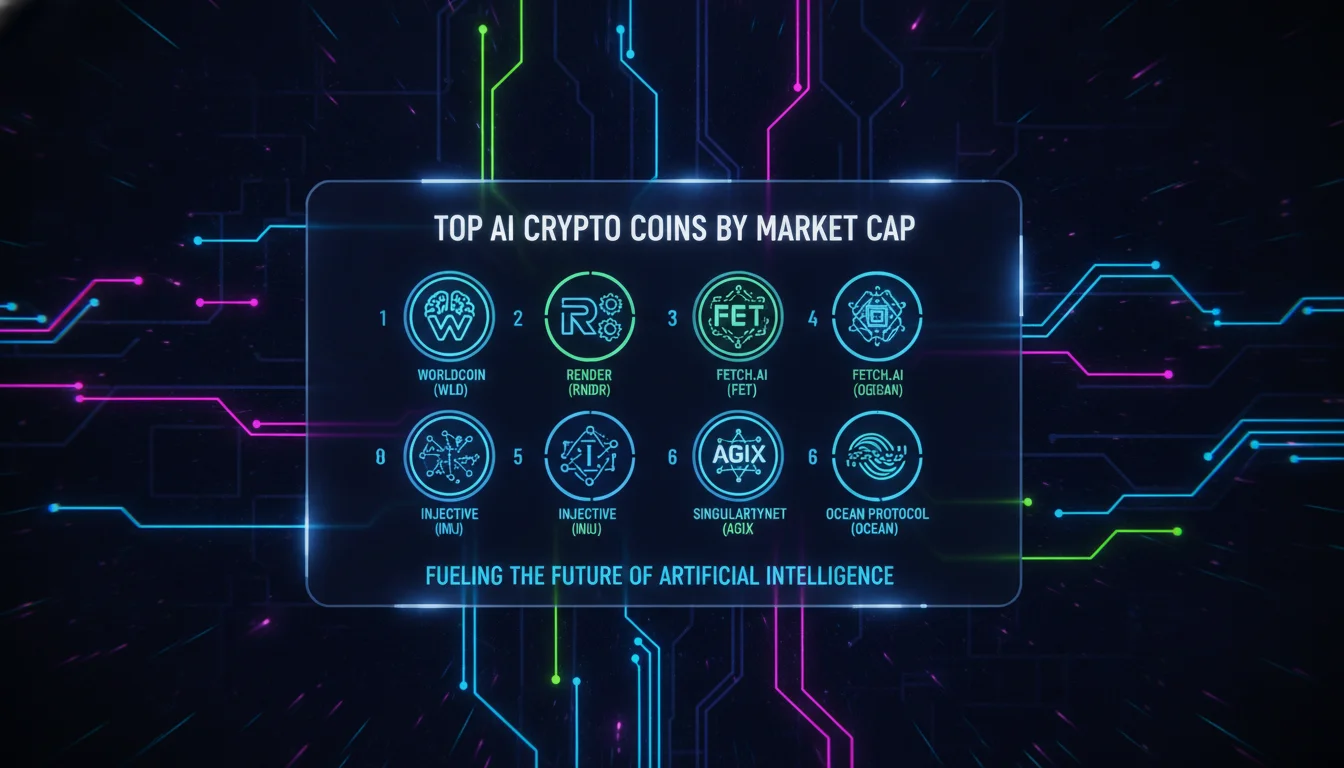
Market capitalization is the clearest snapshot of which AI projects have captured the most investor value right now. The table below compares leading AI coins by market cap, core category, and standout feature as of early June 2026.
| Coin | Category | Market Cap (approx.) | Key Innovation |
|---|---|---|---|
| Bittensor (TAO) | Decentralized intelligence | $2.16 billion | Subnet architecture rewarding ML model contributions |
| NEAR Protocol (NEAR) | AI agent infrastructure | $2.14 billion | Chain Abstraction for seamless AI agent cross-chain operations |
| Internet Computer (ICP) | Decentralized cloud | $1.15 billion | On-chain AI inference via WebAssembly-based smart contracts |
| Render (RENDER) | GPU compute network | $690 million | Distributed rendering and AI compute marketplace |
| Venice Token (VVV) | AI infrastructure | $552 million | Privacy-focused generative AI platform on chain |
Data sourced from CoinGecko and CoinMarketCap as of June 2026.
How Market Cap Reflects Project Maturity
Market cap alone doesn’t tell the full story. A high market cap can signal strong network effects and liquidity, but it can also just reflect speculative premium. The strongest candidate for best artificial intelligence crypto status over the long run usually shows consistent developer activity and rising on-chain usage, which is exactly what we’re seeing with Bittensor’s growing subnet count and Render’s climbing GPU job volume.
Notable Shifts in Rankings
In 2026, AI crypto rankings shifted away from pure narrative tokens and toward infrastructure plays. According to a Mudrex analysis, projects like Sentient and Kite AI emerged as key players in open-source AI coordination and agent payments, while older tokens like Fetch.ai rebranded under the Artificial Superintelligence Alliance (FET). This shift underscores why real demand, not branding, is what separates a lasting project from a narrative trade.
Best Artificial Intelligence Crypto for Decentralized Compute

The best artificial intelligence crypto picks for decentralized compute are Render and Akash Network, both of which turn idle GPU capacity into usable AI infrastructure. Decentralized compute networks are the backbone of the AI crypto stack, enabling cheaper, censorship-resistant access to GPU power.
Render (RENDER)
Render connects GPU node operators with users needing rendering and AI compute services. It has evolved from a graphics rendering platform into a full AI compute marketplace, with a market cap of $690 million and growing job volume. By tapping a global network of idle GPUs, Render cuts costs for AI training and inference, making it a critical piece of the decentralized AI stack.
Akash Network (AKT)
Akash runs a decentralized cloud computing marketplace where users lease compute resources for AI workloads. Its container-based architecture supports GPU-intensive tasks, and the AKT token handles staking and governance. As of 2026, Akash’s focus on privacy and cost reduction has attracted AI developers looking for alternatives to centralized cloud providers.
According to CryptoSocrat, an AI and bitcoin analyst: “Render and Akash are redefining how we access silicon. The narrative has shifted from ‘AI meme coins’ to tokens that actually provision compute cycles. That’s where sustainable value lies.”
Other Notable Compute Projects
Emerging protocols like io.net (IO) and Golem (GLM) also contribute to the decentralized compute landscape. io.net aggregates GPU resources for ML training, while Golem’s long-standing marketplace supports general-purpose computing. These platforms, while smaller by market cap, are expanding the addressable market for AI crypto utilities. Smartphone-based compute is also entering the picture: projects like Acurast are testing AI inference across networks of hardware-attested phones, a lower-cost complement to GPU-heavy rigs.
Bittensor: The Leading AI Crypto for Intelligence Markets
Bittensor (TAO) is widely considered the leading answer when people ask which project deserves the best artificial intelligence crypto title for decentralized intelligence. Unlike compute networks, Bittensor builds a peer-to-peer market for intelligence itself, where miners run machine learning models and get rewarded based on output quality.
How Bittensor’s Subnet Architecture Works
Bittensor operates through subnets, specialized groups of miners competing to produce the most valuable AI inferences, translations, image generations, or other model outputs. Validators score these contributions, and TAO emissions get distributed accordingly. Per reporting from Bitcoin Foundation, the network had grown to more than 50 active subnets as of 2026, aligning incentives around continuous model improvement.
Why TAO Is Considered a Strong AI Play
TAO’s value is tied directly to demand for decentralized intelligence. As centralized AI giants face regulatory and bias concerns, Bittensor’s open, permissionless design appeals to developers building censorship-resistant AI. The token’s market cap above $2 billion reflects real investor confidence in this thesis, and its subnet expansion signals usage beyond pure speculation.
Risks and Considerations
Bittensor’s complexity is a real barrier to entry. The subnet model demands technical understanding, and the token’s price point can limit retail access. On top of that, output quality varies widely across subnets, and the protocol’s success depends on sustained miner participation. Despite these hurdles, many analysts still treat Bittensor as a foundation of the broader AI crypto thesis.
AI Agent Cryptos: The Best Artificial Intelligence Crypto for Autonomous Economies
AI agents, autonomous software entities that execute tasks on-chain, represent the next frontier for the sector. Projects like Virtuals Protocol and NEAR Protocol are building the infrastructure for these agent-driven economies.
Virtuals Protocol (VIRTUAL)
Virtuals Protocol enables the creation, ownership, and monetization of AI agents for gaming, DeFi, and social applications. Its token, VIRTUAL, governs the protocol, gets staked for agent creation, and facilitates transactions within agent ecosystems. In 2026, Virtuals gained traction through partnerships with metaverse platforms, showing a functioning agent-to-agent economy rather than just a whitepaper concept.
NEAR Protocol’s Agent-Centric Design
NEAR Protocol differentiates itself with Chain Abstraction, a framework that simplifies how AI agents interact with multiple blockchains. This cuts friction for developers building cross-chain AI applications. NEAR’s Nightshade sharding also keeps the network scalable for agent swarm transactions. According to a Binance Academy guide, NEAR’s AI integrations are positioning it as a leading layer-1 for autonomous AI agents.
Why Agent Coins Are Gaining Attention
The rise of GPT-based agents and automated DeFi strategies has accelerated demand for on-chain agent platforms. The category’s strongest agent economy candidates offer more than token speculation: they generate actual fees from agent interactions. Both VIRTUAL and NEAR have shown early usage, though this sub-sector remains nascent and speculative. Newer entrants worth watching include Kite AI, which is building cross-chain payment rails and identity systems specifically for autonomous agents, and Holoworld AI, which focuses on AI character creation for creator-driven applications.
Data and Oracle AI Cryptos: Essential Infrastructure
Data and oracle AI cryptos matter because AI models need reliable, verifiable data feeds to function on-chain. Blockchain oracles and indexing protocols bridge the gap between off-chain AI computation and on-chain smart contracts.
Chainlink (LINK)
Chainlink is the dominant oracle network, providing tamper-proof data feeds for DeFi and, increasingly, for AI applications. Its Cross-Chain Interoperability Protocol (CCIP) and decentralized computing services let smart contracts tap AI models off-chain while settling on-chain. With a market cap over $6 billion, LINK remains the largest token in the AI-adjacent category, according to CoinGecko data.
The Graph (GRT)
The Graph indexes blockchain data, enabling efficient querying for dApps and AI analytics. As AI workflows demand faster access to historical on-chain data, GRT’s role only grows more important. The protocol’s network of indexers earns GRT tokens, and its market cap of roughly $157 million reflects steady, if modest, adoption.
Data Availability and Privacy
Emerging projects like OriginTrail (TRAC) focus on verifiable knowledge graphs for AI, ensuring data provenance from source to output. OpenLedger takes a related but distinct approach, tracking how specific datasets contribute to AI model outputs so contributors can get credited and paid. Privacy-preserving layers being built out on Internet Computer and Acurast aim to protect sensitive AI inputs. Together, these data-centric solutions round out the AI crypto stack, ensuring intelligence markets run on trustworthy information.
How to Identify the Best Artificial Intelligence Crypto for Your Portfolio
Finding the best artificial intelligence crypto for your own portfolio requires a structured evaluation framework that looks past hype and narrative.
Step 1: Assess Real Utility and Product-Market Fit
Does the project solve a concrete AI problem? Render clearly addresses GPU shortage for AI training, while Virtuals Protocol enables agent monetization. Skip tokens whose only AI connection is a mention buried in the whitepaper.
Step 2: Review On-Chain Metrics
Check network usage directly: daily active subnets on Bittensor, GPU jobs on Render, agent transactions on Virtuals. Platforms like CoinGecko and Dune Analytics provide dashboards covering many of these metrics. Consistent growth in fee generation and active wallets points to organic demand rather than speculation.
Step 3: Evaluate Tokenomics and Incentive Design
Sound tokenomics align long-term incentives with actual usage. TAO’s emissions reward model quality, not just quantity. RENDER’s burn-and-mint equilibrium balances supply against demand. Be cautious with tokens that carry high inflation and no clear sink; they tend to struggle holding value over time.
Step 4: Analyze Team and Development Activity
A strong, publicly known team with relevant AI and blockchain expertise is a good signal. Regular GitHub commits and active community engagement act as proxies for project longevity. The Artificial Superintelligence Alliance (FET), for example, has a publicly known team and a track record of development milestones.
Step 5: Diversify Across AI Sub-Sectors
Since the AI crypto space is fragmented, consider exposure across compute (Render, Akash), intelligence (Bittensor), agents (Virtuals, NEAR), and data (Chainlink, The Graph). This spread hedges against technology risk concentrated in any single category. As of 2026, this kind of diversification matters more than ever given how quickly rankings have shifted between narrative tokens and infrastructure plays.
Per the CoinGecko 2026 Q2 report: “the AI crypto sector has matured, with projects that deliver verifiable compute and intelligence commanding higher premiums than pure narrative plays.”
Pros and Cons
Pros
- Exposure to a genuine technology trend backed by measurable on-chain usage rather than pure speculation.
- Diversification opportunities across compute, intelligence, agent, and data sub-sectors.
- Growing institutional and developer attention supports long-term infrastructure demand.
- Several leading tokens (TAO, RENDER, LINK) show consistent network growth metrics, not just price action.
Cons
- High volatility, with many tokens still trading heavily on narrative and sentiment shifts.
- Technical complexity: understanding subnet architecture or agent frameworks requires real due diligence.
- Regulatory uncertainty remains unresolved for tokens tied to AI compute and data services.
- Smaller-cap AI tokens carry thin liquidity, and rankings can shift quickly as new entrants emerge.
Regulatory and Security Considerations
Regulatory clarity for AI crypto tokens is still developing, and investors should treat any AI-labeled token with the same scrutiny as other crypto assets. Regulators in multiple jurisdictions are examining how tokens tied to AI compute and data services fit into existing securities frameworks, and this remains unsettled as of 2026. There’s also a structural risk worth naming directly: AI-agent centralization, where a handful of large agent operators or compute providers end up controlling disproportionate network influence, undermining the decentralization thesis these projects are built on. Anyone evaluating the best artificial intelligence crypto for their portfolio should weigh smart contract audit history, governance decentralization, and validator or miner distribution alongside the usual token metrics.
At Digital Blockchains, we think about these same questions when advising teams on tokenomics design and protocol architecture. If you’re building in this space rather than just investing in it, our development process walks through how we approach security and incentive design from day one.
Frequently Asked Questions
What is the best AI crypto right now?
There’s no single best artificial intelligence crypto; it depends on your investment thesis. Bittensor (TAO) leads in decentralized intelligence, Render (RENDER) leads in compute, and Virtuals Protocol (VIRTUAL) leads in AI agents. Each dominates its own niche rather than competing head-to-head.
Which AI coin will boom in 2026?
Projects with real on-chain traction, such as Bittensor and Render, are often cited as strong candidates. That said, emerging tokens like Sentient (SENT) and Kite AI (KITE) could see outsized growth if their ecosystems keep attracting developers, according to Mudrex.
Which crypto coins are tied to AI?
Many coins have AI ties, including Chainlink (LINK), NEAR Protocol (NEAR), Internet Computer (ICP), The Graph (GRT), and Akash Network (AKT), alongside pure-play AI tokens like Fetch.ai (FET) and Bittensor (TAO).
What AI crypto is Elon Musk investing in?
As of 2026, Elon Musk hasn’t publicly announced direct investment in any specific AI cryptocurrency. His public focus remains on xAI and Tesla’s AI work. Treat any claims otherwise with suspicion, since crypto scams frequently misuse celebrity names.
How do I safely buy an AI crypto coin?
Buy from reputable exchanges like Binance, Coinbase, or Kraken after creating an account and completing KYC. Store your tokens on a hardware wallet like Tangem or Ledger, and never share your private keys with anyone.
Is AI crypto a good long-term investment?
AI crypto offers exposure to a high-growth technology trend, but it carries real volatility and regulatory risk. Long-term holders should focus on projects with proven utility and skip short-term speculation on names that only mention AI in passing.
Building AI-native protocols or evaluating tokenomics for an agent economy of your own? Apply to the Genesis Cohort at digitalblockchains.com and work directly with our studio team on architecture, security, and incentive design.