Bad idea ai crypto (BAD) is a meme token on Ethereum that fuses blockchain, artificial intelligence, and DAO governance into a single satirical experiment. As of August 2026, BAD trades around $0.00000000065 with a market cap near $400,000.
Key Takeaways
- Bad Idea AI (BAD) is an experimental meme coin on Ethereum combining AI, blockchain, and DAOs.
- As of August 2026, BAD’s price hovers around $0.00000000065, with a market cap between $397,000 and $441,000 depending on the data source.
- The token has a maximum supply of 831.04 trillion and a circulating supply of roughly 618 to 684 trillion.
- BAD trades primarily on Uniswap V2, with low liquidity and high volatility typical of micro-cap meme coins.
- The project features an AI chatbot called S.A.R.A.H. on Telegram and holds a CertiK security score of 3.9, which signals meaningful smart contract risk.
- BAD is down over 99% from its all-time high. Any investment should be treated as a high-risk speculative position.
What Is Bad Idea AI Crypto?
ai crypto, ticker BAD, is a decentralized experiment that merges blockchain technology, artificial intelligence, and decentralized autonomous organizations into a single meme-inspired token. According to CoinMarketCap, BAD operates on the Ethereum blockchain with a maximum supply of 831.04 trillion tokens. The project launched as a satirical commentary on crypto’s habit of chasing flashy trends, but it has since grown into a genuine community-driven initiative with a real smart contract, a live Telegram bot, and an active DAO structure.
The Concept: AI Meets Meme Coins
A meme coin gains traction primarily through social media buzz and community enthusiasm rather than technical utility. this type of crypto takes this model and injects a dose of artificial intelligence, but with a deliberate wink. As described on CoinGecko, the project is humanity’s “Hail Mary” pass: it hands over planning and decision-making to both an AI agent and token holders, hoping for the best outcome. The result is a chaotic yet oddly captivating blend of humor and genuine governance experimentation.
Why “Bad Idea”? Satire and Seriousness
The name is intentionally self-deprecating. The project’s website opens with the unfinished sentence: “Maybe this is all just a…” leaving the implication hanging. It quotes Claude Shannon, the father of information theory: “I visualize a time when we will be to robots what dogs are to humans. And I am rooting for the machines.” That satirical edge attracts investors who enjoy the irony. It also signals genuine risk: an AI-steered treasury might indeed be a bad idea. The project’s whitepaper and pitch deck, while tongue-in-cheek, outline a real attempt at decentralized governance.
“Bad Idea AI is a decentralized experiment that combines Blockchain, AI, and DAOs in a risky, meme-worthy concoction. It explores the potential of AI and blockchain technology, handing over planning and decision-making to both the AI and the community, hoping for the best outcome.” – CoinGecko project description
Key Features at a Glance
- Ethereum ERC-20 Token (BAD): Tradable on decentralized exchanges, verifiable on Etherscan at contract address 0x32b86b99441480a7e5bd3a26c124ec2373e3f015.
- Cross-Chain Potential: The project lists a SHIB address (0xef99…8581), indicating a potential bridge to Shibarium, the Layer-2 network for the Shiba Inu ecosystem.
- AI Chatbot S.A.R.A.H.: Available on Telegram, S.A.R.A.H. answers crypto questions with wit and serves as the project’s primary AI interface.
- DAO Governance: Token holders vote on proposals, steering the project alongside AI input.
- Community and Merchandise: The official site includes a Shop page and newsletter, signaling an attempt to build brand identity beyond the token itself.
Pros and Cons of Bad Idea AI Crypto
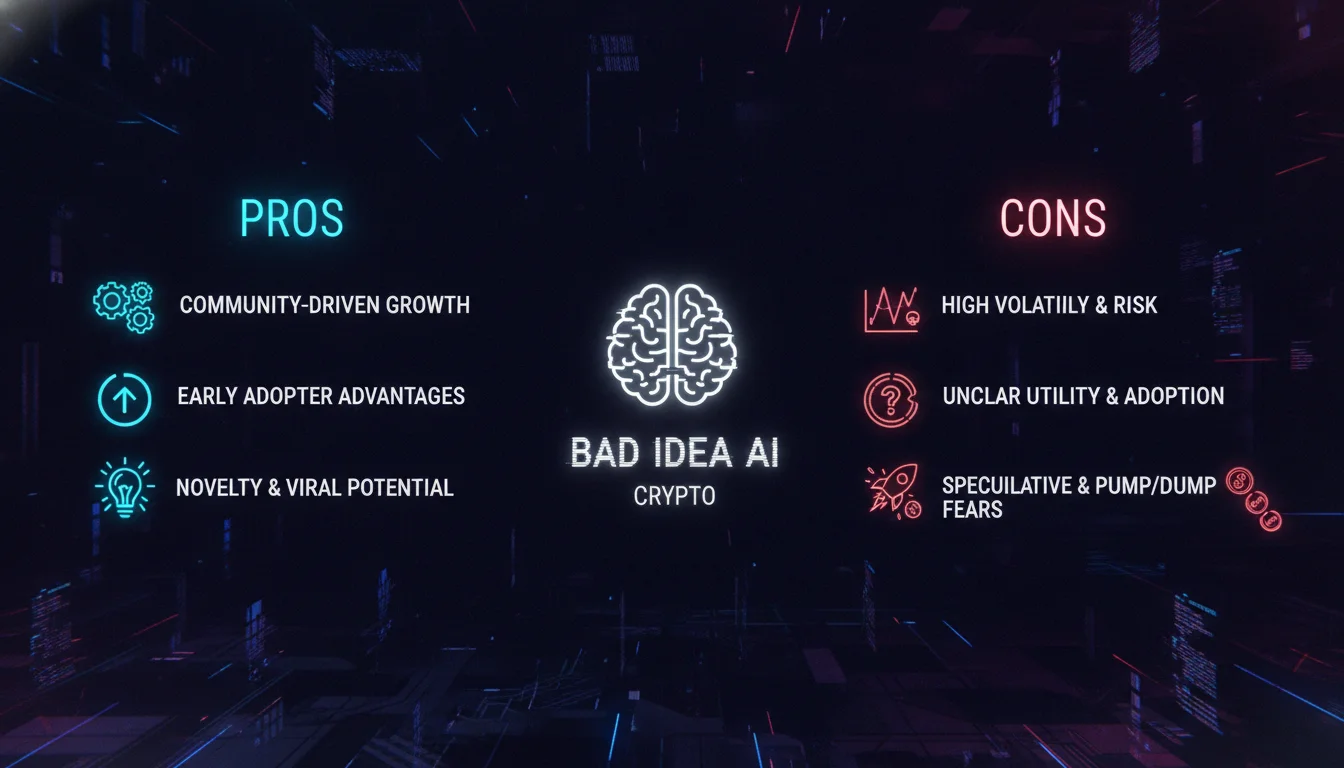
Pros
- Radical transparency: The contract is publicly verifiable on Etherscan, and team-controlled tokens are held in multi-signature wallets requiring multiple approvals.
- AI narrative with real implementation: S.A.R.A.H. is a functional Telegram bot, not just a whitepaper promise. The DAO structure gives holders actual voting rights.
- Low entry cost: The sub-cent price per token makes BAD accessible to small-capital speculators who want exposure to the AI meme coin niche.
- Cross-chain ambition: The Shibarium integration, if completed, could expose BAD to one of crypto’s largest existing communities.
- Self-aware branding: The satirical identity is a genuine differentiator in a market full of projects that oversell utility they don’t have.
Cons
- CertiK score of 3.9: This is a low score that indicates meaningful smart contract vulnerabilities. Users should treat this as a material risk, not a footnote.
- Down over 99% from all-time high: According to CoinMarketCap, BAD has declined 99.67% from its August 2023 peak. Most of that value has not returned.
- Dangerously thin liquidity: With roughly $2,000 in daily trading volume across all venues, even a modest buy order can move the price significantly, making BAD easy to manipulate.
- Anonymous team: The founders remain anonymous. While common in meme coin projects, this limits accountability in the event of a security incident.
- No confirmed burn schedule: The massive token supply creates persistent inflationary pressure with no deflationary mechanism currently in place.
- AI integration is primarily branding: S.A.R.A.H. does not execute on-chain transactions or make autonomous governance decisions. The AI angle is more experimental concept than deployed infrastructure.
Technology Behind Bad Idea AI
this kind of ai crypto runs on Ethereum, one of the most battle-tested and decentralized blockchains in existence. As an ERC-20 token, BAD inherits Ethereum’s security model and benefits from smart contract automation for token transfers and governance rules. The AI component is less about deployed machine learning models and more about experimental decision-making frameworks, currently expressed through the S.A.R.A.H. chatbot and community votes.
Built on Ethereum and Proof of Stake
Ethereum transitioned to Proof of Stake in 2022, replacing energy-intensive mining with a validator system where participants lock up ETH to secure the network. This mechanism keeps the BAD token ledger immutable and censorship-resistant. Every BAD transaction requires ETH for gas fees paid to validators. The token’s contract address (0x32b86b99441480a7e5bd3a26c124ec2373e3f015) is fully verifiable on Etherscan, providing complete on-chain transparency. Because BAD’s transaction volume is minimal, gas costs for individual trades remain relatively low.
Smart Contracts and AI Integration
BAD’s smart contracts govern its tokenomics and the rudimentary DAO framework. CertiK, a leading blockchain security firm, audited these contracts and assigned a score of 3.9 out of 100. That score is on the lower end of the scale and signals medium-risk vulnerabilities that users should factor into any position sizing decision. The AI integration includes a functional Telegram bot. S.A.R.A.H. can answer basic questions about crypto and the project, but she does not execute trades or make autonomous on-chain decisions. The AI narrative is primarily about branding and community engagement rather than deployed machine learning infrastructure.
“The token’s supply is meticulously managed, with locked and team-controlled tokens verified by data aggregators. These tokens are safeguarded through multi-signature safes, ensuring robust security.” – CoinMarketCap project description
Decentralized Governance with DAOs
A Decentralized Autonomous Organization is an entity governed by smart contracts and voting rights distributed among token holders. the idea ai crypto’s DAO is still early-stage. Anyone can submit proposals, but voting power is proportional to BAD holdings. The twist: S.A.R.A.H. is supposed to collaborate in governance, though the exact on-chain mechanism remains vague. This setup mirrors other Ethereum DAOs but adds a layer of playful ambiguity. The ultimate goal is to test whether a hybrid human-AI model produces better decisions, or complete chaos.
Bad Idea AI Tokenomics and Supply
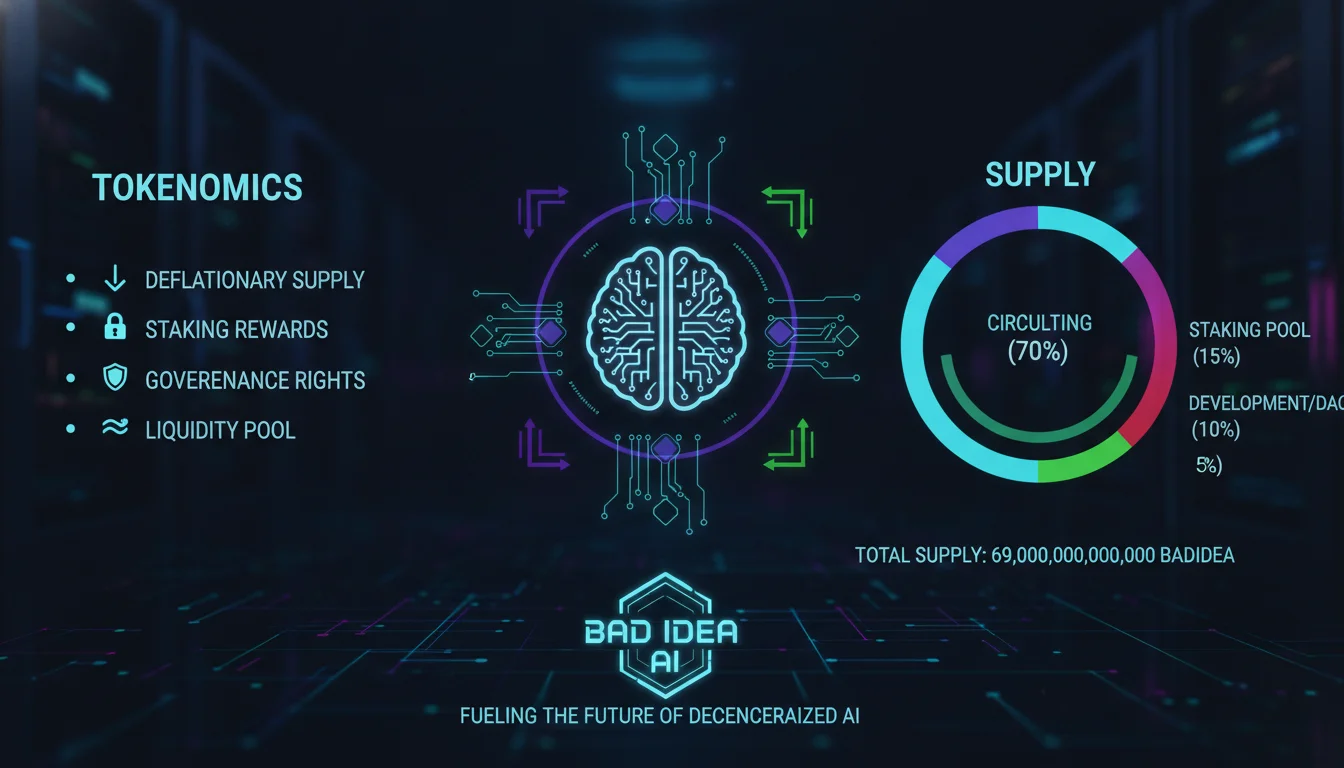
Tokenomics is the economic model of a cryptocurrency, covering supply, distribution, and incentives. For crypto, the numbers are staggering. With a maximum supply of 831.04 trillion BAD, the token’s abundance is reminiscent of other meme coins like Shiba Inu. As of August 2026, the circulating supply is reported as 618.73 trillion per CoinMarketCap or 684.787 trillion per CoinGecko, a discrepancy likely due to different tracking methodologies. The fully diluted valuation sits around $534,000, assuming the maximum supply is fully in circulation.
Circulating Supply and Maximum Supply
BAD’s tokenomics are built for virality. The total supply of 831 trillion means that even a market cap of $10 million would push the price to roughly $0.000000012, still a fraction of a cent. The current circulating supply represents the majority of the total, with the remainder possibly reserved for ecosystem development. No official burn events have been confirmed, though the community regularly speculates about token burn initiatives. A burn would permanently remove tokens from circulation, potentially increasing scarcity. Without a clear burn schedule, the supply remains a potential inflationary pressure on price.
Token Distribution and Security
According to CoinMarketCap, team-controlled tokens are locked in multi-signature wallets requiring multiple approvals for transactions. This setup reduces the risk of a rug pull. However, the CertiK audit score of 3.9 raises real flags. It suggests the smart contracts carry medium-risk vulnerabilities that investors should weigh carefully. The anonymous founding team adds another layer of uncertainty, a common trait in meme coin projects but one that limits accountability if something goes wrong.
The Role of Token Burns
Token burns are a recurring topic among BAD holders. A burn mechanism would reduce supply and could support the token’s price over time. The project’s website does not explicitly mention a burn schedule. Community searches for “bad idea ai token burn” indicate real demand for this feature. Should the DAO vote to implement burns, it could become a meaningful catalyst. For now, investors should not factor supply reduction into any thesis. The tokenomics remain static with no confirmed deflationary mechanism.
Bad Idea AI Price History and Market Performance
Price movements for bad idea have been volatile since the token launched in May 2023. According to CoinMarketCap, BAD reached an all-time high on August 13, 2023, before declining sharply. As of August 2026, it trades at approximately $0.00000000065, with a 24-hour trading volume of roughly $2,000 and a market cap of about $397,000 to $441,000 depending on the data source. These figures place BAD firmly in the micro-cap category, where large percentage swings can happen on tiny volumes.
Current Price and Market Cap
At the time of writing, CoinMarketCap reports a market capitalization of $397,260, while CoinGecko reports $441,296 due to differing circulating supply counts. The 24-hour trading volume of roughly $2,014 on CoinGecko dropped significantly from the prior day, indicating waning activity. Such thin liquidity means a small buy order can move the price materially. This makes ai crypto a high-risk instrument, unsuitable for risk-averse traders or anyone allocating meaningful capital.
All-Time High and Low: What the Data Shows
BAD is down 99.67% from its all-time high, per CoinMarketCap data. The Forbes Digital Assets tracker shows a 5-year high around $0.00000019, which provides a more grounded reference point than some of the raw feed figures that appear to reflect display glitches. What’s clear from on-chain data: BAD has lost nearly all of its peak value, a fate shared by most meme coins after their initial hype cycle fades. The all-time low per CoinGecko was recorded in June 2026.
Price Predictions and Analyst Views
No credible research firm covers this type of crypto. Price predictions circulating online come primarily from anonymous social media accounts and algorithmic tools. The token’s future depends almost entirely on community sentiment and the broader AI crypto trend. In 2026, several AI-focused cryptocurrencies have posted gains driven by real-world AI adoption. BAD, however, lacks utility beyond its meme status and governance experiment. A resurgence is possible if the community rallies or a meme wave hits, but continued value erosion is equally plausible. Treat any price targets with serious skepticism.
How to Buy Bad Idea AI Crypto: Step-by-Step
Buying this kind of ai crypto is not as straightforward as purchasing a top-100 coin on a major exchange. Since BAD is not listed on major centralized exchanges, you need a decentralized exchange like Uniswap. The process involves setting up a Web3 wallet, funding it with Ethereum, and swapping for BAD. Binance’s own educational material on acquiring unlisted tokens via its Web3 Wallet confirms this general approach.
Step 1: Set Up a Wallet
Download a cryptocurrency wallet that supports ERC-20 tokens. MetaMask is the most widely used option, available as a browser extension and mobile app. Create a new wallet and store your 12-word recovery phrase securely. Never share it. Alternatively, use the Binance Web3 Wallet built into the Binance app. After setup, import BAD manually by pasting the contract address (0x32b86b99441480a7e5bd3a26c124ec2373e3f015) into the token import field. Verify this address against the official Bad Idea AI website or CoinGecko before proceeding.
Step 2: Fund Your Wallet
You need Ethereum (ETH) to pay transaction fees and to swap for BAD. Purchase ETH on a centralized exchange like Kraken, Binance, or Coinbase, then transfer it to your MetaMask address. Buy slightly more than you plan to spend to cover gas fees, which fluctuate with network congestion. If you prefer stablecoins, USDC works as a base pair on most DEXs. Binance’s Web3 Wallet also supports direct stablecoin purchases via debit card or bank transfer.
Step 3: Use a Decentralized Exchange
The primary marketplace for the idea ai crypto is Uniswap V2, which according to CoinGecko handles roughly 74% of BAD’s daily volume. Go to app.uniswap.org, connect your wallet, and confirm you’re on Ethereum Mainnet. Select ETH as the input token. For the output, paste the BAD contract address. Because BAD has low liquidity, set slippage tolerance to 3 to 5% to prevent transaction failures. Other options include Shibaswap for holders in the Shiba Inu ecosystem and BVOX, a centralized exchange offering a BAD/USDT pair.
Step 4: Secure Your Tokens
After swapping, BAD tokens appear in your wallet. For meaningful holdings, consider moving them to a hardware wallet like Ledger or Trezor. Always double-check the contract address before any interaction to avoid phishing scams. Join the project’s official Telegram or Discord channels to stay updated. Never share your private keys or recovery phrase with anyone, under any circumstances.
Comparing Bad Idea AI with Other AI Cryptos
To understand where crypto fits in the market, compare it with projects that also merge AI and crypto. Serious AI platforms like Fetch.ai (FET) or SingularityNET (AGIX) aim to build decentralized AI marketplaces with real infrastructure and venture backing. BAD is a meme coin first. Its value proposition is not technological utility but community cohesion and humor. Within the meme coin niche, BAD stands out by injecting an AI narrative and a functional governance layer.
Comparison Table: BAD Trading Across Exchanges
Data sourced from CoinGecko and provider websites as of August 2026.
| Exchange | Type | Trading Pair | 24h Volume (USD) | Notes |
|---|---|---|---|---|
| Uniswap V2 (Ethereum) | Decentralized (DEX) | BAD/WETH | $1,484.23 | Dominant venue; roughly 74% of BAD volume |
| Shibaswap | Decentralized (DEX) | BAD/WETH | N/A | Shiba Inu ecosystem; lower liquidity |
| BVOX | Centralized (CEX) | BAD/USDT | N/A | KYC required; supports stablecoin pair |
| Binance Web3 Wallet | Wallet with DEX access | Multiple | N/A | Not a direct listing; facilitates DEX swaps |
| StealthEX | Instant swap service | Various | N/A | No registration required; fixed or floating rates |
Unique Value Proposition
Compared to Fetch.ai, which raised significant venture capital and carries a market cap in the hundreds of millions, bad idea is a pure grassroots movement. Its unique selling point is self-awareness: the project doesn’t pretend to be the next breakthrough in AI. It mocks the hype instead. This resonates with a niche audience that values irony and community over polished roadmaps. The potential Shibarium bridge could unlock new use cases, such as microtransactions or tipping within Shiba Inu ecosystem applications. In a market saturated with AI tokens, BAD’s offbeat approach might be its strongest differentiator.
Is Bad Idea AI Crypto a Good Investment?
Deciding whether to invest in bad idea ai crypto requires a cold look at the facts. The token has a market cap under $500,000, almost no trading volume, and a security audit score that signals caution. Yet the AI meme coin niche has produced significant returns in past cycles. The question is whether BAD can capture similar momentum. Below are the bull and bear cases, grounded in on-chain data.
The Bull Case: Community and AI Hype
The macro environment in 2026 is favorable to AI-themed assets. Real-world AI adoption is accelerating, and crypto projects riding that trend have seen meaningful gains. Bad idea ai crypto’s community, while small, is passionate and creative. The DAO structure could drive community-led marketing campaigns, similar to what propelled Shiba Inu in earlier cycles. The token’s low price attracts speculators hoping for a “penny jump,” and its presence on multiple chains broadens its reach. If a major influencer or meme wave hits BAD, its price could multiply quickly given the low market cap baseline. A relatively small influx of capital could produce large percentage moves.
The Bear Case: Volatility and Meme Coin Risks
The downside risks are severe. BAD is down 99.67% from its all-time high, erasing nearly all investor value. Meme coins often have short lifespans; the hype that drives initial surges rarely returns at the same intensity. The token’s liquidity is dangerously thin. A few hundred dollars of buying pressure can move the price by several percentage points, making it easy to manipulate. The CertiK score of 3.9 indicates persistent vulnerabilities, and the anonymous team offers no legal recourse in a security incident. Unlike utility tokens that power decentralized applications, BAD produces no revenue or cash flow, making traditional valuation frameworks inapplicable.
On-Chain Metrics to Watch
As of 2026, on-chain data shows approximately 24,980 BAD holders per CoinMarketCap. No analyst from firms like Messari or Delphi Digital has issued a formal rating on bad idea ai crypto. Trading volume has been declining, and social media activity appears sporadic. Concentration risk is real: when a small number of wallets hold a large share of supply, the threat of coordinated selling is meaningful. Any investment in BAD should be treated as a speculative position with money you can afford to lose entirely. The probability of permanent loss is high.
The Future of Bad Idea AI
What lies ahead for bad idea ai crypto? The project’s roadmap is deliberately vague, but clues are scattered across the official website and community discussions. The team hints at expanding S.A.R.A.H.’s capabilities and deepening the DAO’s governance role. The potential Shibarium integration could be the most significant near-term catalyst, opening doors to a large pre-existing community.
Roadmap and Upcoming Developments
The official pitch deck mentions plans to enhance S.A.R.A.H. with more autonomous decision-making features. There is also discussion of NFT collections and a merchandise store, with a Shop page already live on the website. Strategic partnerships with other AI or meme projects are possible, though none have been announced publicly. The DAO is expected to take a larger role in treasury allocation and marketing decisions. Without a clear timeline, these developments remain speculative. Progress depends heavily on the core team’s ability to maintain community interest and ship working products.
Shibarium Integration and Ecosystem Growth
The existence of a SHIB contract address for BAD strongly suggests a bridge to Shibarium, the Layer-2 network incubated by the Shiba Inu community. Shibarium aims to reduce fees and enable faster transactions for ecosystem tokens. If BAD becomes a recognized token on Shibarium, it could participate in games, staking pools, or DeFi applications built there. The Shiba Inu community is one of the largest in crypto, and even a small fraction of its members buying BAD could meaningfully boost demand. Concrete implementation details are still missing, but the on-chain address exists as evidence of intent.
Community and DAO Expansion
Bad idea ai crypto’s fate ultimately rests with its community. The DAO model encourages decentralized ownership, but it also requires active participation to function. If the community grows larger and more organized, it could drive genuine innovation, perhaps even turning the “bad idea” into a self-sustaining ecosystem. Community-driven projects often struggle with coordination and funding, especially without a paid full-time development team. Watch for sustained GitHub activity, increasing holder counts, and evidence of real utility beyond the meme. For now, BAD remains an entertaining, high-risk bet on the collective imagination of its supporters.
If you’re building at the intersection of AI, DAOs, and token infrastructure, the work happening in projects like bad idea ai crypto points to a broader question worth taking seriously: how do decentralized communities make decisions at scale? That’s a question we explore actively at Digital Blockchains. Apply to the Genesis Cohort if you’re building something in this space and want to work with a team that reads the whitepapers and deploys the contracts.
Frequently Asked Questions
Where can I buy Bad Idea AI crypto?
Bad idea ai crypto is primarily available on Uniswap V2 on Ethereum and Shibaswap. You can also use the Binance Web3 Wallet to access DEX swaps, or trade on the centralized exchange BVOX using a BAD/USDT pair. Always verify the token contract address (0x32b86b99441480a7e5bd3a26c124ec2373e3f015) before executing any transaction.
Is Bad Idea AI crypto a good investment?
Investing in bad idea ai crypto carries extreme risk. It has a market cap under $500,000, near-zero daily trading volume, and has lost over 99% of its peak value. While meme coins can surge on community momentum, BAD should only ever represent a small, speculative allocation in a diversified portfolio. Never invest more than you can afford to lose entirely.
What is the price prediction for Bad Idea AI?
No reliable price prediction exists for bad idea ai crypto due to its obscurity and lack of fundamental drivers. Community members hope for a return toward all-time highs, but thin liquidity and declining volume suggest continued price pressure is more likely than a sustained rally. Treat any price targets from anonymous sources with serious skepticism.
How does Bad Idea AI use artificial intelligence?
Bad idea ai crypto incorporates AI primarily through its S.A.R.A.H. chatbot on Telegram, which answers questions about crypto and the project with a conversational interface. The DAO theoretically involves AI in governance decisions, but actual machine learning capabilities are minimal. The AI angle is largely an experimental concept and branding framework rather than deployed on-chain infrastructure.
Is Bad Idea AI a meme coin?
Yes, bad idea ai crypto is a meme coin. It was created as a satirical take on AI and crypto trends, with a deliberately self-deprecating name and identity. Its value is driven almost entirely by community engagement and social media activity rather than tangible utility or revenue-generating protocol mechanics.
What is the maximum supply of BAD tokens?
The maximum supply of Bad Idea AI (BAD) tokens is 831.04 trillion, with a circulating supply of roughly 618 to 684 trillion depending on the data source. The enormous supply keeps the per-token price extremely low, similar to other meme coins like Shiba Inu, and creates persistent inflationary pressure without a confirmed burn mechanism.