Blockchain startups are companies building decentralized infrastructure across DeFi, AI data, stablecoin payments, and security. In 2026, curated directories list anywhere from 60 to 1,000+ active firms. Compare them by investor, funding stage, location, and open roles before engaging.
Key Takeaways
- startups span infrastructure, DeFi, AI data, security, gaming, and stablecoin payments.
- Y Combinator lists 73 crypto/web3 startups; CryptocurrencyJobs profiles 1,000+ hiring companies; Built In NYC lists 180 blockchain companies.
- Top investors include Y Combinator, Sequoia, Andreessen Horowitz, Benchmark, and Bessemer.
- Funding rounds range from $6M seeds to $300M Series B raises, with valuations reaching into the billions.
- Use multiple directories to cross-reference funding, valuation, and open roles before making any decision.
What Are Blockchain Startups in 2026?

Definition and Core Business Models
A blockchain startup is a company whose primary product uses distributed ledger technology to record transactions, enforce smart contracts, or coordinate digital assets without a central intermediary. In 2026, these companies range from YC-backed public companies like Coinbase to four-person active startups building AI-powered compliance tools. Some focus on core protocol infrastructure; others build applications such as trading platforms, NFT marketplaces, and stablecoin payment rails.
How Blockchain Startups Differ from Traditional Fintech
Traditional fintechs rely on centralized ledgers, bank rails, and card networks. this type of startups use on-chain settlement, tokenized assets, and smart contracts to remove intermediary risk. Consider Arbital, a YC S2026 startup: it lets users trade perps, memes, stocks, and run market-making strategies from one interface. According to Y Combinator’s Crypto/Web3 directory, Arbital reached $1.3B in volume across 2,600 traders in its first 7 months and now handles $377M/month. That kind of traction is structurally impossible on a traditional brokerage stack.
Sector Categories in 2026
- DeFi and trading: Automated market makers, perpetual futures, pre-IPO share trading.
- Stablecoin payments: Global payout rails and compliant on/off ramps.
- AI data infrastructure: Payouts, provenance, and data verification for AI training.
- Security and compliance: On-chain risk scoring, transaction monitoring, and fraud detection.
- Gaming and digital identity: Licensed poker platforms, NFT utilities, and decentralized social.
- Layer 1 and Layer 2 infrastructure: Rollup deployment, modular chains, and privacy tooling.
How to Compare Blockchain Startups by Funding and Investors
Venture-Backed vs. Public Blockchain Companies
Directories often mix publicly traded companies with early-stage startups, and that distinction matters. Y Combinator lists Coinbase as a public company founded in June 2012 with 6,112 employees in Los Angeles, while Built In NYC’s blockchain company list shows Block at 12,000 employees, Mastercard at 38,800 employees, and Coinbase at 4,700 employees. These are useful benchmarks, but early-stage this kind of startups operate with teams of 3 to 100 people and carry very different risk profiles.
Top Investors and Funding Rounds
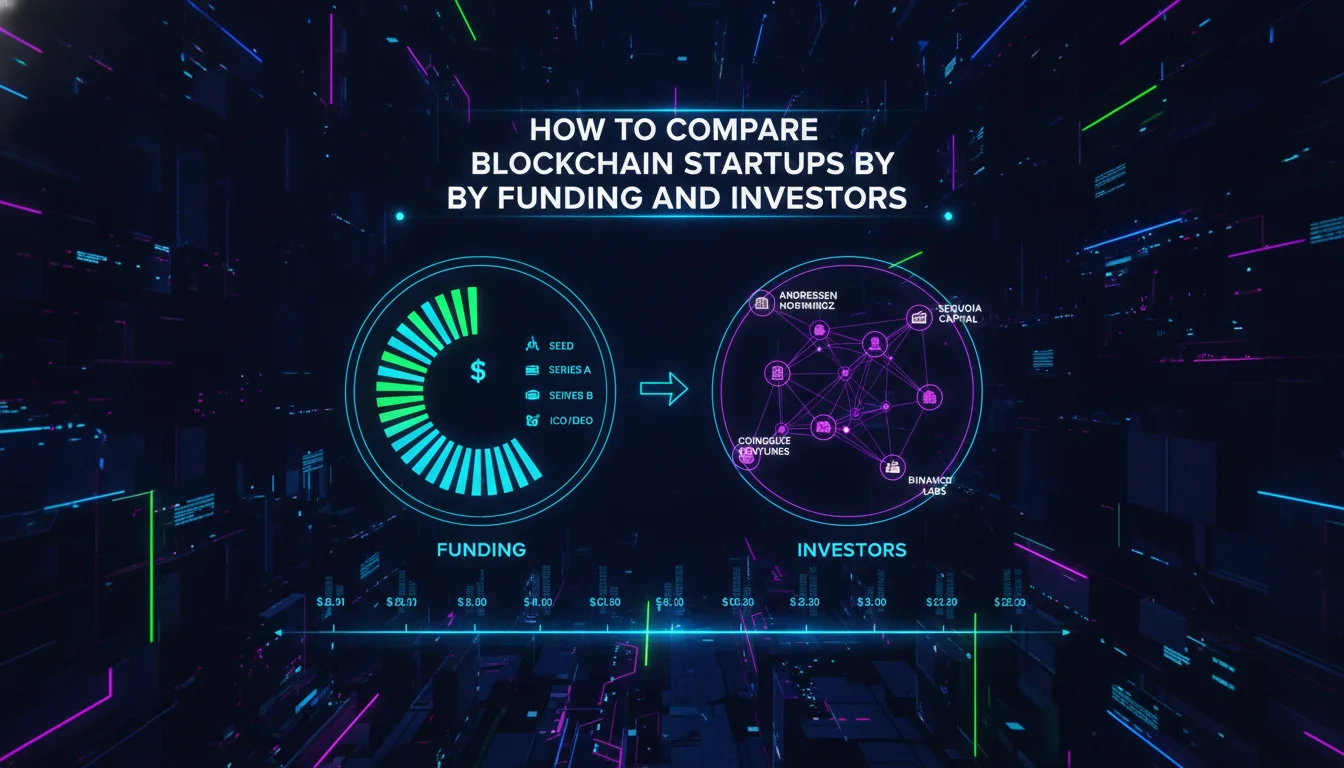
Topstartups.io tracks 60 crypto/blockchain startups with filters by investor, stage, and funding. Key rounds from its dataset include Sahara AI’s $43M Series A led by Sequoia in 2024, Story Protocol’s $80M Series B led by Andreessen Horowitz in 2024, and Mysten Labs’ $300M Series B led by Andreessen Horowitz in 2022 at a $2.0B valuation. Magic Eden raised $130M Series B led by Sequoia at a $1.6B valuation in 2022, and Chainalysis raised $170M Series F from Benchmark and Accel at an $8.6B valuation.
Reading Funding Data from Directories
Not every directory reports valuation or live funding totals. Failory’s Top 100 Blockchain Startups to Watch in 2026 notes that Polygon raised $451.5M to scale Ethereum, while BlockDAG secured $420M for its layer 1 technology. Use these figures as directional signals, not definitive rankings. Round sizes and valuations are often self-reported or delayed, so treat any single directory as a starting point rather than a source of truth.
Where to Find Blockchain Startups Hiring in 2026

Job Board Directories and Talent Collectives
CryptocurrencyJobs profiles over 1,000 crypto startups and hiring companies, including 0x, CoW DAO, Ethena Labs, Lisk, and Wintermute. Its filters cover roles such as engineering, marketing, design, sales, operations, finance, and product, as well as blockchains like Web3, DeFi, Ethereum, Solana, and Layer 2. Contract, freelance, part-time, and internship filters make it easier to find entry-level or non-technical roles in early-stage blockchain startups.
Geographic Hubs: NYC, Remote, and Global
Built In NYC lists 180 blockchain companies, with top names including Block, Mastercard, Rain, Coinbase, Trail of Bits, Spiral, Circle, and Cash App. Rain is building global payments infrastructure for the stablecoin era and reports 100 employees and 38 open positions in New York. Y Combinator’s 73 crypto/web3 startups are distributed across Los Angeles, Tel Aviv, Singapore, New York City, San Francisco, and Costa Rica, reflecting a genuinely global talent pool.
Roles in Demand Across Blockchain Startups
According to Built In NYC’s data, Block currently has 23 open positions, Rain has 38, and Mastercard has 39 across product management, engineering, sales, AI, and machine learning. The range of roles is broader than most people expect. You don’t need to write Solidity to contribute to a blockchain startup.
How to Evaluate a Blockchain Startup: A Step-by-Step Framework

Step 1: Define Your Goal
Start by asking what you actually want from this engagement. Job seekers should weigh team size, open roles, and funding runway. Investors should prioritize valuation, tokenomics, and investor track record. Enterprise partners need to assess regulatory posture and custody infrastructure. The criteria shift significantly depending on your objective.
A 5-Step Evaluation Process
- Define your objective: Clearly state whether you are hiring, investing, or partnering.
- Choose two or three directories: Cross-reference Y Combinator, Topstartups, CryptocurrencyJobs, and Built In NYC to avoid single-source bias.
- Check funding and investors: Look for rounds led by Sequoia, Andreessen Horowitz, Y Combinator, or Bessemer as quality signals.
- Review open roles and team size: A four-person Active S2026 startup may signal early-stage risk; a 100-person startup like Rain indicates product traction.
- Verify on-chain or product activity: For trading platforms, look for volume metrics like Arbital’s $377M/month. For security, look for POCs with asset managers and active evaluations at global banks.
Red Flags and Due Diligence Checks
Unlicensed peer-to-peer poker clubs can expose players to deposit risk. YC-backed PokerClubHub addresses this directly: it uses Fireblocks for custody and holds a gaming license shared with BetHog and Nexa Poker. Players deposit with PokerClubHub rather than individual club owners. That structural difference matters. When evaluating any blockchain startup, check for regulated custody, audit history, and whether users interact with the platform or with unverified third parties.
Leading Blockchain Startups to Watch by Sector
DeFi and Trading Infrastructure
Arbital, a YC S2026 startup, supports perps, memes, stocks, and market-making strategies from one interface. Freeport Markets, a YC F2025 startup, offers trading for pre-IPO shares, equities, crypto, and perpetual futures with AI analysts. Wintermute is described by CryptocurrencyJobs as a leading global algorithmic trading firm in digital assets, and CoW DAO develops user-protective DeFi products. These are not speculative projects: they have live volume, institutional counterparties, and verifiable on-chain activity.
AI, Data, and Security
Archer builds financial infrastructure for the AI data economy, enabling global payouts, stablecoin banking, and yield for companies supplying data to AI labs. Verdict Machine, a YC S2026 startup, uses AI to assess on-chain cyber risk and generate tailored controls. Its founding team launched and led blockchain security at Check Point (NASDAQ: CHKP). In its first weeks, Verdict Machine started POCs with asset managers and digital-asset infrastructure providers whose systems move billions of dollars weekly. Sahara AI, Allium, Chainalysis, and TRM Labs round out the AI and compliance segment.
Payments and Stablecoin Infrastructure
Rain is building the global payments infrastructure for the stablecoin era, with tools for credit card programs, cross-border payments, and embedded wallets. Plasma develops purpose-built stablecoin money movement infrastructure, and Agora focuses on money and payments for internet markets. Blockchain Technology News also recommends watching Aptos, LayerZero, Concordium, Flare Networks, and Celestia, with Celestia noted for its modular infrastructure approach.
Pros and Cons of Working With Early-Stage Blockchain Startups
Pros
- Broader ownership and equity upside compared to later-stage or public companies.
- Direct exposure to protocol-level innovation and architectural decisions.
- Faster decision-making cycles with less organizational overhead.
- Access to pre-token or pre-Series A valuations not available in public markets.
Cons
- Token equity and stock options can be illiquid for years.
- Regulatory uncertainty around stablecoins and digital asset securities adds compliance risk.
- Some directories list companies with no public hiring data or unaudited volume claims.
- Early-stage teams of 3 to 4 people carry real execution risk if key founders depart.
Comparison Table: Early-Stage vs. Later-Stage Blockchain Startups
| Factor | Early-Stage Blockchain Startups | Later-Stage / Public Blockchain Companies |
|---|---|---|
| Funding stage | Pre-seed, Seed, Series A (e.g., Codex $6M Seed in 2025) | Series C+ or Post-IPO (e.g., Coinbase S2012, Chainalysis $170M Series F) |
| Team size | 3–100 employees (Arbital 3, Verdict Machine 4, Rain 100) | 500–38,800 employees (Chainalysis 501–1,000, Mastercard 38,800) |
| Equity upside | Higher potential, lower liquidity | Lower potential, public or secondary market liquidity |
| Product risk | High; unproven traction | Moderate; established user base |
| Example profiles | Arbital, Verdict Machine, PokerClubHub | Coinbase, Block, Chainalysis, Magic Eden |
Why Blockchain Startup Failure Rates Deserve Attention
Most blockchain startup directories highlight winners. Failory is one of the few that also documents failures, and that context is valuable. Projects fail for predictable reasons: regulatory shutdown, token collapse after launch, founder departure, or simply running out of runway before achieving product-market fit. Before committing capital or accepting an offer, check whether the startup has a working product, verifiable on-chain activity, and a funded runway that extends beyond 12 months. A four-person team with a $6M seed round has roughly 18 to 24 months to prove traction. That’s a tight window.
“The blockchain sector continues to attract major investment for building the next generation of the internet. Companies are focused on everything from core infrastructure to specific applications.” – Failory, Top 100 Blockchain Startups to Watch in 2026
Where Industry Directories Disagree on the ‘Top’ Blockchain Startups
Count Differences: 73 vs 60 vs 100 vs 180 vs 1,000+
The same search for blockchain startups returns very different list sizes depending on the source. Y Combinator curates 73 crypto/web3 startups; Topstartups.io lists 60 funded crypto startups; Failory names 100; Built In NYC shows 180 blockchain companies; and CryptocurrencyJobs profiles 1,000+ hiring profiles. None of these numbers is wrong. They reflect different inclusion criteria.
| Directory | Number of Blockchain Startups | Primary Focus |
|---|---|---|
| Y Combinator Crypto/Web3 | 73 | YC-funded startups |
| Topstartups.io Crypto | 60 | Funded startups with filters |
| Failory Top 100 | 100 | Startups to watch |
| Built In NYC Blockchain | 180 | NYC companies |
| CryptocurrencyJobs | 1,000+ | Hiring profiles |
Why Inclusion Criteria Change Rankings
Y Combinator only includes companies that went through its accelerator. Topstartups.io filters by investor and stage. Built In NYC restricts results to New York. CryptocurrencyJobs includes any company with an open role, and Failory mixes unicorns, active startups, and companies worth watching. Each list optimizes for a different use case, which is exactly why you should use more than one.
What the Discrepancies Mean for Research
Directory counts are not an absolute ranking. Y Combinator curates 73 crypto/web3 companies, while CryptocurrencyJobs lists over 1,000 startup profiles. The difference reflects whether the dataset is optimized for venture funding, hiring, or location.
Use two or more directories and compare the overlap. A startup appearing in both Y Combinator and Topstartups with a known lead investor is a stronger signal than a single-directory listing. Cross-referencing is the most reliable filter you have.
Frequently Asked Questions
What is a blockchain startup?
A blockchain startup is a company whose core product uses distributed ledger technology, smart contracts, or digital assets to provide a service. Examples range from trading platforms and stablecoin rails to AI data infrastructure and security tools.
How many blockchain startups are there in 2026?
Directory counts vary widely. Y Combinator lists 73 crypto/web3 startups, Topstartups.io tracks 60 funded startups, Failory names 100, Built In NYC lists 180 companies, and CryptocurrencyJobs profiles over 1,000 hiring profiles. The right number depends on which criteria matter to you.
Which investors back the top blockchain startups?
Leading blockchain startups are backed by Y Combinator, Sequoia, Andreessen Horowitz, Benchmark, and Bessemer. Round sizes range from $6M seeds to $300M Series B and $170M Series F rounds, per Topstartups.io data.
Where can I find blockchain startups that are hiring?
CryptocurrencyJobs lists over 1,000 hiring crypto startups with filters by role, blockchain, location, and employment type. Built In NYC highlights NYC-based blockchain companies like Rain, Block, and Mastercard with active openings.
What sectors do blockchain startups focus on in 2026?
Key sectors include DeFi and trading, stablecoin payments, AI data infrastructure, security and compliance, gaming, and Layer 1/Layer 2 infrastructure. Each sector carries different risk and growth profiles, so align your research with the vertical that matches your goals.
How do I evaluate a blockchain startup before joining or investing?
Define your goal, cross-reference two or three directories, check lead investors and funding stage, review team size and open roles, and verify on-chain or product metrics such as monthly volume or POC activity. Independent verification is essential before committing capital or accepting an offer.
Build With Us
As of 2026, the blockchain startup ecosystem is maturing beyond speculative crypto into infrastructure for AI data, stablecoin payments, and regulated applications. Funding data from Topstartups and Failory shows continued capital flowing into layer 1s, privacy tooling, and compliance analytics, while job boards reflect strong hiring demand in engineering, sales, and product.
Don’t rely on a single list. Use Y Combinator for accelerator quality signals, Topstartups for investor filters, CryptocurrencyJobs for hiring data, and Built In NYC for geographic concentration. Cross-referencing these sources gives you a commercial, evidence-based view of the ecosystem.
If you’re building in this space and want to go deeper on protocol architecture, tokenomics design, or smart contract infrastructure, apply to the Genesis Cohort at digitalblockchains.com. We work with serious builders who read whitepapers and ship code.