The top blockchain companies in 2026 are Coinbase, Binance, IBM, Ripple, and Strategy, driving innovation across exchanges, enterprise infrastructure, and financial services. These firms shape the digital economy through crypto trading, blockchain infrastructure, and decentralized applications.
Key Takeaways
- Top blockchain companies span multiple sectors, including exchanges, mining, fintech, and enterprise software.
- Coinbase and Binance dominate cryptocurrency trading, while IBM and Ripple lead in enterprise blockchain adoption.
- Mining giants like Core Scientific are pivoting to support AI and high-performance computing workloads.
- The global blockchain market is projected to reach nearly $1.4 trillion by 2030, fueled by tokenization and stablecoins.
- Regulatory clarity, such as the GENIUS Act, is beginning to provide a framework for institutional participation.
- Blockchain.com has processed over $1.1 trillion in transaction volume across its 95M+ wallets, according to the platform’s own data.
Understanding Blockchain Companies
What Is a Blockchain Company?
A blockchain company is an organization that develops, deploys, or utilizes blockchain technology as a core part of its products or services. Blockchain itself is a decentralized digital ledger that records transactions across a network of computers, ensuring transparency, security, and immutability without a central authority. These companies range from cryptocurrency exchanges that let users buy and sell digital assets to infrastructure providers that build the underlying protocols and hardware powering the entire ecosystem.
According to Gartner, blockchain platforms are “emerging platforms and, at this point, nearly indistinguishable in some cases from core blockchain technology. They are being used for generalized distributed value exchange, consisting of an expanding list of cryptographically signed, irrevocable transactional records shared by all participants in a network.” That definition matters because it explains why the top blockchain companies are not merely crypto startups but often large enterprises integrating distributed ledger technology into existing workflows.
The Evolution of Blockchain Companies in 2026
As of 2026, the blockchain industry has matured far beyond its cryptocurrency roots. Early pioneers like Coinbase and Blockchain.com have evolved into comprehensive financial platforms, while traditional tech giants like IBM and Microsoft have expanded their blockchain-as-a-service offerings. The competitive field now includes pure-play crypto firms, financial incumbents, and a new breed of hybrid companies bridging Web2 and Web3.
Three trends define the current moment: tokenization of real-world assets, integration of AI with blockchain for verifiable compute, and the rise of stablecoins as a payment rail. The top blockchain companies are those that successfully navigate these shifts while managing regulatory compliance and scalability at the same time.
Categories of Top Blockchain Companies
Cryptocurrency Exchanges
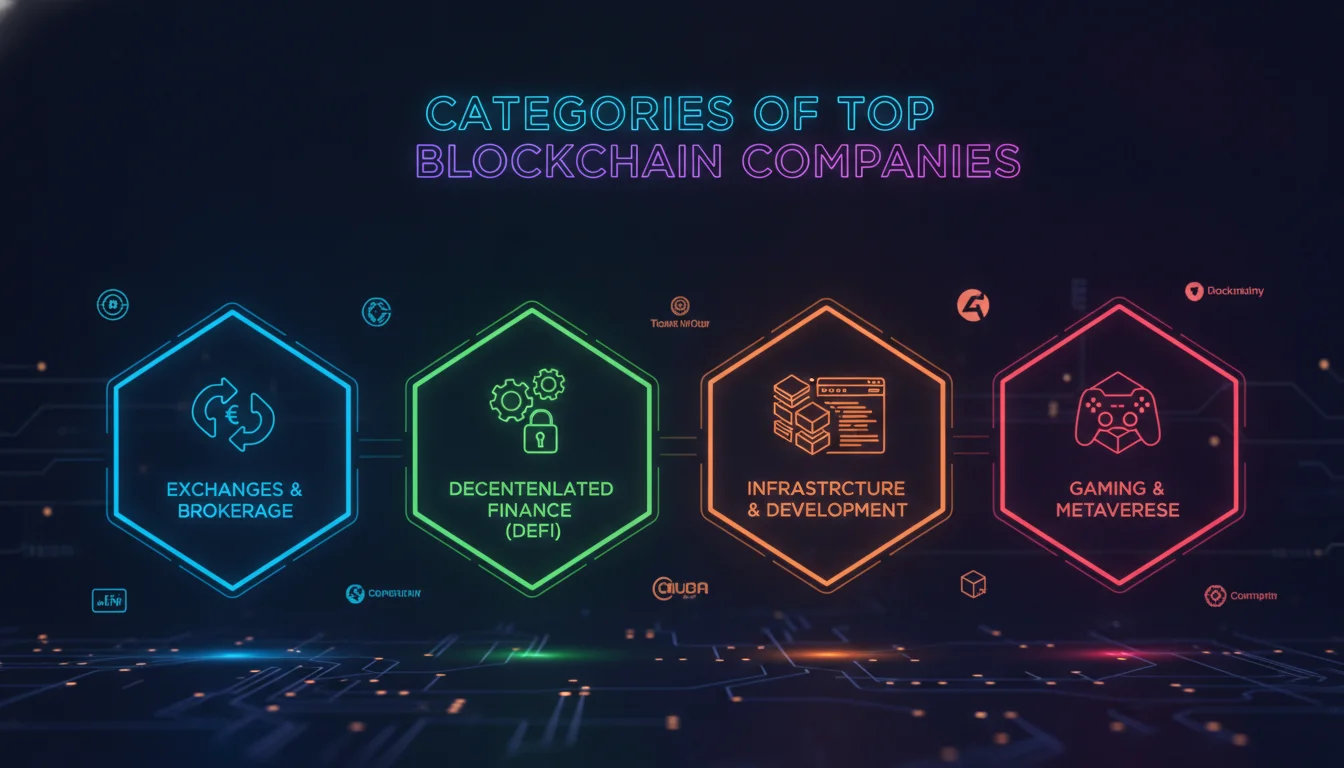
Cryptocurrency exchanges are the most visible face of the blockchain economy, providing platforms for buying, selling, and trading digital assets. The leading firms in this category include Coinbase, Binance, and Robinhood. Coinbase, the largest U.S.-based exchange, serves as a gateway for millions of retail and institutional investors, with over $404 billion in assets on its platform as of 2026, according to Built In. Binance operates the world’s largest cryptocurrency exchange by trading volume, offering access to over 190 cryptocurrencies and more than 250 trading pairs. Both companies have expanded into custody, staking, and decentralized finance (DeFi) services.
Mining and Infrastructure Providers
Mining companies are the backbone of proof-of-work blockchains like Bitcoin, investing in specialized hardware and large-scale data centers to secure the network and earn block rewards. Core Scientific, one of the largest Bitcoin miners in North America, is evolving beyond crypto mining by transforming its infrastructure to support AI and high-performance computing (HPC) workloads, as highlighted by VanEck. Other notable miners include Cipher Mining and Bitfarms, both of which have delivered strong performance amid Bitcoin’s price recovery. These firms are diversifying into dual-use facilities that can serve both blockchain and AI compute, a trend reshaping the data center industry.
Enterprise Blockchain and Development Platforms
Enterprise blockchain companies focus on building permissioned or private distributed ledger solutions for businesses. IBM Blockchain, built on the open-source Hyperledger Fabric framework, is a leading enterprise platform enabling applications in supply chain management, financial services, and IoT. Microsoft Azure offers blockchain-as-a-service (BaaS) that allows organizations to deploy and manage blockchain networks with minimal overhead, using smart contracts for rapid provisioning. According to ZipBooks, 90% of Fortune 500 companies use Azure, though this figure reflects Azure’s overall cloud footprint rather than blockchain adoption specifically. These enterprise-focused top blockchain companies prioritize interoperability, privacy, and compliance, making them the preferred choice for consortia and regulated industries.
Financial Services and Stablecoins
Ripple is a prime example of a blockchain company transforming traditional finance. It provides a stablecoin-powered platform and the XRP Ledger for real-time cross-border payments, offering an alternative to legacy correspondent banking. Ripple’s custody software and payment network have been adopted by a growing number of financial institutions. Stablecoins have emerged as a killer application for payments, and the GENIUS Act in the U.S., noted by Built In, introduces consumer protections and a licensing framework for banks to issue stablecoins. That regulatory clarity could further boost companies like Circle and Paxos operating in this space.
Top Blockchain Companies to Watch

The following table summarizes some of the most influential top blockchain companies in 2026, based on publicly available information and industry reports. These firms represent distinct niches within the blockchain ecosystem.
| Company | Type | Key Offering | Notable Fact |
|---|---|---|---|
| Coinbase | Exchange | Cryptocurrency trading and custody | Largest U.S.-based exchange; $404B assets on platform |
| Binance | Exchange | Global crypto trading | World’s largest by volume; 190+ cryptos, 250+ trading pairs |
| IBM | Enterprise | Blockchain platform (Hyperledger Fabric) | Leading enterprise blockchain adoption; open-source framework |
| Ripple | Financial Services | Cross-border payments, XRP Ledger | Stablecoin-powered platform for real-time settlement |
| Strategy (MSTR) | Corporate HODLer | Bitcoin treasury | Largest corporate holder of Bitcoin |
| Blockchain.com | Infrastructure | Wallet, exchange, explorer | 95M+ wallets created; $1.1T+ transaction volume |
Coinbase: The Gateway to Crypto
Coinbase Global Inc. (NASDAQ: COIN) is synonymous with mainstream crypto adoption. Founded in 2012, it holds a unique regulatory position as a publicly traded entity subject to U.S. reporting standards. Beyond retail trading, its institutional arm, Coinbase Custody, and its Layer-2 scaling solution, Base, are expanding its influence across the ecosystem. As noted by VanEck, Coinbase is a foundation of the crypto economy, and its stock is held in many thematic ETFs.
Binance: Global Trading Powerhouse
Binance remains the most dominant exchange by global trading volume. Despite regulatory challenges in various jurisdictions, it offers a vast array of services: spot and derivatives trading, staking, a native blockchain (BNB Chain), and a launchpad for new tokens. Its competitive fee structure and deep liquidity make it a preferred platform for active traders worldwide. That said, it operates with less jurisdictional clarity than Coinbase, which may affect its standing among the top blockchain companies for institutional investors who prioritize compliance.
IBM Blockchain: Enterprise Solutions
IBM has doubled down on blockchain for business, using its Hyperledger Fabric contributions to build permissioned networks for supply chain traceability, food safety, and trade finance. IBM Blockchain Platform is designed for scalability and integration with existing enterprise systems, making it a staple in sectors like logistics and healthcare. It does not generate the same consumer excitement as crypto exchanges, but its role in digitizing global trade is substantial.
Ripple: Transforming Cross-Border Payments
Ripple’s technology addresses the high cost and slow speed of international money transfers. XRP, its native digital asset, serves as a bridge currency in its on-demand liquidity service. The company’s focus on stablecoins and central bank digital currencies (CBDCs) positions it at the center of next-generation payment infrastructure. Ripple’s expanding partnership network and its partial legal victory against the U.S. SEC have bolstered its standing among financial top blockchain companies.
Strategy (MicroStrategy): A Bitcoin Treasury Play
Strategy Inc. (formerly MicroStrategy) transformed from a software firm into the largest corporate holder of Bitcoin. Under executive chairman Michael Saylor, the company now views Bitcoin as its primary treasury reserve asset. This approach has made its stock a proxy for Bitcoin exposure in equity markets. As of 2026, it remains the most visible example of a corporate balance sheet bet on blockchain’s flagship currency.
Blockchain Development Companies Worth Knowing
Beyond the headline names, a robust ecosystem of specialized development firms builds the smart contracts, DeFi protocols, and Web3 applications that run on top of public blockchains. Platforms like Clutch list thousands of verified blockchain development companies, with firms like Peiko and SpaceDev earning strong client reviews for smart contract work and decentralized application development. These providers sit at the intersection of distributed systems, cryptography, and product engineering. For teams evaluating a development partner, Clutch’s verified review data and Techreviewer’s ranked lists of U.S.-based blockchain firms offer useful starting points for due diligence.
If you’re building a protocol, launching a token, or architecting a DAO, the choice of development partner matters as much as the choice of chain. For a deeper look at how protocol infrastructure decisions get made, see our breakdown of blockchain development resources at Digital Blockchains.
How to Choose Among Top Blockchain Companies
Criteria for Evaluating Blockchain Companies
Selecting a blockchain partner, whether for investment, as a service provider, or as a technology vendor, requires rigorous evaluation. The following steps can guide decision-making:
- Step 1: Define the use case. Determine whether you need a public or private blockchain, a DeFi protocol, or tokenization capabilities.
- Step 2: Scrutinize the technology stack. For enterprise solutions, check compatibility with frameworks like Hyperledger Fabric or Ethereum. For crypto, examine the exchange’s security track record and proof-of-reserves.
- Step 3: Assess regulatory compliance. The strongest top blockchain companies proactively engage with regulators. Look for licenses such as BitLicense in New York or MiCA authorization in Europe, and review any history of enforcement actions.
- Step 4: Review on-chain and financial metrics. For publicly traded companies, analyze revenue growth, balance sheet holdings, and quarterly filings. For private companies, explore user statistics and audit reports.
- Step 5: Consider the team and community. Strong developer communities and transparent roadmaps are positive indicators of long-term viability.
Regulatory Considerations
Regulation is reshaping the blockchain field fast. The GENIUS Act in the U.S. creates a licensing framework for stablecoin issuers, while the Markets in Crypto-Assets (MiCA) regulation in Europe sets comprehensive rules for crypto-asset service providers. Top blockchain companies that embrace these frameworks are likely to attract institutional capital and broader user adoption. Firms that resist or ignore regulatory trends face existential risks. Investors should closely monitor enforcement actions and legislative developments when assessing any blockchain company.
Pros and Cons of the Leading Blockchain Companies
Pros
- Diverse sector coverage: The leading firms span exchanges, enterprise software, mining, payments, and treasury management, giving investors and builders multiple entry points.
- Regulatory maturity: Publicly traded companies like Coinbase operate under U.S. reporting standards, providing transparency that institutional investors require.
- Infrastructure depth: Platforms like IBM Blockchain and Blockchain.com have processed trillions of dollars in transactions, demonstrating production-grade reliability.
- Expanding use cases: From tokenized real-world assets to AI-integrated compute, the top firms are building revenue streams that extend well beyond simple crypto trading.
- Open-source foundations: Many enterprise platforms build on Hyperledger Fabric or Ethereum, reducing vendor lock-in and enabling community-driven security audits.
Cons
- Regulatory fragmentation: Jurisdictional inconsistency means a company compliant in the EU may face restrictions in Asia or the U.S., creating operational complexity.
- Concentration risk: A handful of exchanges control the majority of trading volume, making the ecosystem vulnerable to single points of failure.
- Market correlation: Most blockchain company stocks remain highly correlated with Bitcoin’s price, limiting diversification benefits for equity investors.
- Security exposure: Smart contract vulnerabilities and exchange hacks remain persistent risks across the sector.
- Scalability trade-offs: Enterprise permissioned chains sacrifice decentralization for throughput, while public chains still face congestion during peak demand.
The Impact of Blockchain Companies Across Industries
Finance and Banking
Blockchain’s most significant disruption is in finance. Decentralized finance (DeFi) protocols are built by organizations like the Ethereum Foundation and ConsenSys. Centralized top blockchain companies like Coinbase and Binance have also launched DeFi wallets and staking services. Meanwhile, JPMorgan’s Onyx platform and Goldman Sachs’ tokenization efforts show that even Wall Street giants are becoming blockchain companies in their own right. The tokenization of real-world assets, from real estate to bonds, promises to increase liquidity and broaden access to capital markets.
Supply Chain and Logistics
IBM Blockchain and VeChain are leading the charge in supply chain transparency. By recording every step of a product’s journey on an immutable ledger, these companies help combat counterfeiting, improve recalls, and verify sustainability claims. Walmart’s use of blockchain for food traceability is a well-documented success story, demonstrating the technology’s value when deployed by established firms at scale.
Healthcare and Identity
Blockchain solutions in healthcare focus on secure patient data sharing and pharmaceutical supply chains. Companies like BurstIQ and Medicalchain build platforms that give patients control over their medical records. In digital identity, Microsoft’s ION (Identity Overlay Network) uses Bitcoin’s blockchain to create decentralized identifiers (DIDs). These firms represent the frontier of blockchain’s non-financial use cases.
Future Trends for Blockchain Companies in 2026 and Beyond
Tokenization and Real-World Assets
Tokenization, the conversion of physical and financial assets into digital tokens on a blockchain, is expected to grow substantially. According to VanEck, tokenization and onchain settlement are transforming capital markets. Firms like Securitize and Polymath are building the infrastructure for regulated security tokens. BlackRock, the world’s largest asset manager, has experimented with tokenized funds, signaling that established institutions are entering this space. As legal frameworks solidify, tokenized assets could become a multitrillion-dollar market over the next decade.
AI Integration and High-Performance Computing
The convergence of AI and blockchain is an emerging theme with real infrastructure implications. Blockchain can provide transparent, tamper-proof audit trails for AI training data and model outputs, while AI can optimize blockchain consensus and smart contract execution. Mining companies like Core Scientific are already repurposing their energy-optimized facilities for AI workloads. This dual-use model could fundamentally alter the revenue profile of mining businesses, making them not just top blockchain companies but key enablers of the AI infrastructure stack.
Decentralized Finance (DeFi) and Web3
The DeFi ecosystem continues to mature, with total value locked (TVL) staying above key psychological levels despite market cycles. Companies building non-custodial wallets, decentralized exchanges (DEXs), and liquid staking protocols are becoming household names among crypto-native users. Uniswap Labs, the developer of the leading DEX, and Lido, which dominates liquid staking, exemplify the next generation of blockchain-native firms. These organizations are increasingly subject to regulatory scrutiny, and their evolution will shape the future of permissionless innovation.
“Blockchain platforms are emerging platforms and, at this point, nearly indistinguishable in some cases from core blockchain technology.” – Gartner, Blockchain Platforms Market Definition
“Tokenization, stablecoins, and onchain settlement are transforming capital markets heading into 2026.” – VanEck Thematic Investing, November 2025
Frequently Asked Questions
What is the biggest blockchain company?
By public market capitalization, Coinbase is often considered the largest pure-play blockchain company. By trading volume, Binance dominates globally. The answer depends on the metric used, but both are widely regarded as industry leaders among the top blockchain companies.
What are the top 5 blockchain companies?
Based on market impact and revenue, the top 5 include Coinbase, Binance, IBM, Ripple, and Strategy (MicroStrategy). Each represents a different segment: exchange, enterprise, payments, and corporate Bitcoin adoption, covering the full breadth of the ecosystem.
What are the top 10 blockchain companies?
An expanded list adds Blockchain.com, Core Scientific, Block (Square), Robinhood, and Nvidia. These companies span infrastructure, mining, fintech, and semiconductor supply for blockchain hardware, reflecting how broadly the technology has penetrated the tech sector.
What is Elon Musk’s favorite cryptocurrency?
Elon Musk has publicly endorsed Dogecoin on multiple occasions, calling it “the people’s crypto.” His companies Tesla and SpaceX hold Bitcoin on their balance sheets, but his personal affinity for Dogecoin is well-documented across public statements and social media.
What are the top blockchain companies to invest in?
Publicly traded blockchain companies with high liquidity include Coinbase (COIN), Marathon Digital Holdings (MARA), Riot Platforms (RIOT), and Strategy (MSTR). These stocks offer traditional investors exposure to the blockchain sector without directly holding crypto assets, though all carry significant volatility tied to Bitcoin’s price.
How are blockchain companies regulated?
Regulation varies by jurisdiction. In the U.S., the SEC, CFTC, and FinCEN have oversight, while the GENIUS Act provides a framework for stablecoins. The EU’s MiCA regulation sets a precedent for comprehensive crypto-asset rules. Top blockchain companies typically maintain robust compliance departments to navigate this patchwork of requirements.
Ready to build on the next layer of blockchain infrastructure? Apply to the Genesis Cohort at digitalblockchains.com and work alongside protocol engineers who read whitepapers for breakfast.