- Blockchain types are primarily categorized as public, private, consortium, and hybrid, each with distinct governance and access models.
- Public blockchains like Bitcoin and Ethereum are open and permissionless, ideal for decentralized applications and cryptocurrencies.
- Private blockchains restrict participation, offering speed and privacy for enterprise use cases like supply chain tracking.
- Consortium blockchains share control among multiple organizations, common in banking and government collaborations.
- Hybrid blockchains blend features of public and private networks, providing flexibility for industries like sports and finance.
- Choosing the right type of blockchain depends on requirements for transparency, scalability, security, and regulatory compliance.
Types of blockchain are the distinct architectural models that determine how a distributed ledger manages access, governance, and consensus. The four primary categories are public, private, consortium, and hybrid.
Key Takeaways
- Public blockchains are permissionless and fully transparent, making them the foundation of cryptocurrency and DeFi.
- Private blockchains trade decentralization for speed and confidentiality, suited to single-organization deployments.
- Consortium blockchains distribute governance across multiple known institutions, common in banking and energy sectors.
- Hybrid blockchains layer a private network over a public chain, enabling selective transparency.
- The right choice depends on your trust model, throughput requirements, and regulatory obligations.
- Permissioned versus permissionless is the foundational distinction that drives every other trade-off.
What Is Blockchain Technology?

Blockchain technology is a decentralized, distributed digital ledger that records transactions across a network of computers, ensuring that data cannot be altered retroactively without network-wide consensus. That single property is what makes it useful across industries that have historically relied on trusted intermediaries.
Core Principles of Blockchain
Blockchain operates on a few foundational principles:
- Decentralization: Unlike traditional databases controlled by a central authority, blockchain is maintained by a peer-to-peer network. Each participant (node) holds a copy of the ledger, reducing single points of failure and minimizing the risk of manipulation.
- Immutability: Once a block is added to the chain, it is cryptographically sealed. Altering any block would require recalculating proofs for all subsequent blocks, which is computationally infeasible on large networks.
- Consensus Mechanisms: Blockchains use algorithms like Proof of Work (PoW) and Proof of Stake (PoS) to ensure all nodes agree on the ledger’s state. This replaces the need for a trusted intermediary.
- Smart Contracts: Platforms like Ethereum enable self-executing contracts with terms written in code, automating processes without human intervention.
A Brief History of Blockchain Evolution
The first blockchain was introduced in 2008 by the pseudonymous Satoshi Nakamoto as the underlying technology for Bitcoin. That was a public, permissionless system designed for peer-to-peer digital cash. In 2015, Ethereum expanded blockchain capabilities with smart contracts, paving the way for decentralized applications (dApps), DeFi, and NFTs. According to IBM citing Statista, blockchain technology is forecast to grow by nearly 1 trillion US dollars by 2032, reflecting its escalating enterprise adoption.
The Four Types of Blockchain
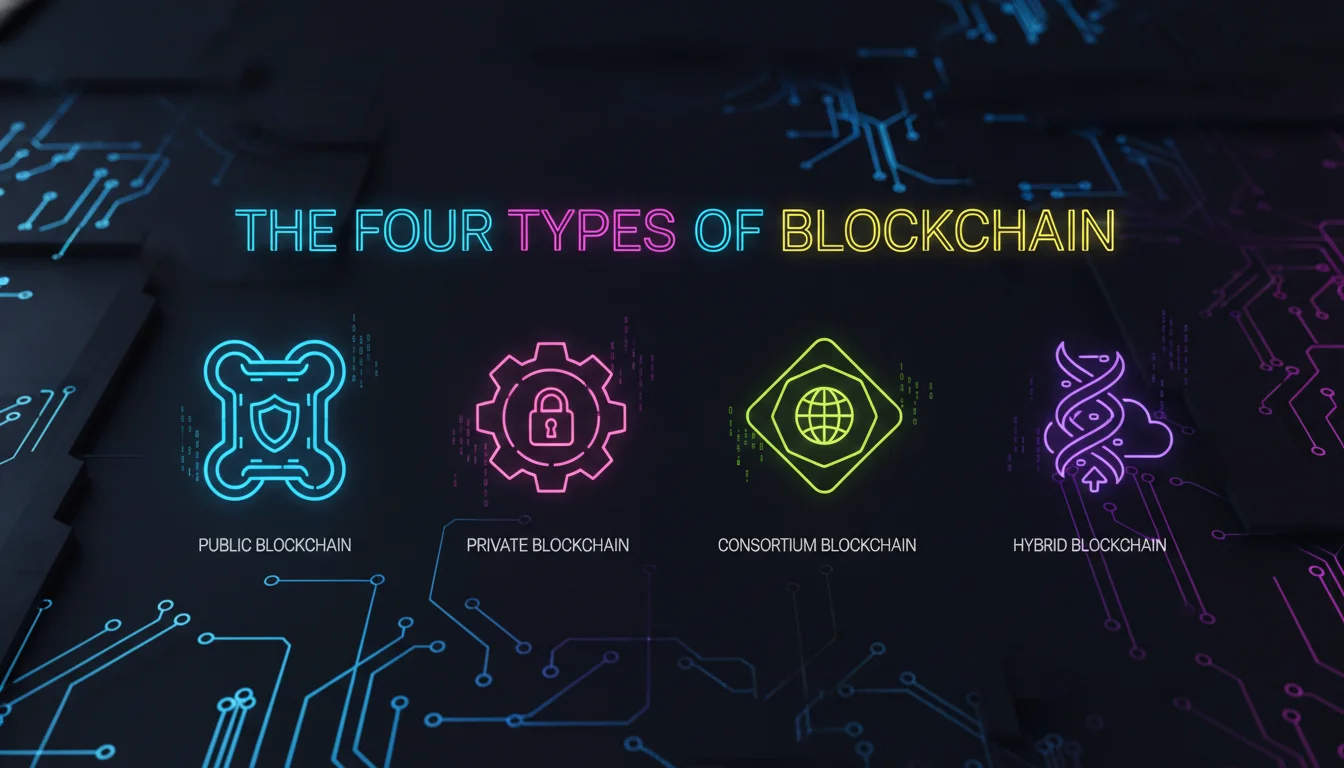
Blockchain networks are not monolithic. The four main of blockchain – public, private, consortium, and hybrid – each serve different needs, and understanding them starts with one foundational distinction: permissioned versus permissionless access.
Why Multiple Blockchain Types Exist
The original Bitcoin blockchain was designed for complete openness, but as industries explored distributed ledger technology, they hit real limitations. Public blockchains can be slow and expose all transaction data, which is unsuitable for confidential business operations. Fully private chains, on the other hand, sacrifice the decentralized trust that makes blockchain valuable in the first place. That tension between openness and control is exactly what drove the development of multiple types of blockchain, each optimizing for a specific set of trade-offs.
Permissioned vs. Permissionless Foundations
At the core, blockchain types split into two camps: permissionless and permissioned. In a permissionless blockchain, anyone can join, validate, and view data without approval – Bitcoin and Ethereum are the canonical examples. A permissioned blockchain restricts access to an authorized set of participants. Private and consortium blockchains are permissioned by design, while hybrid blockchains may incorporate both models. This distinction is the first question to answer when evaluating types of blockchain for any project.
“Hybrid blockchains are becoming the preferred choice for enterprises seeking to leverage public verifiability while maintaining control over sensitive data,” according to research from IBM’s blockchain division.
Public Blockchains: Open and Decentralized
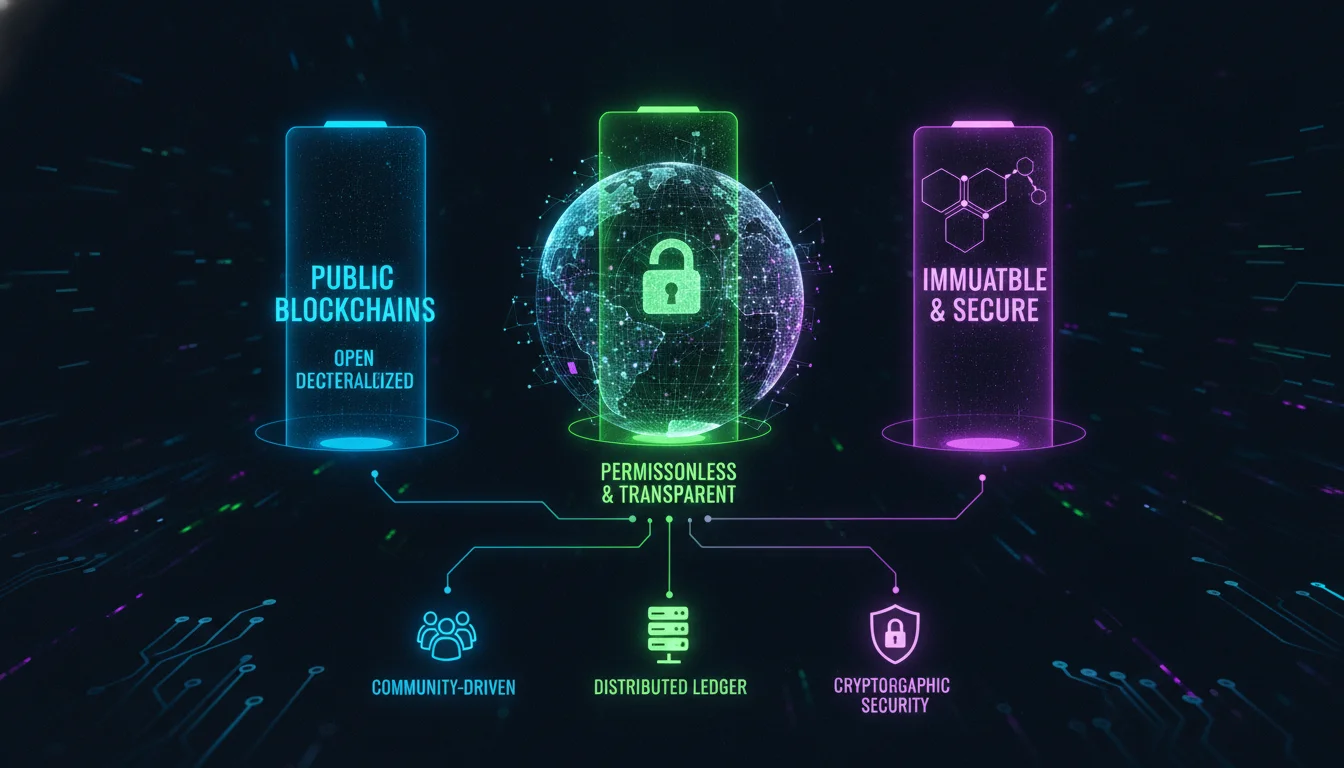
Public blockchains are the most well-known types of blockchain, built on the original vision of full decentralization. They are permissionless: anyone with an internet connection can participate as a node, view the ledger, or engage in consensus.
Key Characteristics of Public Blockchains
- Open Access: No centralized authority governs membership. Anyone can join the network.
- Full Transparency: All transactions are visible on a public ledger, fostering trust through auditability.
- Decentralized Governance: Upgrades and rules are typically decided through community-driven proposals and voting.
- Incentivized Consensus: Participants are rewarded through mining or staking for validating blocks, which secures the network.
- Pseudonymity: Users operate under public keys, offering a degree of privacy while maintaining public traceability.
Use Cases and Examples
Public blockchains power the cryptocurrency ecosystem. Bitcoin enables trustless peer-to-peer payments and serves as digital gold. Ethereum extends functionality to smart contracts, hosting DeFi protocols, NFTs, and dApps. Solana offers high throughput for scalable applications. Beyond finance, public blockchains support open voting systems, charitable donation tracking, and supply chain transparency where public verifiability is critical. As Paxos notes, public blockchains thrive on robust participation: the more nodes, the more secure the network. That said, they carry real trade-offs. Public chains often struggle with relatively slow transaction speeds and limited scalability, and their high transparency makes them unsuitable for sensitive business data.
Private Blockchains: Controlled and Efficient

Private blockchains are permissioned types of blockchain that operate within a closed environment, typically maintained by a single organization. Access is strictly controlled, and only vetted participants can read, write, or validate the ledger.
Key Characteristics of Private Blockchains
- Restricted Participation: Nodes must be authorized, ensuring all actors are known and trusted.
- Centralized Governance: The controlling organization sets rules, manages permissions, and can override consensus if needed.
- High Performance: With fewer nodes and controlled conditions, private blockchains achieve faster transaction speeds and higher throughput.
- Enhanced Privacy: Data can be kept confidential among authorized parties, suitable for sensitive corporate information.
- Customizable Consensus: Organizations can choose efficient consensus mechanisms like Practical Byzantine Fault Tolerance (PBFT) instead of energy-intensive PoW.
Use Cases and Examples
Private blockchains excel in enterprise contexts. Hyperledger Fabric, hosted by the Linux Foundation, is a modular framework for building private DLT solutions. MultiChain enables organizations to deploy private blockchains with fine-grained permission controls. Walmart has used a private blockchain to track food products across its supply chain. J.P. Morgan’s Onyx platform processes interbank settlements privately. These examples show how private types of blockchain optimize for efficiency and confidentiality over decentralization.
Consortium Blockchains: Collaborative Governance
Consortium blockchains, also called federated blockchains, are semi-decentralized types of blockchain where multiple organizations share control of the network. They sit between the openness of public chains and the tight centralization of private ones.
Key Characteristics of Consortium Blockchains
- Multi-Party Control: Governance is distributed among a preselected group of institutions, preventing any single entity from dominating.
- Selective Privacy: Data can be kept private among consortium members or partially disclosed, depending on the use case.
- Efficiency and Scalability: With a limited number of known validators, consensus can be faster and less resource-intensive than public chains.
- Regulatory Compliance: Consortiums can design rules that align with industry regulations, making them suitable for heavily regulated sectors.
Use Cases and Examples
Consortium blockchains are popular in banking, insurance, and government applications. The R3 Corda network, launched by Goldman Sachs and other enterprise banks, streamlines financial agreements and settlements. Energy Web Foundation uses a consortium chain to enable decentralized energy markets among utility companies. In healthcare, consortiums allow providers to share patient data securely while complying with HIPAA regulations. These types of blockchain enable collaborative ecosystems that require shared trust without full public exposure.
Hybrid Blockchains: The Best of Both Worlds
Hybrid blockchains combine elements of public and private networks, offering a flexible architecture where certain data stays private while other parts are publicly verifiable. Unlike consortium blockchains, which are managed by a group of known institutions, hybrid designs typically integrate a public chain with a private permissioned layer.
Key Characteristics of Hybrid Blockchains
- Dual Transparency: Only selected data or transactions are published to a public ledger, keeping sensitive information confidential.
- Granular Access Control: Organizations can define who sees what, down to individual data fields, using cryptographic techniques.
- Interoperability: Hybrid architectures can connect with multiple public chains, enabling broader asset movement while maintaining a core private network.
- Flexible Governance: The private layer enforces corporate policies, while the public layer ensures external auditability.
Use Cases and Examples
Hybrid blockchains are used where both transparency and privacy are required. Chiliz Chain is a practical example: it operates with 11 active validators (a characteristic of private chains) but remains an open network where anyone can build and launch sport-focused Fan Token projects, as Chiliz documents. In finance, a bank might use a hybrid design to keep client records private while publishing transaction hashes on a public chain for auditing. Government land registries can similarly hide personal ownership data while making land title proofs publicly accessible. These types of blockchain bridge the gap between strict privacy and the trustless security of public networks.
Pros and Cons of Each Blockchain Type
Every blockchain architecture involves real trade-offs. Here is an honest breakdown across the four types of blockchain.
Pros
- Public: Maximum decentralization, censorship resistance, and open participation. No single point of control.
- Private: Fast throughput, full data confidentiality, and straightforward regulatory compliance for single-organization deployments.
- Consortium: Shared governance reduces single-party risk while maintaining efficiency and selective privacy across multiple institutions.
- Hybrid: Combines public auditability with private data control, offering the most architectural flexibility of all four types.
Cons
- Public: Slower transaction speeds, scalability constraints, and full data exposure make them unsuitable for confidential business operations.
- Private: Centralized control introduces trust assumptions about the operator and reduces the core value proposition of decentralization.
- Consortium: Requires ongoing coordination among multiple organizations. Governance disputes can stall upgrades or create deadlocks.
- Hybrid: Architectural complexity is higher. Integrating public and private layers demands careful cryptographic design and ongoing maintenance.
Blockchain Types Comparison
A side-by-side comparison across key dimensions clarifies the differences among the four types of blockchain.
| Feature | Public | Private | Consortium | Hybrid |
|---|---|---|---|---|
| Access | Permissionless: anyone can join | Permissioned: restricted to authorized nodes | Permissioned: multiple known organizations | Both: private layer plus optional public verification |
| Governance | Decentralized community | Single central authority | Group of known entities | Flexible: private rules plus public audit |
| Consensus Mechanism | PoW, PoS, etc. | PBFT, Raft, or custom | Multi-party consensus (e.g., voting) | Custom, usually layered |
| Transaction Speed | Slow (scalability challenges) | Fast (limited nodes) | Moderate to fast | Variable |
| Privacy | Completely transparent | Full privacy within the network | Selective sharing among members | Controlled transparency |
| Use Cases | Cryptocurrencies, DeFi, voting | Supply chain, internal record-keeping | Banking, government, collaborative R&D | Sports, finance, real estate registries |
| Examples | Bitcoin, Ethereum, Solana | Hyperledger Fabric, MultiChain | R3 Corda, Energy Web Foundation | Chiliz Chain |
While some networks blur these lines, this taxonomy covers the predominant types of blockchain in use today.
Consensus Algorithms Across Blockchain Types
Consensus mechanisms are not interchangeable across blockchain types. The choice of algorithm is tightly coupled to the network’s trust model and performance requirements.
Public blockchains rely on open, adversarial-resistant mechanisms. Proof of Work, used by Bitcoin, requires nodes to expend computational energy to produce valid blocks, making attacks prohibitively expensive. Proof of Stake, now used by Ethereum after its 2022 Merge, replaces energy expenditure with economic collateral. Both mechanisms are designed to function correctly even when a significant portion of participants are unknown or potentially hostile.
Private and consortium blockchains operate in a different threat model. Because all participants are known and vetted, they can use more efficient algorithms. Practical Byzantine Fault Tolerance (PBFT) reaches consensus in a small number of communication rounds among a fixed validator set, enabling much higher throughput. Raft is another common choice for private deployments where simplicity and speed matter more than Byzantine fault tolerance.
Hybrid blockchains typically layer these approaches: a fast permissioned consensus mechanism handles internal transactions, while periodic checkpoints or proofs are anchored to a public chain for external verifiability. Understanding which consensus algorithm a network uses is one of the most reliable signals for identifying which of the four types of blockchain you are actually dealing with.
“Blockchain operates as a decentralized distributed database, with data stored across multiple computers, making it resistant to tampering. Transactions are validated through a consensus mechanism, ensuring agreement across the network,” per IBM’s blockchain documentation.
Regulatory Considerations by Blockchain Type
Regulatory fit is often the deciding factor when enterprises choose between blockchain types. Public blockchains present the most complex compliance picture. Full transaction transparency can conflict with data protection regulations like GDPR, which grants individuals the right to erasure. Storing personally identifiable information on an immutable public ledger creates a structural tension that requires careful architectural mitigation, such as storing only hashes on-chain and keeping raw data off-chain.
Private and consortium blockchains are easier to align with regulatory requirements. Because access is controlled and participants are known, organizations can enforce data residency rules, implement audit trails for regulators, and restrict data visibility to authorized parties. Healthcare consortiums, for example, can design their networks to comply with HIPAA by ensuring patient data is only accessible to credentialed providers.
Hybrid blockchains offer the most regulatory flexibility. Sensitive data stays on the private layer, while only cryptographic proofs or anonymized records touch the public chain. This architecture is increasingly relevant as regulators in financial services push for both auditability and data protection simultaneously.
How to Choose the Right Blockchain Type
Selecting the appropriate type of blockchain for a project requires careful evaluation of both technical and business requirements. No single type is universally best. The choice hinges on the problem being solved.
Five-Step Decision Framework
- Step 1: Define the trust boundaries. Are all participants known and trusted, or does the system need to withstand adversarial actors? If trust is pre-established, a private or consortium chain may suffice.
- Step 2: Assess transparency needs. Must transaction data be publicly verifiable? If yes, a public or hybrid model with public anchors is necessary. If not, full privacy is achievable with private or consortium chains.
- Step 3: Evaluate scalability and speed. How many transactions per second are required? Public chains often bottleneck at dozens of TPS, while private and consortium chains can achieve thousands.
- Step 4: Consider regulatory compliance. Industries like healthcare and finance must comply with data protection laws. Permissioned types of blockchain simplify compliance by limiting data visibility.
- Step 5: Analyze governance model. Who will make upgrade decisions? A single organization may prefer full control (private), while a group of companies may favor shared governance (consortium).
Key Trade-offs to Remember
- Privacy vs. Transparency: Private and consortium chains prioritize confidentiality; public chains maximize openness.
- Efficiency vs. Decentralization: Permissionless networks are more resistant to censorship but often slower and costlier to operate.
- Cost vs. Security: Building and maintaining a private blockchain may be cheaper than paying public transaction fees, but it introduces trust assumptions about the operator.
- Interoperability: Public blockchains are increasingly connected through cross-chain bridges, but private networks may require custom integrations.
If you are building a protocol or evaluating DLT infrastructure for your organization, the Digital Blockchains studio works through exactly these decisions. You can also explore our thinking on tokenomics design and protocol architecture for deeper context on how blockchain type selection affects the full system design.
Frequently Asked Questions
What are the 4 types of blockchain?
The four main types of blockchain are public, private, consortium, and hybrid. Public blockchains are open to everyone; private blockchains are restricted to authorized users; consortium blockchains are governed by multiple organizations; and hybrid blockchains combine features of public and private networks.
What is the difference between permissioned and permissionless blockchain?
A permissionless blockchain allows anyone to join and validate transactions (Bitcoin is the standard example), while a permissioned blockchain restricts access to approved participants (Hyperledger Fabric is a common enterprise example). Permissioned models provide greater control and privacy; permissionless ones offer full decentralization and censorship resistance.
Can a blockchain be both public and private?
Yes. Hybrid blockchains enable a mixed architecture where a private network maintains confidentiality and selected data or proofs are posted to a public blockchain for external verification. This approach balances the benefits of both types of blockchain without fully committing to either extreme.
Which type of blockchain is best for enterprise use?
Most enterprises opt for private or consortium blockchains because they offer controlled access, faster performance, and the ability to keep data confidential. Hybrid solutions are gaining traction when public auditability is also required alongside data privacy.
What are real-world examples of consortium blockchains?
Prominent consortium blockchains include R3 Corda, used by banks for financial transactions, and Energy Web Foundation, used by energy companies for decentralized energy markets. These types of blockchain facilitate collaboration among pre-approved participants without exposing data to the general public.
Is Bitcoin a public or private blockchain?
Bitcoin is a public blockchain. It is permissionless, meaning anyone can join the network, validate transactions, and view the entire ledger without needing authorization from any central party.
Ready to build on the right foundation? Apply to the Genesis Cohort at digitalblockchains.com and work with a team that has thought deeply about protocol architecture, tokenomics, and which blockchain type actually fits your use case.